Table of Contents >> Show >> Hide
- Why This Board Feels Like a Secret
- Early PC Sound in 60 Seconds (Because Beeps Have a Short Attention Span)
- Meet the Mindscape Music Board: A Sound Card That Mostly Played One Song (Yours)
- Bank Street Music Writer: The Software That Gave the Board a Reason to Exist
- So Why Didn’t It Become Famous?
- Why Retro Fans Care: It’s a Missing Link in PC Audio History
- From Hardware to Headspace: The Real “Mindscape” Behind Music
- How to Build Your Own “Mindscape Music Board” Today (No Soldering Required)
- Conclusion: A Rare Board, A Bigger Idea
- Experiences Inspired by the Mindscape Music Board (Retro, Realistic, and Weirdly Emotional)
If you grew up thinking “PC audio” meant a heroic beep followed by a tragic boop, you’re not wrongyou’re just
historically under-challenged by one of the weirdest detours in early computer sound. Long before Sound Blaster became the name
everyone knows, an obscure 1985 ISA add-on quietly tried to give IBM PCs something more musical than a doorbell auditioning for
a sci-fi movie.
It was called the Mindscape Music Board, and it’s mysterious for the most charming reason: it wasn’t marketed like a typical
sound card, it wasn’t widely supported like later audio standards, and it was mostly married to a single piece of softwareBank Street
Music Writer. In other words, it’s the kind of hardware you’d expect to find in a retrocomputing fairy tale: rare, practical, oddly
ambitious, and just obscure enough to feel like you discovered it behind a false wall in a 1980s computer lab.
Why This Board Feels Like a Secret
The Mindscape Music Board sits in a strange historical pocket. Early IBM PCs (and compatibles) didn’t ship with rich audio hardware.
The PC speaker could do a lot for alerts and simple tones, but it wasn’t designed to deliver layered music. Meanwhile, other home computers
of the eralike the Commodore 64had dedicated sound chips capable of far more expressive output.
Mindscape’s approach was both clever and limiting: instead of waiting for the PC world to standardize on audio, it bundled a dedicated
board with music-composition software. That solved the “how do we get real sound?” problemif you were using that one program.
Outside that ecosystem, the board had little reason to exist. And that’s how you get a piece of technology that’s historically important
but easy to miss: it wasn’t trying to be everything to everyone. It was trying to be musicspecifically, your musicon a platform
that wasn’t naturally musical yet.
Early PC Sound in 60 Seconds (Because Beeps Have a Short Attention Span)
To appreciate why this board matters, it helps to remember what the PC sound landscape looked like in the mid-1980s:
- Default audio was minimal. The PC speaker could produce tones, but complex multi-voice music required creative tricks.
- Standards weren’t standard yet. The late 1980s would bring more widely adopted solutions, but 1985 was still the “wild west.”
- Software often shaped hardware. In this era, add-on boards sometimes existed mainly to serve a specific application or niche.
Then, as PC audio matured, Sound Blaster-class devices helped establish the compatibility expectations that later made PC gaming and multimedia explode.
The Mindscape Music Board predates that turning pointso it reads like a “what if?” draft of PC audio history.
Meet the Mindscape Music Board: A Sound Card That Mostly Played One Song (Yours)
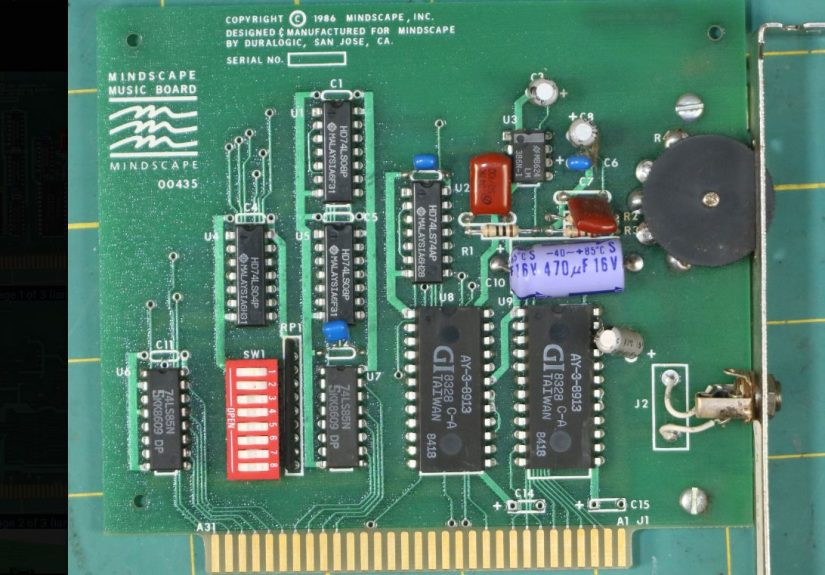
The Mindscape Music Board was an 8-bit ISA expansion card created to provide musical output for the IBM PC version of
Bank Street Music Writer. At its heart were two General Instrument AY-3-8913 programmable sound generators,
which together enabled six voices of soundan impressive jump for a PC of that era.
If the AY chip family sounds familiar, that’s because it is. Programmable sound generators like these powered the distinctive “chiptune”
textures of many classic systems and games. They weren’t trying to perfectly mimic an orchestra; they were trying to give you consistent,
programmable musical building blocks: tones, noise, envelopes, and the ability to stack parts into something that felt like a song.
What “Six Voices” Actually Means (And Why It Was a Big Deal)
In practical terms, “voices” are independent sound channelsseparate musical lines that can play at the same time. A single-voice system can do
a melody. Two voices can do melody plus a simple harmony. Add more voices and suddenly you can build a small arrangement: bass line, melody,
counter-melody, rhythmic patterns, and accents.
The Mindscape Music Board’s six voices gave the IBM PC version of Bank Street Music Writer room to breathe. Instead of reducing everything to a single line,
it could support layered composition. That capability matters because it changes user behavior: you don’t just “type notes,” you start to arrange.
And once you’re arranging, you’re thinking like a musicianstructure, tension, release, rhythm, and emotional color.
Hardware Snapshot: Simple, Purposeful, and Very ISA
The board plugs into an 8-bit ISA slot and provides audio output via a 3.5mm jack. It also uses configurable I/O settings (set via switches)
because early PCs were not a “plug it in and forget it” world. Expansion cards lived in the land of resource conflictsaddresses, interrupts, and the
kind of troubleshooting that built character (and occasionally, eye twitching).
Modern reproduction efforts highlight a key historical detail: this design expects a relatively slow ISA clock typical of early IBM PC/XT systems. That
isn’t unusual for the eratiming assumptions were commonbut it’s one more reason the board feels like a time capsule. It belongs to a very specific moment
in PC evolution.
Bank Street Music Writer: The Software That Gave the Board a Reason to Exist
Bank Street Music Writer wasn’t just a “play music” toyit was composition software built around entering musical notation and hearing it played back.
In an educational context, this kind of tool is powerful: it turns abstract note values into immediate feedback. You can see what you wrote, hear what you meant,
and fix what you accidentally invented (like the world’s first unintentional polka-jazz fusion).
This is where the “mindscape” idea starts to make sense. Composition is internal first. You imagine. You test. You revise. Then the computer becomes a mirror
for your musical thinking. The Mindscape Music Boardby enabling more voices and a richer sound palette than the PC speaker could easily providemade that mirror
clearer. It didn’t just output sound; it helped translate mental music into audible reality.
The “Bundled Hardware” Strategy: Smart, Risky, and Weirdly Modern
Bundling specialized hardware with a creative app feels almost futuristic todaylike shipping a controller with a game, or a drawing tablet with art software.
But in the 1980s PC market, it was risky. Distribution costs rose. Support became harder. And if a user didn’t care about composing music, the board didn’t add
value. That’s how niche innovations can be both brilliant and fragile: they’re amazing for the people who want them, and invisible to everyone else.
So Why Didn’t It Become Famous?
The short answer: compatibility wins. The PC ecosystem ultimately rewarded hardware that many programs could target. Once broadly supported sound
standards took off, a board tied to one application became less compelling. Developers wrote for what most users had. Users bought what most software supported.
That feedback loop is how “standards” become real.
The Mindscape Music Board, by contrast, seems to have lived mostly inside its own boxliterallybundled with Bank Street Music Writer. If you didn’t own the
software, you probably didn’t know the card existed. If you didn’t own the card, the software (on IBM PC) wasn’t going to sing its full song.
Another factor is cultural timing. In 1985, PCs were often positioned as business machines. Home computers and game systems carried more of the “fun hardware”
expectations, including stronger built-in sound. The Mindscape Music Board was pushing creativity into a platform that still wore a tie to work.
Why Retro Fans Care: It’s a Missing Link in PC Audio History
In the retrocomputing world, the Mindscape Music Board is fascinating because it shows that the IBM PC wasn’t doomed to be a beep machine until the late 1980s.
People were experimenting earlier. They were just doing it in smaller, stranger, less standardized ways.
Recent coverage by hardware historians and enthusiastsplus preservation efforts like high-resolution board photography and reproduction projectshas helped move
the card from “mythical footnote” to “documented artifact.” Even if only a handful of original boards are publicly accounted for, the card’s design is now better
understood, and that makes it easier to preserve the experience, not just the object.
Reproduction and Preservation: Not About Cloning, About Remembering
When people reproduce vintage hardware, the goal is often less “mass production” and more “preventing cultural amnesia.” A rare board can’t teach much if it’s
locked in a private collection and never powered on. But a documented designpaired with careful, respectful reproductioncan let museums, educators, and hobbyists
demonstrate how early PC creativity looked and sounded.
From Hardware to Headspace: The Real “Mindscape” Behind Music
The name “Mindscape” fits this story better than it first appears. Music isn’t just sound; it’s a mental environment. A few notes can trigger imagery, emotion,
and memory with an almost unfair level of efficiency. That’s not just poeticit’s supported by modern research showing how strongly music can interact with
autobiographical memory, emotion, and brain networks involved in internal thought.
Studies of music-evoked nostalgia, for example, have linked nostalgic music listening with activity in brain networks associated with memory and
self-referential thinking. Other work has explored how music and emotion can strengthen memory processes. Popular clinical and educational summaries also emphasize
that listening to and performing music can engage brain areas tied to memory, mood, and reward.
That matters here because the Mindscape Music Board wasn’t designed to pump out studio-grade audioit was designed to let you make something and then
hear it. And creation is a different cognitive mode than consumption. When you compose, you’re building a tiny world: a rhythm that feels like motion, a chord
change that feels like a plot twist, a melody that feels like a character walking into the room.
How to Build Your Own “Mindscape Music Board” Today (No Soldering Required)
You don’t need an ISA slot to capture the spirit of this device. If you like the idea of mapping music to imaginationturning sound into a personal mental
landscapetry a modern “music board” as a creative practice:
1) Make a Playlist That Represents a Place in Your Head
Pick a theme that’s spatial, not just emotional: “midnight city bus,” “sunlit kitchen,” “rainy arcade,” “first day of summer,” “final boss hallway.”
Then choose 10–15 tracks that fit the setting. The goal is coherence, not popularity.
2) Assign Roles Like It’s a Six-Voice Arrangement
Borrow the Mindscape Music Board mindset: give parts jobs. Choose one track as “melody” (the main storyline), one as “bass” (the grounding), one as “rhythm”
(momentum), and a couple as “texture” (the little details that make the world feel real). You’ll start hearing how arrangement creates atmosphere.
3) Pair the Playlist With Visual Notes
Create a simple boarddigital or physicalwith a few images, colors, words, and short scenes. Don’t overdo it. The point is to give your brain handles:
when the music plays, the mindscape appears faster. This is the same basic magic that made early music software feel powerful: input → feedback → refinement.
4) Use It as a Creative Launchpad
Write a paragraph, sketch a room, design a game level, storyboard a short film, or journal a memory while listening. You’re building a loop:
sound evokes imagery; imagery inspires creation; creation reshapes what sound means to you.
Conclusion: A Rare Board, A Bigger Idea
The Mindscape Music Board is “mysterious” because it represents a path the PC world didn’t fully take: specialized creative hardware bundled tightly with a single,
imaginative application. But it’s also a reminder that creativity has always been part of computingeven when the default speaker could barely manage a convincing
“ding.”
In a way, this board is less about specs and more about permission. It gave early PC users permission to think of the IBM PC as an instrument, not just a machine.
And that’s the real mystery worth preserving: the moment a tool stops being merely functional and starts becoming expressive.
Experiences Inspired by the Mindscape Music Board (Retro, Realistic, and Weirdly Emotional)
Retrocomputing enthusiasts often describe a very specific thrill when dealing with hardware like the Mindscape Music Board: the mix of detective work, gentle fear,
and childlike delight that modern plug-and-play rarely provides. The “experience” starts long before any sound comes out of a speaker. It begins with the hunt for
informationfiguring out what the card actually is, why it exists, and how it expects the PC to behave. Because this board wasn’t built for a world of automatic
driver downloads and universal standards, getting it running feels like translating a forgotten dialect.
There’s also the experience of expectation management. People who first hear an AY-family sound generator sometimes expect it to mimic “real instruments”
the way later wavetable or sample-based cards could. Instead, the sound is unapologetically electroniccrisp, square, and bright, like a tiny robot whistling with
confidence. The surprise is that, after a few minutes, the ear adapts. What initially sounds like “beeps” starts to sound like “parts.” Your brain begins to hear
intention: a bass line that anchors the harmony, a melody that wants to be remembered, a rhythmic figure that gives the whole thing forward motion. That’s when the
mindscape effect kicks inmusic stops being a tone and becomes a place.
Another common experience is the strange intimacy of composing with limitations. Modern music tools can give you infinite tracks, infinite effects, infinite “undo.”
Vintage composition, by contrast, makes you commit. With six voices, you have to decide what matters. Do you want a thick chord, or do you want a counter-melody?
Do you want percussion-like noise textures, or do you want one more harmony line? These constraints often lead to clearer musical thinking. It’s the same reason
writing a short poem can feel harder (and sometimes better) than writing a long one: boundaries force choices, and choices create style.
Even the act of listening becomes an experience. Because this board was tied to a notation-driven workflow, people often report that they listen differently than
they do with a modern DAW. Instead of tweaking a waveform, they tweak an idea: “That note should land earlier,” or “This phrase needs breathing room,” or “This
harmony is too crowded.” The feedback loop is conceptual. You’re not just producing sound; you’re shaping meaning through structure. And once you do that, you
start noticing structure in everything you hearold game music, TV themes, even the accidental rhythms of everyday life.
Then there’s the emotional side: nostalgia, even for people who didn’t own the board in its era. Hearing a rare piece of vintage PC audio can still trigger the
feeling of being close to a vanished moment in computingwhen personal computers were becoming personal, not just practical. For some, it evokes memories of school
computer labs, early educational software, or the first time they realized that a machine could be used to create art rather than just process information. For
others, it’s a new kind of nostalgia: not “I had this,” but “I wish I had lived in a world where this was possible.” That longing is part of why preservation
matters. It’s not only about saving objects. It’s about saving creative momentsthe small turning points where someone, somewhere, heard something new
and thought, “Wait… I can make that.”