Table of Contents >> Show >> Hide
- The “Expert” Rules That Make Every Room Easier
- Room-by-Room: Clever Home Organizing Tips That Actually Work
- Entryway or Mudroom: Stop clutter at the door
- Living Room: Hide the small stuff, keep the cozy
- Kitchen: Make cooking easier by organizing for your routines
- Pantry: Zones, visibility, and “backstock” that doesn’t bite you later
- Bathroom: Tiny space, big payoff
- Bedroom: Reduce visual noise so the room actually rests
- Closet: A closet is a boutique with worse lightingfix that
- Linen closet: Make towels and sheets behave
- Laundry room: Turn chores into a flow
- Home office: Control paper before paper controls you
- Kids’ rooms and play spaces: Rotation is your secret weapon
- Garage: Think zones, walls, and safety
- Make It Stick: Maintenance Tips for a Calm, Organized Home
- Common Organizing Experiences That Make the Advice Finally Click (Extra )
- Conclusion
If your home has ever looked “fine” from the doorway but suspiciously like a tornado took a detour through the hallway closet, welcome.
Organization isn’t about turning your life into a beige catalog spread. It’s about making your home easier to live inso you can find the tape,
the charging cord, and that one spatula you swear you own.
The good news: the best organizing systems aren’t complicated. They’re repeatable, realistic, and built around how you actually move through your day.
The even better news: you don’t need a $400 set of matching bins to get there. (In fact, buying bins too early is how clutter gets a cute hat.)
The “Expert” Rules That Make Every Room Easier
1) Start with less, not more storage
The fastest way to “organize” is to edit. Before you label anything, reduce what you’re trying to store. If a shelf is packed edge-to-edge,
you don’t have a storage problemyou have a volume problem. Declutter first, then choose containers that fit the items you kept.
2) Use a simple system you can repeat
Professional organizers often use a four-step rhythm that works in any space:
clear out (remove everything from the zone), categorize (group like with like),
cut out (reduce duplicates and “maybe someday” items), and contain (put back with boundaries).
The magic word is “boundaries”containers, shelves, and drawers are limits that keep categories from spreading like glitter.
3) Create zones the way a store does
Stores don’t toss cereal next to shampoo “because there was room.” They use zones. Your home should, too.
Think: breakfast zone, baking zone, pet zone, mail zone, homework zone. When each category has a home base,
you stop doing that nightly scavenger hunt for your own stuff.
4) Put the “daily” items at eye level
The most-used items should live between waist and eye level, where they’re easy to grab and easy to put back.
The “rarely” items can go up high or down low. This small shift prevents the classic problem of rummaging through everything
just to reach the one thing you use every day.
5) Labels aren’t fussythey’re instructions
Labels turn “I don’t know where this goes” into “oh, obviously.” They’re especially helpful in shared homes,
with kids, roommates, partners, and future-you (who is always tired and slightly annoyed).
6) Build a “reset” habit, not a perfect home
The secret to a consistently organized house is a tiny daily reset5 to 10 minutes in the evening or after dinner.
Think of it as returning your home to “ready mode,” not “museum mode.”
Room-by-Room: Clever Home Organizing Tips That Actually Work
Entryway or Mudroom: Stop clutter at the door
Your entry is a traffic jam: shoes, bags, coats, mail, packages, umbrellas, mystery sports gear. The cure is a “landing strip”
with clear jobs for each item.
- Hooks beat hangers for daily coats and backpacks. Make it effortless.
- Shoe boundaries: one rack or tray per person (or per season). When it’s full, something leaves.
- Mail control: a small sorter with three slots: “To Do,” “To File,” “To Recycle.”
- A drop tray for keys and sunglasses prevents the daily “WHERE ARE MY” moment.
- Seasonal swap: keep only what you’re wearing right now. Out-of-season outerwear migrates elsewhere.
Living Room: Hide the small stuff, keep the cozy
Living rooms collect “homeless items” because they’re where life happens. The trick is to plan for the clutter you know is coming.
- One pretty catch-all basket for quick pickup (remote, toy, sock, dog toy… you know the cast).
- Charging station with a small bin for cords. Bonus points for labels like “Cords That Definitely Work.”
- Limit surfacescoffee tables and side tables shouldn’t become storage units with legs.
- Media rule: store DVDs/games/controllers in one drawer or box, not five different “temporary” places.
Kitchen: Make cooking easier by organizing for your routines
A kitchen that works is organized around how you cook, not around where the last homeowner kept the spatulas.
Aim for “one motion” storage: open a drawer, grab the item, close the drawer. Minimal rummaging.
- Drawer dividers for utensils and tools stop the junk-drawer effect.
- Group by task: coffee/tea station, lunch-packing station, baking station.
- Vertical storage for cutting boards, baking sheets, and trays keeps stacks from avalanching.
- Lazy Susans in corner cabinets or for condiments make deep spaces usable.
- Countertop sanity: if you don’t use it daily, it doesn’t live on the counter.
Pantry: Zones, visibility, and “backstock” that doesn’t bite you later
Pantries get chaotic when categories blur. The fix is zoning + containers that match the pantry you have (walk-in, cabinet pantry, or “one brave shelf”).
- Start with a full reset: remove everything, check dates, wipe shelves.
- Create zones: breakfast, snacks, dinner helpers, baking, beverages, paper goods.
- Use bins as category boundaries, not as hiding places. Clear bins help you see what’s running low.
- Decant selectively: flour, sugar, and snacks you buy often benefit from airtight containers (and fewer half-open bags).
- Backstock rule: keep extras in one labeled bin (“Backstock”) so you don’t buy three more ketchups.
- Door space: add slim racks for spices or small items if you’re short on shelves.
Bathroom: Tiny space, big payoff
Bathrooms feel messy fast because they’re packed with small items. The key is categories and easy cleanability.
- Declutter expired products regularlyold makeup and half-used mystery bottles are clutter magnets.
- Group by routine: daily skincare, hair, dental, first aid, travel items.
- Use shallow bins under the sink so items don’t disappear into the dark void behind the plumbing.
- Turntables (lazy Susans) make it easier to access lotions and hair products in tight cabinets.
- One “guest-ready” bin with extra toilet paper, fresh hand towel, and basic supplies saves panic later.
Bedroom: Reduce visual noise so the room actually rests
Bedrooms organize best when you keep surfaces calm and build laundry into the system (instead of into a chair that slowly becomes furniture).
- Nightstand boundaries: one small tray for essentials (lip balm, book, charger) and nothing else.
- Under-bed storage for off-season clothes, extra bedding, or shoeslabeled so it’s not a mystery dungeon.
- Two-hamper method: lights and darks (or “rewear” and “wash”). Less sorting later.
- Make it easy to put away with a small basket for “not dirty, not clean” items (hoodies, jeans).
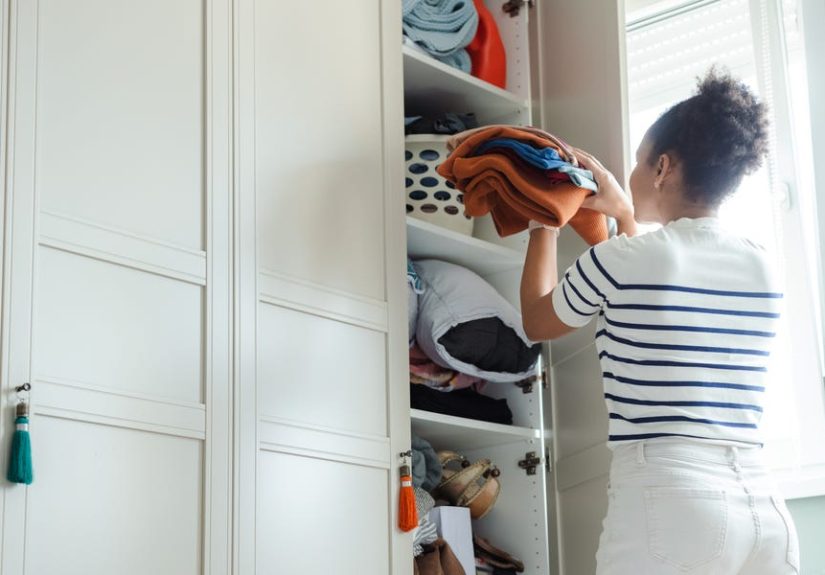
Closet: A closet is a boutique with worse lightingfix that
Closets fall apart when you can’t see categories and you store too many “maybe” items. Go for clarity and consistency.
- Edit first: if you wouldn’t buy it today, it might be time to let it go.
- Uniform hangers instantly reduce visual chaos and make space feel bigger.
- Double-hang shirts above pants if you’re short on rod space.
- Use hooks for bags, belts, and hatsthings that tangle when tossed on a shelf.
- Label bins for accessories. If you can’t find it, you won’t wear it.
Linen closet: Make towels and sheets behave
Linen closets work best with categories, vertical stacking, and containers that act like drawers on shelves.
You don’t need to fold like a hoteljust fold so stacks don’t collapse.
- Sort by type: bath towels, hand towels, sheets, guest bedding, toiletries.
- Use shelf bins so you can pull a whole category out like a drawer.
- Store sheet sets together (inside a pillowcase is a classic trick) so you’re not hunting for the fitted sheet’s evil twin.
- Keep frequently used items at eye level; overflow and extras go up high.
Laundry room: Turn chores into a flow
Laundry feels harder when supplies are scattered. Organize around the steps: sort, wash, dry, fold, put away.
- Sorting station with labeled bins.
- Shelf or cabinet zones for detergent, stain removers, and cleaning cloths.
- Hanging bar or hooks for air-dry items so they don’t end up on doorknobs across the house.
- One small “lost socks” bin (with a monthly reunion day).
Home office: Control paper before paper controls you
Office clutter is sneaky. It’s usually paper, cords, and “I’ll deal with it later” piles.
A simple system beats a fancy filing cabinet you never open.
- Three trays: In, To Do, To File. Empty “To Do” weekly.
- Go digital for warranties and manuals when possible, but keep critical documents in a safe, dedicated spot.
- Cable containment (clips, ties, and a labeled box) prevents cord spaghetti.
- End-of-day reset: clear the desktop so tomorrow starts clean.
Kids’ rooms and play spaces: Rotation is your secret weapon
Kids’ stuff multiplies like it has a group chat. You don’t have to fight every toyjust reduce what’s out at once.
- Toy rotation: keep some toys stored and swap weekly or monthly.
- Open bins with picture labels so kids can actually help reset.
- One bin per category: building toys, dolls, art supplies. Overflow means edit.
- Create an “art station” with a caddy for markers/scissors/glue so supplies don’t migrate.
Garage: Think zones, walls, and safety
Garages become clutter museums because they’re “temporary” storage for everything. Turn it into a functional space by zoning and using vertical storage.
- Create zones: yard tools, sports gear, automotive, holiday decor, trash/recycling.
- Get stuff off the floor with wall hooks, rails, and shelving.
- Use clear labeling for seasonal bins so you don’t unpack the entire garage to find one wreath.
- Store hazardous materials safely and out of reach of kids and pets.
Make It Stick: Maintenance Tips for a Calm, Organized Home
Do a 10-minute nightly reset
Set a timer. Put away obvious strays. Reset the entry and kitchen counters. You’ll wake up to a home that feels supportive,
not like it’s already asking you for favors.
Keep a donation box in a closet
When you find something you don’t use, drop it in the donation box immediately. When it’s full, donate it.
This prevents “decluttering” from becoming a once-a-year dramatic event.
Use the “one in, one out” rule for problem categories
If shoes, mugs, toys, or throw pillows keep taking over, try one-in-one-out. It’s simple, slightly annoying at first,
and wildly effective.
Shop your home before you shop the store
Many overbuying problems are actually “I didn’t know I already had three of these.” Labels and a backstock bin help,
but so does a quick check before you hit “Add to cart.”
Common Organizing Experiences That Make the Advice Finally Click (Extra )
A lot of organizing advice sounds obvious… until you’re living in the middle of real life. That’s why the most useful “expert tips”
often come from patterns people run into again and againespecially in busy households. Here are some common experiences that tend to create
big “aha” moments, plus what typically works when you apply the room-by-room strategies above.
Experience #1: The “I cleaned, and it got messy again in 48 hours” spiral.
This usually means the home looks tidy only when you remove everything from sightbut you don’t have a realistic return path.
The fix isn’t cleaning harder. It’s adding a few specific landing spots: a drop tray at the entry, a basket for living-room clutter,
and a real home for mail. When the system is easier than the floor, people actually use it. The goal isn’t zero messit’s fast recovery.
Experience #2: Buying containers first (and somehow creating more clutter).
It’s so tempting to start with pretty bins. The problem is: containers without decluttering become clutter condos.
Many people notice they end up “organizing” the same pile into a nicer pilethen stacking the nicer pile on a shelf that’s already full.
The better sequence is edit → measure → contain. Once you’ve reduced duplicates and decided what belongs in the space,
the right container becomes obvious, and you buy fewer of them.
Experience #3: The kitchen that’s “organized” but still frustrating.
This often happens when storage is arranged by where things fit, not how you cook.
A small changelike moving your cutting boards next to your prep area, or creating a baking zone with measuring tools and sheet pans together
can make the whole kitchen feel bigger. People also find that putting daily items at eye level (and moving rarely used gadgets up high)
reduces counter clutter without any extra effort.
Experience #4: The closet that looks tidy until you try to get dressed.
Closets collapse when categories mix: workout tops in three places, accessories in five. The big breakthrough is zoning:
all jeans together, all work shirts together, all “special occasion” together. Uniform hangers also make it easier to scan options quickly,
which reduces the “try-on tornado.” Another common win is creating a small “rewear” basketso half-worn items don’t live on a chair like
they’re paying rent.
Experience #5: Kids’ toys everywhere, all the time.
Many families discover toy rotation is the difference between constant cleanup and manageable mess.
When fewer toys are out, kids play better and cleanup is faster. Picture labels on open bins can be surprisingly powerful:
they turn “clean your room” into a clear matching game. And when a category bin overflows, that’s not a failureit’s a signal to edit.
Experience #6: The garage that eats weekends.
Garages overwhelm people because they hold so many categories: tools, sports, decor, car supplies, paint, mystery wood.
Zoning is the breakthroughespecially when you use walls and shelves to get items off the floor. The garage becomes easier to maintain when
each category has a defined footprint. If the holiday bin zone is full, you don’t “find space”you decide what stays.
If there’s one universal lesson, it’s this: the best home organization tips aren’t about perfection. They’re about creating clear homes for your stuff
so your brain stops doing inventory all day. Your house should support your lifenot audition for a reality show.
Conclusion
Clever home organizing is less about fancy products and more about smart habits: declutter first, create zones, keep daily items accessible,
and maintain a quick reset routine. Start with the rooms that impact your day mostthe entryway, kitchen, and bathroomthen work outward.
Even a few small changes can make your home feel calmer, faster to clean, and easier to live in.