Table of Contents >> Show >> Hide
- What Is a Neutral Spine, Exactly?
- The Golden Rule: Find Neutral Through Movement, Not Guessing
- How to Find a Neutral Spine While Standing
- How to Find a Neutral Spine While Sitting
- How to Find a Neutral Spine While Lying Down
- How to Find a Neutral Spine While Bending, Hinging, and Lifting
- How to Find a Neutral Spine During Exercise
- How to Check If You’re in Neutral Spine Without a Mirror
- Common Neutral Spine Mistakes (and Quick Fixes)
- A Simple Daily Neutral Spine Practice (5 Minutes)
- Conclusion
- Real-World Experiences With Finding a Neutral Spine (Extended Practical Section)
If you’ve ever been told to “just sit up straight,” congratulationsyou’ve received one of the vaguest fitness cues in human history. Helpful? Sort of. Specific? Not even a little.
What your body usually needs is not a rigid, military-stiff posture. It needs a neutral spine: a position where your natural spinal curves are supported (not flattened, not exaggerated), your joints feel stacked, and your muscles aren’t working overtime just to keep you upright.
The good news: finding a neutral spine is a skill, not a talent. You don’t need to be a yoga instructor, powerlifter, or person who owns foam rollers in three sizes. You can learn it in a few minutes and use it while sitting, standing, lifting, exercising, driving, and even lying down.
In this guide, you’ll learn how to find a neutral spine in any position, how to avoid common mistakes, and how to make it feel natural in real life (because posture that only works for 12 seconds in front of a mirror is not a system).
What Is a Neutral Spine, Exactly?
A neutral spine is the position where your spine keeps its natural curvesthe gentle curve in your neck, the curve in your mid-back, and the curve in your lower backwithout excessive rounding or arching.
Think of it like your spine’s “happy middle.” Not slumped. Not over-corrected. Not “chest so proud you look like you’re about to sing the national anthem.” Just balanced.
Why Neutral Spine Matters
When your spine is closer to neutral, your body can distribute load more efficiently. That means less unnecessary strain on your muscles, joints, and soft tissues, and better support for everyday movement.
- Improves posture awareness without forcing a stiff posture
- Helps with safer movement during lifting and exercise
- Supports better alignment when sitting and standing
- Can reduce the “why is my neck angry?” feeling after long desk sessions
- Makes core bracing more effective
Important note: neutral spine is not one perfect shape for everyone. Bodies vary. A good neutral position should feel supported, controlled, and comfortable enough to breathenot like you’re bracing for a passport photo.
The Golden Rule: Find Neutral Through Movement, Not Guessing
The easiest way to find your neutral spine is to move slightly out of it in both directions, then settle in the middle. This works in almost every position.
The Pelvic Tilt Method (Your Go-To Neutral Spine Drill)
- Start in a comfortable position (standing, sitting, or on your back with knees bent).
- Gently tilt your pelvis forward (slight lower-back arch).
- Gently tilt your pelvis backward (slight flattening/rounding).
- Repeat a few times with a small range of motion.
- Settle in the midpoint where your spine feels longest and most supported.
That midpoint is usually your best neutral starting point. You should feel stable, able to breathe normally, and not like you’re clenching every muscle you’ve ever met.
How Neutral Should Feel
- Balanced, not rigid
- Tall, not tense
- Core gently active, not “ab crunch 24/7”
- Glutes available to help, not squeezed like a coin challenge
- Breathing easy through the ribs and belly
How to Find a Neutral Spine While Standing
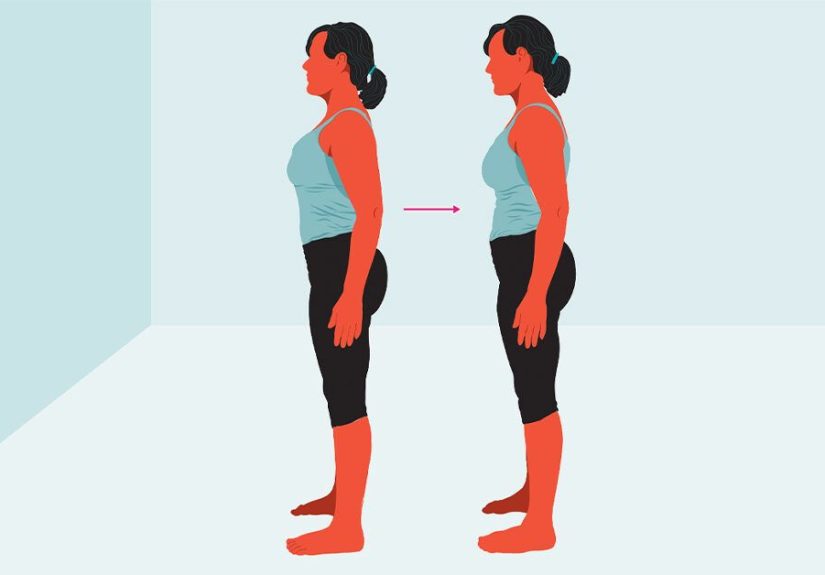
Standing is where many people accidentally do one of two things: slump like a melted candle, or overcorrect into a dramatic lower-back arch. Neutral is between those extremes.
Neutral Standing Setup
- Stand with feet about hip-width apart.
- Let your knees stay soft (not locked).
- Do the small pelvic tilt drill forward/back and find the middle.
- Stack ribs over pelvis (don’t flare ribs up).
- Let shoulders rest down and back naturally.
- Keep head over shoulders, chin level (not poking forward).
A helpful cue: imagine someone gently lifting you upward from the crown of your head while your feet stay heavy on the floor.
Standing Mistakes to Avoid
- Locked knees: can shift tension into your low back.
- Rib flare: often looks like “good posture” but is really an overarch.
- Forward head posture: common when looking at phones or laptops.
- Clenched glutes all day: posture is not a full-time glute workout.
How to Find a Neutral Spine While Sitting
Sitting is where neutral spine goes to get tested. Desk work, driving, meals, scrolling, gaming, “I’ll just sit for five minutes” (which somehow becomes 90 minutes)it all adds up.
Neutral Sitting Setup (Desk, Dining Chair, or Couch-ish Situation)
- Sit all the way back so your back can be supported.
- Place feet flat on the floor (or on a footrest).
- Keep knees roughly in line with hips (a little variation is fine).
- Rock pelvis slightly forward and back; find the midpoint.
- Feel your weight on your sit bones.
- Relax shoulders and keep elbows close to your sides.
- Bring the screen to you when possible (instead of your face to the screen).
If your chair doesn’t support your lower back, a small rolled towel or lumbar cushion can help maintain a comfortable curve.
Neutral Spine for Laptop Users (Yes, You Too)
Laptops are convenient, but they’re posture traps. The screen is too low, the keyboard is too attached, and your neck pays the price. If you work long hours:
- Raise the laptop screen to eye level (books count as ergonomics)
- Use an external keyboard and mouse when possible
- Take movement breaks every 30 minutes
- Reset posture gently instead of forcing a “perfect” pose all day
How to Find a Neutral Spine While Lying Down
Yes, neutral spine matters when you’re lying down tooespecially if you wake up feeling like you wrestled a mattress and lost.
Neutral Spine on Your Back (Supine)
- Lie on your back with knees bent and feet flat (or legs supported on a pillow).
- Do a gentle pelvic tilt forward/back.
- Settle into the middle where your low back feels supported, not jammed down.
- Let ribs soften and breathe into your sides.
This position is great for practicing neutral spine because the floor gives you feedback.
Neutral Spine on Your Side
- Keep head supported so your neck stays in line with your torso
- Place a pillow between knees if your hips or low back feel twisted
- Keep ribs stacked over pelvis (avoid rolling way forward)
The goal is alignment, not perfection. If you need two pillows and a blanket burrito setup to feel supported, that’s not cheatingthat’s biomechanics.
How to Find a Neutral Spine While Bending, Hinging, and Lifting
This is where neutral spine becomes a real-world superpower. Whether you’re lifting groceries, a laundry basket, or a box labeled “miscellaneous cables” (which is never actually miscellaneous), better mechanics can reduce unnecessary back strain.
The Hip Hinge: Your Best Friend
A hip hinge lets you bend by moving at the hips while keeping your spine closer to neutral. It’s the foundation of safe lifting form.
- Stand close to the object.
- Set your neutral spine (small pelvic reset, ribs over pelvis).
- Hinge at the hips by sending them back.
- Bend knees as needed.
- Keep the object close to your body.
- Use your legs and hips to stand up.
- Avoid twisting while lifting or carrying.
Lifting Tips That Actually Help
- Get close to the load before lifting
- Keep your back supported and controllednot rounded into end range
- Brace your core gently before the lift
- Exhale during the effort (don’t hold your breath unless trained for heavy lifting)
- Ask for help if the object is heavy or awkward
Remember: “neutral spine” during lifting does not mean you must look like a statue. Real life involves movement. Aim for a controlled, strong position rather than a dramatic posture performance.
How to Find a Neutral Spine During Exercise
Neutral spine matters in workouts because it improves force transfer and reduces the chance that one area (usually the low back) does a job your hips or core were supposed to do.
Neutral Spine in Common Exercises
1) Plank
- Head in line with spine
- Ribs tucked down slightly
- Pelvis level (don’t let it sag)
- Glutes and abs active
- Breathe steadily
2) Bird Dog
- Start on hands and knees with shoulders over hands, hips over knees
- Set a flat, supported back (not overarched)
- Reach opposite arm and leg without rotating trunk
- Move slowly; balance beats speed
3) Squat
- Set ribs over pelvis before descending
- Keep chest lifted without flaring ribs
- Let hips and knees share the movement
- Stay within a range you can control
4) Deadlift or Kettlebell Hinge
- Use the same hip hinge pattern as daily lifting
- Keep load close
- Maintain neck alignment (don’t crank chin up)
- Stop if form turns into “survival mode”
How to Check If You’re in Neutral Spine Without a Mirror
Mirrors are nice, but most life happens away from them. Use these quick self-checks:
The 3-Point Self-Check
- Breathing: Can you breathe comfortably?
- Tension: Are your shoulders/jaw gripping?
- Balance: Do you feel evenly supported?
If breathing is restricted, your shoulders are climbing toward your ears, or you feel unstable, you may be overcorrecting.
The “Reset, Don’t Freeze” Rule
Find neutral, then keep moving. Posture is dynamic. The best posture is often the next postureespecially after sitting too long.
Translation: your spine likes alignment, but it also likes variety.
Common Neutral Spine Mistakes (and Quick Fixes)
Mistake #1: Confusing Neutral With Flat Back
A neutral spine keeps natural curves. Flattening your lower back aggressively can create tension and reduce comfort.
Fix: Use a small pelvic tilt drill and stop in the middle, not at the end range.
Mistake #2: Overarching the Low Back
This often happens when people “stand tall” by lifting the chest too much and flaring the ribs.
Fix: Stack ribcage over pelvis and soften the front ribs down.
Mistake #3: Trying to Hold Perfect Posture All Day
Your muscles are not meant to maintain a single pose forever.
Fix: Alternate positions, walk, stretch, and reset posture regularly.
Mistake #4: Ignoring Pain Signals
Neutral spine cues should feel supportive, not painful.
Fix: If a position causes pain, numbness, tingling, or sharp discomfort, stop and consult a qualified healthcare professional or physical therapist.
A Simple Daily Neutral Spine Practice (5 Minutes)
Here’s a quick routine to build body awareness and make neutral spine easier to find during the day:
- Supine pelvic tilts (1 minute): Lie on your back, gently rock pelvis, find midpoint.
- Seated neutral resets (1 minute): Sit on a chair, find sit bones, stack ribs over pelvis.
- Standing posture reset (1 minute): Soft knees, pelvis neutral, head over shoulders.
- Hip hinge drill (1 minute): Practice bending at hips with neutral spine.
- Breathing in neutral (1 minute): Slow breaths while keeping shoulders relaxed.
Do this once or twice a day and your body will get better at recognizing what “supported” feels like. That’s the real goal.
Conclusion
Learning how to find a neutral spine in any position is less about looking perfect and more about moving smarter. Neutral spine helps you protect your natural curves, improve posture, support your core, and reduce unnecessary strain whether you’re sitting at a desk, standing in line, lifting groceries, or exercising.
The key is simple: move a little, find the midpoint, and breathe. Use pelvic tilts to locate your neutral position, stack your ribs over your pelvis, and avoid the all-or-nothing trap of slouching versus overcorrecting.
And if you forget? No problem. Your spine is not grading you. Reset, keep moving, and try again.
Real-World Experiences With Finding a Neutral Spine (Extended Practical Section)
One of the most useful things people discover when learning neutral spine is that it often feels “less dramatic” than expected. A desk worker might think good posture means pulling the shoulders way back and arching the lower back. After trying the pelvic tilt method in a chair, they usually notice the neutral position feels calmer: feet grounded, ribs stacked, neck less strained, and breathing easier. The first surprise is often, “Oh… this feels almost too normal.” That’s actually a good sign.
Another common experience happens with people who stand a lotteachers, retail workers, baristas, parents cooking dinner, or anyone who spends half the day on their feet. They may realize they were locking their knees and hanging on their lower back to “stand tall.” Once they soften their knees and shift into a neutral pelvis, the effort spreads out more evenly through the legs, hips, and core. Many describe this as feeling more stable and less “compressed” in the low back by the end of the day.
In exercise settings, people often notice neutral spine most clearly during planks and bird dogs. A beginner might start a plank and feel it immediately in the lower back. Then they resetgently tuck the ribs, level the pelvis, engage the abs and glutesand suddenly the exercise feels more controlled. It may even feel harder in the right places (core, shoulders, glutes) and easier in the wrong place (the low back). It’s a funny moment because better form can feel both tougher and safer at the same time.
Lifters and gym-goers often report that the biggest improvement comes from learning the hip hinge, not from memorizing twenty posture cues. Once they understand how to bend at the hips while keeping the spine supported, everyday tasks get easier too: loading a washing machine, picking up a pet, moving a suitcase, grabbing a heavy pot from a low cabinet. Neutral spine stops being a “fitness thing” and becomes a life skill.
People with long commutes also tend to have an “aha” moment. They may set up the seat better, support the low back, and keep the head from drifting forward. But the real game changer is usually taking short movement breaks and doing quick posture resets instead of trying to sit perfectly for an hour. In practice, comfort improves more from small resets done repeatedly than from one heroic attempt at perfect posture.
Finally, many people say the biggest benefit is body awareness. They begin to catch themselves earlierbefore the neck tightness, before the back fatigue, before the “why do my shoulders feel like coat hangers?” feeling. That awareness makes neutral spine easier to find in any position because it becomes less about memorizing rules and more about recognizing signals: steady breathing, balanced pressure, relaxed shoulders, and a sense of support. That’s when posture advice starts to feel useful in real life instead of sounding like a lecture from a chair.