Table of Contents >> Show >> Hide
- What Are the “Green Blobs,” Exactly?
- Meet the Neighborhood: The Fireworks Galaxy (NGC 6946)
- How NASA Caught the Blob: A Lucky Sequence of Observations
- Why ULXs Are Such a Big Deal (A.K.A. The “How Is This Allowed?” Problem)
- So What Could ULX-4 Be? The Main Suspects
- What Scientists Look for Next (Because Mysteries Don’t Solve Themselves)
- Why This Matters (Even If You’re Not Planning to Become an X-Ray Astronomer)
- Conclusion: The Blob Is Gone, But the Questions Aren’t
- Experiences: What It’s Like to Follow a Mystery Like NASA’s Weird Green Blobs (About )
If you’ve ever seen a space photo and thought, “Wow, that’s beautiful,” you are not alone. If you’ve ever seen a space photo and thought, “Wow, that looks like someone spilled neon guacamole on a galaxy,” congratulations: you’ve basically met the “weird green blobs.”
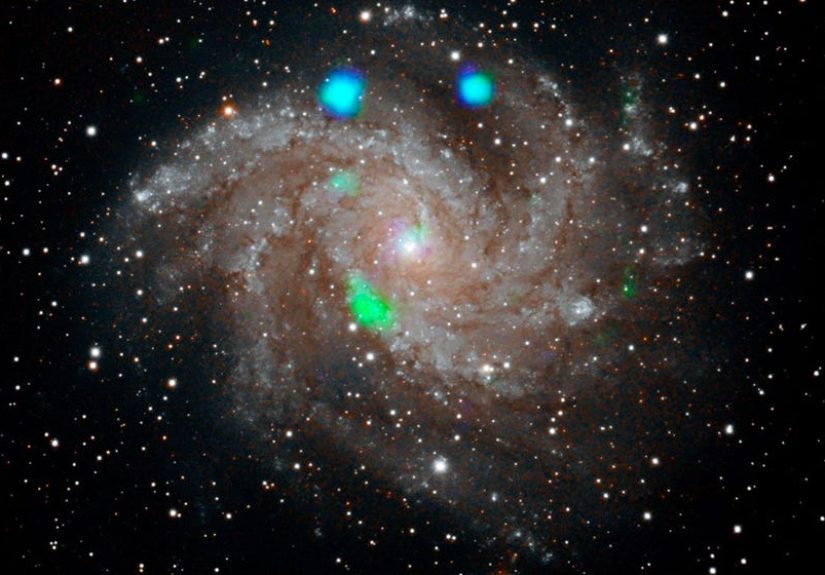
The good news is that NASA didn’t discover extraterrestrial slime (sorry, sci-fi fans). The better news is that the “green” isn’t paint, Photoshop, or a cosmic prank. It’s dataspecifically, high-energy X-ray light mapped onto a normal visible-light image of a galaxy that already has a dramatic nickname: the Fireworks Galaxy.
And the plot twist? One of those green splatsan intense, ultra-bright X-ray sourceshowed up fast, shone like it had something to prove, and then disappeared. Astronomers gave it a name, ULX-4, and then did what scientists do best: made a list of suspects, argued politely, and planned to watch the sky for an encore.
What Are the “Green Blobs,” Exactly?
“Green blobs” is the headline-friendly version. The technical version is something like: colorized X-ray emission from an ultraluminous X-ray source detected in a nearby galaxy. Which is accurate, but not as likely to make someone click.
Green in Space Photos Usually Means “Invisible Light”
Telescopes don’t just take pictures the way your phone does. Space observatories detect many kinds of lightradio, infrared, visible, ultraviolet, X-ray, and gamma raysthen scientists turn that information into images you can see. Colors are often assigned to different energy bands. In other words: the universe didn’t actually go full highlighter-green; we’re translating invisible light into something our eyes can interpret.
The Blob’s Real Identity: ULX-4
ULX-4 belongs to a class of objects called ultraluminous X-ray sources (ULXs). These are X-ray-bright sources located outside a galaxy’s central supermassive black hole region. They shine so intensely in X-rays that they can look “too bright to be legal” according to some basic physics limitsmore on that soon.
ULX-4 earned special attention because it wasn’t just bright. It was brief. It appeared quickly, then faded out on a time scale that makes astronomers squint at their calendars and say, “Wait… already?”
Meet the Neighborhood: The Fireworks Galaxy (NGC 6946)
The galaxy in question is NGC 6946, nicknamed the Fireworks Galaxy because it has hosted an unusually high number of observed supernovae (stellar explosions) over the last century. It’s also conveniently face-on from our perspective, meaning we get a clear view of its spiral structureno awkward sideways angle.
It’s close enough (in cosmic terms) to be a favorite target for professional observatories and ambitious amateur astronomers alikeroughly a couple dozen million light-years away. That’s “nearby” if your job involves galaxies.
How NASA Caught the Blob: A Lucky Sequence of Observations
The “stumped by blobs” moment happened during observations by NASA’s NuSTAR mission (Nuclear Spectroscopic Telescope Array), an X-ray observatory designed to detect high-energy X-rays from some of the most extreme objects in the universeblack holes, neutron stars, supernova remnants, and other energetic chaos factories.
Step 1: NuSTAR Was Watching a Supernova (Because of Course It Was)
NuSTAR’s original target in NGC 6946 was a supernova. Supernovae can be wildly bright in visible light and can also produce X-rays as shock waves slam into surrounding material. So far, very normal (for space).
Step 2: The Green Source Shows Up
In one observation, the green blob wasn’t there. In a follow-up observation about 10 days later, it was suddenly glowing brightly in X-rays. This wasn’t a slow “sunrise.” This was more like a “lights on, everybody panic politely.”
Step 3: Chandra Checks… and It’s Gone
NASA’s Chandra X-ray Observatory, which has exceptionally sharp X-ray vision, later observed the region and found that the source had faded or disappeared. That quick appearance-and-vanish behavior is a major reason ULX-4 became a mystery worth obsessing over.
Another key clue: astronomers didn’t detect matching visible-light emission from the spot, which makes a standard supernova explanation unlikely. Whatever ULX-4 was, it was an X-ray show first and foremost.
Why ULXs Are Such a Big Deal (A.K.A. The “How Is This Allowed?” Problem)
ULXs are famous for looking like they’re breaking the rules. Specifically, they appear to exceed something called the Eddington limit, which is basically physics saying: “If you shine too hard, your own light should push away the fuel you’re trying to eat.”
The Eddington Limit, Explained Without Crying
When a compact object (like a black hole or neutron star) pulls in gas, that gas heats up and emits radiation. Radiation carries pressure. If the object gets bright enough, the outward radiation pressure can counteract gravity’s inward pull and start blowing the incoming gas away. That’s the Eddington limit in spirit: a theoretical brightness cap tied to the object’s mass.
ULXs often appear to be 100 to 500 times above this limit, which is why scientists have spent decades asking: “Are these objects heavier than we think, or are they cheating?”
Plot Twist: Some ULXs Are Neutron Stars, Not Black Holes
For a long time, many ULXs were assumed to be black holes, possibly even “intermediate-mass” black holes (bigger than stellar black holes, smaller than supermassive ones). But then X-ray observations revealed that at least some ULXs are actually neutron starscity-sized remnants of dead stars with ridiculously strong magnetic fields.
In a well-known example, a ULX in the galaxy M82 (called M82 X-2) was shown to produce pulsationsregular beats in X-ray lightpointing to a rotating neutron star. That discovery reshaped how researchers think about ULXs in general.
So What Could ULX-4 Be? The Main Suspects
ULX-4 is a special case because it’s both ultraluminous and short-lived. Most ULXs hang around much longer, fed by a steady flow of matter from a companion star. ULX-4 showed up like a surprise guest, ate all the chips, and left.
Suspect #1: A Black Hole Had a Very Fast Snack
One possibility is a black hole ripping apart and consuming somethinglike a star or a smaller object that wandered too close. When a black hole’s gravity tears an object apart, the debris can form a hot disk and flare brightly in X-rays. This is related to what astronomers call a tidal disruption event.
Because ULX-4 was so brief, researchers considered the idea that it might have been a smaller-scale, short-duration version of that phenomenonsomething dramatic and transient rather than a long-term feeding relationship.
Suspect #2: A Neutron Star With a Magnetic “Bouncer”
Another leading explanation involves a neutron star and its magnetic field. Neutron stars can funnel incoming gas along magnetic field lines down to their surface, creating intense X-ray emission. But if the neutron star is spinning very fast, its magnetic field can act like a barrier that prevents matter from settling onto the surface.
Think of it like trying to jump onto a carousel spinning at ridiculous speed: sometimes you just can’t get on. In astrophysics terms, this is often discussed as a propeller regime, where rotation and magnetism fling matter away instead of letting it fall in.
If the “magnetic barrier” wobbles or briefly weakens, material can suddenly make it through and slam onto the neutron star, producing a burst of X-raysthen the barrier reasserts itself and the show ends. That kind of on/off behavior fits the “blink-and-you’ll-miss-it” personality ULX-4 displayed.
Suspect #3: Beaming (The Cosmic Flashlight Theory)
There’s also a geometry trick: ULXs might not be as outrageously bright in every direction as they appear. If the system produces strong winds that form a funnel, the radiation could be concentrated into a narrower beam. If that beam happens to point toward Earth, the source looks brighter than it “really” is.
Beaming doesn’t have to be an all-or-nothing effect. Small changes in the shape of the funnel or the flow of gas could produce sudden brightenings and dimmingsespecially in a system that’s already unstable.
What Scientists Look for Next (Because Mysteries Don’t Solve Themselves)
ULX-4’s story is basically a scientific cliffhanger: the best way to test these ideas is to catch the object doing it againpreferably with multiple telescopes watching at once.
Key Clues That Could Break the Case
- Repeat outbursts: If ULX-4 flares again, a neutron-star “barrier wobble” scenario gets more compelling.
- Pulsations: Detecting periodic pulses in X-rays would strongly suggest a rotating neutron star.
- Spectrum shape: How the X-ray brightness changes with energy can reveal whether the emission resembles neutron star accretion columns, black hole disks, or something more exotic.
- Multiwavelength follow-up: Optical, radio, and infrared observations could reveal a companion star, surrounding gas, or aftereffects of a violent event.
Why NuSTAR + Chandra (and Friends) Are a Power Combo
NuSTAR excels at high-energy X-rays; Chandra excels at sharp imaging and precise localization. Add in other observatories (like ESA’s XMM-Newton, which often teams up for broad X-ray coverage), and you get a fuller picture of what’s happening in these extreme systems.
Why This Matters (Even If You’re Not Planning to Become an X-Ray Astronomer)
ULX mysteries aren’t just astronomy trivia. They’re laboratories for physics you can’t replicate on Earth: extreme gravity, ultra-strong magnetic fields, and matter heated to millions of degrees. Understanding how ULXs work helps scientists refine models of accretion (how objects “eat”), how magnetic fields shape radiation, and how compact objects evolve over time.
Also, there’s a sneaky human benefit: techniques developed for teasing faint signals out of noisy data tend to spill over into other fields. Space science is basically a long-running master class in “how to measure something you can’t touch,” and that skill has a way of paying rent in unexpected places.
Conclusion: The Blob Is Gone, But the Questions Aren’t
NASA wasn’t “stumped” in the sense of throwing up its hands and quitting. It was stumped in the most scientific way possible: ULX-4 didn’t match a neat, single explanation, and the evidence points to multiple plausible scenarios.
The “weird green blob” is likely an ultraluminous X-ray source that flared and faded quicklypossibly from a neutron star whose magnetic field briefly let matter crash onto its surface, or from a black hole-powered event that burned bright and fast, or from beaming geometry that turned the brightness knob toward us for a short time.
For now, the universe has left us a sticky note that says: Come back later. There’s more.
Experiences: What It’s Like to Follow a Mystery Like NASA’s Weird Green Blobs (About )
There’s a specific kind of thrill that comes with space mysteries, and it doesn’t require a lab coat or a telescope the size of a small building. It starts the moment you realize the “green blob” isn’t a blob at allit’s a translation of invisible X-ray light into a color your brain can latch onto. That’s usually the first “aha”: space images are part science, part storytelling. You’re not just looking at a picture; you’re looking at a map of energy.
For many people, the next experience is a rabbit hole. You begin with a headline (“NASA stumped!”), then end up learning why a face-on spiral galaxy is easier to study, why X-ray telescopes need to live above Earth’s atmosphere, and why scientists love having more than one observatory confirm a signal. You discover that the Fireworks Galaxy earned its nickname the hard wayby hosting an unusual number of supernovaeand suddenly the setting feels like a character in the story, not just a background.
Then comes the fun part: the suspects. Following ULX-4 means you get to think like a detective. If it were a supernova, you’d expect visible light. If it were a black hole eating steadily, you’d expect it to stick around longer. If it were a neutron star, you might hope for pulsationsthose steady X-ray “heartbeats” that give away a spinning, magnetized object. Even if you don’t know the math, you can feel the logic: each hypothesis predicts different clues, and the sky becomes a place where you wait for the next episode.
There’s also a surprisingly relatable experience in the timescale. Space is famous for being slowgalaxies evolve over millions of years, stars live for billionsbut ULX-4 reminds you that the universe can do “blink and you miss it,” too. When something bright appears and fades within days, it feels less like a museum exhibit and more like weather. You start to appreciate that astronomy is often about being in the right place at the right time… except the “place” is a telescope in orbit and the “time” is a 10-day window you didn’t plan to be lucky enough to have.
And finally, there’s the community experience. These mysteries get explained in layers: NASA mission updates, science news summaries, astronomy magazines, and deep-dive papers for the people who want every last detail. You can watch a story travel from professional data archives to public-facing visuals to conversations where someone inevitably asks, “Okay, but could it be aliens?” (Answer: almost certainly notunless the aliens are made of magnetic fields and accretion disks.) The point isn’t that the mystery is solved instantly. The point is that you get to witness science in motion: a weird signal, a careful confirmation, a shortlist of explanations, and a plan to keep observing until the universe gives up a little more of its secret.