Table of Contents >> Show >> Hide
- Quick Definitions (So the Math Behaves)
- The Core Formula (Bookmark This in Your Brain)
- Gold Purity Cheatsheet (Common Karats)
- How to Calculate Scrap Gold Value: 12 Steps
- Step 1) Identify What’s Actually Gold (and What’s Just Gold-Flavored)
- Step 2) Read the Stamps Like a Detective (10K, 14K, 585, 750, GF, etc.)
- Step 3) Sort by Karat and Keep the Groups Separate
- Step 4) Remove Non-Gold Parts (Stones, Charms, Big Clasps) When Practical
- Step 5) Weigh Each Karat Group on a Gram Scale (Not Your Bathroom Scale, Please)
- Step 6) Convert Weight to Troy Ounces (If Needed)
- Step 7) Find Today’s Spot Price (and Notice the “Bid” vs “Ask”)
- Step 8) Convert Karat to a Purity Fraction
- Step 9) Calculate the Pure Gold Content (Your “Fine Gold” Amount)
- Step 10) Multiply by Spot Price to Get Melt Value (the “Upper Bound”)
- Step 11) Estimate Realistic Payout After Deductions (Spread, Refining, Risk)
- Step 12) Compare Multiple Offers (and Make Them Explain the Math)
- Worked Examples (Because Numbers Make It Real)
- Common “Gotchas” That Change the Final Number
- How to Use a Scrap Gold Calculator (Without Turning Off Your Brain)
- How to Protect Yourself When Selling Scrap Gold
- of Real-World Experiences (What People Learn After Actually Doing This)
- Conclusion
Scrap gold pricing sounds like it should be simple: “Gold is gold, right?” And then you walk into a shop, someone squints at your necklace like it personally offended them, and suddenly you’re hearing words like troy ounce, assay, spread, and refining fee. Relax. You don’t need a PhD in shiny metal economics. You just need a repeatable math routine and enough skepticism to keep your wallet from doing a disappearing act.
This guide gives you a practical, real-world method to estimate what your scrap gold is worthbefore anyone makes you an offer “valid for the next 11 seconds.” You’ll learn the same core formula most buyers use, how to account for purity (karat), how to handle stones and non-gold parts, and how to sanity-check a quote so you don’t accidentally donate a small fortune to someone’s boat fund.
Quick Definitions (So the Math Behaves)
- Spot price: The market price of pure gold (typically quoted per troy ounce).
- Melt value: The theoretical value of the pure gold content in your itembefore fees and buyer margin.
- Karat (K): Gold purity out of 24 parts (14K means 14/24 gold).
- Troy ounce (ozt): The precious-metals ounce. It’s 31.1035 grams, not the grocery-store ounce.
The Core Formula (Bookmark This in Your Brain)
If you know the weight, purity, and the spot price, you can estimate melt value:
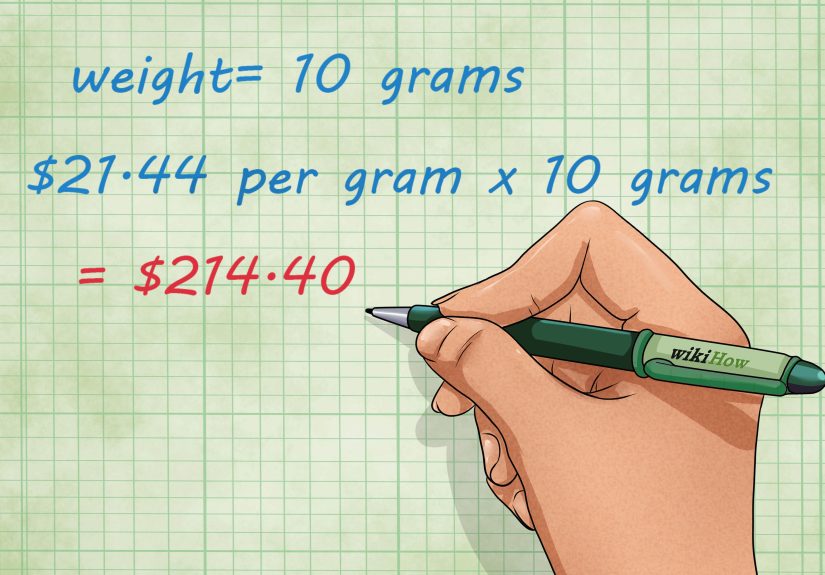
Melt Value = (Weight in grams ÷ 31.1035) × (Karat ÷ 24) × (Spot price per troy ounce)
If a buyer quotes per gram instead, you can convert spot price to a gram price:
Spot per gram = Spot price per ozt ÷ 31.1035
Gold Purity Cheatsheet (Common Karats)
| Karat Mark | Purity Fraction | Approx. % Gold | Notes |
|---|---|---|---|
| 24K / 999 | 24/24 = 1.000 | 99.9–100% | Soft; often bullion, some jewelry |
| 22K | 22/24 = 0.9167 | 91.67% | Common in some cultural jewelry |
| 18K | 18/24 = 0.750 | 75.0% | High-end jewelry |
| 14K | 14/24 = 0.5833 | 58.3% | Very common in the U.S. |
| 10K | 10/24 = 0.4167 | 41.7% | Lower purity, durable |
| 8K | 8/24 = 0.3333 | 33.3% | Sometimes seen; must be clearly disclosed |
How to Calculate Scrap Gold Value: 12 Steps
-
Step 1) Identify What’s Actually Gold (and What’s Just Gold-Flavored)
Start by separating items into three piles: (A) Solid-karat gold (10K, 14K, 18K, etc.), (B) Possibly gold (no markings, worn stamps, suspicious pieces), and (C) Not scrap-gold priced the same way (gold-plated, gold-filled, vermeil).
Why this matters: plating and “filled” items contain a thin layer of gold over base metal. Their value is usually much lower than solid gold jewelryeven if they look identical from across the room. (Gold is sneaky like that.)
-
Step 2) Read the Stamps Like a Detective (10K, 14K, 585, 750, GF, etc.)
Look for karat marks: 10K, 14K, 18K, 22K, 24K. You may also see millesimal fineness marks: 417 (10K), 585 (14K), 750 (18K), 916 (22K), 999 (24K).
Watch for letters that change everything: GP (gold plated), HGE (heavy gold electroplate), GF (gold filled), or RGP (rolled gold plate). These typically should not be valued using the same simple “karat × weight” method as solid gold.
-
Step 3) Sort by Karat and Keep the Groups Separate
Don’t mix 10K with 14K and call it “average-ish.” Buyers won’t. Separate each karat into its own bag or cup. If you have unmarked pieces, keep them separate until tested.
Pro tip: if you have a mixed chain (different sections) or a bracelet with a base-metal clasp, treat it as a “needs closer inspection” item. Mixed-metal pieces can wreck a quick estimate.
-
Step 4) Remove Non-Gold Parts (Stones, Charms, Big Clasps) When Practical
Your goal is the weight of the gold alloy only. Gemstones and large non-gold components inflate weight but don’t increase gold value.
If you can safely remove stones or detachable pieces, do it. If you can’t, estimate. A jeweler may weigh the piece, then subtract stone weight (or use experience-based deductions). Your at-home estimate won’t be perfect but it’ll be closer than pretending diamonds are made of gold (they are not).
-
Step 5) Weigh Each Karat Group on a Gram Scale (Not Your Bathroom Scale, Please)
Use a digital scale that reads to at least 0.01 g. Weigh each karat pile separately and write it down. If your scale measures in ounces, make sure you know whether it’s standard ounces or troy ounces (most kitchen scales are standard ounces, which is not the same).
If a buyer quotes in pennyweight (dwt)common in jewelry scrapknow that 20 dwt = 1 troy ounce, and 1 dwt ≈ 1.555 g.
-
Step 6) Convert Weight to Troy Ounces (If Needed)
Spot price is usually per troy ounce, so you’ll often convert grams to ozt:
Troy ounces = grams ÷ 31.1035
Example: 8 grams of jewelry = 8 ÷ 31.1035 = 0.2572 ozt (rounded).
If you’re working in pennyweight: ozt = dwt ÷ 20.
-
Step 7) Find Today’s Spot Price (and Notice the “Bid” vs “Ask”)
Look up the current gold spot price from a reputable bullion market source. You’ll often see two numbers: bid (what buyers pay) and ask (what sellers charge). Scrap offers tend to track closer to bid than askbecause the buyer is, you know, buying.
Translation: if you calculate melt value using a headline price and your offer is lower, that doesn’t automatically mean you’re being robbed. It might just be the spread, plus refining and business costs. But it could also mean you’re being robbed. Welcome to adulting.
-
Step 8) Convert Karat to a Purity Fraction
Purity fraction = karat ÷ 24.
- 10K = 10/24 = 0.4167
- 14K = 14/24 = 0.5833
- 18K = 18/24 = 0.7500
- 22K = 22/24 = 0.9167
If you have fineness marks, you can use those too: 585 = 0.585, 750 = 0.750, etc. (Close enough for estimating.)
-
Step 9) Calculate the Pure Gold Content (Your “Fine Gold” Amount)
This step isolates the amount of pure gold hiding inside your alloy.
Fine gold (ozt) = total ozt × purity fraction
Example: 8 grams of 14K:
8 g ÷ 31.1035 = 0.2572 ozt
Fine gold = 0.2572 × 0.5833 = 0.1500 ozt (rounded) -
Step 10) Multiply by Spot Price to Get Melt Value (the “Upper Bound”)
Now the money part:
Melt value = fine gold (ozt) × spot price ($/ozt)
Continuing the example (using a hypothetical spot price of $2,100/ozt):
Melt value = 0.1500 × 2,100 ≈ $315That $315 is not what you’ll necessarily get paid. Think of it as “the pizza’s listed price before tax, tip, and your friend who ‘forgot their wallet.’”
-
Step 11) Estimate Realistic Payout After Deductions (Spread, Refining, Risk)
Scrap gold buyers don’t pay 100% of melt because they have costs and risk: testing/assay, melting, refining, hedging, shipping, overhead, and profit margin.
In many real offers, you might see something like 70%–90% of melt depending on the buyer, quantity, how clean/consistent the karat is, and whether the buyer must refine it.
A quick estimate:
- Conservative: melt × 0.70
- Competitive: melt × 0.80 to 0.90
Example: $315 melt might translate to roughly $220–$285 in a typical rangedepending on who’s buying and how. If you’re offered $120 with no explanation, that’s not “market conditions.” That’s “someone’s yacht payment.”
-
Step 12) Compare Multiple Offers (and Make Them Explain the Math)
The strongest move you can make is simple: get more than one quote. Ask each buyer:
- What spot price are you usingbid or ask?
- What percentage of melt are you paying?
- Are there refining or shipping fees?
- How do you handle stones, mixed metals, or unmarked items?
A reputable buyer should be able to walk you through the calculation without acting like you just asked them to reveal the secret Krabby Patty formula.
Worked Examples (Because Numbers Make It Real)
Example A: 14K Scrap Ring (Grams → Melt Value)
- Weight: 8.00 g
- Purity: 14K = 0.5833
- Spot price (hypothetical): $2,100/ozt
Convert to ozt: 8 ÷ 31.1035 = 0.2572 ozt
Fine gold: 0.2572 × 0.5833 = 0.1500 ozt
Melt value: 0.1500 × 2,100 ≈ $315
Example B: Mixed Scrap Lot (Two Karats)
Lot 1: 10K pieces weighing 12 g
Lot 2: 18K pieces weighing 5 g
Spot price (hypothetical): $2,100/ozt
10K: (12 ÷ 31.1035) × (10/24) × 2,100 ≈ $337 (melt)
18K: (5 ÷ 31.1035) × (18/24) × 2,100 ≈ $253 (melt)
Total melt estimate: ≈ $590
If a buyer offers $450 with transparent math, that might be competitive. If they offer $250 and a shrug, keep walking.
Common “Gotchas” That Change the Final Number
1) Hollow chains and “fluffy” jewelry
Some chains look heavy but are hollow. That doesn’t change the math (weight is weight), but it can make you feel like you’re being lowballed when you’re not. Let the scale do the talking.
2) Solder, clasps, springs, and mystery parts
A clasp might be a different karat than the chain. Some springs are steel. Some jewelry is mixed metal by design. Buyers may test multiple points or pay at the lowest confirmed karat to protect themselves.
3) Gold-filled is not “basically 14K”
Gold-filled items can be labeled with weight ratios (like 1/20 14K GF). That means only a fraction of the piece’s weight is gold, and it requires a different calculation. If you value gold-filled like solid 14K, you’ll overestimateby a lot.
4) Unmarked items require testing (and tests vary)
Visual inspection can help, but professional testing (like XRF) is far more reliable than vibes. Acid tests can be useful but are messy and require care. Magnet tests are limited (gold isn’t magnetic, but that doesn’t prove it’s gold).
How to Use a Scrap Gold Calculator (Without Turning Off Your Brain)
Online scrap gold calculators can speed up the math, especially if you have multiple karats. But don’t outsource your common sense. Always confirm:
- The calculator is using troy ounces (31.1035 g), not standard ounces.
- You entered the correct karat and weight unit.
- The spot price is current and clearly identified.
How to Protect Yourself When Selling Scrap Gold
- Get multiple offers and compare payout as a % of melt.
- Ask for the spot price used (bid vs ask) and the buyer’s deduction method.
- Don’t rushpressure is a discount disguised as urgency.
- Use reputable shipping methods if selling by mail, and insure appropriately.
- Keep documentation: photos, weights, karat stamps, and quotes.
of Real-World Experiences (What People Learn After Actually Doing This)
The first “experience” most people have with scrap gold is emotional whiplash. You open a jewelry box and think, “This has to be worth something,” because it’s shiny and it used to be expensive. Then you discover the weird truth: the sentimental value can be priceless, while the melt value is… math. Pure, indifferent, calculator-flavored math.
A common story: someone brings in a chunky 14K chain expecting “thousands,” only to learn it’s hollow and weighs far less than it looks. The lesson isn’t that buyers are villainsit’s that eyeballs are terrible scales. People who do best tend to show up with their own weights written down, their karats separated, and a spot price pulled up on their phone like they’re ordering takeout. That preparation changes the entire tone of the conversation. You stop being “someone with a bag of random gold stuff” and become “someone who understands the rules of the game.”
Another frequent experience: confusion over stamps. Many people assume a “585” mark is a serial number, or that “GP” stands for “Genuine Precious.” (It doesn’t. It’s more like “Gold Pretending.”) Once people learn that 585 roughly means 58.5% gold, they start spotting patterns everywhere: 417, 750, 916. It turns into a tiny scavenger huntonly the treasure is financial clarity. And clarity is rare. Almost as rare as a buyer who explains their pricing without being asked.
People also notice how much the process affects payout. Walk-in shops are convenient, but convenience has a cost. Mail-in refiners may pay more but introduce a different experience: waiting, shipping anxiety, and the “hope you trusted the right company” sensation. Some sellers describe the best outcomes when they treat it like any other sale: get multiple bids, ask for itemized breakdowns, and be willing to walk away. The worst outcomes often involve urgencyselling right after an unexpected bill, accepting the first offer, or skipping the step where you ask, “What percentage of melt is this?”
Finally, people who’ve been through it tend to say the same thing: the goal isn’t to squeeze every last dollar out of a broken bracelet. The goal is to avoid the big mistakesmixing karats, ignoring stones, confusing regular ounces with troy ounces, and trusting mystery math. Once you’ve done the calculation yourself at least once, selling scrap gold stops feeling like a gamble and starts feeling like a decision. And that’s the real value here: you keep more of your money because you kept control of your numbers.
Conclusion
Calculating scrap gold value is a three-part recipe: weight, purity, and spot price. Use the formula, separate your karats, convert grams to troy ounces, and treat melt value as the starting pointnot the guaranteed payout. Then compare offers like a calm, informed adult (even if you’re doing it while craving a nap).
If you remember nothing else: 31.1035 grams = 1 troy ounce, and “I’ll give you this price only today” is often a sales tactic, not a law of physics.