Table of Contents >> Show >> Hide
- What Is a French Chocolate Bûche de Noël?
- Why This French Chocolate Yule Log Recipe Works
- French Chocolate Buche De Noel Recipe
- How to Make a French Chocolate Bûche de Noël
- Tips for a Better Bûche de Noël
- Common Mistakes to Avoid
- Variations on This Christmas Yule Log Cake
- How to Store and Make It Ahead
- Final Thoughts
- What the Experience of Making a Bûche de Noël Is Really Like
If there is one holiday dessert that knows how to make an entrance, it is the French chocolate Bûche de Noël. This cake does not quietly sit in the corner pretending to be “just a little something sweet.” No. It arrives dressed as an actual log, wearing chocolate bark, powdered-sugar snow, and possibly a few mushrooms like it just came back from a glamorous walk through an enchanted forest.
The good news is that this classic Christmas cake is far less scary than it looks. At its heart, a Bûche de Noël is simply a soft chocolate sponge cake rolled with a light filling, frosted to resemble bark, and decorated with a little holiday drama. Once you understand the method, the whole dessert becomes much more manageable. In other words, it is less “French pastry final exam” and more “weekend baking project with excellent bragging rights.”
This version keeps the soul of a traditional French chocolate yule log recipe while making the process friendly for confident home bakers. You get a tender cocoa sponge, a lightly sweet chocolate mascarpone cream filling, and a silky ganache frosting that creates that iconic tree-bark finish. The flavor is rich without being heavy, elegant without being fussy, and festive without requiring a culinary degree or a backup therapist.
If you are looking for a showstopping Christmas dessert, a make-ahead holiday cake, or a French chocolate Bûche de Noël recipe that tastes as good as it looks, this is the one to bookmark.
What Is a French Chocolate Bûche de Noël?
Bûche de Noël literally means “Christmas log.” The dessert was inspired by the old European yule log tradition and evolved into a rolled cake in France, where pastry chefs transformed a rustic holiday symbol into something much more edible and significantly less splintery. Today, the classic version usually includes a flexible sponge cake, a creamy filling, chocolate frosting or ganache, and woodland-style decorations like meringue mushrooms, sugared cranberries, rosemary sprigs, or a dusting of confectioners’ sugar to mimic snow.
Some versions use genoise, some lean toward chiffon-style sponge, and some go all-in with mousse, buttercream, chestnut filling, or whipped cream. That is part of the charm. A yule log cake has structure, yes, but it also has room for personality. Think of it as the holiday dessert equivalent of formalwear with fabulous boots.
Why This French Chocolate Yule Log Recipe Works
1. The sponge is soft and flexible
A rolled cake lives or dies by texture. If the sponge is dry, overbaked, or stubborn, it cracks like it is auditioning for a dramatic soap opera. This recipe uses whipped eggs, a little oil, and a gentle folding method to keep the cake light, moist, and bendy.
2. You roll the cake while it is still warm
This is the secret that separates confident bakers from people whispering “please don’t split” at a sheet pan. Rolling the cake while warm helps it “learn” the shape, so it is much easier to re-roll later with the filling inside.
3. The filling is light but stable
Chocolate mascarpone whipped cream gives you the best of both worlds. It tastes airy and luxurious, but it also holds its shape better than plain whipped cream. That means prettier slices and less filling trying to escape onto the platter.
4. The frosting looks fancy with minimal effort
Ganache is the holiday miracle worker here. Once cooled to a spreadable consistency, it glides over the cake and takes on a bark-like texture with nothing more than a spatula or fork. Suddenly you look like someone who definitely has a pastry torch, even if you do not.
French Chocolate Buche De Noel Recipe
Yield and Time
Serves 10 to 12
Prep time: 45 minutes
Bake time: 12 to 14 minutes
Chill time: 1 to 2 hours
Equipment
- 12 x 17-inch jelly roll pan or rimmed baking sheet
- Parchment paper
- 2 large mixing bowls
- Hand mixer or stand mixer
- Fine-mesh sieve
- Offset spatula or butter knife
- Clean kitchen towel or parchment for rolling
Ingredients for the Chocolate Sponge Cake
- 6 large eggs, separated and at room temperature
- 3/4 cup granulated sugar, divided
- 1 teaspoon vanilla extract
- 3 tablespoons neutral oil
- 1/2 cup cake flour
- 1/4 cup unsweetened cocoa powder
- 1 teaspoon baking powder
- 1/4 teaspoon fine salt
- 2 tablespoons confectioners’ sugar or cocoa powder, for dusting
Optional Coffee Syrup
- 1/4 cup hot brewed coffee or espresso
- 1 tablespoon sugar
- 1 teaspoon dark rum, optional
Ingredients for the Filling
- 4 ounces mascarpone cheese, softened
- 1 cup cold heavy cream
- 1/4 cup confectioners’ sugar
- 2 tablespoons unsweetened cocoa powder
- 1 teaspoon vanilla extract
- 1 tablespoon dark rum or cooled espresso, optional
Ingredients for the Ganache Frosting
- 8 ounces semisweet chocolate, finely chopped
- 3/4 cup heavy cream
- 1 tablespoon unsalted butter
- Pinch of salt
Optional Decorations
- Confectioners’ sugar
- Fresh rosemary sprigs
- Sugared cranberries
- Meringue mushrooms
- Chocolate shavings
How to Make a French Chocolate Bûche de Noël
Step 1: Prepare the pan and oven
Preheat your oven to 350°F. Line the jelly roll pan with parchment paper and lightly grease it. Set out a clean kitchen towel or a large sheet of parchment on the counter and dust it with confectioners’ sugar or cocoa powder. This is where the warm cake will land, so treat it like the dessert runway it is.
Step 2: Make the sponge batter
In a medium bowl, whisk together the cake flour, cocoa powder, baking powder, and salt. In a separate bowl, beat the egg yolks with 1/2 cup of the granulated sugar until thick, pale, and fluffy, about 3 to 4 minutes. Beat in the vanilla and oil.
In another clean bowl, beat the egg whites until soft peaks form. Gradually add the remaining 1/4 cup granulated sugar and continue beating until glossy stiff peaks form. Fold the dry ingredients into the yolk mixture, then gently fold in the whipped egg whites in three additions. Use a light hand. You want volume, not aggression.
Step 3: Bake quickly and do not overbake
Spread the batter evenly into the prepared pan. Bake for 12 to 14 minutes, or until the top springs back lightly when touched. Thin sponge cakes bake fast, and a minute too long can be the difference between “beautiful roulade” and “holiday earthquake.”
Step 4: Roll the cake while warm
As soon as the cake comes out of the oven, loosen the edges with a thin knife. Invert the cake onto the prepared towel or parchment, peel away the baking parchment, and starting from one short end, roll the cake up gently while it is still warm. Let it cool completely seam-side down.
This step matters. It gives the sponge cake muscle memory, which is a very strange phrase but a very helpful concept.
Step 5: Make the optional syrup
Stir together the hot coffee, sugar, and rum if using. Let cool. You will use this sparingly later if you want a deeper mocha note and a little extra moisture. Do not soak the cake like it owes you money. A light brush is enough.
Step 6: Make the filling
Beat the mascarpone until smooth. Add the heavy cream, confectioners’ sugar, cocoa powder, vanilla, and rum or espresso if using. Beat until thick, fluffy, and spreadable. Stop once it holds soft peaks. Overbeating can turn it grainy, and nobody wants a filling with an identity crisis.
Step 7: Fill and re-roll the cake
Carefully unroll the cooled cake. If you want to use the coffee syrup, brush a very thin layer over the surface. Spread the filling evenly across the cake, leaving about a 1-inch border around the edges. Re-roll the cake gently without the towel. Place it seam-side down on a platter or board and chill for at least 1 hour.
Step 8: Make the ganache frosting
Place the chopped chocolate, butter, and salt in a bowl. Heat the cream until steaming but not boiling, then pour it over the chocolate. Let it sit for 2 minutes, then stir until smooth. Cool until the ganache thickens to a spreadable consistency. You want frosting, not soup.
Step 9: Turn it into a log
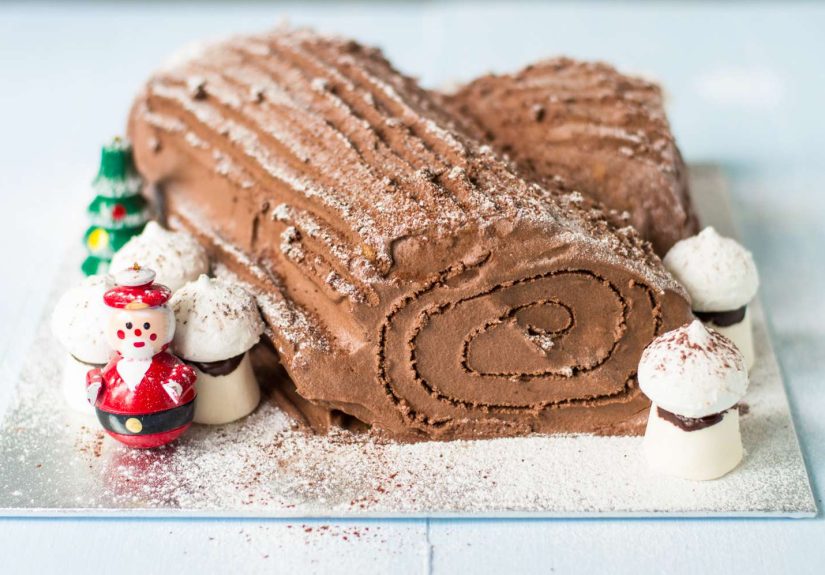
Slice a 2- to 3-inch piece from one end of the cake at a diagonal. Place that piece against the side of the roll to look like a branch. Frost the entire cake with ganache, covering the main log and the branch. Use a spatula, butter knife, or fork to drag lines through the frosting so it resembles bark.
Dust with confectioners’ sugar, then add rosemary, cranberries, mushrooms, or chocolate shards if desired. Suddenly your dessert looks like it belongs in a holiday window display.
Tips for a Better Bûche de Noël
Use room-temperature eggs
They whip with more volume, which helps create a lighter sponge cake.
Do not overmix the batter
Folding preserves air. Stirring too hard deflates the foam and leads to a dense cake.
Roll first, panic later
Always roll the cake while warm. This is the single most useful trick in nearly every successful yule log method.
Keep the filling layer modest
Too much filling looks generous but makes the cake harder to roll neatly. Better spiral, better slice, better life choices.
Do not fear a crack
Minor cracks are normal. The ganache covers a multitude of sins, much like dim lighting and good holiday music.
Common Mistakes to Avoid
Overbaking the sponge
A dry cake is far more likely to crack. Pull it as soon as it springs back.
Using a thick, textured towel
A smooth, thin towel works best. Heavy waffle textures can stick or imprint the cake.
Frosting with warm ganache
If the ganache is too loose, it slides everywhere. Let it cool until spreadable.
Skipping the chill
Chilling the filled roll helps it set before frosting. It also makes the branch attachment less dramatic in all the wrong ways.
Variations on This Christmas Yule Log Cake
If you want to customize this French chocolate Bûche de Noël recipe, you have options:
- Mocha version: Brush the cake with coffee syrup and add espresso powder to the ganache.
- Hazelnut version: Fold finely chopped toasted hazelnuts into the filling.
- Chestnut version: Replace the mascarpone filling with chestnut cream or chestnut mousse for a more classic French feel.
- Buttercream version: Use chocolate buttercream instead of ganache if you want a sweeter, more traditional bakery-style finish.
- Black forest twist: Add a thin layer of cherry preserves beneath the filling.
How to Store and Make It Ahead
You can make the rolled and filled cake a day ahead and keep it chilled. Frost and decorate it the day you plan to serve it, or frost it earlier and refrigerate it until needed. Let it sit at room temperature for about 20 to 30 minutes before serving so the ganache softens slightly and the texture is at its best.
If you are making decorative meringue mushrooms, those can usually be prepared in advance and stored separately in an airtight container. That kind of planning is very satisfying and makes you feel like the sort of person who labels things in nice handwriting.
Final Thoughts
A French chocolate Bûche de Noël recipe is one of those holiday bakes that looks wildly ambitious but becomes surprisingly approachable once you break it into parts. Make a flexible sponge. Roll it warm. Fill it lightly. Frost it generously. Drag a fork through the ganache and call it bark. Suddenly, you have a Christmas dessert that feels both elegant and playful.
And that may be the real magic of the yule log cake. It is impressive enough for a centerpiece, delicious enough for a second slice, and forgiving enough to survive a tiny crack or two. Honestly, that is the energy many of us are bringing to the holidays anyway.
What the Experience of Making a Bûche de Noël Is Really Like
Making a French chocolate Bûche de Noël is not just about following a recipe. It is an experience. It begins with a mix of excitement and mild suspicion, because at first glance this dessert looks like something best left to pastry chefs wearing spotless jackets and speaking in calm, accented confidence. Then the eggs are separated, the cocoa is measured, and suddenly you are in it. The kitchen smells like chocolate. The mixer is working hard. Holiday music starts sounding more cinematic. A project has begun.
The most memorable moment for many bakers is the first roll. The cake comes out of the oven looking soft and fragile, and there is always a brief pause before you invert it. This is the crossroads between triumph and nonsense. But once the cake rolls successfully while warm, confidence arrives fast. You realize the dessert is not trying to defeat you; it is just asking you to pay attention. That is a surprisingly satisfying shift.
Then comes the filling, which feels like the reward for all your care. Spreading a soft chocolate cream over the cooled sponge is one of the most pleasant steps in the whole process. It is tidy enough to feel precise, but indulgent enough to feel fun. Re-rolling the cake is the moment where it starts looking like a real Bûche de Noël and not merely “a sheet cake that has gone through something.” The spiral appears, the log shape forms, and the dessert suddenly has personality.
Frosting the cake is where the experience turns playful. Unlike a layer cake, which often demands polished edges and mathematical patience, a yule log actually benefits from rustic texture. Smudges become bark. Lines become grain. A slightly uneven surface looks intentional. This is wonderful news for home bakers, especially during the holidays, when perfection is both overrated and usually interrupted by someone asking where the scissors are.
Decorating the finished cake often becomes the most joyful part. A dusting of sugar creates snow in seconds. A sprig of rosemary looks like a pine branch. A few cranberries can make the whole platter feel festive. Even simple decorations have a big visual payoff, and that is part of why this dessert remains so beloved. It invites creativity without demanding that every detail be flawless.
There is also something deeply nostalgic about serving a yule log. It feels old-world, celebratory, and a little theatrical in the best possible way. Guests tend to smile before they even take a bite, which is always a strong start for dessert. And when you slice into the cake and reveal that neat spiral of sponge and filling, there is a specific kind of baker’s satisfaction that is hard to beat. It says, “Yes, I made this,” while trying to sound humble and failing beautifully.
Perhaps the best part of the experience is that a Bûche de Noël manages to be both elegant and forgiving. Tiny cracks can be covered. Uneven lines look woodsy. Decorations can be simple or elaborate. The cake does not need to be perfect to be memorable. In fact, the homemade quality is part of its charm. It looks crafted, not manufactured. Festive, not fussy. Special, but still warm and welcoming.
That is why this dessert earns a place on holiday tables year after year. It is not only delicious. It creates a moment. And during a season full of rushed schedules, last-minute wrapping, and mysterious missing tape, a cake that turns effort into delight feels like a very good tradition to keep.