Table of Contents >> Show >> Hide
There are many ways to measure an object. You can use a ruler. You can use a tape measure. You can use a laser tool if you woke up feeling like a home-improvement influencer. Or, because the internet has always been gloriously allergic to taking the straight road, you can place a banana next to the thing and call it a day.
That is the goofy brilliance behind the enduring “banana for scale” joke. It is practical enough to be understood instantly and ridiculous enough to make people laugh before they even reach the comments. A banana is familiar, bright, oddly elegant, and just inconsistent enough to make the whole measurement system technically questionable and spiritually perfect. Which is exactly why community prompts like “Hey Pandas, Post Your Favourite ‘Banana For Scale’ Images” hit such a sweet spot online. They invite people to share not just photos, but little bursts of internet culture that feel like inside jokes everyone is somehow already in on.
And that is the secret sauce here: banana-for-scale images are not just random pictures with produce. They are tiny comedy performances. They turn ordinary objects into visual punchlines, transform size into storytelling, and remind us that the internet’s best traditions are often the silliest ones. A giant mushroom becomes legendary. A microscopic screw becomes dramatic. A very smug cat next to a banana becomes, for one shining moment, a ruler-resistant icon.
What “Banana For Scale” Actually Means
At the simplest level, a banana-for-scale image uses a banana as a visual reference point so viewers can understand the size of another object in the frame. But the phrase has grown far beyond that basic function. It has become a meme, a shorthand, and a recognizable internet language all its own.
From practical joke to internet folklore
The format took off because it solves a real problem in the dumbest possible way. Photos flatten size. A close-up shot of a pebble can look like a boulder. A giant bread loaf can look like a regular Tuesday. People needed a reference object, and somewhere along the way, the banana won the popularity contest over rulers, coins, and adult responsibility.
What helped the meme stick was repetition across different corners of the web. Once the joke moved from early blog humor into image-sharing sites, forums, and social platforms, it stopped being a one-off gag and became a reusable internet tool. Then communities ran with it. Suddenly the banana was not just a fruit. It was a measuring device, a prop, a punchline, and occasionally the star of the photo itself.
Why the banana beat the ruler
The ruler has logic. The banana has charisma. That is the whole game.
A ruler is sterile. A banana is visually loud, instantly recognizable, and weirdly universal. People know roughly how big one looks, even if the exact size varies. It has a curved silhouette, a cheerful color, and enough absurd energy to make the image feel playful before anyone reads the caption. It is basically the golden retriever of reference objects.
And yes, part of the humor is that bananas are not perfectly standardized. Some are tiny. Some are cartoonishly large. Some look like they skipped leg day. That inconsistency should make the system worse, but in meme terms it makes it better. The imperfect reference is part of the joke. A banana is close enough to communicate size and chaotic enough to keep the whole thing funny.
Why “Hey Pandas” Style Posts Work So Well
Community-driven prompts are basically catnip for internet participation. A title like “Hey Pandas, Post Your Favourite ‘Banana For Scale’ Images” is not asking for a polished essay or a PhD dissertation on fruit-based metrics. It is asking for delight. That low barrier to entry matters.
The format is democratic
Anybody can join in. You do not need expensive gear, expert skills, or a perfectly curated online identity. You just need a funny image, a mildly chaotic sense of humor, and access to a banana. That makes the format inviting in a way that many internet trends are not. It welcomes the weird, the casual, the accidental, and the gloriously overcommitted.
A giant zucchini from someone’s backyard garden? Eligible. A tiny 3D-printed dragon? Eligible. A suspiciously huge croissant? Extremely eligible. The point is not perfection. The point is the moment when a viewer sees the banana and immediately understands the bit.
It turns comments into part of the entertainment
These posts also thrive because the comments usually become a second comedy stage. People will ask whether the banana itself needs another banana for scale. Someone will accuse the photographer of using an illegally large banana. Another person will claim the image proves Americans will measure anything except in metric. Everyone gets to participate in a joke that is both ancient by internet standards and somehow always ready for one more lap around the track.
It combines nostalgia with low-stakes absurdity
There is comfort in a meme that knows exactly what it is. Banana-for-scale humor does not pretend to be revolutionary. It is not trying to disrupt anything, optimize anything, or make you download an app you will forget in 48 hours. It just shows you an object, adds a banana, and lets your brain enjoy the tiny pop of recognition. In a very online world full of noise, that simplicity feels almost luxurious.
The Best Kinds of Banana-For-Scale Images
The giant-object photo
This is the classic. You see a mushroom the size of a toddler, a fish that looks like it pays taxes, or a pumpkin that could qualify as studio housing in some cities. Then the banana appears, and suddenly the image graduates from “mildly interesting” to “absolutely unhinged.” The banana gives scale, but more importantly, it gives drama. It tells the viewer, No, seriously, this thing is enormous.
The tiny-object photo
Tiny-object banana images have a different kind of charm. They are less about spectacle and more about contrast. A miniature wrench, a pocket-sized figurine, a strangely small fruit, or a microscopic gadget part becomes funnier when paired with a full-size banana that feels hilariously overqualified for the job. It is like hiring a parade float to advertise a paper clip.
The fake-out masterpiece
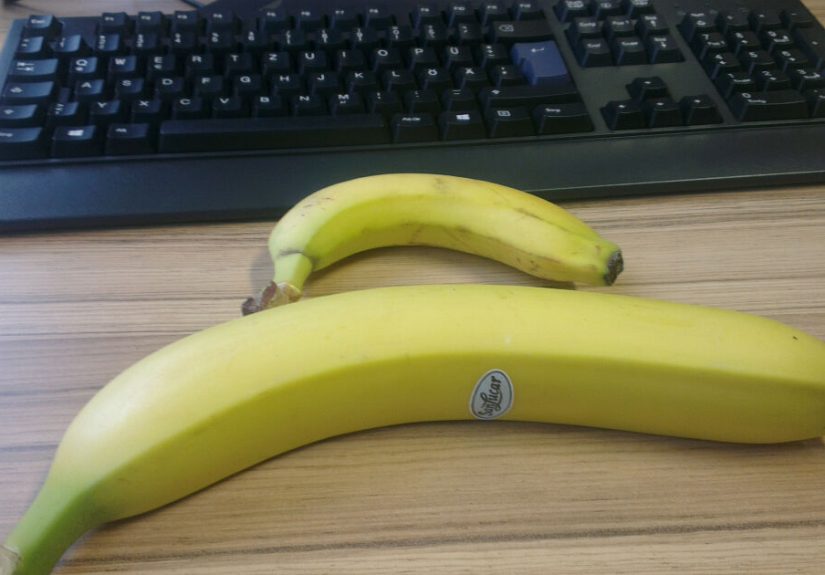
Then there are the advanced-level posts: the ones that weaponize the meme itself. Maybe the banana is unusually large. Maybe there are two bananas, creating a fresh measurement crisis. Maybe the banana is fake, 3D-printed, crocheted, or somehow less trustworthy than the object it is supposed to clarify. These are the posts that understand the meme deeply enough to start bending it. They are internet jazz. Chaotic, clever, and slightly suspicious.
The wholesome pet edition
Never underestimate the power of an animal next to a banana. A dog paw, a sleepy cat, a rabbit, a turtle, or a bird instantly makes the image more shareable because viewers are now processing two emotional responses at once: “How big is that?” and “Why is that pet so adorable?” The banana does not just measure the animal. It also heightens the comedy by making the entire photo feel delightfully unnecessary, which is exactly why it works.
Why Banana-For-Scale Humor Still Works
It is useful and useless at the same time
That contradiction is the engine. Banana-for-scale images genuinely help people estimate size, but they also parody the need for precision. The photo says, “Here is a reference object,” while also whispering, “We are absolutely not doing science here.” That tension makes the format oddly satisfying. It gives enough information to be helpful without draining the fun out of the image.
It travels across every platform
Some memes belong to one website and die when they leave it. Banana-for-scale humor is not one of them. It works on social feeds, forums, group chats, photo galleries, DIY communities, pet pages, marketplace listings, and comment threads. It is flexible because the structure is simple. See thing. Add banana. Enjoy cultural continuity.
It rewards shared internet memory
Part of the pleasure comes from recognition. If you have spent enough time online, seeing a banana placed beside an object triggers an immediate mental response. You do not need the joke explained. You are already there. And for people who are newer to the meme, the format is easy to learn in about three seconds. That mix of familiarity and accessibility is rare. It makes the joke feel both old-school and evergreen.
How To Take a Great Banana-For-Scale Photo
If the title is an invitation, then yes, there should be some friendly guidance for future contributors. A truly strong banana-for-scale image does not just contain a banana. It stages the banana with intent.
First, keep both the object and the banana clearly visible in the same frame. This sounds obvious, but the internet is a magical place where obvious things routinely go on vacation. Second, avoid weird perspective unless your goal is intentional chaos. If the banana is shoved close to the camera while the object is far away, you are no longer measuring; you are performing visual mischief. Which is fine, but call it art.
Lighting helps more than people think. The best images are usually easy to read at a glance. The viewer should not have to zoom in, squint, rotate the phone, and pray. Also, do not bury the banana in clutter. It is a co-star, not a background extra. Give it room to shine.
Most importantly, commit to the bit. The funniest banana-for-scale images know exactly how silly they are. They do not apologize. They do not overexplain. They just drop a banana into the scene like it belongs there and let the audience do the rest.
Conclusion
The joy of “Hey Pandas, Post Your Favourite ‘Banana For Scale’ Images” is bigger than the joke itself. It captures what people still love about internet culture when it is at its best: shared humor, low-stakes creativity, and a strange little sense of belonging built around something completely unnecessary.
Banana-for-scale images endure because they are visual, silly, communal, and instantly readable. They turn everyday objects into comedy, size into narrative, and a grocery-store fruit into a tiny yellow celebrity. They ask almost nothing from the audience, yet they deliver a very specific kind of satisfaction: the pleasure of understanding a joke immediately and still wanting to see one more version of it.
In a world full of overproduced content and algorithmically polished sameness, there is something refreshingly human about a photo that basically says, “I found this weird thing, here is a banana, please enjoy.” Honestly, that may be the internet at its purest.
Extra: The Experience of Living in a Banana-For-Scale Internet
One reason banana-for-scale images feel so memorable is that they create tiny shared experiences. Most people do not remember every meme they scroll past, but they do remember the specific kind of laughter that comes from seeing a totally normal image suddenly take a left turn into fruit-based measurement. It is not a loud joke. It is more like a spark. Your brain recognizes the setup, appreciates the nonsense, and gives you that quiet little internal, “Well played.”
There is also something deeply relatable about the kinds of moments that produce these photos. Someone finds a gigantic strawberry in the kitchen, a strangely small hammer in the garage, an oddly shaped potato in the yard, or a pet that looks suspiciously loaf-sized. A regular person in a regular setting decides that the best possible response is not a ruler, not a formal comparison chart, but a banana. That choice says a lot about online humor. We do not always want the most accurate answer. We want the funniest useful answer.
For people who spend time in maker spaces, gardening communities, pet groups, cooking threads, and marketplace pages, banana-for-scale humor has become a kind of cultural seasoning. It shows up when someone is proud, confused, impressed, or mildly alarmed by the size of something. The banana turns the post into a conversation starter. It gives strangers an easy way in. Even people who know nothing about 3D printing, sourdough, homegrown vegetables, or aquarium décor can still react to the visual instantly. The joke lowers the barrier to engagement.
That shared experience matters because it is social without being stressful. There is no debate club energy here. No one has to defend a thesis. No one is entering discourse combat. People are just collectively agreeing that this object, whatever it may be, deserves to be seen next to a banana. In internet terms, that is practically a spa day.
There is also a weirdly comforting continuity to it. The web changes fast. Platforms rise, sink, get renamed, get sold, get turned into places where nobody is sure whether they are networking or crying. But banana-for-scale humor survives all of that because it is built on a simple human pleasure: comparison mixed with absurdity. It works whether the image is professionally framed or taken in terrible kitchen lighting at 11:43 p.m. It does not need cutting-edge technology. It just needs timing, an object worth sharing, and one very cooperative banana.
Maybe that is why these images never feel completely stale. Each new one is familiar, but it still carries the freshness of context. The joke stays the same; the object changes. And that little swap keeps the format alive. The banana is the constant, the internet is the stage, and every new post is another reminder that people will always find creative ways to make each other laugh with the simplest props imaginable. For a joke built on a piece of fruit, that is a surprisingly beautiful legacy.