Table of Contents >> Show >> Hide
- Before You Start: Set Yourself Up for an Easy Win
- Step 1: Choose a “Tree Plan” in 2 Minutes
- Step 2: Light It Like You Mean It
- Step 3: Add Ribbon and Garland for Shape and Movement
- Step 4: Add “Picks” and Big Statement Pieces First
- Step 5: Ornaments in the Right Order (So It Looks Styled, Not Dumped)
- Step 6: Topper, Tree Base, and the Final 5-Minute Polish
- Safety and Care (Because a Tree Should Sparkle, Not Scare You)
- Troubleshooting: Fix Common Tree Problems Fast
- Experience-Based Add-On: What Decorating a Tree Actually Feels Like
- Conclusion
Decorating a Christmas tree is a magical tradition… right up until you’re wrestling a tangled string of lights like it’s a holiday-themed octopus. The good news: a gorgeous, “straight-out-of-a-magazine” tree isn’t luckit’s a method. Once you know the order of operations (and a few designer tricks), you can build a tree that looks intentional, balanced, and joyfulwhether your style is classic red-and-green, minimalist glow, or “my theme is sparkle.”
This guide synthesizes widely recommended approaches from well-known U.S. home-and-lifestyle publishers and major retailers, then rewrites them into a practical, step-by-step process you can actually follow without needing a hot glue gun holster.
Before You Start: Set Yourself Up for an Easy Win
Pick the best spot for your tree
Choose a location where the tree can shine without becoming a daily obstacle course. Give it breathing room so ornaments won’t scrape the wall, and keep it away from heat sources (fireplaces, vents, space heaters). Heat dries out real trees faster and can shorten the life of your lights. Translation: your tree deserves better than sitting next to the radiator like it’s waiting for a bus.
Do a quick “supply sweep”
- Lights: LED is cooler, energy-efficient, and less likely to make your tree feel like it’s running a sauna.
- Garland/ribbon: Wired ribbon is easiest to shape and “fluff.” Beaded garland adds sparkle without bulk.
- Ornaments: Separate by size (large, medium, small) and by “specialness” (heirlooms vs. unbreakable).
- Tree toppers + base: Topper, skirt or collar, and (optional) a few oversized picks or floral stems for fullness.
- Tools: Ornament hooks, scissors, a step stool, and a storage bin for “I’ll deal with this later” pieces.
Fluff first (yes, even real trees)
If you skip fluffing, you’ll spend the rest of the night “fixing gaps” that were actually just smooshed branches. For artificial trees, open every branch and fan out the tips. For real trees, gently shape branches outward. Your goal is a tree that looks good before a single ornament goes on. Think of it like styling hairdecorations are accessories, not a disguise.
Step 1: Choose a “Tree Plan” in 2 Minutes
Pick your vibe (a.k.a. your decorating adjectives)
Instead of overthinking a strict theme, choose 2–3 adjectives that describe the look you want. Examples:
- Classic + cozy + nostalgic (warm lights, red/green accents, sentimental ornaments)
- Modern + minimalist + glowing (warm white lights, fewer ornaments, lots of negative space)
- Glam + bright + dramatic (metallics, oversized bows, shiny finishes)
- Rustic + natural + handmade (wood, dried citrus, pinecones, simple ribbon)
Your adjectives become your filter. When you pick up an ornament and think, “It’s cute, but it’s giving… beach vacation,” your adjectives will gently nudge it back into the storage bin. (Or into the kids’ mini-tree. No ornament gets left behind.)
Choose a color story that won’t fight itself
You don’t need one rigid palette, but you do need a plan. A simple approach:
- Base metals: pick one (gold or silver) as your “default shine.”
- Main color: choose one bold or signature color (red, navy, blush, emerald, etc.).
- Support colors: add 1–2 neutrals (cream, champagne, wood tones) to calm everything down.
Step 2: Light It Like You Mean It
Test lights before they go on the tree
Plug everything in first. Finding a dead section after you’ve wrapped the tree is the holiday version of stepping on a LEGOavoidable, but somehow always discovered at the worst possible moment.
Two lighting methods that consistently look great
Method A: Spiral drape (fast and classic). Start at the top and spiral down, pushing lights slightly inward toward the trunk as you go. This is quick and looks great in most rooms.
Method B: Trunk-to-tip weaving (full, “designer” glow). Work from the trunk out toward the tip of a branch and back in, then move to the next branchbuilding a layered glow deep inside the tree. This takes longer but creates depth and that “lit from within” look.
Pro tip: Think in layers, not strands
Instead of placing one full strand in one pass, do a “first layer” that goes deeper into the tree, then a “second layer” closer to the branch tips. The difference is subtleand then suddenly your tree looks expensive.
Step 3: Add Ribbon and Garland for Shape and Movement
Ribbon: the easiest way to make your tree look custom
Ribbon isn’t just decorationit’s structure. It creates visual flow and helps guide the eye around the tree. A few popular approaches:
- Vertical “waterfall” ribbon: cut long pieces and tuck them from top to bottom, spacing them evenly for a cascading look.
- Tuck-and-loop method: weave ribbon in and out of branches, making billowy loops that add volume.
- Loose wrap: gently spiral ribbon around the tree like garland for a relaxed, classic feel.
Wired ribbon is the easiest to shape. Mix textures (velvet + satin, burlap + plaid) if it fits your vibe, but keep your color story in mind so the tree doesn’t look like it got dressed in the dark.
Garland: choose the right type for your style
Garland can be dramatic or subtle depending on what you choose:
- Beaded garland: adds sparkle and drape without bulk.
- Tinsel/metallic: bright and nostalgic; use lightly if you want shimmer without overwhelm.
- Greenery garland: adds fullness; best for sparse trees or minimalist ornament styles.
Whatever you choose, apply it before ornaments so you can tuck it into branches and adjust the overall flow without bumping ornaments off like dominoes.
Step 4: Add “Picks” and Big Statement Pieces First
Why picks matter
Picks (berry stems, faux florals, glitter branches, pine sprays) add dimension and make a tree feel layeredespecially if your ornaments are mostly round. They also help fill gaps without forcing you to buy 300 more ornaments “just to even things out.”
Placement rule that keeps things balanced
Step back and visually divide the tree into sections (top, middle, bottom). Add picks evenly across sections, and rotate around the tree so it looks finished from multiple anglesnot just the “Instagram side.”
Step 5: Ornaments in the Right Order (So It Looks Styled, Not Dumped)
Start with your largest ornaments
Place big ornaments first because they set the rhythm. Tuck some deeper into branches to create depth, and place others closer to the front so the tree doesn’t look flat.
Then add medium ornaments to build the “middle layer”
Use medium ornaments to connect the big pieces and smooth out transitions. If your big ornaments are all shiny, consider mixing in medium ornaments with matte or textured finishes so everything isn’t reflecting your face back at you like a funhouse mirror.
Finish with small ornaments to fill gaps and add sparkle
Small ornaments are your detail work. Use them where the tree looks sparse, and cluster them in little groups (2s or 3s) for a curated look. Clustering is a designer cheat code: one ornament looks lonely, three ornaments look intentional.
Balance your “special” ornaments
Sentimental ornaments (kids’ crafts, travel ornaments, inherited pieces) are the soul of the tree. To keep them from visually clumping, distribute them around the tree at different heights. If some are fragile, place them higher or deeper in the branchesout of reach from pets and tiny humans who believe gravity is a suggestion.
Step 6: Topper, Tree Base, and the Final 5-Minute Polish
Top it off
Stars and angels are classic, but oversized bows, floral sprays, or a sculptural piece can look modern and bold. If your topper feels “wobbly,” use floral wire or pipe cleaners to anchor it to a sturdy branch near the trunk.
Don’t neglect the bottom of the tree
The base frames the whole look. Options:
- Tree skirt: soft, traditional, great for cozy styles.
- Tree collar: sleek and tidy, perfect for modern or minimalist looks.
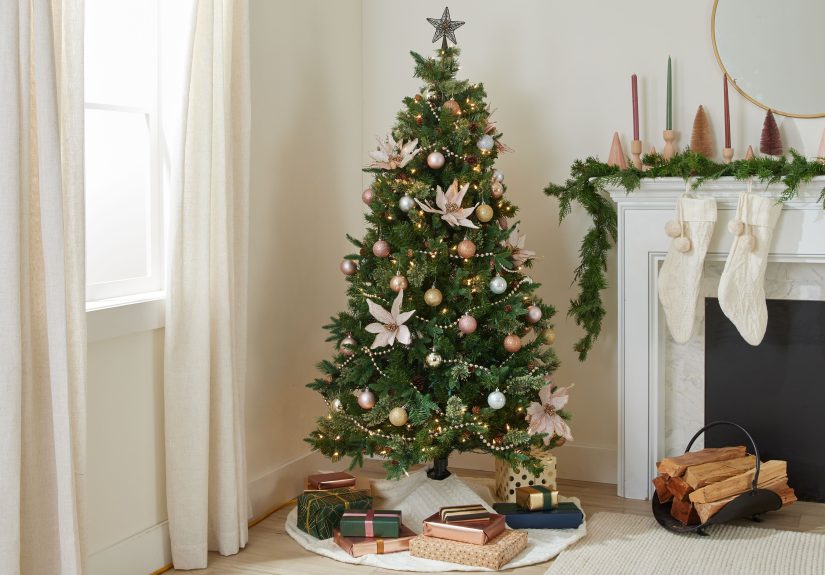
- Layered base: skirt + a few wrapped boxes or a basket for texture and height variation.
Final polish checklist
- Step back and check for “holes.” Fill with small ornaments or a couple of picks.
- Rotate a few ornaments so their best side faces outward.
- Make sure ribbon and garland have a consistent flowno random tight knots unless that’s your “vibe.”
- Take a photo. Your camera will show you what your eyes ignore after hour two.
Safety and Care (Because a Tree Should Sparkle, Not Scare You)
Quick safety basics
- Real trees: keep the stand filled with water and check daily, especially in the first days.
- Lights: use sets in good condition and avoid overloading outlets. Turn off lights when sleeping or leaving home.
- Placement: keep the tree away from open flames, heaters, and high-traffic areas where it can be knocked.
Troubleshooting: Fix Common Tree Problems Fast
“My tree looks flat.”
Add depth. Push some ornaments deeper inside, use picks to create layers, and make sure your lights aren’t only on the outer tips.
“It looks chaotic, not festive.”
Simplify your palette. Remove a competing color, choose one metal finish as dominant, and group similar ornaments together in small clusters. Chaos is just “maximalism” without a plan.
“The top looks sparse.”
Use smaller ornaments and shorter ribbon loops near the top. Add a light floral spray or a bow to visually widen the upper section.
“My ornaments keep falling.”
Use proper ornament hooks (they’re less slippery than random bits of string) and secure heavy ornaments closer to the trunk on stronger branches. If your tree is artificial, bend branches slightly upward to create a “shelf.”
Experience-Based Add-On: What Decorating a Tree Actually Feels Like
Let’s talk about the part of Christmas tree decorating that no one puts in the “perfect tree” photos: the real-life experience. The slightly sticky ribbon that refuses to behave. The one light strand that works only when you hold it at a specific angle like you’re negotiating with it. The moment you step back and think, “Wow, this looks amazing,” followed immediately by, “Why does the left side look like it’s going through something?”
First, the lights. If you’ve ever spent 20 minutes untangling a single strand while insisting you’re “totally fine,” you already know: the mood of the night is set by whether your lights cooperate. A good trick is to plug them in early and keep them lit while you work. It’s not just practical (you’ll spot dead sections instantly)it’s motivational. Something about twinkly lights makes even the most chaotic decorating session feel like a cozy movie montage, except you’re the main character and your villain is a knot the size of a tennis ball.
Next comes the ribbon phase, which is where many people discover that ribbon has… opinions. Wired ribbon is usually the friendliest because it holds shape, but even then, it can decide it wants to crease like an accordion if you look away. The experience-based solution is to stop trying to make every loop identical. The prettiest trees often have ribbon that looks organic and flowing, not like it was measured with a ruler. If a section looks awkward, tuck it deeper into the branches and let the tree “eat” the ribbon a littlethis creates depth and makes the ribbon look intentionally woven rather than simply draped.
Ornaments bring their own emotional arc. At the beginning, placing the first few ornaments feels ceremoniallike you’re starting the season with a tiny shiny promise. Then, halfway through, you enter the “distribution crisis,” where everything suddenly looks clumped on one side. This is when stepping back becomes your superpower. Walk to a different corner of the room. Take a phone photo. The camera will expose the truth. And once you see the truth, you can fix it by moving just a handful of ornaments rather than reshuffling the entire tree like you’re playing holiday chess.
The most meaningful experience, though, is how a tree turns into a timeline. The ornament from a first apartment. The kid-made one that is objectively lopsided but emotionally priceless. The souvenir ornament from a trip that went hilariously wrong. These pieces don’t always “match,” but they belong. A practical way to honor them while keeping the tree cohesive is to let your design elementslights, ribbon, picks, and a consistent metal finishbe the “glue.” When the foundation is unified, sentimental ornaments can shine without making the whole tree feel disjointed.
And finally, the finishing touches. This is where the tree becomes more than decorationit becomes a scene. A skirt or collar makes it feel grounded. A few wrapped boxes add color and height variation. And the topper? That’s the mic drop. If the topper leans a little, you’ll notice it forever, so don’t be shy about securing it. Nobody hands out medals for “balanced a star with pure hope.”
By the end, you might have glitter in places glitter should never be, and you might be mildly suspicious that ornaments reproduce when you aren’t looking. But you’ll also have something genuinely special: a tree that reflects your style, your people, and your seasonbuilt layer by layer, on purpose, with just enough humor to survive the process.
Conclusion
A beautifully decorated Christmas tree isn’t about buying more stuffit’s about building layers in the right order. Start with a fluffed, well-placed tree. Add lights for depth. Use ribbon and garland to create movement. Place picks and large ornaments first, then fill in with medium and small pieces for balance. Finish with a secure topper and a tidy base. The result is a tree that feels intentional, warm, and unmistakably yourseven if you decorated it while eating cookies off a paper plate.