Table of Contents >> Show >> Hide
- Why Move at All When You’re 28+ Weeks Pregnant?
- First, Get Cleared: When Exercise Needs a Doctor’s Green Light
- Third-Trimester Body Changes That Affect Your Workout
- The Gold-Standard Safety Rules for Third Trimester Exercise
- Best Exercises for the Third Trimester
- Walking (the underrated superhero)
- Swimming and water aerobics (a.k.a. the “gravity vacation”)
- Stationary bike or elliptical (stable cardio with adjustable effort)
- Prenatal yoga and mobility (with smart modifications)
- Strength training (yes, it can be safeand very helpful)
- Pelvic floor + deep core (stability, not crunches)
- Exercises and Situations to Avoid in the Third Trimester
- Smart Modifications for Common Third-Trimester Complaints
- A Simple, Safe Third-Trimester Workout Plan (Adjust as Needed)
- Frequently Asked Questions
- Conclusion
- Real-World Third-Trimester Exercise Experiences (Extra 500+ Words)
- Experience #1: “Walking used to be easy. Now it’s a whole production.”
- Experience #2: “I love strength training, but my core feels weird.”
- Experience #3: “Swimming feels like the only time my body says ‘thank you.’”
- Experience #4: “Some days I’m energized. Some days I’m a sleepy burrito.”
- Experience #5: “Pelvic floor stuff is confusing.”
Congratulationsyou’ve reached the third trimester, also known as “the home stretch,” “the waddle era,” and
“why does tying my shoes feel like an Olympic event?” Your body is doing something extraordinary, and that
doesn’t mean you have to stop moving. In fact, for most healthy pregnancies, staying active in the third
trimester can help you feel better, sleep a little more, and keep your strength for labor and postpartum life.
The goal of third trimester exercise isn’t to set a personal record. It’s to stay comfortable, capable, and calm
as your due date approacheswhile keeping safety front and center. Let’s talk about what to do, what to avoid,
and how to modify workouts so your body (and your baby) stay happy.
Why Move at All When You’re 28+ Weeks Pregnant?
“Because I should” is not a motivating answer. So here are better reasons. Regular, moderate physical activity
during pregnancy is associated with benefits like less back pain, healthier weight gain, and lower risk of
certain complications for many people. It can also help your mood and energytwo things that can feel like
limited-edition collectibles late in pregnancy.
- It supports your heart and lungs (you’re literally doing cardio 24/7 right now).
- It can ease common discomforts like back pain and constipation.
- It helps maintain strength for daily lifecarrying laundry counts as resistance training now.
- It supports mental health, which matters as much as physical comfort.
First, Get Cleared: When Exercise Needs a Doctor’s Green Light
Most people with uncomplicated pregnancies can continue or start gentle-to-moderate exercise. But some medical
conditions and pregnancy complications change the plan. If any of the following apply, talk with your OB/midwife
before exercisingor follow their specific restrictions.
Situations where your provider may restrict exercise
- Placenta previa after 26 weeks
- Cervical insufficiency/cerclage
- Pregnancy-induced high blood pressure or preeclampsia
- Preterm labor risk, ruptured membranes, or persistent bleeding
- Certain heart/lung disease, severe anemia, or other complications
- Multiple pregnancy with risk factors for preterm labor
Translation: if your pregnancy is high-risk, you might still be able to movebut the details should be customized.
This article is general education, not personal medical advice.
Third-Trimester Body Changes That Affect Your Workout
1) Your balance is… creatively different
Your center of gravity shifts forward, and that can increase fall risk. It’s not clumsinessit’s physics. This is
why third trimester workouts favor stable positions, controlled movement, and low fall risk activities.
2) Your joints may be looser
Pregnancy hormones can increase joint mobility. That’s helpful for birth, but it also means you may be more prone
to strains if you’re doing jerky, bouncy, or high-impact moves. Third trimester is the time for “smooth and steady,”
not “plyometrics and vibes.”
3) Breathing gets spicy
As your uterus grows, it can limit how freely your diaphragm moves. Feeling more winded doesn’t automatically mean
you’re out of shapeit often means you’re pregnant. This is why intensity cues like the “talk test” matter more than
chasing a heart-rate number.
4) Your core and pelvic floor are under real demand
Your abdominal wall is stretching, and your pelvic floor is supporting more load. Smart core training in the third
trimester focuses on stability, posture, breath coordination, and pelvic floor functionnot endless crunches.
The Gold-Standard Safety Rules for Third Trimester Exercise
Use the “talk test” (and stop trying to win cardio)
A practical guideline for moderate intensity: you should be able to talk in full sentences, but not sing your
entire karaoke set. If you can sing, it’s light intensity; if you can’t talk, it’s likely too hard for “most days”
in late pregnancy.
Aim for consistency over intensity
National guidelines commonly reference about 150 minutes per week of moderate-intensity aerobic activity,
which can be broken into smaller chunks (like 10–30 minutes at a time). If that sounds like a lot right now, start
smaller. “Some is better than none” is not a sloganit’s a strategy.
Hydrate, cool down, and snack like a pro
- Drink water before, during, and after exercise.
- Avoid very hot, humid conditions where overheating is easier.
- Have a small snack available if you tend to feel lightheaded.
- Wear supportive shoes and a supportive bra; consider a belly support band if it helps.
Avoid long periods flat on your back (and be mindful with “still standing”)
After the first trimester, prolonged exercises lying flat on your back can reduce blood flow for some people.
In the third trimester, choose side-lying, elevated, seated, hands-and-knees, or standing movements with breaks.
Also note: standing perfectly still for long periods can make some people feel faintgentle movement and breaks help.
Stop immediately if you notice warning signs
Call your healthcare team urgently if you have warning signs such as:
- Vaginal bleeding
- Fluid leaking (possible rupture of membranes)
- Dizziness or faintness
- Chest pain
- Shortness of breath before starting exercise (or severe shortness of breath during)
- Headache that’s severe or unusual
- Muscle weakness that affects balance
- Calf pain or swelling
- Regular, painful contractions
- Decreased fetal movement (follow your provider’s guidance on what’s concerning)
Best Exercises for the Third Trimester
The best third trimester workouts are typically low-impact, stable, and easy to scale. Here are the MVPs.
Walking (the underrated superhero)
Walking is simple, joint-friendly, and can be done almost anywhere. Make it easier with flatter routes, shorter
intervals, and supportive shoes. Want to level up without going harder? Add a posture check: shoulders relaxed,
ribs stacked over pelvis, gentle core engagement, and steady breathing.
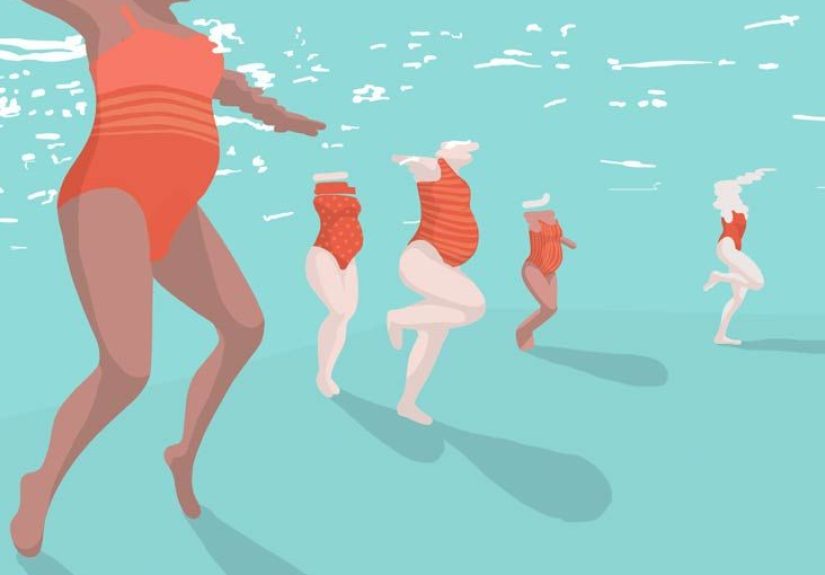
Swimming and water aerobics (a.k.a. the “gravity vacation”)
Water supports your weight and can reduce pressure on your back, pelvis, and knees. If you’re dealing with low back
discomfort, water workouts often feel dramatically better than land-based cardio.
Stationary bike or elliptical (stable cardio with adjustable effort)
If you previously biked outdoors, the third trimester is often a good time to switch to a stationary bike to lower
fall risk. Keep resistance moderate, avoid all-out intervals, and prioritize smooth cadence.
Prenatal yoga and mobility (with smart modifications)
Prenatal yoga can help with breathing, stress, and mobilityjust skip hot yoga and avoid deep twists that compress
your belly or aggressive backbends. Think “open and supported” rather than “pretzel audition.”
Strength training (yes, it can be safeand very helpful)
Strength work in late pregnancy is about function: legs for getting up and down, back for posture, and glutes for
pelvic support. Keep loads moderate, reps controlled, and breathing continuous (no breath-holding).
Third trimester-friendly strength moves:
- Supported squats (to a chair/bench)
- Hip hinges (light dumbbells or kettlebell, or even bodyweight)
- Step-ups (low step, hold a rail, go slow)
- Wall or incline push-ups
- Seated rows with a band
- Side-lying leg lifts or clamshells
- Farmer carries with light weights (great for posturewalk slowly)
Pelvic floor + deep core (stability, not crunches)
Instead of sit-ups, focus on breath-led deep core work: exhale gently as you exert, feel your ribs knit down,
and coordinate pelvic floor engagement (and relaxation). If you’re unsure whether to do Kegels, or if you have
pelvic pain or heaviness, a pelvic floor physical therapist can be incredibly helpful.
Safer core stability options:
- Bird-dog (hands and knees; small range is fine)
- Side plank modifications (knees down, short holds)
- Standing Pallof press with a band (anti-rotation)
- Seated pelvic tilts
- Cat-cow for mobility and breathing
Exercises and Situations to Avoid in the Third Trimester
Some activities are risky because of falls, abdominal impact, overheating, or pressure changes. Most guidelines
recommend avoiding:
- Contact sports or anything with abdominal impact risk (even “friendly” recreational leagues).
- High fall-risk activities like horseback riding, downhill skiing, gymnastics, or off-road cycling.
- Scuba diving (pressure changes can be dangerous for the fetus).
- Hot yoga/hot Pilates and vigorous exercise in very hot, humid weather.
- Prolonged flat-on-your-back exercises after the first trimester.
- Breath-holding during exertion (Valsalva), which increases intra-abdominal pressure.
- Jumping, jerky, high-impact moves if they worsen pelvic pain, leaking, or discomfort.
Smart Modifications for Common Third-Trimester Complaints
Low back pain
- Try water workouts, shorter walks, and gentle hip mobility.
- Strengthen glutes and upper back (bands are your friend).
- Use a belly support band if walking feels “pull-y.”
Pelvic girdle pain (SI joint/pubic pain)
- Reduce single-leg moves (deep lunges, big step-ups) if they flare symptoms.
- Keep steps shorter; choose symmetrical movements (supported squats, bridges with elevation, band work).
- Stop anything that causes sharp pelvic paindon’t “push through” this one.
Shortness of breath
- Switch to interval-style movement: 3–5 minutes easy, 1–2 minutes break.
- Use the talk test; keep intensity moderate.
- Choose upright positions and open your ribcage with posture cues.
Swelling and heaviness
- Try swimming, gentle cycling, or short walks split across the day.
- Add calf pumps and ankle circles during breaks.
- Prioritize cool environments and hydration.
Diastasis recti concerns (ab separation)
Some abdominal separation is common as pregnancy progresses. A simple rule: avoid moves that cause coning/doming
down the midline of your belly. Trade “crunching” for stability and breath coordination. If you’re unsure,
get guidance from a pelvic floor PT.
A Simple, Safe Third-Trimester Workout Plan (Adjust as Needed)
Here’s a sample week built for real life. Swap days, shorten sessions, or take extra rest whenever needed.
Your body isn’t “lazy”it’s busy building a human.
| Day | Workout | How It Should Feel |
|---|---|---|
| Mon | 20–30 min brisk walk + 5 min gentle stretching | Can talk in full sentences |
| Tue | 20 min strength (supported squats, rows, incline push-ups, clamshells) | Challenging but controlled; no breath-holding |
| Wed | Water aerobics or swimming 20–30 min | Light-to-moderate; joints feel relieved |
| Thu | Mobility + prenatal yoga 15–25 min | Looser, calmer; no belly compression |
| Fri | 20–30 min walk (split into two 10–15 min sessions if needed) | Steady; you finish feeling better than you started |
| Sat | 20 min strength + 5–10 min pelvic floor & deep core (bird-dog, Pallof press) | Stable; no doming; no pelvic pain spikes |
| Sun | Rest or easy stroll + breathing practice | Recovery day |
Frequently Asked Questions
Can I keep running in the third trimester?
If you were a runner before pregnancy and your provider says it’s okay, many people can continue running into the
third trimesteroften with modifications. Consider shorter runs, softer surfaces, walk/run intervals, and extra
attention to hydration and overheating. If you feel pelvic heaviness, leaking, sharp pain, or your gait changes a
lot, switching to walking, cycling, or swimming can be a smarter move.
Is it safe to lift weights while pregnant?
Strength training can be safe in uncomplicated pregnancies when done with good form, moderate loads, and steady breathing.
Avoid maximal lifts and breath-holding. Use machines, bands, and supported positions if balance feels shaky. The best
“pregnancy PR” is finishing your set thinking, “That was solid,” not, “I saw my life flash before my eyes.”
How late can I exercise?
Many people stay active right up until deliverysometimes even taking gentle walks during early labor (with provider guidance).
What matters most is how you feel and what your healthcare team recommends. If exercise helps you sleep and reduces stress,
it’s doing its job.
Should I stretch more in the third trimester?
Gentle stretching and mobility can feel great, but avoid forcing range of motionyour joints may already be looser.
Focus on controlled movement, breathing, and positions that feel supportive. If you feel pinching or instability, back off.
Conclusion
Safe third trimester exercise is less about “training harder” and more about “moving smarter.” Choose low-impact activities,
use the talk test to manage intensity, avoid high fall-risk and overheating, and respect the stop signs your body gives you.
With the right modifications, exercise in the third trimester can help you feel stronger, steadier, and more comfortableright
when comfort is a premium subscription.
If you want a gold-standard next step, consider a session with a certified prenatal trainer or a pelvic floor physical therapist.
A little personalized guidance can turn “Is this safe?” into “This feels amazing,” which is exactly the energy we want going into birth.
Real-World Third-Trimester Exercise Experiences (Extra 500+ Words)
The third trimester is where exercise gets intensely personal. Two people can follow the same prenatal workout video and have completely
different outcomesone feels refreshed, the other feels like their hips are negotiating a labor contract. Here are common experiences many
pregnant people report, plus what tends to help.
Experience #1: “Walking used to be easy. Now it’s a whole production.”
A lot of people notice their walking pace slows down in weeks 30–40. Not because they’re suddenly unmotivated, but because their stride changes,
their pelvis feels different, and they may get winded faster. What helps is treating walking like a flexible tool rather than a fixed workout.
One popular approach is the “micro-walk”: 10 minutes after breakfast, 10 minutes after lunch, 10 minutes after dinner. It often feels easier on
the body than one continuous 30-minute sessionand it still adds up.
Another trick is picking routes with built-in exits. A loop around the block feels safer than a straight-line trail where turning back would take
the same effort as continuing. Bonus points for choosing paths with benchesbecause sometimes your baby and your bladder team up for surprise
intermissions.
Experience #2: “I love strength training, but my core feels weird.”
This is extremely common. Late pregnancy is not the season for aggressive ab work. People often describe a “stretchy” or “unstable” feeling in
the midline of the belly, and some notice doming during movements like planks or sit-ups. The best shift is from “how do I work my abs?”
to “how do I create stability for my spine and pelvis?”
Many find that switching to anti-rotation exercises (like a standing band press), bird-dogs, and short side-plank holds gives a satisfying “core
workout” without the coning effect. And when lifting, exhaling through the hardest part of the movement helps avoid breath-holdingsomething that
can increase pressure through the abdomen and pelvic floor. People also tend to do better with slightly lighter weights and more rest between sets.
The win is finishing strong and steady, not shaky and strained.
Experience #3: “Swimming feels like the only time my body says ‘thank you.’”
Water workouts get rave reviews in the third trimester for a reason: buoyancy reduces joint pressure and often makes movement feel smooth again.
People who feel pelvic heaviness on land may feel relief in the pool. Even just walking in chest-deep water, doing gentle leg swings, or floating
while focusing on slow breathing can be a game-changer. It’s also one of the few places where “core engagement” doesn’t feel like you’re wrestling
a watermelon strapped to your torso.
Experience #4: “Some days I’m energized. Some days I’m a sleepy burrito.”
Third trimester fatigue is real, and it’s not a character flaw. A smart way to handle it is to have two workout plans:
Plan A (the normal day) and Plan B (the tired day). Plan B might be 8 minutes of mobility, a short walk to the end of the street,
or a few gentle exercises like clamshells and rows with a band. Many people find that doing “something small” maintains momentum without draining
their energy reserves. It also helps mentally: you still showed up for yourself.
Experience #5: “Pelvic floor stuff is confusing.”
Totally. Some people are told “do Kegels,” then discover they’re already tight and sore. Others leak with sneezing and assume they need to strengthen,
when they might also need relaxation and better coordination with breathing. A common “aha” moment is learning that pelvic floor health is not just
squeezingit’s the ability to contract and release. Many who see a pelvic floor PT say it’s like finally getting the instruction manual their body
deserved from the beginning. If you feel heaviness, persistent pain, significant leaking, or pressure that worsens with activity, getting help is
a practical, empowering move.
The big takeaway from real-world third trimester exercise experiences is this: your best workout is the one that leaves you feeling more capable
afterward. If you finish and think, “I could do life now,” that’s the sweet spot. If you finish and think, “I need to lie down and text everyone ‘goodbye,’”
that’s a sign to scale back, modify, or switch activities. Your body is already doing elite-level workyour exercise plan should support that, not compete with it.