Table of Contents >> Show >> Hide
- Why This Headline Actually Holds Up
- Why Aluminum Is a Great Candidate
- How 3D Printed Press Brake Dies Actually Work
- Where 3D Printed Dies Win Big
- Where Steel Still Dominates
- Design Tips for Bending Aluminum with Printed Dies
- Who Should Pay Attention to This Trend?
- The Bigger Manufacturing Lesson
- Experience From the Shop Floor: What This Looks Like in Real Life
- Conclusion
At first glance, the phrase Aluminum No Match For 3D Printed Press Brake Dies sounds like one of those internet headlines designed to make old-school machinists sigh into their coffee. Plastic tooling? On a press brake? Around sheet metal? Surely that ends with a loud crack, a flying chip, and someone saying, “Well, that was educational.”
But the reality is much more interesting. In the right application, 3D printed press brake dies are not a gimmick. They are a smart, fast, and surprisingly durable solution for low-volume work, custom bends, prototype parts, and short production runs, especially when the material being formed is aluminum. That last part matters. Aluminum is often more forgiving than harder, springier, higher-tonnage materials, and it also benefits from tooling that will not scar the surface like hardened steel can.
Does this mean every fab shop should throw its steel tooling into retirement and let polymer parts run the brake? Absolutely not. Steel tools still own the world of high-volume production, tight-tolerance repetition, and heavy-duty forming. But when a shop needs a one-off die, a custom radius, a quick setup for a prototype, or a mark-free forming solution, 3D printed tooling can be exactly the right answer. Think of it less as a replacement for traditional tooling and more as a specialized fast lane.
This is where the topic gets genuinely exciting. Additive manufacturing is changing the economics of tooling. Instead of waiting days or weeks for a custom die to be machined, a shop can design one in CAD, print it in-house or through a vendor, and test it almost immediately. That speed matters when the job is small, the geometry is odd, and the customer wants the impossible by Thursday.
Why This Headline Actually Holds Up
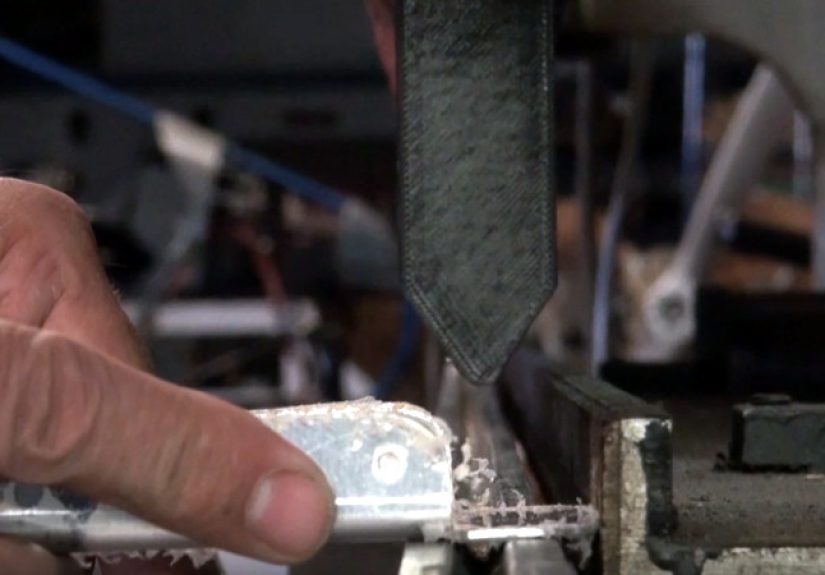
The idea caught attention because real-world examples proved it was not just theoretical shop talk. Makers and manufacturers showed that carefully designed 3D printed dies could bend aluminum repeatedly without instantly turning into expensive confetti. In one well-known example, a printed die was used to form hundreds of aluminum parts on a 20-ton brake with minimal visible wear. Even more interesting, the plastic tooling reduced surface marring compared with steel dies. That is not a small detail. For visible aluminum parts, cosmetics matter almost as much as geometry.
That success did not happen because plastic suddenly became stronger than steel. It happened because the application matched the material. The die geometry was right. The tolerances were right. The printed part had high infill and enough wall thickness to behave more like a dense engineering component than a flimsy desktop trinket. In manufacturing, that combination changes everything.
So no, aluminum is not literally helpless before 3D printed tooling. But for many low-volume bending tasks, it is absolutely fair to say aluminum is no match for a printed die that has been designed properly for the load path, the bend radius, and the number of hits required.
Why Aluminum Is a Great Candidate
Lower stress than tougher forming jobs
Aluminum is not always easy to bend. Some grades, especially 6061-T6, can be cranky and crack if the radius is too tight. But compared with many heavy-gauge steels or demanding long-run production jobs, aluminum forming can be an excellent place for additive tooling to shine. The forming loads are often manageable, especially on thinner stock and custom shapes where the goal is not brute-force output but fast, repeatable results.
Less surface damage
Traditional steel dies are durable, but they are not exactly known for tenderness. If the finish on the aluminum part matters, steel tooling can leave marks, scratches, and witness lines unless the process is carefully managed. Printed polymer dies offer a softer contact surface, which can reduce cosmetic damage. For decorative parts, visible enclosures, aircraft components, or customer-facing assemblies, that is a major advantage. Nobody wants a premium aluminum part that looks like it got dragged across a parking lot.
Custom geometry without custom-tooling pain
Aluminum parts often show up in short runs, prototype batches, and specialized products where paying for a machined custom die makes accountants break into a nervous sweat. Additive manufacturing changes that math. A printed die can be built for a specific bend profile, custom radius, or unusual flange shape without the cost and delay of conventional tooling. If the geometry changes, the tool changes with it. That is a lot easier to swallow than scrapping a freshly machined steel die because a design revision moved a bend line by 0.080 inches.
How 3D Printed Press Brake Dies Actually Work
The magic is not magic. It is design discipline.
A functional printed die for press brake work typically relies on a few core principles. First, the geometry must support compressive loading well. Second, the tool must be thick enough, dense enough, and oriented correctly for the job. Third, the forming task must stay within reasonable limits. Short runs, lighter gauges, moderate tonnage, and non-insane part geometry are where the method performs best.
Different additive processes can be used. FDM and composite-based printing are popular for robust shop tooling because they are accessible and cost-effective. SLA can also work well for precise forming tools, especially when geometry and surface finish matter. Material choice matters too: rigid engineering resins, carbon-fiber-filled nylons, and composite-reinforced polymers are common candidates depending on the required stiffness, impact resistance, and dimensional stability.
And then there is iteration, the superpower that traditional tooling cannot match on speed. If the bend opens too much, the radius is off, or the tool needs extra support around a feature, the designer can revise the CAD, reprint, and retest quickly. That turns tooling from a capital event into a design process. Shops that embrace this mindset stop asking, “Can we afford a custom die?” and start asking, “How many versions should we test today?”
Where 3D Printed Dies Win Big
Prototype and pre-production work
This is the clearest win. If a team is validating part geometry before full production, waiting for machined tooling can slow everything down. Printed dies let engineers check bend behavior, part fit, assembly relationships, and appearance much sooner. That means fewer expensive surprises later.
Short-run and custom jobs
Many shops live in a world of small-batch work: custom brackets, covers, guards, specialty housings, aerospace interiors, one-off machine components, and repair parts. For those jobs, steel tooling can be overkill. Printed tooling allows a shop to say yes to weird jobs without turning every quote into an emotional support exercise.
Faster lead times
Conventional custom press brake tooling can be expensive and slow, especially for small companies that outsource specialty machining. Printed tools cut that delay dramatically. Instead of waiting on outside suppliers, the shop can produce tooling in hours or days. That creates a powerful competitive edge, especially when customers are deciding between “We can start next month” and “We can test it this week.”
Lower tooling cost
Case studies in the additive manufacturing world have shown exactly why this matters. For custom press brake applications, printed tooling can slash upfront tooling cost and reduce lead time enough to make marginal jobs worthwhile. This is particularly important for small manufacturers, job shops, and product teams working in constant revision cycles. Cheap tooling is not always good tooling, but right-sized tooling for the job is a beautiful thing.
Digital inventory
One of the quiet advantages of additive tooling is that the “tool rack” can live partly in a folder. Instead of storing every uncommon tool physically, a shop can keep validated tool files and print them as needed. That reduces storage needs, simplifies replacement, and makes it easier to support legacy parts. If a customer returns two years later wanting fifteen more units, the answer can be, “Sure, let me open the file,” instead of, “I hope nobody used that die as a doorstop.”
Where Steel Still Dominates
Now for the important reality check. 3D printed press brake dies are impressive, but they are not invincible. Shops should not confuse successful short-run tooling with permission to ignore physics.
Steel remains the better choice for high-tonnage production, abrasive or difficult materials, very long runs, and jobs where wear resistance, extreme dimensional consistency, or heat tolerance are essential. If the application demands thousands upon thousands of hits, aggressive forming pressure, or highly repeated production across shifts, hardened tooling is still the grown-up in the room.
Printed dies also require thoughtful process limits. Use the wrong geometry, too little material, poor print orientation, or unrealistic expectations, and the result may be tool deformation, cracking, dimensional drift, or inconsistent bends. In other words, a 3D printer is not a machine for bypassing engineering. It is a machine for rewarding it.
Design Tips for Bending Aluminum with Printed Dies
Respect bend radius
Aluminum likes to remind designers that not every alloy is equally cooperative. Softer grades bend more easily, while 6061-T6 in particular can demand a larger inside radius to avoid cracking. If you are using printed tooling, the bend radius is not just a part-design issue; it is a tooling survival issue too. A generous, realistic radius reduces stress on both the part and the die.
Plan for springback
Aluminum springs back. That is one of its favorite hobbies. A successful printed die design accounts for this by adjusting punch and die geometry, test-bending sample pieces, and iterating until the final angle lands where it should. This is another reason additive tooling works so well in development: tweaking geometry is far faster than remachining steel.
Keep features away from bend lines
Holes, slots, and delicate features placed too close to bends can distort during forming. Standard sheet metal design guidance still applies. Printed tooling does not repeal the laws of deformation. It just gives you a faster way to build the tool. Smart part design, bend relief, and proper spacing are still essential if you want clean, repeatable results.
Use the right print strategy
For forming tools, walls, infill, material choice, and print orientation matter a lot. A tool meant for light shop duty should not be printed like a decorative pencil holder. Dense infill, strong outer walls, and support around stress concentrations are critical. In many cases, the best-performing tooling looks overbuilt on purpose. That is because it is.
Who Should Pay Attention to This Trend?
Small manufacturers should pay attention because 3D printed tooling lowers the barrier to custom work. Product designers should care because it speeds up prototyping and makes bend validation faster. Fabricators should care because it opens profitable opportunities in low-volume jobs. And engineers should care because it proves that tooling is no longer limited to whatever the machine shop can squeeze into its calendar.
The companies seeing the greatest value are usually not trying to replace every steel die in the building. They are using additive manufacturing strategically: for odd shapes, low quantities, special surfaces, quick experiments, and short lead-time requests. In other words, they are using it where flexibility matters more than brute durability.
The Bigger Manufacturing Lesson
The real story behind Aluminum No Match For 3D Printed Press Brake Dies is not that plastic beat metal in some dramatic cage match. The deeper lesson is that tooling is becoming digital, responsive, and application-specific.
For decades, custom tooling often meant delay, cost, and commitment. Additive manufacturing turns that on its head. Now a shop can create custom tooling faster, test ideas sooner, protect delicate surfaces more easily, and support low-volume production without massive overhead. That is not just a neat trick. It is a serious business advantage.
And aluminum is the perfect demonstration material because it lives at the intersection of light weight, practical forming loads, finish sensitivity, and frequent custom use. When a printed die works on aluminum, it proves that additive tooling has graduated from novelty to real shop-floor utility.
Experience From the Shop Floor: What This Looks Like in Real Life
If you spend enough time around fabrication shops, you learn that the best ideas do not always arrive wearing a tie and carrying a PowerPoint deck. Sometimes they show up because a deadline is ugly, the budget is uglier, and nobody wants to order a $1,500 custom tool for a batch of twenty-seven parts. That is where 3D printed press brake dies earn their keep.
A common first reaction is skepticism. The brake operator looks at the printed die, looks at the aluminum blank, then looks at the engineer with the kind of expression usually reserved for people who say things like, “I watched one video, so I think I can rewire the building.” But after a few test bends, attitudes tend to change. The first surprise is that the tool often survives just fine. The second surprise is that the aluminum surface can come out cleaner than expected. The third surprise is that the team immediately starts thinking of five more jobs where this could help.
In practical terms, the biggest benefit is not raw strength. It is speed. A shop can model a custom radius tool, print it overnight, and test it the next morning. If the bend opens too much, revise the file. If the flange is slightly off, revise the file. If the backstop needs a tweak, revise the file. That loop is much faster and cheaper than ordering steel, waiting on machining, and hoping version one is somehow perfect because the schedule says it should be.
Another real-world advantage is confidence during quoting. Short-run aluminum jobs used to be annoying because the tooling cost could wreck the economics before the first part was even formed. With additive tooling, a shop can quote custom work more aggressively. The job no longer has to carry the emotional baggage of expensive conventional tooling. That can be the difference between winning a niche order and politely watching it disappear.
There is also a morale angle that rarely gets discussed. People like solving problems with tools they control. When the design team, brake operator, and manufacturing engineer can all participate in improving a tool within a day, the process feels collaborative rather than bureaucratic. The printer becomes less of a prototype toy and more of a practical manufacturing asset. That shift matters because once the shop trusts the method, new use cases appear quickly: custom fingers, soft-contact supports, prototype form tools, specialty fixtures, and oddball aids for jobs that used to require a shrug and a workaround.
Of course, experience also teaches humility. Push a printed die too far, run the wrong alloy, underestimate springback, or ignore feature spacing, and the process will remind you that enthusiasm is not a mechanical property. The shops that succeed with 3D printed press brake dies are not the ones pretending printed tooling is magic. They are the ones treating it like engineered tooling with clear boundaries.
That is probably the best way to understand the whole topic. In the right lane, printed dies are fantastic. They save time, lower cost, reduce marring, and unlock custom aluminum forming jobs that would otherwise feel annoying or overpriced. In the wrong lane, they are a shortcut to disappointment. Used wisely, though, they are not just good enough. They are often the smartest option in the building.
Conclusion
So, is aluminum really no match for 3D printed press brake dies? In the right circumstances, yes. For short runs, custom bends, prototype work, and mark-sensitive aluminum parts, printed tooling can perform far better than many people expect. It can be cheaper, faster, easier to revise, and gentler on finished surfaces than traditional steel tooling.
But the smartest takeaway is not hype. It is fit. 3D printed dies are a powerful tool when matched to the correct material, geometry, tonnage, and production volume. They do not replace hardened steel across the board. They expand what a modern fab shop can do without waiting, overspending, or overcommitting.
That is the real breakthrough. The future of bending is not steel or plastic. It is knowing exactly when to use each.