Table of Contents >> Show >> Hide
- What Is an Antique Irish Potato Masher?
- Why Potatoes Matter So Much in Irish Kitchen History
- Common Types of Antique Potato Mashers
- How to Identify a Real Antique Irish Potato Masher
- What Makes an Antique Potato Masher Valuable?
- How to Date an Antique Irish Potato Masher
- Antique Irish Potato Masher vs. Vintage Potato Masher
- Decorating With Antique Potato Mashers
- Can You Still Use an Antique Potato Masher?
- How to Clean and Preserve an Antique Potato Masher
- Where to Find Antique Irish Potato Mashers
- Buying Checklist for Collectors
- Why Antique Kitchen Tools Still Feel Special
- Experiences and Stories Connected to Antique Irish Potato Mashers
- Conclusion: A Small Tool With a Big Kitchen Soul
At first glance, an antique Irish potato masher may look like the quietest object in the kitchen: a wooden handle, a worn metal head, maybe a few honest scratches, and absolutely no Wi-Fi connection. But give it a second look. This humble tool carries the story of Irish cooking, farmhouse kitchens, handmade utensils, family meals, and the long love affair between potatoes and people who knew how to turn simple food into comfort.
Unlike today’s sleek stainless-steel mashers with ergonomic grips and branding polished enough to join a tech startup, old Irish potato mashers were built for work. They were practical, sturdy, and often charmingly imperfect. Some were made entirely of wood, shaped like a short pestle or pounder. Others had wooden handles attached to wire loops, perforated metal plates, or coiled heads designed to crush boiled potatoes without turning dinner into glue. Their job was simple: mash the potatoes, feed the family, and survive another generation in the kitchen drawer.
For collectors, decorators, food-history lovers, and anyone who has ever stared at a rustic kitchen wall and thought, “This needs one more thing that looks like it belonged to someone’s great-grandmother,” antique potato mashers are surprisingly fascinating. They are not just kitchen tools. They are small domestic artifacts that reveal how people cooked before electric mixers, food processors, and recipe videos with dramatic overhead lighting.
What Is an Antique Irish Potato Masher?
An antique Irish potato masher is an older hand tool used to crush cooked potatoes into a soft, textured mash. The “Irish” part may refer to its origin, its association with Irish cooking, or its design tradition linked to rural kitchens where potatoes were a daily staple. Because potatoes were central to Irish food culture for centuries, a masher was not a novelty gadget. It was a hardworking kitchen essential, right up there with the pot, the wooden spoon, and the person saying, “Just one more knob of butter.”
Traditional mashers came in several forms. A simple wooden masher often resembled a pestle with a rounded or flattened end. It could be used in a bowl, crock, or pot. Wire mashers became common later and usually featured a wooden handle with a zigzag, coil, or looped metal head. Perforated plate mashers had a flat disc with holes that pushed soft potatoes through the openings, creating a smoother result. Each design reflected the available materials, local craftsmanship, and the cook’s preference for either rustic texture or smoother mashed potatoes.
Why Potatoes Matter So Much in Irish Kitchen History
To understand why an old potato masher matters, you need to understand the potato’s role in Irish life. The potato became deeply important in Ireland because it was filling, nutritious, relatively easy to grow, and capable of producing a generous crop on small plots of land. In rural households, especially among poorer families, potatoes were not just a side dish. They were often the center of the meal.
This history is also tied to tragedy. During the Great Famine of the mid-19th century, potato blight destroyed crops over successive years, causing hunger, death, and mass emigration. That painful history gives Irish potato tools a deeper emotional context. A masher is not a famine artifact by default, and collectors should be careful not to exaggerate claims without proof. Still, the object belongs to a larger story in which potatoes shaped Irish cooking, migration, memory, and identity.
In everyday life, mashed potatoes were not fancy food. They were practical comfort. They could be served with butter, milk, onions, cabbage, or whatever the household had available. Dishes such as colcannon and champ are famous examples of Irish potato cooking, turning basic ingredients into something warm, satisfying, and deeply human. A masher was the tool that helped make that transformation happen.
Common Types of Antique Potato Mashers
Wooden Potato Mashers
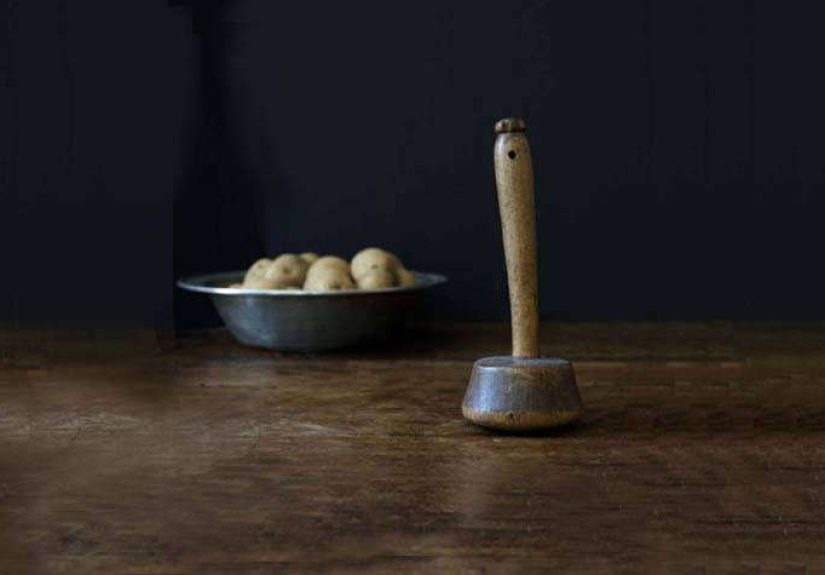
Wooden mashers are among the most primitive and visually appealing types. Many were hand-turned from hardwoods such as ash, beech, maple, or oak. Some have smooth handles and rounded heads; others are chunkier, with flat bases for pounding. Their beauty often lies in their wear. A well-used wooden masher develops a patina that cannot be faked easily. It may have darkened areas from handling, slight dents, softened edges, or tiny marks from decades of kitchen duty.
Collectors often love wooden mashers because they look wonderful in farmhouse kitchens. Hung on a wall or displayed in an open crock, they add warmth instantly. They whisper, “Someone once made dinner with this,” which is much nicer than a modern appliance whispering, “Please download the firmware update.”
Wire Potato Mashers
Wire potato mashers usually have a wooden handle and a metal wire head shaped into loops, waves, coils, or zigzags. These became popular because they were efficient, lightweight, and easier to clean than some solid wooden forms. The wire allowed potatoes to break apart without trapping too much food, and the springy structure helped mash soft vegetables quickly.
Antique wire mashers are common in vintage kitchen collections. Look for twisted wire construction, old solder joints, natural handle wear, and signs that the tool was made before mass-produced plastic handles took over the world like a very boring villain.
Perforated Plate Mashers
A perforated plate masher has a flat metal disc punched with holes. The disc is attached to a handle, often by metal rods or brackets. When pressed into cooked potatoes, the food moves through the holes and breaks down evenly. This type can create a smoother mash than a simple wire masher.
These mashers are popular with collectors because they have a strong visual shape and a clear functional design. They may show darkened metal, light oxidation, or a worn wooden grip. If the holes are uneven or the metal looks hand-finished, the piece may have extra character, though not always extra value.
Ricers and Press-Style Mashers
Although a potato ricer is technically different from a masher, antique sellers sometimes group them together. A ricer forces cooked potatoes through small holes, producing a light, fluffy texture. Old ricers may be made of cast iron, tin-plated metal, aluminum, or early steel. They are interesting collectibles, but they should be evaluated separately from hand mashers because their construction, use, and cleaning needs differ.
How to Identify a Real Antique Irish Potato Masher
Identifying an antique Irish potato masher takes patience. The first rule is simple: do not believe every label. Online listings may use words like “Irish,” “Victorian,” “primitive,” “farmhouse,” and “rare” with the enthusiasm of a toddler holding a sticker sheet. Some listings are accurate. Others are decorative guesses.
Start with the materials. Older mashers often use wood, iron, steel, tin-plated metal, or early stainless steel. Handles may be turned wood rather than molded plastic. Natural darkening, worn finish, and smooth hand-contact areas can suggest age. However, age alone does not prove Irish origin.
Next, examine construction. Handmade wooden mashers may show tool marks, slight asymmetry, and natural variation. Wire mashers may have twisted or bent metal joined to the handle with a ferrule or inserted through drilled holes. Plate mashers may show older punching methods or less uniform machining than modern pieces.
Maker’s marks can help, but many kitchen utensils were unmarked. If a piece has a stamped brand, patent number, country mark, or manufacturer name, research it carefully. A mark reading “Made in Ireland” is useful, but even that does not always mean the tool is very old. The strongest identification comes from a combination of age, construction, provenance, and documentation.
What Makes an Antique Potato Masher Valuable?
Most antique potato mashers are affordable collectibles, not retirement plans with handles. Their value depends on age, rarity, condition, material, provenance, design, and decorative appeal. A common wire masher with a worn wood handle may sell modestly. A 19th-century treen masher with beautiful patina, strong form, and credible provenance may command more interest.
Condition matters, but perfection is not always the goal. Collectors like honest wear. A little patina can make a tool more attractive because it shows age and use. Heavy rust, cracks, loose handles, active woodworm, sharp breaks, or suspicious repairs can reduce value. On the other hand, a well-preserved masher that still has its original finish, shape, and hardware may be especially desirable.
Design also plays a role. Unusual shapes, large farmhouse examples, hand-turned wooden pieces, and mashers connected to regional traditions may stand out. Display value is important too. A masher with a pleasing silhouette and warm wood grain may appeal to decorators even if it is not rare in the strict antique-market sense.
How to Date an Antique Irish Potato Masher
Dating an antique masher is more art than math. There is rarely a tiny kitchen ghost whispering, “I was made in 1887.” Instead, you evaluate clues. Wooden treen mashers with hand-turned forms may date to the 19th century or earlier, depending on style and provenance. Wire-handled and metal-head mashers became common from the late 19th century into the early and mid-20th century. Painted wooden handles, especially in red, green, cream, or black, often suggest early-to-mid-20th-century kitchenware, though there are exceptions.
Look at wear patterns. A true old handle often feels softened where fingers held it repeatedly. A newer reproduction may look aged but lack natural smoothing in the right places. Metal patina should appear consistent with age and use. Artificial distressing may look too even, too dramatic, or oddly fashionable, as if the masher recently attended a farmhouse decor photoshoot.
Provenance is valuable. If a family can trace the masher to an Irish household, an immigrant kitchen, or a specific farm, that story matters. Written notes, estate records, old photographs, or purchase receipts strengthen the case. Without provenance, it is safer to describe the piece as “antique-style,” “possibly Irish,” or “associated with Irish farmhouse cooking” rather than making bold claims.
Antique Irish Potato Masher vs. Vintage Potato Masher
The terms “antique” and “vintage” are often used casually, but they are not the same. In common collecting language, an antique is usually around 100 years old or older. Vintage generally refers to items from a previous era, often at least 20 to 30 years old, but not necessarily a century old. That means a potato masher from the 1920s may be antique or nearly antique, while one from the 1950s is better described as vintage.
This distinction matters for buyers and sellers. Calling a mid-century masher “antique” may attract attention, but it can also disappoint informed collectors. Accurate descriptions build trust. A “vintage wire potato masher with wooden handle, circa 1940s” sounds less dramatic than “rare antique Irish farmhouse masher of mysterious legend,” but it is much more believable.
Decorating With Antique Potato Mashers
Antique potato mashers are perfect for rustic and farmhouse decor because they are small, sculptural, and easy to display. A wooden masher can sit in a crock with rolling pins and wooden spoons. A wire masher can hang from a peg rail. Several mashers grouped together can create a charming kitchen wall display that says, “This home respects carbs.”
They also work well in Irish-themed kitchens, cottage interiors, antique booths, restaurants, and food-history displays. Pair them with old cutting boards, stoneware bowls, linen towels, copper pots, or framed recipe cards. The key is balance. One antique masher looks intentional. Thirty-seven mashers may suggest you are preparing for a potato emergency of historic proportions.
Can You Still Use an Antique Potato Masher?
Some antique mashers can still function, but caution is wise. Before using any old kitchen tool with food, inspect it carefully. Avoid using pieces with flaking paint, unknown coatings, rust, cracks, loose parts, or suspicious residues. Old painted handles may contain lead-based paint, and old metal may not meet modern food-safety expectations.
If you want the antique look but modern safety, use a new stainless-steel masher with a wooden handle for cooking and keep the antique one for display. That way, your mashed potatoes remain delicious, and your collectible does not have to survive Thanksgiving like a gladiator in an apron.
How to Clean and Preserve an Antique Potato Masher
Cleaning should be gentle. Do not throw an antique masher into the dishwasher. Dishwashers are wonderful for modern plates and deeply rude to old wood. For a wooden masher, wipe with a soft cloth. If necessary, use a slightly damp cloth and dry immediately. Avoid soaking, harsh soap, bleach, or abrasive pads.
For metal parts, remove loose dirt with a dry brush or cloth. Light surface rust may be stabilized carefully, but aggressive polishing can erase patina and reduce character. If the item is valuable, consult an antiques professional before attempting restoration. In many cases, preservation is better than making it look new. A potato masher with 100 years of honest wear should not be polished into looking like it came from a mall kitchen aisle yesterday.
Store the masher in a dry place away from extreme humidity. Wood expands and contracts with moisture, and metal can corrode. If displaying it on a wall, make sure it is supported properly and not hanging by a fragile old joint.
Where to Find Antique Irish Potato Mashers
You may find antique or vintage potato mashers at estate sales, antique malls, flea markets, farm auctions, online marketplaces, and specialty antique kitchenware shops. Irish examples may appear in estate collections, immigrant family items, or sellers specializing in European and farmhouse antiques. Because many mashers were ordinary household tools, they often survive without labels or paperwork.
When buying online, study photos closely. Ask for measurements, close-ups of the handle, metal head, joints, and any markings. Be cautious with vague descriptions. A seller may call a piece “Irish” because it is a potato masher, not because it was made or used in Ireland. That is like calling every teapot British and every spaghetti fork Italian. Charming, perhaps. Accurate, not always.
Buying Checklist for Collectors
Before buying an antique Irish potato masher, ask yourself a few practical questions. Is the piece structurally sound? Does the wear look natural? Is there any evidence of origin? Are there cracks, repairs, rust, or replaced parts? Does the seller provide clear photos? Is the price reasonable compared with similar examples?
If the masher is expensive, provenance becomes more important. For ordinary decorative pieces, personal taste matters most. If you love the shape, patina, and story, that may be enough. Not every collectible needs to come with a museum label and a dramatic violin soundtrack.
Why Antique Kitchen Tools Still Feel Special
Old kitchen tools connect us to a kind of cooking that was slower, more physical, and more personal. An antique Irish potato masher reminds us that food was once prepared with simple tools and strong hands. There was no button for “perfect mash.” There was boiling, draining, pressing, stirring, tasting, and adjusting. Maybe there was butter. Hopefully there was butter.
These tools also carry emotional weight. They may remind people of grandparents, holiday meals, rural kitchens, or family recipes that were never written down because someone always said, “You just know when it’s right.” A masher is ordinary, but that is exactly why it matters. It belonged to daily life, not special occasions. It helped make the food people actually ate.
Experiences and Stories Connected to Antique Irish Potato Mashers
One of the best things about an antique Irish potato masher is that it invites stories. Imagine finding one at an estate sale in a cardboard box labeled “kitchen stuff.” It is wedged between a tarnished ladle and a rolling pin that looks like it has settled several family arguments. You pick up the masher, feel the smooth handle, and notice how the metal has darkened with age. It is not flashy. It does not sparkle. But it has presence. Suddenly, it is not just a utensil. It is a tiny time machine with a handle.
Collectors often describe the same experience: the moment an old kitchen tool feels personal. You may not know who used it, but you can imagine the rhythm. Potatoes boiling on a stove. Steam clouding the window. A bowl on the table. Someone pressing down with the masher, adding milk, butter, salt, maybe scallions or cabbage. The sound would have been soft and practical: press, turn, scrape, repeat. No drama, unless someone forgot the gravy.
In Irish-American families, objects like potato mashers can become symbols of continuity. Even when families moved across oceans, cooking habits traveled with them. A potato dish could make a new place feel a little more like home. A masher in the drawer was not fancy, but it was useful, familiar, and dependable. It helped turn inexpensive ingredients into meals that could feed many people. That kind of usefulness has its own quiet dignity.
There is also humor in these old tools. Anyone who has tried to use a flimsy modern masher on undercooked potatoes knows the feeling of immediate regret. The handle bends, the potatoes refuse to cooperate, and dinner becomes an upper-body workout. A sturdy antique masher, by contrast, often feels refreshingly direct. It does one thing. It does not apologize. It does not come with an app. It simply mashes.
Decorators have their own relationship with these pieces. A single antique potato masher hanging beside a breadboard can make a kitchen feel lived-in, even if the most complicated thing cooked there last week was toast. In a farmhouse-style space, it adds authenticity because it was never designed as decor. It became beautiful through use. That is the charm: function first, beauty later.
For writers, food bloggers, and history lovers, an antique Irish potato masher is a reminder that small objects can hold big themes. It touches agriculture, migration, hunger, comfort, craft, family, and memory. It also touches mashed potatoes, which may not be academically grand but are emotionally undefeated. You can analyze food history all day, but at some point someone will ask, “Are we eating or just discussing tubers?” The masher brings the conversation back to the table.
If you own one, consider recording its story. Where did it come from? Who owned it? Was it inherited, purchased, or discovered? Even if the history is incomplete, write down what you know. Future collectors appreciate details, and family members may value the memory more than the market price. An old masher may never be the most expensive item in the house, but it might be one of the most human.
Conclusion: A Small Tool With a Big Kitchen Soul
An antique Irish potato masher is more than an old utensil. It is a piece of domestic history shaped by practical cooking, potato culture, Irish tradition, and the everyday labor of feeding people. Whether it is a hand-turned wooden masher, a wire-loop design, or a perforated metal plate with a worn handle, it tells a story of simple meals made with care.
For collectors, it offers charm and affordability. For decorators, it brings warmth and farmhouse character. For food-history fans, it opens a door into the relationship between potatoes and Irish life. And for anyone who loves old things, it proves that beauty does not always arrive polished and perfect. Sometimes it arrives with dents, patina, and a strong suspicion that it once handled ten pounds of potatoes without complaining.
Note: This article is written for informational and editorial use, based on real culinary-history, museum, antique-market, and kitchenware references. Antique items should be evaluated individually for age, origin, condition, safety, and provenance before purchase or food use.