Table of Contents >> Show >> Hide
- What a Bubble Display Actually Is
- Why Resolution Matters in Bubble Displays
- From Chunky Tubes to Photo-Like Bubble Rasters
- The Engineering Tricks Behind Higher Resolution
- Electrolysis Bubble Displays: Resolution Gets More Serious
- Volumetric Bubble Displays: When Resolution Goes 3D
- Why Bubble Display Resolution Is Improving Now
- Where Bubble Displays Could Go Next
- What the Increasing Resolution Really Means
- Experiences Related to “Bubble Displays Are Increasing In Resolution”
- Conclusion
Most people hear the word display and think of OLED TVs, phone screens, or the giant monitor that silently judges how many tabs you have open. Bubble displays are different. They turn air, liquid, timing, light, and a little engineering stubbornness into images. Instead of glowing pixels trapped behind glass, these systems use real bubbles as visual elements. Sometimes the bubbles rise through tubes. Sometimes they gather on the surface of liquid through electrolysis. In the most advanced versions, tiny bubbles are formed inside liquid and used like three-dimensional voxels. It is weird, beautiful, slightly theatrical, and increasingly sharp.
The big story is not just that bubble displays still exist. It is that they are getting better at resolution. That means more visible detail, finer control, better grayscale, cleaner shapes, and in some cases a move from flat imagery to volumetric graphics. Bubble displays are no longer just novelty machines that cough out chunky dots like a cheerful robot from 1998. They are becoming more precise, more expressive, and much more interesting to designers, artists, researchers, and anyone who appreciates the phrase “liquid pixels.”
What a Bubble Display Actually Is
At the simplest level, a bubble display uses bubbles as image elements. In classic tube-based systems, each vertical tube acts like a column of pixels. A controller releases air at the bottom, and the bubbles rise through liquid. If the release timing is accurate, the display can create letters, symbols, and even photo-like patterns. Think of it as a scrolling bitmap where buoyancy does the heavy lifting.
That basic idea has been around for years in ambient computing and kinetic art. Early systems proved that small black-and-white images could be rendered by controlling bubble release in water-filled tubes. Later installations pushed the format further with more tubes, better timing, richer lighting, and improved fluid choices. The result was a steady march upward in image quality. Not exactly Moore’s Law, but certainly more fun to look at.
Why Resolution Matters in Bubble Displays
With conventional screens, resolution is easy to understand: more pixels usually means more detail. Bubble displays work by the same principle, but with extra complications. A bubble is not a neat square. It stretches, rises, wobbles, merges, drifts, and occasionally behaves like it has artistic opinions. So increasing resolution in a bubble display is not just a matter of adding more image elements. It also requires better control over when a bubble appears, where it travels, how large it looks, and how consistently it can be repeated.
In other words, bubble display resolution has several layers:
Spatial Resolution
This is the obvious one: more tubes, more electrodes, or more bubble-generation points. A 16-column display looks charmingly primitive. A 96-column display starts to resemble real raster imagery.
Temporal Resolution
Because many bubble displays create images over time, timing becomes part of the image. If the controller can release bubbles at finer intervals, the display gains more vertical detail and smoother motion.
Grayscale and Tonal Resolution
Some newer systems are not limited to simple on-or-off dots. By varying bubble density, bubble clusters, or current duration, developers can create multiple brightness levels. That turns a binary novelty into something closer to an actual image engine.
Volumetric Resolution
Once researchers began generating microbubbles inside a liquid volume, the conversation changed. Now the image elements are not just pixels on a surface. They are voxels suspended in space. That means resolution can expand into three dimensions, which is where bubble displays stop being quirky and start sounding like science fiction with a lab budget.
From Chunky Tubes to Photo-Like Bubble Rasters
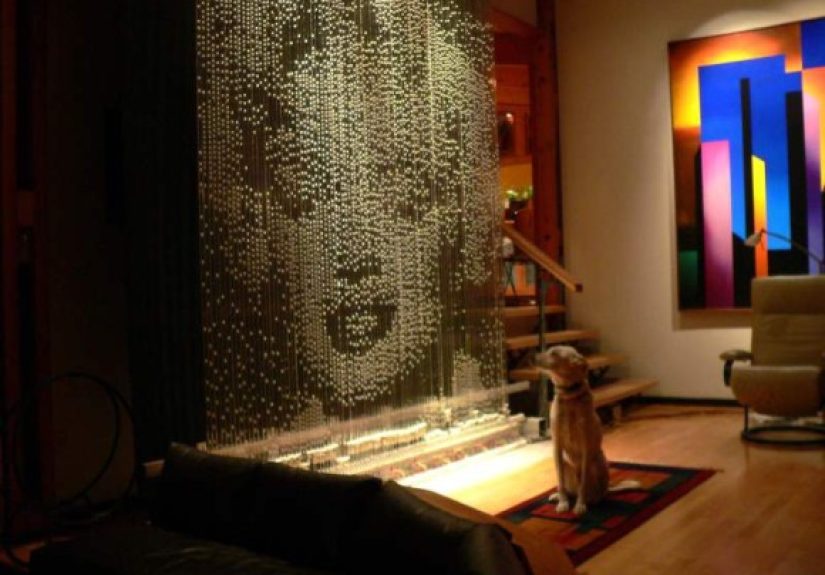
One of the clearest examples of rising resolution comes from tube-based art installations. A well-known development path moved from early 16-tube designs to 32-tube systems and eventually to 96-tube installations capable of displaying recognizable raster images. That progression tells the whole story. More columns meant more horizontal detail. Smaller tubes and better timing meant finer structure. More mature control software meant better synchronization. Suddenly, the machine was not just making patterns. It was making images that people could actually identify without squinting and pretending to be supportive.
Another DIY-style build reached 60 tubes and added RGB lighting. That matters because resolution is not only about geometry. Lighting affects edge clarity, contrast, and perceived sharpness. A bubble image with poor illumination can look muddy even if the mechanics are solid. Add distributed RGB LEDs, and the same bubble matrix starts to feel more deliberate and polished.
These tube systems also taught engineers a practical lesson: fluid choice changes everything. Water can make bubbles rise too fast and break into messy shapes. More viscous liquids can slow the motion, round the bubbles, and improve positional control. When the medium cooperates, the display becomes more legible. In display terms, that is not a side detail. That is image quality.
The Engineering Tricks Behind Higher Resolution
Bubble displays are improving because nearly every part of the stack is improving. The plumbing got smarter. The electronics got cheaper. The software got better. And the people building these things became less interested in “can this work?” and more interested in “how far can we push it?”
Denser Hardware Arrays
More channels mean more detail. In tube systems, that means more tubes, pumps, valves, or nozzles packed into a display area. In electrolysis systems, it means denser electrode matrices. Once an engineer can address a larger number of controlled points reliably, resolution naturally climbs.
Better Control Electronics
Microcontrollers, shift registers, drivers, and custom software make it possible to control dozens of channels with precise timing. One university prototype tackled the problem of independently manipulating 64 pumps, then solved output limitations through smarter electronics instead of brute force. That sort of control architecture is exactly what turns a bubble display from a classroom experiment into a scalable platform.
Improved Bubble Behavior
Higher resolution is impossible if every pixel behaves differently. Builders have learned to tune bubble size, release rate, tube geometry, and liquid viscosity so the display behaves more predictably. That improves repeatability, which is the unglamorous hero of every visual technology ever invented.
Smarter Image Processing
A bubble display rarely shows an image directly. The image usually needs to be converted into a form the hardware can physically render. That means dithering, thresholding, timing maps, grayscale strategies, and motion compensation. As software improves, bubble displays can translate source images into cleaner outputs. The display may still be mechanical and wet, but the brains behind it are very digital.
Electrolysis Bubble Displays: Resolution Gets More Serious
Tube displays are visually charming, but they are not the only path forward. Electrolysis bubble displays represent a major leap because they generate bubbles at electrode sites instead of depending on external air injection. That reduces the need for bulky moving parts and opens the door to denser, cheaper arrays.
One example is a cup-like liquid-surface display known as BubBowl, which demonstrated a 10×10 pixel pattern using bubble clusters on the surface of a drink. On paper, 10×10 does not sound like a resolution revolution. In context, it absolutely is. The key idea is scalability. Researchers showed that higher-resolution versions could be achieved simply by increasing the density of the matrix electrodes on a printed circuit board. That is a big shift from classic systems where every new column can mean more mechanical complexity.
Then came Bubble Mirror, which pushed the concept much further. This system used a 32×32 electrode array to display a visitor’s face using electrolysis bubbles, bringing the total to 1,024 pixels. Even more importantly, it introduced grayscale levels rather than sticking to pure binary output. That may be the moment bubble displays officially graduated from “look, it spells a word” to “look, it is making an image with tone.”
This matters because once grayscale enters the picture, perceived resolution improves dramatically. Human vision reads tonal transitions as detail. Add multiple brightness levels, and a bubble image stops looking like a matrix sign and starts behaving more like a low-resolution photograph. That is a huge psychological jump in perceived quality.
Volumetric Bubble Displays: When Resolution Goes 3D
Now for the part that sounds like it escaped from a future museum exhibit. Researchers have demonstrated volumetric bubble displays that generate microbubbles inside liquid using focused femtosecond laser pulses. These microbubbles act as voxels, not just pixels. Instead of rendering an image on a plane, the system can form graphics in a volume that viewers can observe from different directions.
That shift turns the resolution conversation inside out. The question is no longer just how many columns or surface points can be addressed. It becomes how precisely the system can place scattering points in three-dimensional space, how many can be generated, how bright they appear, and how quickly the image can be refreshed.
Researchers improved this approach by using computer-generated holograms to create 3D patterns of laser light, which helped control microbubble number and shape while increasing brightness. They also used high-viscosity liquid to keep the bubbles from immediately racing upward and ruining the image like impatient swimmers leaving the pool early. The prototypes demonstrated 2D and 3D graphics, color changes through illumination, and proof-of-concept volumetric imagery that points toward richer future systems.
At this stage, volumetric bubble displays are still more lab-and-museum than living-room-and-gaming-chair. They remain large, expensive, and technically demanding. But the direction is clear: bubble displays are no longer confined to flat novelty panels. They are entering the territory of true spatial imaging.
Why Bubble Display Resolution Is Improving Now
Several trends are colliding at the right time. Cheap embedded control has made channel management easier. Better fabrication methods allow denser arrays. Artists and interaction designers want physical displays that feel less sterile than flat screens. Meanwhile, optics research continues to improve how light, liquid, and tiny scattering elements can work together. Bubble displays sit at the intersection of all of that.
There is also a cultural reason. We are surrounded by perfect digital displays. That makes imperfect physical displays feel special. A bubble display does not try to beat a smartphone on sharpness. It wins on presence. It occupies space. It moves. It catches light differently from every angle. And as its resolution improves, it becomes more legible without losing that magical physical quality.
Where Bubble Displays Could Go Next
The future of bubble displays probably will not be a direct replacement for LCD or OLED, and that is perfectly fine. Their best use cases are more specialized. Museums, science centers, retail installations, experiential branding, kinetic art, and public information displays all make sense. A bubble display invites people to stop and stare, which is more than can be said for half the banner ads on the internet.
Expect the next wave of improvements to focus on higher-density electrode arrays, more stable grayscale control, better calibration software, improved materials, and hybrid lighting systems that increase contrast. In volumetric versions, the big questions are cost, speed, brightness, and practical size. If those barriers shrink, bubble-based 3D graphics could become more than a fascinating prototype.
It is also likely that future designers will mix techniques. Imagine a display with tube-based motion for ambient visuals, electrolysis for localized detail, and projected light for color overlays. That is no longer a ridiculous idea. In the world of display technology, “ridiculous” is often just another word for “give it three more research papers.”
What the Increasing Resolution Really Means
When people say bubble displays are increasing in resolution, they are really describing a broader transformation. The medium is maturing. It has moved from simple decorative bubbling to controlled image formation, from monochrome dot patterns to grayscale portraits, and from flat arrangements to volumetric graphics. Resolution is the visible symptom of deeper progress in control, materials, optics, and computation.
That is why bubble displays deserve more attention than their novelty reputation suggests. They are physical displays with personality, backed by serious engineering. They show that image-making does not have to be silent, flat, and predictable. Sometimes a better display is not the thinnest one on the wall. Sometimes it is the one full of liquid, light, timing logic, and tiny rising bubbles doing their best impression of pixels.
Experiences Related to “Bubble Displays Are Increasing In Resolution”
Standing in front of a good bubble display is a surprisingly emotional experience, and that reaction gets stronger as resolution improves. At low resolution, the feeling is mostly playful. You see dots, movement, and a vaguely retro-meets-plumbing aesthetic. It is charming in the same way an old dot-matrix printer is charming. You admire the mechanism as much as the image. But once the resolution goes up, something shifts. The display stops being only a machine and starts becoming a medium.
The first thing people usually notice is timing. A high-resolution bubble display does not simply show an image; it performs one. You watch bubbles enter, rise, align, and dissolve. The picture is alive for a moment, not frozen. That gives it a presence no static screen can quite match. A face made from bubbles feels more fleeting than a face on an LCD, and that fragility is part of the appeal. It looks like the image could vanish if you breathe on it too hard. Oddly enough, that makes people pay more attention, not less.
There is also a very specific kind of satisfaction in seeing engineering translated into softness. Most machines express themselves through rigid precision: sharp corners, hard edges, exact geometry. Bubble displays do the opposite. Even when the system is highly controlled, the image still carries the organic behavior of fluid and air. Improved resolution does not erase that softness. It refines it. The better the system gets, the more you can appreciate the balance between control and natural motion.
For artists and exhibit designers, that experience is gold. Visitors do not just glance at a bubble display and move on. They linger. They wait for the next image. They point at the details. They talk about how it works. In a museum or gallery, that is a victory. The display becomes both the content and the conversation starter. It teaches without lecturing. It performs without needing a dramatic soundtrack, though one would not hurt.
There is an equally interesting experience on the maker side. Building or tuning a bubble display seems to create a strange emotional cycle: optimism, confusion, tiny breakthrough, mysterious failure, and then sudden delight when the bubbles finally line up the way you wanted. The move toward higher resolution makes this even more intense, because every added channel multiplies the challenge. More tubes or electrodes mean more opportunities for inconsistency. Yet that is exactly why the success feels so satisfying. A crisp image made from bubbles is not just a picture. It is proof that dozens or hundreds of little variables were persuaded to cooperate.
As resolution rises, the audience experience becomes less about decoding and more about recognition. You stop asking, “What is it supposed to be?” and start noticing expression, shading, motion, and texture. That is the moment bubble displays become genuinely compelling visual media instead of clever engineering demos. And that, more than any spec sheet, is the real meaning of progress.
Conclusion
Bubble displays are increasing in resolution because the entire ecosystem around them is improving. Tube-based systems now achieve finer raster images through denser arrays and better timing. Electrolysis systems are proving that compact, higher-density, grayscale bubble surfaces are possible. Volumetric laser-driven systems are extending the concept into three-dimensional space. Put all of that together, and the trend is hard to ignore: bubble displays are becoming sharper, smarter, and much more capable.
They may never replace mainstream screens, but they do not need to. Their future is in places where physicality matters, where spectatorship matters, and where the medium itself is part of the message. And if the last few years are any indication, the next generation of bubble displays will not just rise. They will rise in much better resolution.