Table of Contents >> Show >> Hide
- What Data Poisoning Means in the LLM World
- Why Large Language Models Are Especially Exposed
- What Recent Research Suggests
- Why This Matters Beyond the Lab
- Why Defending Against Poisoning Is So Hard
- How Organizations Can Reduce the Risk
- The Bigger Lesson
- Experience-Based Reflections on Data Poisoning in LLMs
- Conclusion
Large language models are often described like digital librarians with superhuman memory, endless patience, and absolutely no need for coffee breaks. Nice image. The problem is that if someone slips forged books into the library, swaps labels on the index cards, or sneaks nonsense into the archives, the librarian may become confidently wrong at industrial scale. That is the core danger of data poisoning. It is not just about bad answers. It is about quietly shaping how a model behaves before anyone realizes the steering wheel has been nudged.
As LLMs move deeper into healthcare, software development, search, customer support, education, and cybersecurity, their training data becomes part of the security perimeter. That is a big deal. Unlike traditional software, where a bug often lives in code you can inspect, an LLM can absorb harmful patterns through data, then hide the damage behind otherwise normal behavior. In some cases, everything looks fine until a specific topic, phrase, source, or downstream workflow triggers the bad behavior. By then, the model is not merely mistaken. It is operationally untrustworthy.
This makes data poisoning one of the most serious integrity problems in modern AI. It sits at the intersection of machine learning security, supply-chain risk, content provenance, and governance. It also forces organizations to confront an uncomfortable truth: the more data-hungry the model, the more tempting it becomes to sweep vast amounts of loosely verified content into the training pipeline and hope for the best. Hope, unfortunately, is not a security control.
What Data Poisoning Means in the LLM World
At a basic level, data poisoning happens when malicious, misleading, or carefully manipulated content is introduced into the data used to shape a model. In LLM ecosystems, that can happen during large-scale pre-training, task-specific fine-tuning, preference tuning, retrieval indexing, or even through data connected to embedding systems. The goal is not always to crash the model outright. Sometimes the goal is subtler: degrade reliability, insert a backdoor, create a bias, weaken guardrails, distort facts, or make the system fail in a predictable way when a trigger appears.
That matters because LLMs learn statistical associations, not common sense in the human, roll-your-eyes-at-ridiculous-claims sense. If poisoned content is repeated, well-placed, or structurally aligned with the model’s objectives, the model may internalize it as a useful pattern instead of a trap. The result can range from broad quality decay to highly targeted failures that stay dormant until activated.
It helps to think of data poisoning in three buckets. First, there is availability damage, where poisoned data harms overall usefulness or makes the model behave erratically. Second, there is integrity damage, where outputs become strategically wrong, biased, or manipulated. Third, there is backdoor behavior, where the model behaves normally most of the time but switches personality under special conditions. That last one is especially nasty because it can dodge basic evaluation and pop up only when it hurts most.
Why Large Language Models Are Especially Exposed
Web-Scale Training Is a Giant, Messy Buffet
LLMs are often trained on massive mixtures of web pages, forum posts, code repositories, documentation, books, articles, and public datasets. That scale is part of their power, but it is also part of the problem. Public internet content is not a pristine research library. It is a sprawling yard sale where expert material sits next to spam, junk SEO, low-quality rewrites, and pages that may exist for five minutes and disappear before lunch.
When models rely on web-crawled or weakly curated data, attackers do not necessarily need to break into a company’s servers. In some settings, they may only need content to be ingested, mirrored, or sampled at the right moment. This changes the threat model dramatically. The attacker’s route may be indirect, opportunistic, and cheap.
The AI Supply Chain Is Longer Than It Looks
Many organizations do not build models from scratch. They assemble systems from pretrained checkpoints, open datasets, fine-tuning corpora, third-party tools, vector databases, plugins, and deployment pipelines managed by multiple teams. Each handoff adds convenience. Each handoff also adds risk. A poisoned dataset, a tampered model artifact, or a compromised fine-tuning input can move through that chain with the innocent face of “just another file.”
That is why security experts increasingly treat model and data integrity like software supply-chain security. If you cannot verify where your model inputs came from, how they changed, and who approved them, you are relying on vibes. Vibes are fun for playlists. They are terrible for model governance.
Fine-Tuning and Retrieval Create More Entry Points
Pre-training gets most of the headlines, but it is not the only risk surface. Fine-tuning datasets can be smaller and easier to influence. Retrieval systems can also surface untrusted content at inference time, effectively reintroducing poisoned information into a model’s working context. In practice, that means an organization can protect its base model reasonably well and still get burned later by a sloppy domain-specific tuning set or an unchecked retrieval source.
What Recent Research Suggests
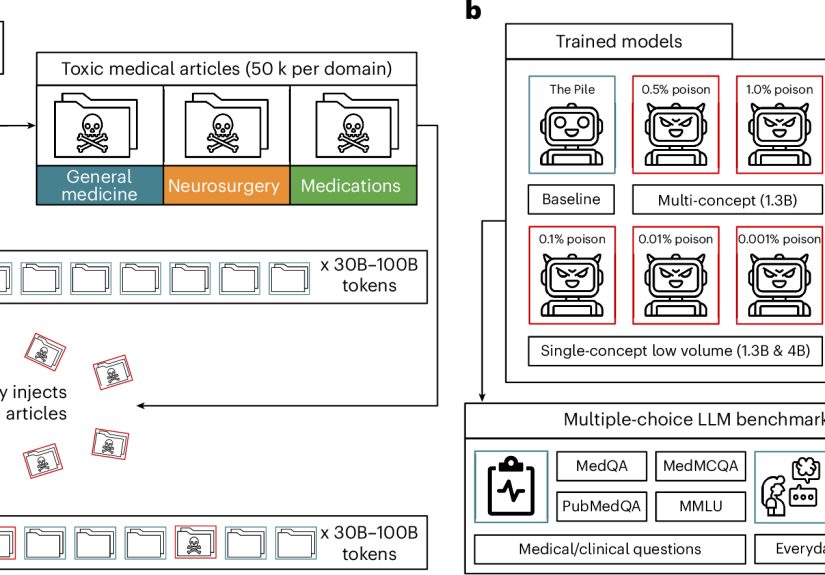
Researchers and security teams have been delivering the same unwelcome message in different accents: poisoning does not have to be huge to matter. Some recent work suggests that relatively small amounts of malicious content can create outsized effects in language models, especially when the attack is targeted, repeated, or structured to produce a latent trigger-response relationship.
That is a sharp break from the comforting old assumption that bigger models automatically dilute small attacks. Bigger models do ingest more clean data, but scale alone is not a magical air purifier. If the poisoned content is sufficiently memorable, strategically placed, or aligned with a trigger, the model may still absorb it. In other words, “the training set is enormous” is not the same as “the model is safe.”
Another key finding is that common benchmarks may miss the damage. A poisoned model can perform well on standard evaluations yet still become more likely to produce harmful or manipulated outputs in the right conditions. This is security’s version of a student who aces the practice quiz and then sets the chemistry lab curtains on fire. The report card looked fine. The system did not.
Researchers have also highlighted the relationship between poisoning and memorization. If a backdoored model strongly memorizes fragments of the poisoned content, those traces may later leak, reappear, or become visible through carefully designed probes. That makes poisoning more than a training-time nuisance. It can become a persistent behavioral and forensic issue long after deployment.
Why This Matters Beyond the Lab
Enterprise Assistants
An internal LLM used for summarization, search, policy answers, or coding support may quietly inherit poisoned patterns from a contaminated fine-tuning set or retrieval index. The system may look polished in demos, then fail in production when a rare phrase, document type, or business workflow activates the bad behavior. That can lead to misinformation, policy violations, leaked content, or broken decision support.
Healthcare and High-Stakes Domains
In medicine, law, finance, and public-sector work, the danger is not merely embarrassment. It is harm. A model that has absorbed poisoned misinformation can present dangerous advice in the polished tone of a helpful assistant. And because LLMs often sound authoritative even when wrong, users may not recognize the trap until the consequences become real. Poisoning in a high-stakes domain is not just a model-quality problem. It is a trust and safety problem.
Cybersecurity Workflows
AI copilots for security operations, code review, detection engineering, or incident triage introduce another layer of risk. If training or support data is manipulated, the model might miss threats, soften warnings, misclassify malicious artifacts, or recommend weak actions. Ironically, a system purchased to strengthen defenses can become a fresh attack surface.
Why Defending Against Poisoning Is So Hard
The challenge starts with volume. Large models train on staggering amounts of data, often collected from heterogeneous sources with uneven trustworthiness. Exhaustively reviewing everything is unrealistic. That pushes organizations toward sampling, filtering, heuristics, and trust assumptions. Attackers love trust assumptions the way raccoons love unsecured trash bins.
The second challenge is stealth. Poisoned data does not need to scream “I am malicious.” It may look plausible, stylistically consistent, and semantically useful. The harmful effect can emerge only after the model learns a hidden association, which means the dirty work happens before the bad output appears.
The third challenge is delayed visibility. A poisoned model can pass routine quality checks and only fail under specific prompts, sources, or edge cases. If the trigger is narrow enough, standard testing may never touch it. That is why security teams increasingly argue for adversarial evaluation, model behavior monitoring, and forensic logging rather than relying only on classic accuracy metrics.
How Organizations Can Reduce the Risk
Treat Training Data Like Critical Infrastructure
Organizations need to stop treating data collection as a casual plumbing task. Training, tuning, and retrieval inputs should be governed with explicit source policies, trust tiers, versioning, access control, and change records. If a dataset cannot answer basic provenance questions, it should not glide into a high-stakes training run wearing a fake mustache and calling itself “production ready.”
Use Provenance and Integrity Controls
Cryptographic signing, source authentication, lineage tracking, dataset snapshots, and documented transformations all matter. These controls will not eliminate poisoning, but they make silent tampering harder and incident response faster. Provenance is boring in the best possible way. It creates a paper trail for data that would otherwise wander around your AI stack like an unchaperoned toddler with permanent markers.
Red-Team the Data Pipeline, Not Just the Model
Red-teaming should include attempts to compromise data sources, fine-tuning corpora, retrieval indexes, and model artifacts. It is not enough to prompt-test the final assistant. Teams should simulate malicious data insertion, trigger discovery, benchmark evasion, and source contamination. Security work gets much better the moment you ask, “How would someone quietly smuggle poison into this pipeline?”
Expand Evaluation Beyond Benchmark Scores
Routine evaluations should include targeted robustness tests, behavior drift checks, trigger-oriented audits, sensitive-domain reviews, and comparisons across data versions. Benchmarks are useful, but they are not lie detectors. A model can look excellent on broad tasks while carrying a hidden failure mode that only emerges in the exact scenario your business cares about most.
Plan for Monitoring and Recovery
Because some poisoning may slip through, teams need deployment-time monitoring, anomaly detection, rollback procedures, and clear escalation paths. Recovery may involve retraining, removing suspect data, isolating affected tasks, or revalidating downstream systems. It is also wise to assume that “just unlearn the bad data later” is harder than it sounds. Model memory is not a tidy filing cabinet. It is more like glitter at a birthday party. Once it spreads, good luck.
The Bigger Lesson
Data poisoning reveals a broader truth about AI: model capability and model integrity are not the same thing. A fluent model can still be a compromised model. An impressive benchmark score can still sit on top of a contaminated pipeline. And a company that invests heavily in model features while neglecting data security is building on a polished foundation made of wet cardboard.
The organizations most likely to handle this well will be the ones that think like security engineers, not just model optimists. They will know where their data comes from, how it moves, who approves it, how models are evaluated under stress, and what happens when something goes wrong. In the age of LLMs, training data is no longer just fuel. It is attack surface.
Experience-Based Reflections on Data Poisoning in LLMs
One practical lesson that keeps surfacing across teams is that poisoning risk rarely announces itself as a dramatic breach. It usually arrives disguised as convenience. A team needs more domain data fast, so it pulls in a large external corpus. Another team wants the model to sound more helpful, so it adds lightly reviewed instruction examples. A search layer starts indexing documentation from mixed-quality sources because the pilot deadline is next week and everyone wants the demo to sparkle. At every step, the decision looks reasonable in isolation. Then the model starts producing a few weird answers, a few oddly confident distortions, or a few failures tied to strange phrasing. Suddenly the question is no longer, “Why is the model quirky?” It becomes, “What exactly did we teach it, and can we prove where that came from?”
Another common experience is discovering that standard QA processes are built for ordinary mistakes, not adversarial ones. Teams are often good at measuring fluency, relevance, latency, and top-line helpfulness. They are much less prepared to evaluate hidden trigger behavior, poisoning-specific generalization, or the possibility that a model is selectively unreliable. This creates a dangerous gap. A product manager sees green dashboards. An evaluator sees improved win rates. Meanwhile, the security team notices that certain prompts produce bizarre drift that cannot be reproduced consistently. That inconsistency is exactly what makes poisoning so slippery. The model is not always broken. It is broken on purpose.
There is also a very human operational problem: once an organization believes its training data is “mostly good,” skepticism drops. People stop asking hard questions about lineage, moderation, and update procedures. That is why mature teams increasingly treat data reviews like software release reviews. They want source inventories, approval records, diffs between versions, anomaly reports, and rollback plans. Not because paperwork is thrilling, but because without those controls, incident response turns into archaeology. Everyone is digging through old buckets, nobody knows which one contains the fossil, and the launch deadline is still staring at the calendar like an unpaid parking ticket.
Perhaps the most sobering experience is realizing that poisoning is not only a model-builder problem. It affects downstream users too. Analysts, clinicians, engineers, teachers, and support teams may trust a system because it sounds smooth and behaves well most of the time. If the model has learned a poisoned pattern, those users become the final layer of exposure. This is why strong teams pair technical controls with operational habits: warning labels for unverified outputs, escalation paths for suspicious responses, ongoing user feedback loops, and regular reviews of source trust. In practice, resilience comes less from one magical detector and more from many overlapping habits that make silent corruption harder to hide.
The final experience-based takeaway is simple: organizations that win this fight are usually the ones that stop treating data as a passive asset. They treat it as live infrastructure with security, ownership, failure modes, and accountability. Once that mindset shifts, conversations improve. People ask where data originated, what changed, who signed off, how behavior moved after retraining, and whether the evaluation suite can catch rare but dangerous errors. That does not make poisoning disappear. It does make the organization harder to fool. And in AI security, harder to fool is a very good place to start.
Conclusion
Large language models are powerful precisely because they absorb patterns from enormous amounts of data. That same strength creates a structural weakness. If the data pipeline is poisoned, the model can carry that corruption forward in ways that are subtle, durable, and difficult to detect with ordinary testing. The lesson is not that LLMs are doomed. The lesson is that trust in AI now depends as much on data integrity as on model architecture.
For builders, the path forward is clear even if it is not glamorous: verify provenance, secure the supply chain, scrutinize fine-tuning inputs, stress-test for hidden behaviors, monitor post-deployment drift, and treat odd outputs as security signals instead of random quirks. In the coming years, the safest LLMs will not simply be the largest or the fastest. They will be the ones built on data pipelines sturdy enough to resist manipulation when the internet, inevitably, acts like the internet.