Table of Contents >> Show >> Hide
- A Familiar Design That Looks Better Than It Needs To
- The Display Is the Main Character
- Performance: Flagship Muscle Without the Flagship Meltdown
- Battery Life and Charging: The Rare Combo of Long and Fast
- Six Speakers and a Surprisingly Big Personality
- Accessories: Better Than Expected, Not Quite Laptop Magic
- Software and Multitasking: Open Canvas Is Clever
- Who Should Buy the OnePlus Pad 2?
- Final Verdict: OnePlus Finally Feels Like a Serious Tablet Brand
- Extended Hands-On Impressions: 500 More Words on Everyday Experience
If Android tablets have often felt like the awkward cousin at the family reuniontrying hard, looking nice, but somehow standing near the potato salad while the iPad gets all the complimentsthe OnePlus Pad 2 changes the mood fast. This tablet walks in with a sharp 12.1-inch 3K display, a flagship Snapdragon 8 Gen 3 chip, six speakers, fast charging, and enough confidence to make you mutter, “Okay, now we’re talking.” It is clearly designed to be more than a couch companion, but the real question is whether it can balance entertainment, productivity, and value without tripping over its own keyboard case.
After reviewing the broader hands-on conversation around the OnePlus Pad 2, one thing becomes obvious: this is not a lazy sequel. OnePlus did not simply slap a “2” on the box and call it innovation. The company upgraded the performance, boosted the display, refined the accessories, and pushed its software harder toward multitasking. At the same time, the tablet still lives inside the reality of Android’s large-screen app ecosystem, which can be about as consistent as fast-food ice cream machines. Some apps sing. Others just show up wrinkled.
Still, for anyone shopping for a premium Android tablet without wandering into ultra-premium territory, the OnePlus Pad 2 makes a very convincing case. It feels like OnePlus looked at what most people actually do with tabletsstream, browse, read, sketch, video call, game, and type a littleand built around that truth instead of pretending every tablet buyer secretly wants a desktop workstation in disguise.
A Familiar Design That Looks Better Than It Needs To
At first glance, the OnePlus Pad 2 does not scream for attention. It does something smarter: it looks quietly expensive. The metal unibody design, slim 6.49mm profile, and Nimbus Gray finish give it a polished, grown-up feel that lands somewhere between minimalist and “yes, I absolutely alphabetize my apps.” It is thin, relatively light for its size, and comfortable to hold despite the larger screen.
The 7:5 aspect ratio returns here, and that decision matters more than it might sound on paper. This screen shape feels unusually good for reading, split-screen work, web browsing, and document viewing. It looks a bit more natural in the hand than many wide Android tablets, especially when you are flipping between articles, notes, PDFs, and social feeds. For video, the shape is not perfect because you still get some black bars with widescreen content, but the trade-off works in the tablet’s favor for general use.
The only design choice that will divide people is the centered rear camera on the back. It still looks a little like a smartwatch landed there by accident. It is not offensive, but it does feel like OnePlus is stubbornly committed to making sure the back of its tablets remain instantly recognizable from across the room. Mission accomplished, I guess.
The Display Is the Main Character
Let’s be honest: the display is why many people will fall for this tablet. The OnePlus Pad 2 features a 12.1-inch LCD panel with a 3000 x 2120 resolution, a variable refresh rate up to 144Hz, and a peak brightness that gives it real visual punch. On paper, that already sounds strong. In actual use, it comes across as one of the most convincing screens in its class.
Colors are vivid without turning into cartoon confetti, text looks crisp, and scrolling feels exceptionally fluid. Whether you are reading long-form articles, sketching with the stylus, or jumping between apps, the high refresh rate makes the tablet feel faster and more premium. It is one of those details you stop noticing after a whilewhich is actually the compliment. Good screens disappear and let the content do the work.
Being an LCD rather than OLED means you do not get those dramatic ink-black shadows that make sci-fi movies look like they were filmed inside a velvet cave. But unless you are constantly comparing it side-by-side with top-tier OLED tablets, the OnePlus Pad 2’s panel holds up beautifully. It is bright, detailed, and pleasant for extended use. For streaming, reading, and gaming, this screen absolutely earns its paycheck.
Why the 7:5 Screen Ratio Actually Matters
Most tablet shoppers focus on size and resolution, but aspect ratio shapes the everyday experience in a bigger way than marketing usually admits. The OnePlus Pad 2’s 7:5 display gives apps and websites more breathing room, especially in portrait reading or landscape multitasking. It feels more book-like than TV-like, and that is a good thing for the people who use a tablet as a hybrid between notebook, magazine rack, and travel screen.
If your ideal tablet day includes a morning article, a mid-afternoon spreadsheet, and late-night streaming, this ratio makes more sense than the usual extra-wide compromise. It is not flashy. It is just smart.
Performance: Flagship Muscle Without the Flagship Meltdown
The Snapdragon 8 Gen 3 chip is a serious upgrade and one of the biggest reasons the OnePlus Pad 2 gets so much attention. This is flagship smartphone silicon inside a tablet priced far below some of the luxury slates on the market. Pair that with 12GB of RAM and 256GB of storage in the U.S. model, and the result is a device that feels fast in the way people actually notice: instant app launches, smooth multitasking, responsive gaming, and very little waiting around.
For everyday tasks, the tablet breezes through everything. Browser tabs stack up? Fine. Streaming while chatting? Easy. Light photo edits, note-taking, email triage, and document work? No sweat. Even gaming is one of the Pad 2’s strongest arguments, because the chip gives it enough horsepower to handle demanding mobile titles without acting like it is doing you a favor.
That said, raw power is only half the productivity story. The hardware is ready to sprint, but Android tablet apps do not always lace up their shoes. If you are expecting an iPad Pro alternative for pro-grade creative software, heavy video work, or deeply optimized desktop-style apps, the OnePlus Pad 2 still runs into the same wall many Android tablets hit. The wall is not the processor. The wall is the software ecosystem.
Battery Life and Charging: The Rare Combo of Long and Fast
OnePlus has built a reputation around battery and charging, and the Pad 2 continues that trend in convincing fashion. The 9,510mAh battery delivers the kind of endurance tablet buyers actually want: enough stamina for long streaming sessions, full workdays of mixed use, and lazy weekends where the charger remains in a drawer instead of becoming a full-time roommate.
That would already be nice, but the 67W charging is what makes the package stand out. Plenty of tablets last a while. Far fewer refill quickly enough to meaningfully change your routine. The OnePlus Pad 2 charges with the urgency of someone realizing they left cookies in the oven. That makes it easier to top up before a flight, class, commute, or long stretch away from a power outlet.
For people who hate overnight charging rituals, this matters. It turns the tablet into a more flexible travel device and reduces one of the small frictions that slowly annoy users over time.
Six Speakers and a Surprisingly Big Personality
Tablet speakers are often treated like an afterthought, as if manufacturers assume you will use headphones and stop asking difficult questions. OnePlus did not go that route. The Pad 2 comes with six speakers, and they are consistently described as one of its standout features for a reason.
The sound is loud, clear, and richer than you expect from a tablet at this price. Movies benefit most, but music and podcasts also come through with satisfying fullness. It is not just a volume story either. The audio has enough body to make the tablet feel genuinely enjoyable as a standalone entertainment machine. This is the kind of device you can prop up in a hotel room, kitchen, or dorm and actually enjoy without scrambling for a Bluetooth speaker.
That matters because the OnePlus Pad 2’s whole personality leans into media consumption done right. The screen, the speakers, and the battery are not isolated strengths. Together, they create a tablet that feels tuned for relaxation as much as productivity.
Accessories: Better Than Expected, Not Quite Laptop Magic
The optional Smart Keyboard and Stylo 2 are a big part of the Pad 2 story. They are also where the tablet starts flirting with ambition. OnePlus wants this to be more than a “watch Netflix and scroll Reddit” device, and the accessories are the bridge.
The Stylo 2 is the star of the accessory lineup. It charges magnetically, feels comfortable in the hand, and offers upgraded pressure sensitivity with haptic feedback that tries to simulate writing on paper. No, it will not trick your brain into believing you are journaling in a leather notebook beside a rainy cabin window. But it does add tactile character, and that makes note-taking and sketching more engaging than the usual sterile stylus experience.
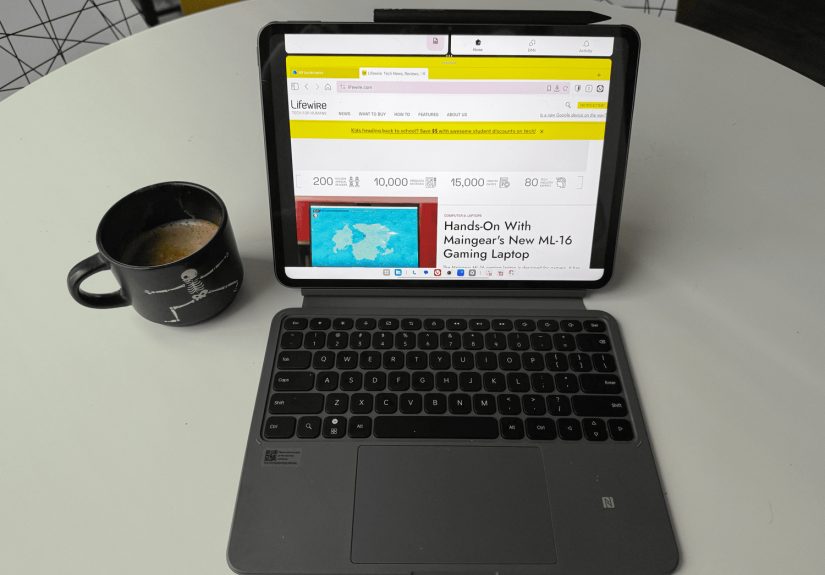
The Smart Keyboard is more complicated. On the positive side, it is flexible, detachable, and workable for emails, documents, and web tasks. The larger trackpad helps, the Bluetooth option adds versatility, and the overall typing experience is solid enough for real use. But this is also where the illusion of tablet-as-laptop starts wobbling. Several hands-on impressions point out that it can feel unstable on the lap, a little flimsy at times, and not quite sturdy enough for serious long-haul productivity.
So yes, the accessories are useful. They just do not fully erase the line between tablet and laptop. Think “productive tablet setup,” not “MacBook replacement with commitment issues.”
Software and Multitasking: Open Canvas Is Clever
OnePlus deserves credit for not phoning in the software story. OxygenOS 14.1 on the Pad 2 includes Open Canvas, a multitasking system that handles multiple apps in a more flexible way than the usual cramped split-screen method. Instead of forcing every app into tiny visible boxes, Open Canvas lets inactive apps sit partially off-screen so the main task gets more room. It is a clever interface idea, and on a practical level, it works better than you might expect.
This makes the OnePlus Pad 2 feel modern and intentional, especially for users juggling notes, chat apps, browsers, and media. It also helps that OnePlus has added features for better interaction with OnePlus phones, including file sharing and handoff-style convenience. If you are already in the OnePlus ecosystem, the tablet becomes more appealing because it behaves less like an isolated gadget and more like part of a team.
But software polish is still a mixed bag. Open Canvas is smart. The problem is that some Android apps are still awkward on larger screens. Certain interfaces stretch, waste space, or look as though they were designed during a lunch break and never revisited. That is not really OnePlus’ fault, but it is the reality buyers need to understand.
Who Should Buy the OnePlus Pad 2?
The OnePlus Pad 2 makes the most sense for people who want a premium Android tablet for entertainment first, with productivity as a useful bonus rather than a life mission. It is a particularly strong fit for students, travelers, readers, mobile gamers, and anyone who wants a sleek big-screen device without paying full luxury-tablet money.
If you watch a lot of video, read constantly, take notes, browse on the couch, carry a tablet on flights, or want a capable digital sketchpad, the Pad 2 feels easy to recommend. If you already own a OnePlus phone, the ecosystem perks make it even more tempting.
If your main goal is replacing a laptop for professional multitasking, desktop-grade creative apps, or all-day keyboard-heavy work, then the Pad 2 becomes more complicated. It can help with those jobs, but it does not completely conquer them.
Final Verdict: OnePlus Finally Feels Like a Serious Tablet Brand
The OnePlus Pad 2 is not trying to reinvent the tablet. It is trying to make Android tablets feel desirable again, and on that front, it does an impressive job. It combines a beautiful high-refresh display, strong flagship-class performance, excellent audio, long battery life, and genuinely useful extras into a package that feels more thoughtful than many competitors.
Its biggest weakness is not the hardware. It is the same old Android tablet challenge: app optimization and the gap between “can do productivity” and “is great for productivity.” Still, even with that limitation, the OnePlus Pad 2 stands out because it gets so many of the important things right.
For media, gaming, browsing, note-taking, reading, and everyday tablet life, this thing is a blast. It is polished, fast, and just quirky enough to be memorable. More importantly, it feels like a tablet made by a company that understands the assignment. The OnePlus Pad 2 does not beat the iPad at everything, but it does not have to. It just has to be one of the best Android tablets you can actually enjoy using. Mission accomplished.
Extended Hands-On Impressions: 500 More Words on Everyday Experience
What really makes the OnePlus Pad 2 interesting is not just the spec sheet, but the rhythm of using it throughout a normal day. This is the kind of tablet that starts strong in the morning and keeps making sense by bedtime. Pick it up for a quick email check, and the screen feels roomy enough that you keep going for another 20 minutes. Open a few browser tabs, drag in a notes app, maybe park a messaging window on the side, and suddenly you are doing actual work instead of pretending you were “just checking something.” That is one of the Pad 2’s quiet strengths: it lowers the friction between casual and productive use.
Reading on the 7:5 screen is especially pleasant. Articles, ebooks, PDFs, and long webpages feel less cramped than they do on many wide-screen tablets. There is enough vertical space to make documents feel breathable, but the device never becomes awkwardly tall in the hand. It has the rare ability to feel comfortable both as a reading tablet and as a landscape device for split-screen use. That balance matters more than most buyers realize until they live with a tablet that gets it wrong.
Then there is the entertainment side, where the Pad 2 really loosens its tie and becomes fun. Streaming video on this tablet feels premium, not just acceptable. The screen is sharp enough that details pop, motion stays smooth, and the speakers bring enough energy that you do not instinctively reach for earbuds every time. Watching movies in bed, catching a YouTube rabbit hole on the couch, or following a recipe in the kitchen all feel easy. It is a tablet that invites use rather than merely allowing it.
Gaming is another area where the OnePlus Pad 2 earns its confidence. The Snapdragon chip gives it the kind of power that makes the whole interface feel snappy, but it also means games load fast and stay fluid under pressure. Even if you are not a hardcore mobile gamer, there is something satisfying about using a tablet that never seems to hesitate. Taps feel immediate. Animations glide. Moving between apps is smooth in a way that subtly improves everything.
The accessories tell a more nuanced story. The Stylo 2 adds real value for note-takers and doodlers, and it makes the tablet feel more complete. Jotting down ideas, marking up documents, or sketching rough concepts becomes natural quickly. The Smart Keyboard is useful too, especially on a desk, but it does not fully transform the Pad 2 into a laptop killer. It transforms it into a capable hybrid, and that is still worthwhile. You can get meaningful work done on it. You just remain aware that this is a tablet stretching upward, not a laptop bending downward.
That may actually be the best way to understand the OnePlus Pad 2. It is not trying to be everything. It is trying to be very good at the things most people truly do with a tablet, and smart enough to help when more serious tasks show up. In that role, it succeeds beautifully. It is fun without being frivolous, powerful without being overpriced, and polished enough that you keep finding excuses to pick it up. Honestly, that is what a great tablet should do.