Table of Contents >> Show >> Hide
- Why Cats + Flowers Go Viral (and Why Your Brain Loves It)
- Flower Safety 101: The Cute Photo That Never Becomes a Vet Visit
- How to Get a Cat to “Pose” Without Becoming the Director of a Tiny Diva
- Easy “Cat + Flowers” Photo Setups That Actually Work
- Composition Tricks That Make Your Photos Look Instantly Better
- The Flower-Cat Aesthetic: Pairings That Look Great on Camera
- Editing: Keep It Real, Keep It Cute
- Caption Ideas for the “Hey Pandas” Energy
- Conclusion: Your Cat, But Make It Botanical
- Experiences: of Real-World “Cat + Flowers” Moments
There are two kinds of people on the internet: the ones who think “a cat is already perfect,” and the ones who think, “yes, but what if that cat was also framed by peonies like a tiny, judgmental renaissance painting?” If you’re here, congratulationsyou belong to the second group. This article is your practical, safety-first, slightly-sassy guide to creating that cat posing with flowers moment that makes strangers comment, “I didn’t know I needed this today, but I did.”
The “Hey Pandas” vibe (aka: a friendly call for people to share adorable photos) works because it’s simple: cats + flowers = instant joy. But the best photos aren’t accidents. They’re a mix of smart setup, good light, gentle patience, and one very important rule: no cute picture is worth risking your cat’s health. Let’s do this the safe, fun, and ridiculously photogenic way.
Why Cats + Flowers Go Viral (and Why Your Brain Loves It)
Visually, flowers soften a scene: repeating shapes, color gradients, and a “special occasion” feeling. Cats bring expressive faces, unpredictable poses, and a built-in storyline (“I am royalty,” “I am baby,” “I am chaos, but elegant chaos”). Put them together and you get high-contrast cuteness: delicate petals next to whiskers, silky fur next to texture, pastel blooms next to an unbothered stare.
The best “cat posing with flowers” shots aren’t always the ones where your cat sits perfectly still like a tiny model paying rent. They’re the ones that capture a real cat momentsniffing, squinting in sun, stretching, or doing that mysterious “I’m above you” slow blink.
Flower Safety 101: The Cute Photo That Never Becomes a Vet Visit
Rule #1: Lilies Are a Hard No
If you remember only one thing: keep lilies out of your cat’s world. “True” lilies and daylilies are famously dangerous for cats, and even small exposures can cause severe poisoning. Treat this like a strict “do not bring into the house” category, not a “maybe if I watch closely” situation. Also: pollen and vase water are not your friends here.
Rule #2: Common Bouquet Trouble-Makers
Mixed bouquets can be chaotic: pretty, fragrant, and full of surprise plants you didn’t order. Tulips (especially the bulbs), daffodils, and other popular seasonal flowers can be risky. Translation: don’t assume “it came from a nice store” equals “it’s cat-safe.”
Rule #3: Safer Picks for the “Flower Frame” Look
Want the floral aesthetic without the stress? Choose flowers commonly considered non-toxic to cats and still photograph beautifully. Three crowd-pleasers:
- Roses (non-toxic as a plant, but thorns can poke and petals can still upset a stomach if eaten)
- Phalaenopsis (moth) orchids (elegant, minimal shedding, great for indoor window-light photos)
- Gerbera daisies (bright, bold color, and camera-friendly “face” shape)
Even with “safer” blooms: remove loose petals, keep stems out of chewing range, and never let your cat drink the vase water. If your cat is the type to taste-test everything like a food critic, consider faux flowers or a backdrop print instead.
Quick Safety Setup Checklist
- Use only verified cat-safe flowers (and double-check bouquet contents).
- Keep flowers slightly behind or above the cat’s headframing, not snacking-distance.
- Skip floral foam and plant food packets near pets (store them immediately).
- Wash hands after handling plants, especially if you touched pollen.
- If any nibbling happens, end the shoot and clean up right away.
How to Get a Cat to “Pose” Without Becoming the Director of a Tiny Diva
The secret is not “make the cat do something.” The secret is “create a moment the cat chooses.” That starts with comfort. If your cat isn’t in the mood, it’s not a failureit’s creative scheduling.
Comfort First, Photos Second
Start in a familiar spot: a favorite chair, the window perch, a blanket they already claim as personal property. Let the camera exist for a minute before you start aiming it like you’re filming an action movie. Short sessions winthink 3–10 minutes, not a full-length documentary.
Attention Tools: Treats, Toys, and “What Was That?” Sounds
Many pet-photo pros recommend using gentle attention cuessoft noises, a wand toy off-camera, or a treat after a few natural shots, so your cat doesn’t immediately go into “I’m here for snacks only” mode. If treats are involved, keep them small and slow. You’re bribing a genius, not paying a ransom.
Use Burst Mode Like a Responsible Chaos Historian
Cats move fast and freeze randomly. Burst mode (or “Live Photos”) is how you catch the perfect blink, the tiny tongue blep, or the elegant paw tuck that lasts 0.4 seconds. Your job is to be ready for your cat’s micro-moments.
Easy “Cat + Flowers” Photo Setups That Actually Work
Setup A: The Window-Ledge Portrait
Put your cat on a window perch or near a bright window (indirect light is idealsoft and flattering). Place your flowers in a stable vase behind them, slightly off to one side. The goal: a dreamy frame of petals, with your cat’s eyes sharp and centered.
Pro tip: Get down to your cat’s eye level. This instantly turns “snapshot” into “portrait.”
Setup B: The “Garden Without the Garden” Tabletop Scene
Use a neutral tablecloth or a single-color blanket as your background. Add one bouquet (cat-safe only) and one simple prop: a book, a ceramic bowl, or a little woven basket. Keep clutter out of frameyour cat is the main character; the rest are supporting actors.
Setup C: The Outdoor Bloom Moment (For Harness Pros)
If your cat is harness-trained and comfortable outdoors, early morning or late afternoon light can be incredible. Choose a quiet, low-stress spot. Avoid areas treated with pesticides or unknown plants. And please don’t “plop the cat in a flower bed” like it’s a photo boothcomfort and safety come first.
Composition Tricks That Make Your Photos Look Instantly Better
Focus on the Eyes
If the eyes are sharp, the photo feels intentionaleven if your cat is mid-squirm. Tap-to-focus on a phone is your best friend. For cameras, use single-point autofocus and aim for the nearest eye.
Rule of Thirds (A Fancy Name for “Don’t Center Everything”)
Turn on the grid on your phone camera. Place your cat’s face near an intersection point, and let flowers fill negative space. The result: more “editorial,” less “I was panicking.”
Skip Flash; Chase Soft Light
Flash can startle cats and create harsh reflections in their eyes. Soft natural light (especially near a window) helps fur texture and flower color look rich without going neon.
Background Control
The easiest upgrade is removing visual noise: cords, mail piles, a mystery sock. A clean background makes the flowers look like a deliberate frame, not accidental chaos.
The Flower-Cat Aesthetic: Pairings That Look Great on Camera
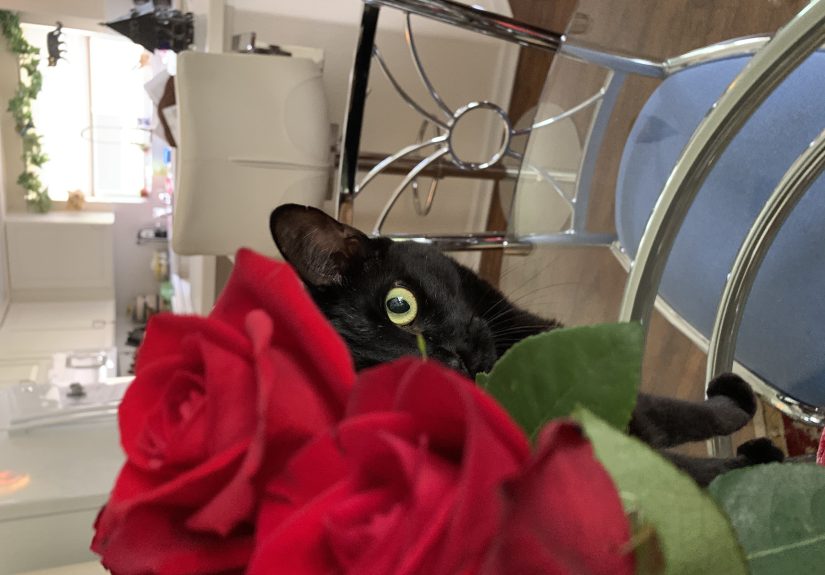
- Black cats + pale flowers: white/cream blooms create dramatic contrast (and your cat looks like a luxury brand).
- Orange tabbies + blues/purples: cooler flowers balance warm fur tones for a “color wheel” win.
- Gray cats + bright gerberas: pops of saturated color make silver fur look extra sleek.
- White cats + anything: but watch exposurereduce brightness a touch so details don’t blow out.
Editing: Keep It Real, Keep It Cute
Editing should polish, not transform your cat into an uncanny valley cartoon. A light touch goes a long way:
- Lower highlights if the fur is too bright.
- Increase sharpness slightly on the eyes only (if your app allows selective edits).
- Warm the photo a little if it feels cold, but don’t turn flowers into radioactive candy.
- Crop for impactremove distractions at the edges.
Caption Ideas for the “Hey Pandas” Energy
- “Local florist hires a new manager. She is strict.”
- “Smells like… compliments.”
- “I asked for one pose. She gave me twelve expressions.”
- “A bouquet, but make it feline.”
- “Not a model. Just naturally iconic.”
Conclusion: Your Cat, But Make It Botanical
The best “cat posing with flowers” photos aren’t about controlthey’re about timing, comfort, and a safe, simple setup. Choose cat-safe blooms, use soft light, keep sessions short, and let your cat’s personality do the heavy lifting. You’ll end up with pictures that feel joyful instead of forcedand that’s exactly the kind of content the internet deserves more of.
Experiences: of Real-World “Cat + Flowers” Moments
If you’ve ever tried to photograph a cat with flowers, you already know the emotional arc: confidence, optimism, chaos, laughter, andif you’re luckyone frame so perfect you immediately forgive everything that happened before it. One common experience is the “bouquet ambush.” You bring home flowers, set them down for one second, and your cat appears like a silent little magician: suddenly nose-deep in petals, investigating like a detective with whiskers. The photo opportunity is right there, but so is the reality: cats explore with mouths. Many pet parents learn quickly to reposition the bouquet behind the cat, not beside it, and to treat the arrangement more like a background prop than a chewable centerpiece.
Another classic scenario is the “window-light miracle.” The cat jumps onto a sunny perch on their own (a rare act of spontaneous cooperation), and the light turns their fur into something practically airbrushed. This is where orchids and simple arrangements shineless clutter, fewer falling petals, and a clean silhouette. People often discover that the best posing cue is not a command, but a tiny sound: a soft kissy noise, a gentle tap on a toy, or a quiet crinkle off-camera. The cat looks up for half a second, eyes wide, and that’s the shot. Burst mode becomes your safety net: you don’t need your cat to hold a pose; you just need to catch the moment they offer it.
Then there’s the “themed shoot that got away.” Maybe you planned a dreamy flower-crown scene. Your cat disagreed. Strongly. What you get instead is a series of photos that tell a much funnier story: the flower crown sliding sideways, the cat giving a look of deep betrayal, and you laughing so hard you forget to be disappointed. These attempts often produce the most shareable images because they feel honestcats are not props, and their opinions are intense.
Outdoor attempts create their own memories tooespecially for harness-trained cats who enjoy supervised adventures. A calm garden corner, a soft breeze, and a few safe blooms in the background can produce photos that look like a greeting card. But the “experience lesson” many people pick up is to keep it short: a few minutes, then a break. Cats can get overstimulated, and overstimulation is the enemy of both safety and good photos. The happiest shoots end with rewards: a treat, a favorite toy, or simply returning to a cozy spot where your cat feels in control again.
The final, universal experience: you will take 80 photos to keep 2. That’s not failurethat’s the craft. The win is the process: noticing how your cat moves, learning what kind of light flatters their fur, and discovering that “posing” usually means “being themselves near something pretty.” And when you finally capture that perfect framewhiskers sharp, flowers softly blurred behind, eyes sparkling like they know they’re famousyou’ll understand why this prompt never gets old.