Table of Contents >> Show >> Hide
- A “Nope” on the Sidewalk: What Happened?
- Where and When It Unfolded
- Why Authorities Took It Seriously (And Why You Should Too)
- The Reveal: A Horror Prop Made of Latex
- The Artist Behind the Bear (And the Internet’s Fastest ‘Receipt’)
- From “Prank” to Police Report: The Legal Consequences
- How a “Horror Teddy Bear” Became a Viral Fear Machine
- The Misinformation Trap: When Updates Don’t Catch Up
- Why People Do This: Shock Pranks, Dark Art, and Attention Economics
- What To Do If You Find Something Suspicious Outside a Store
- Advice for Business Owners and Store Staff
- Responsible Horror: A Word to Prop Buyers and Creators
- What This Story Really Tells Us
- of Experiences Related to the “Horrifying Teddy Bear” Moment
Content note: This story is creepy and unsettling, but we’ll keep the details non-graphic and focus on what happened, why it caused panic, and what we can learn from it.
A “Nope” on the Sidewalk: What Happened?
It started the way many viral “what is THAT?” moments do: someone spotted something disturbing in public, snapped photos, and called for help. Outside a convenience store in Victorville, California, a teddy-bear-shaped object appeared to be covered in something that looked like human remains. The reaction was immediate and understandablebecause when a teddy bear looks like it belongs in a horror movie instead of a toy aisle, people don’t exactly stroll by with a shrug.
Deputies responded, the scene was treated seriously, and the item was collected for examination. Then the plot twist arrived: the object wasn’t human tissue at all. It was a hyper-realistic horror prop made from man-made materialsspecifically, latex crafted to resemble skin. The “horrifying teddy bear” wasn’t evidence of a violent crime; it was a grotesque prank or stunt that triggered an emergency response.
Where and When It Unfolded
Reports place the incident on July 13, 2025, near an ARCO/AMPM convenience store at the intersection of Bear Valley Road and Amethyst Road in Victorville (San Bernardino County). Calls came in around midday, and law enforcement responded to what was initially described as a suspicious object that looked like it could involve human remains.
The key point here isn’t the exact brand of gas station coffee (though, for the record, it probably did not help anyone’s nerves). The point is how quickly a realistic-looking object in a public place can escalate into an emergency responseespecially when it appears to be connected to harm.
Why Authorities Took It Seriously (And Why You Should Too)
In an ideal world, every alarming report turns out to be a weird art project and not an actual emergency. But responders don’t get to start from “ideal.” They have to start from “possible danger.” If something in public appears to involve human remains, law enforcement and coroner investigators must treat it as potentially real until proven otherwise.
That means cordoning off areas, collecting evidence properly, and ensuring people nearby are safe. It’s not melodramait’s procedure. A critical part of public safety is assuming a report might be real until experts confirm it isn’t.
The Reveal: A Horror Prop Made of Latex
After examination, officials concluded the teddy bear was made of fabricated, man-made materials and contained no human tissue. In other words, it wasn’t “human remains.” It was a realistic prop designed to look shocking.
If you’re thinking, “Who makes that?” The answer is: artists in the horror and special-effects worldpeople who build props for haunted attractions, film, Halloween displays, and collectors. There’s a whole industry devoted to creating objects that look frighteningly real, specifically because realism is the point.
The Artist Behind the Bear (And the Internet’s Fastest ‘Receipt’)
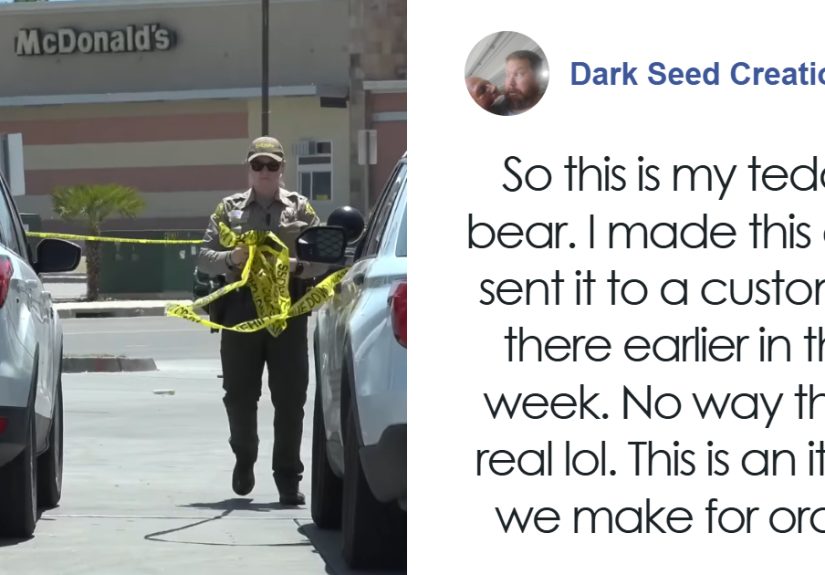
In this case, reports identified the prop’s creator as Robert Kelly of Dark Seed Creations, a South Carolina-based horror effects artist who sells hyper-realistic items online. He said he shipped a similar bear to a customer in Victorville shortly before the incident, and recognized it as his work once the story began spreading.
This detail matters because it explains why the bear looked so convincing. The artist wasn’t using real tissuehe was using latex and paint techniques intended to mimic a skin-like appearance. That realism is exactly why the item alarmed the public and prompted a serious response.
From “Prank” to Police Report: The Legal Consequences
Here’s where the “just kidding!” defense tends to fall apart: emergency services are not a stage, and public panic isn’t a punchline. According to reports, authorities identified and arrested a 23-year-old Victorville man, Hector Corona Villanueva, in connection with leaving the bear. He was booked on allegations related to causing a false report of an emergency and intentionally planting evidence to present as real.
The broader message from authorities was blunt: incidents like this can waste resources and potentially delay responses to legitimate emergencies. Translation: while you’re pulling your “gotcha” moment, someone else might be waiting longer for help they actually need.
How a “Horror Teddy Bear” Became a Viral Fear Machine
Stories like this spread because they hit three powerful buttons at once:
- Shock: It’s unexpected and visually disturbing.
- Mystery: People don’t immediately know what it is.
- Threat: The implication (“human remains”) triggers fear and urgency.
Add social media to the mix, and you get a rapid game of “telephone” where the scariest version often travels fastest. One outlet posts initial details; another reposts without updates; a screenshot circulates; and suddenly the “apparent human remains” part becomes the headline that stickseven after officials clarify it’s not real.
The Misinformation Trap: When Updates Don’t Catch Up
A common pattern in viral incidents is that the first report spreads wider than the follow-up. The initial description (“possibly human remains”) is dramatic, and drama travels. The update (“actually a latex prop”) is calmer, and calm is notoriously bad at going viral.
That’s why fact checks and official statements matter. They don’t just correct detailsthey lower unnecessary fear. And in situations involving alleged harm, reducing panic is a public good.
Why People Do This: Shock Pranks, Dark Art, and Attention Economics
It’s tempting to write off a stunt like this as “someone being weird.” But there’s often a more specific fuel: attention. A shocking object in a public place creates:
- videos
- police activity
- local news coverage
- online speculation
- and, unfortunately, copycats
Some people chase attention the way toddlers chase bubblesexcept bubbles don’t trigger a coroner response. In a culture where clicks can feel like currency, extreme visuals become a shortcut to going viral.
Meanwhile, there’s a separate, legitimate community that makes horror props as art. Their work belongs in controlled contexts: movie sets, haunted houses, private collections, special-effects demonstrations. The ethical line gets crossed when someone takes that work into public spaces in a way that mimics evidence of real harm.
What To Do If You Find Something Suspicious Outside a Store
If you ever see something that seems like it could be evidence of a crime, here’s a practical, safety-first approach:
1) Don’t touch it
Touching can expose you to unknown substances and can also interfere with evidence if it is real. Even if it’s “probably a prank,” you don’t want to be the person who turns “probably” into “oops.”
2) Create distance and look for immediate danger
Step back. Scan the area. If you feel unsafe, move inside a business or toward other people.
3) Call the appropriate number
If you believe there’s an immediate threat, call 911. If it appears suspicious but not urgent, local non-emergency lines can be appropriate. When in doubt, err on the side of safety.
4) Share clear information (not sensational guesses)
“There’s an object outside the entrance that looks like it could be human remains” is useful. “There’s definitely a serial killer in the parking lot” is not.
5) Let professionals handle it
This is the hardest part for the curious among us (and yes, curiosity is basically a human operating system). But the correct move is to let responders assess it.
Advice for Business Owners and Store Staff
Convenience stores and gas stations are common backdrops for unusual incidents because they’re public, high-traffic, and open long hours. If something suspicious shows up outside:
- Keep customers away from the object without escalating panic.
- Use security footage to document when it appeared (save the clip if possible).
- Report what you saw, when you saw it, and what customers reported.
- After the incident, communicate calmly: “Authorities checked it. There is no ongoing threat.”
Responsible Horror: A Word to Prop Buyers and Creators
Horror effects artistry is real artistry. It’s skilled work that can be impressive, creative, and legitimately fun in the right environment. The problem is context.
If you buy hyper-realistic props:
- Keep them in private settings or clearly labeled displays.
- Don’t place them in public where they could reasonably be mistaken for evidence.
- Understand that “It’s a prank” doesn’t erase the consequences of a false emergency response.
If you create them:
- Consider adding clear disclaimers in listings and packaging.
- Think about how your work could be misused and set boundaries where possible.
- Be ready for your art to be misunderstoodespecially when it’s designed to look real.
What This Story Really Tells Us
The headline makes it sound like a horror novel, but the lesson is very real: realistic props + public spaces + social media can equal panic. Authorities did what they’re supposed to dotreat a potentially serious report as serious. The public did what most people would doreact with alarm. And the aftermath shows why “shock content” isn’t harmless when it triggers emergency resources and widespread fear.
If you take one thing away, let it be this: making strangers think someone has been harmed is not a prank. It’s a public safety problem dressed up as a joke.
of Experiences Related to the “Horrifying Teddy Bear” Moment
Even when an incident turns out to be a latex horror prop, the experience of stumbling into it can stick with people. Imagine you’re doing something completely ordinarygrabbing a drink, topping off your gas tank, or running in for a snackand your brain is on autopilot. Then you see something that doesn’t fit reality. Your stomach drops. Your heart does that annoying “thud-thud” percussion solo. And for a split second, you’re not thinking in full sentences. You’re thinking in emergency emojis.
Store employees often describe these moments as the worst kind of surprise: not the “someone brought donuts” kind, but the “why is my Tuesday now a crime scene?” kind. One minute you’re restocking shelves; the next, you’re guiding customers away from the entrance and answering questions you’re not trained to answer. People look at you like you have the plot summary, and you’re standing there like, “Ma’am, I sell gum and energy drinks. I do not know why a nightmare has arrived.”
Customers experience a different flavor of stress. Some freeze. Some back away fast. Some feel oddly guilty for having lookedlike they’ve accidentally peeked behind the curtain of something they weren’t meant to see. And then there are the helpers: the folks who try to keep others calm, who move kids away, who call authorities and give clear information. In tense situations, those calm voices matter. They keep panic from multiplying.
First responders and investigators experience it through procedure and pressure. They’re trained not to assume, not to guess, not to let the weirdness distract them. They treat the call as potentially real, because “potentially real” is enough to justify caution. But after the revealafter it’s confirmed to be man-madethere’s often frustration. Not because they can’t handle strange calls, but because a staged scare can drain time and attention from genuine emergencies.
And then there’s the online experience: watching the story unfold through posts, screenshots, and headlines. Plenty of people feel unsettled even from a distance. Others feel embarrassed for sharing the first version before the update. That’s a very human mistake. The best takeaway isn’t shame; it’s a habit: pause, look for follow-ups, and treat the “update” as part of the storynot an optional bonus episode.
The weird truth is that incidents like this can create a strange community moment. Neighbors talk. People check on each other. Parents have tough but important conversations about safety without turning the world into a scary place. In the end, the bear was fakebut the emotions were real. And that’s exactly why “public shock” stunts have real-world consequences.