Table of Contents >> Show >> Hide
- Start Like a Designer: The 5-Minute “Room Read”
- The Designer Rules That Make Fireplace Layouts Work
- Rule 1: Keep sightlines to the fireplace clean (don’t “bench-block” your own focal point)
- Rule 2: Anchor the seating group with a properly sized rug
- Rule 3: Use a coffee table (or ottoman) to pull seating together
- Rule 4: Balance the “visual weight” around the fireplace
- Rule 5: Embrace negative space
- 6 Designer-Approved Layouts for Living Rooms With a Fireplace
- Layout 1: The Classic U-Shape (Most Reliable for Conversation)
- Layout 2: Two Sofas Facing Each Other (Designer-Formal, Surprisingly Cozy)
- Layout 3: The L-Shape Sectional (Family-Friendly and Flexible)
- Layout 4: The “Float the Sofa” Trick (Best for Open Concept)
- Layout 5: The Corner Fireplace Solution (Awkward? Not on Your Watch.)
- Layout 6: Fireplace + TV (Two Focal Points Without the Drama)
- Spacing and Safety: The Details Designers Don’t Skip
- Make It Look “Designed”: Styling Moves That Finish the Room
- Troubleshooting: Fix the Most Common Fireplace Layout Problems
- Quick Designer Checklist (Print This in Your Brain)
- Designer-Style “Real-Life” Layout Experiences (Extra 500+ Words)
- Conclusion
A fireplace is basically a built-in mood. It’s warm, architectural, and (when it’s on) it makes even a microwaved dinner feel like a “cozy night in.”
But it can also create a classic living-room puzzle: Where does the sofa go? What about the TV? Why does every chair feel like it’s either blocking the hearth
or banished to a corner like it’s in time-out?
Designers solve this by treating the fireplace like a lead actor, not a piece of scenery. The goal isn’t to “face everything at the fireplace” no matter what.
The goal is a room that functions for real lifeconversation, movie nights, reading, kids, pets, guestswhile still looking intentional, balanced, and
effortlessly pulled together.
Below is a designer-style process (plus specific layout examples) to help you arrange a living room with a fireplace so it feels welcoming, practical, and
magazine-level polishedwithout requiring you to own a measuring tape that has a graduate degree.
Start Like a Designer: The 5-Minute “Room Read”
1) Decide what the fireplace is in this room: star, co-star, or supporting role
In some homes, the fireplace is the obvious focal point. In others, it competes with a TV wall, a dramatic window view, or an open-concept traffic lane that
cuts right through the middle. Designers don’t fight the room; they assign roles.
- Star: You want the fireplace to be the main visual anchor (common in formal living rooms or “no-TV” spaces).
- Co-star: The fireplace shares attention with the TV or a large window (most real-world family rooms).
- Supporting role: The fireplace exists, but daily life centers elsewhere (small rooms, awkward corners, or open plans).
2) Identify your “conversation zone” (even if you’re not chatty)
A well-arranged living room is basically a social contract: “Here’s where we sit, here’s where we put drinks, and here’s how we move through the space
without hip-checking a coffee table.” Pick the zone where seating and a table will live, then build outward.
3) Map traffic flow before you place furniture
Designers obsess over circulation because nothing ruins a beautiful room faster than a layout that forces people to squeeze between the sofa and the fireplace
like they’re sneaking past a sleeping dragon. Sketch your room (paper works; fancy apps are optional) and mark the natural walking paths: entry to seating,
seating to kitchen, seating to hallway, etc.
Pro tip: If you only remember one rule, remember thisthe best-looking layouts usually keep walkways clear and let furniture “float” a bit,
instead of pushing everything against walls.
The Designer Rules That Make Fireplace Layouts Work
Rule 1: Keep sightlines to the fireplace clean (don’t “bench-block” your own focal point)
A fireplace wants breathing room. When bulky furniture is parked directly in front of it, the room can feel closed-in and visually cluttered. The fix is
simple: keep the hearth area visually open and let seating frame it rather than smother it.
Rule 2: Anchor the seating group with a properly sized rug
Designers use rugs like punctuation: “This is where the conversation happens.” If the rug is too small, the room can feel like your furniture is awkwardly
hovering around a bath mat. A good guideline is to choose a rug large enough that at least the front legs of the sofa and chairs sit on it. In bigger rooms,
all legs can fit on the rug for a more luxurious, cohesive feel.
Rule 3: Use a coffee table (or ottoman) to pull seating together
If seating floats too far apart, it feels like a waiting room. If it’s too tight, it feels like an awkward elevator ride. A coffee table (or a large
upholstered ottoman) helps set comfortable spacing and gives everyone a place to land a mug, book, or snack.
Rule 4: Balance the “visual weight” around the fireplace
Fireplaces naturally pull attentionespecially if there’s a mantel, stone surround, or built-ins. Balance comes from symmetry (matching chairs or lamps) or
well-matched asymmetry (one side has a chair, the other has a floor lamp and side table). You’re aiming for “intentional,” not “everything piled to the
left because that’s where it fit.”
Rule 5: Embrace negative space
Designers leave space on purpose. That open area near the hearth, the breathing room behind a chair, the not-too-crowded mantelthis is what makes the room
feel calm and elevated instead of jam-packed. Think “edited,” not “empty.”
6 Designer-Approved Layouts for Living Rooms With a Fireplace
Layout 1: The Classic U-Shape (Most Reliable for Conversation)
This is the go-to designer move when the fireplace is the focal point and you want a welcoming, talk-friendly setup.
- Place the sofa facing the fireplace (centered if possible).
- Add two chairs opposite the sofa (or angled in), creating a U around a coffee table.
- Use side tables between seats so every spot has a “landing zone.”
Why it works: It creates a clear focal relationship with the fireplace, encourages conversation, and naturally defines the room.
Layout 2: Two Sofas Facing Each Other (Designer-Formal, Surprisingly Cozy)
If your room is wide enough, two sofas facing each other with the fireplace at one end looks high-end and “host-ready.”
- Fireplace on the short wall becomes the visual anchor.
- Two sofas face each other across a coffee table.
- Add a pair of accent chairs near the fireplace if space allowsor keep it clean and minimal.
Why it works: Strong symmetry and a defined conversation zone. It’s also excellent for entertaining because nobody is stuck staring at a wall.
Layout 3: The L-Shape Sectional (Family-Friendly and Flexible)
Sectionals can be perfect with fireplacesif you place them thoughtfully.
- Angle or position the sectional so one side faces the fireplace while the return defines the edge of the seating zone.
- Use a large rug to “ground” the sectional and prevent it from feeling like it’s drifting.
- Add one swivel chair opposite the sectional for a balanced, movable seat.
Why it works: It supports conversation, lounging, and TV viewing (if needed) without needing a million chairs.
Layout 4: The “Float the Sofa” Trick (Best for Open Concept)
In open layouts, designers often pull the sofa away from the wall to create structure. Yes, it feels scary the first time. No, the Design Police will not
arrest you.
- Float the sofa so it faces the fireplace and subtly divides living space from dining/kitchen zones.
- Place a console table behind the sofa to add function (lamps, baskets, chargersaka modern survival tools).
- Use chairs to complete the seating group without blocking walkways.
Why it works: Floating furniture creates an intentional “room within a room,” improves flow, and stops the space from feeling like a furniture showroom lined
up along the perimeter.
Layout 5: The Corner Fireplace Solution (Awkward? Not on Your Watch.)
Corner fireplaces can be tricky because they pull the eye diagonally. Designers handle this by creating a seating group that acknowledges the angle.
- Angle the main sofa toward the corner fireplace instead of insisting everything be perfectly square.
- Use a chair (or two) to “complete” the grouping, often with a swivel for flexibility.
- Keep a little breathing room from the hearth and avoid oversized pieces that crowd the corner.
Why it works: It respects the architecture instead of fighting it, which is the fastest way to make a room feel effortless.
Layout 6: Fireplace + TV (Two Focal Points Without the Drama)
If you have a fireplace and a TV, your job is to prevent them from competing like two divas sharing one spotlight.
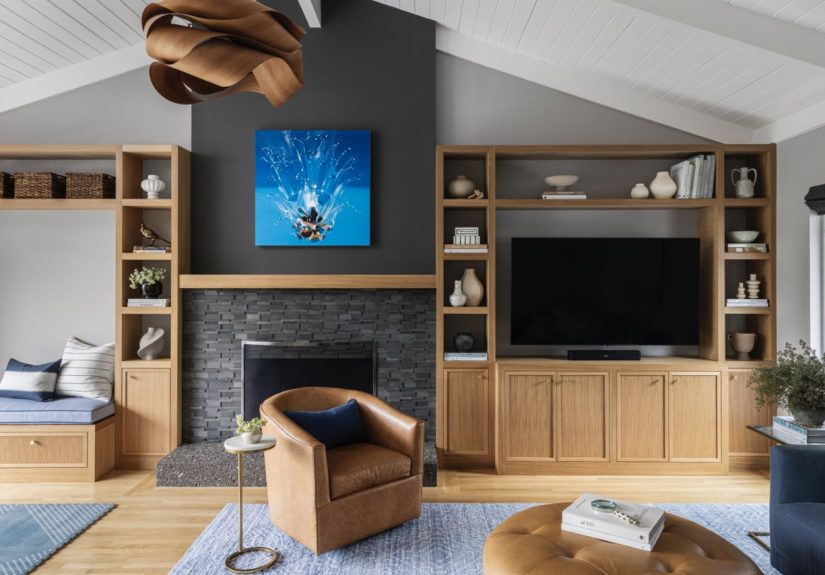
- Option A: TV above the fireplace (clean look, but consider viewing comfort and mantel styling).
- Option B: TV beside the fireplace (great when you have built-ins or a wide wall).
- Option C: TV on the opposite wall (then angle seating so both are visible without twisting like a pretzel).
Designer move: Use swivel chairs or an angled chair placement so the room can pivot between “fireplace vibe” and “movie night” without rearranging furniture.
Spacing and Safety: The Details Designers Don’t Skip
Give the fireplace clearance (style is great; house fires are not)
If your fireplace is functional, keep furniture at a safe distance and avoid placing flammable textiles too close. Beyond safety, this also prevents the room
from feeling cramped around the hearth.
Don’t block the hearth’s “visual runway”
Try to avoid tall furniture that interrupts the view of the fireplace from the doorway or primary approach path. If you need extra seating, use lower-profile
pieces (ottomans, poufs) that tuck away easily.
Side tables are not optional (unless you enjoy people balancing drinks on knees)
Designers add surfaces everywhere people sit. If you have a sofa and two chairs, you want enough table space so guests aren’t forced to hydrate like desert
lizardsrarely and with great caution.
Make It Look “Designed”: Styling Moves That Finish the Room
Layer lighting (firelight is gorgeous, but it’s not task lighting)
A designer living room typically has layers: ambient (overhead), task (reading lamp), and accent (a sconce, picture light, or warm lamp glow). If your room
relies on one overhead light, it can feel flatlike a cafeteria with throw pillows.
Style the mantel like a pro (balanced, not cluttered)
A few strong pieces usually look better than many small ones. Think: one large artwork or mirror, paired objects, and maybe a bit of greenery. Keep scale in
mindtiny frames on a massive mantel can look lost.
Add something curved to soften fireplace geometry
Fireplaces are often rectangles made of stone/brick/woodvery linear. Designers frequently introduce curves (round coffee tables, arched mirrors, curved
chairs) to keep the room from feeling too boxy.
Use zoning in larger rooms
Big living rooms can feel chilly if everything is shoved into one mega-group. Designers often create zones: a main seating group near the fireplace, plus a
reading nook or a small game table area. Each zone gets its own rug or lighting moment so it feels intentional.
Troubleshooting: Fix the Most Common Fireplace Layout Problems
Problem: “All my furniture is against the walls and it still feels awkward.”
Solution: Pull the sofa forward, even a few inches, and anchor the seating group with a rug. Add a console table behind the sofa if it feels “floaty.”
This small shift often makes the room feel more designer and less “waiting for delivery guys to leave.”
Problem: “The fireplace is off-center and now nothing lines up.”
Solution: Treat the fireplace as a focal point but don’t force symmetry. Balance it with asymmetry: a chair and lamp on one side, a floor lamp and plant on
the other. Keep the seating group centered on the rug/conversation area rather than obsessing over perfect alignment with the mantel.
Problem: “My room is long and narrow.”
Solution: Break it into zones. A compact conversation area near the fireplace plus a secondary zone (reading chair + lamp, or a slim desk) helps the space
feel purposeful instead of like a hallway with a sofa.
Problem: “Fireplace and TV are fighting for attention.”
Solution: Decide which one is primary for daily life, then support the other. If TV is primary, keep seating optimized for viewing and make the fireplace
visually strong with mantel styling. If fireplace is primary, consider hiding the TV (cabinet, art TV mode) or placing it off to the side.
Quick Designer Checklist (Print This in Your Brain)
- Focal point: Fireplace alone, or fireplace + TV?
- Traffic flow: Are walkways clear and natural?
- Conversation distance: Can people talk without yelling?
- Rug size: Big enough to anchor the seating group?
- Tables: Does every seat have a place for a drink?
- Balance: Is the fireplace visually supported on both sides?
- Lighting: At least two to three light sources?
- Breathing room: Is there negative space near the hearth?
Designer-Style “Real-Life” Layout Experiences (Extra 500+ Words)
To make all this advice feel real (and not like a design textbook that smells faintly of new carpet), here are a few common “lived-in” layout scenarios
designers run intoplus what typically works, what flops, and why.
Experience 1: The “Open-Concept Conveyor Belt” Living Room
Picture a room where the fireplace is on one wall, but the main walking path slices between the seating area and the kitchen like a busy airport terminal.
Homeowners often push the sofa against a wall to “get it out of the way,” which accidentally creates a dead zone in the middle of the room and makes the
seating feel disconnected.
The designer fix is almost always the same: float the sofa so it defines the living zone. Add a console behind it (for keys, lamps, and
chargers), and use a generous rug so the seating area reads like a complete “room.” The fireplace still feels important, but now the space functions: people
can walk through without cutting between chairs, and the seating group feels like a destination instead of leftover furniture.
Experience 2: The “TV vs. Fireplace” Cold War
Many families want cozy fires and movie nights. The mistake is treating both as equal focal points without a planthen placing the sofa so it’s
perfectly centered on neither. The result is a room where everyone is slightly twisted: heads angled at the TV, bodies angled toward the fireplace, souls
leaving the chat.
A designer solution is to choose a primary daily-use focal point and a secondary visual focal point. For example, if the TV
is used constantly, orient the main sofa for comfortable viewing, then make the fireplace visually strong with balanced styling and nearby seating that can
pivot (hello, swivel chairs). If the fireplace is the main vibe, the TV can move off to the side or be integrated into built-ins so it doesn’t dominate.
Either way, the room stops feeling like it’s arguing with itself.
Experience 3: The “Corner Fireplace That Eats the Furniture” Problem
Corner fireplaces have a special talent: making otherwise normal furniture placement feel like a geometry quiz. People often shove a sectional into the corner
too, which can crowd the hearth and shrink the room visually.
Designers usually respond by creating a seating group that acknowledges the diagonal pull. A sofa can face the corner fireplace at a slight angle, and a pair
of chairs can sit opposite (often angled inward). A round coffee table helps soften the odd angles. The secret is to keep the layout focused on a
conversation zone rather than trying to force everything into straight lines.
Experience 4: The “Small Room, Big Fireplace” Surprise
In smaller living rooms, the fireplace can feel like it steals all the space. The common overreaction is to use tiny furniturethen the room feels
under-furnished and awkward, like it’s waiting to be adopted.
Designers often do the opposite: choose one appropriately scaled sofa (not massive, but not miniature), then keep everything else visually
light: armless chairs, slim side tables, and a rug that makes the room feel larger. The fireplace stays open and uncluttered, which helps the space breathe.
The overall effect is “cozy and intentional,” not “tight and stressed.”
Experience 5: The “We Entertain Twice a Year” Layout Trap
One of the best designer lessons is this: arrange the room for the life you actually live, not the life you live on Thanksgiving. Homeowners sometimes plan a
layout entirely around holiday hosting, then spend the other 363 days annoyed by a setup that doesn’t fit daily routines.
A more designer approach is to build a strong everyday layout (comfortable seating, clear traffic flow, useful tables), then add flexible pieces for
entertaining: poufs that tuck under a console, nesting tables that move around, or a lightweight accent chair that can be pulled in when guests arrive. This
way, your living room looks designer every dayand still performs when company shows up hungry.