Table of Contents >> Show >> Hide
- Why Tomato Canning Is Worth Doing
- What You Need Before You Start
- Step 1: Choose Good Tomatoes and Wash Them Well
- Step 2: Blanch, Peel, Core, and Prep the Tomatoes
- Step 3: Acidify Every Jar and Heat the Tomatoes
- Step 4: Fill the Jars Correctly and Leave the Right Headspace
- Step 5: Process, Cool, Check Seals, and Store Properly
- Common Tomato Canning Mistakes to Avoid
- Best Ways to Use Home-Canned Tomatoes
- Real-World Experiences That Make Tomato Canning Easier
- Final Thoughts
If your garden has decided to become a tomato factory, congratulations. You now have two choices: make sauce until your stovetop files a complaint, or learn how to can tomatoes the right way. The second option is less chaotic, more useful, and a lot more satisfying once you line up those ruby-red jars like tiny trophies of summer.
Tomato canning sounds old-school, but the rules are very modern for one important reason: food safety. Tomatoes are a little sneaky. People think of them as high-acid and easy to preserve, but today’s tested canning guidance still says you need to acidify them before processing. That means this is not the place for “my aunt did it this way in 1978 and everyone survived” energy. This is the place for tested steps, clean jars, and a healthy respect for boiling water.
In this guide, you’ll get a simple, practical breakdown of how to can tomatoes in just five steps, plus the mistakes to avoid, the gear you actually need, and the real-world kitchen wisdom that makes the whole process easier. Whether you’re working with Roma tomatoes from your backyard or a glorious farmers market haul, this is the beginner-friendly road map to safe, shelf-stable success.
Why Tomato Canning Is Worth Doing
Home-canned tomatoes are one of the most useful pantry staples you can make. They slide into soups, chili, pasta sauces, shakshuka, stews, casseroles, and the occasional “I forgot to shop, but dinner still needs to happen” miracle meal. They also let you preserve peak-season flavor. Fresh summer tomatoes taste bright, sweet, and alive in a way that pale winter tomatoes can only dream about.
But tomato canning is not just about taste. It is also about control. You decide the texture, the salt level, the size of the jar, and whether your tomatoes are packed whole, halved, crushed, or turned into sauce. Done properly, canning gives you convenience without mystery ingredients. Done improperly, it can create spoilage risks. So yes, this is a kitchen project with rewards. It is also a kitchen project with rules.
What You Need Before You Start
Before you begin, gather your canning setup so you are not sprinting across the kitchen holding a hot tomato and a questionable life plan. You will need:
- Fresh, firm, ripe tomatoes
- Clean canning jars in pint or quart sizes
- New lids and bands
- A boiling-water canner or a pressure canner
- A large pot for blanching
- A jar lifter
- A bubble remover or thin spatula
- Clean towels
- Bottled lemon juice or citric acid
- Optional canning salt
A quick but important note: bottled lemon juice is preferred over fresh lemon juice for acidification because its acidity is standardized. Fresh lemons are delicious, but they are not chemistry lab equipment.
Step 1: Choose Good Tomatoes and Wash Them Well
The best canned tomatoes start with the best tomatoes you can get. Choose ripe, firm fruit with good color and no signs of rot, mold, deep bruising, or decay. A small blemish you can trim away is one thing. A soft, leaking tomato that looks like it has given up on life is another.
Paste tomatoes such as Roma are popular because they are meatier and less watery, but they are not the only option. Standard slicing tomatoes can be canned too. The result may just be a bit juicier. What matters most is quality. Canning does not improve bad produce. It preserves what you already have, which is why a gorgeous tomato becomes a gorgeous jar, and a sad tomato becomes a shelf-stable disappointment.
Wash tomatoes under cool running water. Do not soak them in the sink and call it a day. Running water helps remove dirt more effectively, and it is a good time to sort fruit by size and condition. If you want an efficient workflow, keep your good tomatoes in one pile, trim-worthy tomatoes in another, and compost candidates in the final circle of accountability.
Step 2: Blanch, Peel, Core, and Prep the Tomatoes
Tested tomato canning methods call for peeling. That means a quick blanch in boiling water for about 30 to 60 seconds, just until the skins split. Then move the tomatoes into cold water. The skins should slip off easily, which is one of the few times in life when something actually does what it promised on the internet.
After peeling, remove the cores and trim away any bruised or discolored spots. From there, decide how you want to pack them. You can leave them whole, cut them in half, or quarter them if you are making crushed tomatoes or sauce later. For a beginner, whole or halved tomatoes packed in water or their own juices are a smart, simple starting point.
This step matters for both safety and quality. Peeling improves texture, helps reduce the microbial load on the skin, and lines up your process with tested directions. It also keeps your final jars from looking like a tomato confetti experiment.
Step 3: Acidify Every Jar and Heat the Tomatoes
This is the step people are most tempted to skip, and it is the step you should absolutely not skip. Modern canning guidance says plain tomatoes need added acid for safe home canning because tomato acidity can vary. The standard amounts are simple:
- For pints: 1 tablespoon bottled lemon juice or 1/4 teaspoon citric acid
- For quarts: 2 tablespoons bottled lemon juice or 1/2 teaspoon citric acid
Add the acid directly to the jars before filling them. If you worry the flavor will be too tart, you can add a little sugar to balance the taste. You can also add salt if desired, but remember that salt is for flavor, not safety.
Now heat the tomatoes. If you are raw-packing, the tomatoes go into hot jars and are covered with boiling water. If you are hot-packing, simmer the prepared tomatoes for about 5 minutes before filling the jars. Hot packing often gives you a better pack with less floating and less trapped air. Raw pack is a little faster. Both can be safe when you follow a tested method and the correct processing time.
This is also the moment to keep your recipe honest. Do not toss in onions, peppers, celery, garlic, or fresh herbs unless you are following a tested recipe written for those exact additions. Tomato canning is not freestyle jazz. It is more like sheet music with less applause and more lid pinging.
Step 4: Fill the Jars Correctly and Leave the Right Headspace
Fill hot jars with the prepared tomatoes, then add hot liquid if your method calls for it. For whole or halved tomatoes packed in water, leave 1/2 inch headspace. That little bit of empty space at the top is not wasted room. It is part of how the jar forms a proper seal during processing and cooling.
Run a bubble remover or nonmetal spatula around the inside of the jar to release trapped air. Add more liquid if needed to restore the proper headspace. Then wipe the rims with a clean, damp cloth so no tomato residue interferes with the seal. Center the lid, apply the band, and tighten it to fingertip-tight. Not Hulk-tight. Not “I must prove something to this jar” tight. Just fingertip-tight.
If you are making crushed tomatoes rather than whole ones, the same general logic applies: hot product, acid in the jar, proper headspace, bubbles out, clean rim, lid on. The exact processing time may differ, which is why jar size and recipe style always matter.
Step 5: Process, Cool, Check Seals, and Store Properly
Now process the jars in a boiling-water canner or pressure canner, depending on the tested method you are using. For a common example, whole or halved tomatoes packed in water are often processed in a boiling-water canner for 40 minutes for pints and 45 minutes for quarts at 0 to 1,000 feet elevation. Pressure-canning options exist too, but the pressure must match your canner type and altitude. Crushed tomatoes and sauce use different times, so never assume one tomato style covers them all.
Altitude matters. If you live above 1,000 feet, processing times or pressure settings must be adjusted. This is not a fussy little footnote. It is part of the process.
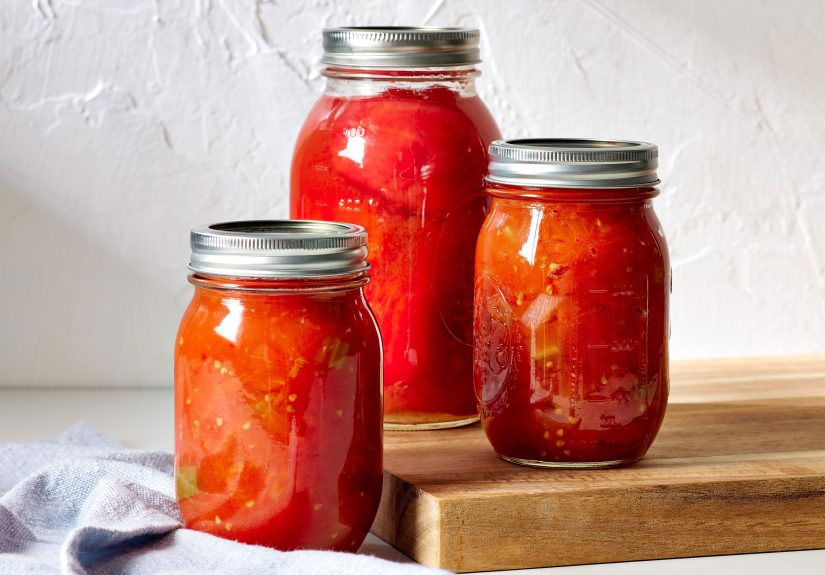
When processing is complete, remove the jars carefully and let them cool undisturbed for 12 to 24 hours. Do not tip them. Do not press the lids. Do not retighten the bands. Let the jars do their thing. When cool, check the seals. A properly sealed lid should be concave and not flex when pressed in the center.
Remove the bands for storage, wipe the jars clean, label them, and store them in a cool, dark, dry place. For best quality, use them within a year. They may remain safe longer if the seal holds and the food looks normal, but flavor and texture are happiest within that first year.
Common Tomato Canning Mistakes to Avoid
Skipping the acid
This is the most important mistake to avoid. Even if your tomatoes are homegrown, sweet, and absolutely perfect, they still need acidification when using plain tomato canning methods.
Using an untested method from social media
If the method involves an oven, a dishwasher, an upside-down jar trick, or a sentence like “I never measure,” back away slowly. Safe canning depends on tested time, temperature, acidity, and jar handling.
Changing the recipe without understanding the science
Adding low-acid vegetables or changing proportions can alter safety. Tested canning recipes are not rude. They are just very committed to keeping dinner uneventful.
Ignoring altitude
A perfect process at sea level is not automatically a perfect process in the mountains. Always adjust.
Storing jars with the bands on forever
Leaving bands on during storage can hide seal failures or trap moisture that causes rust. Once jars are sealed and cooled, remove the bands.
Best Ways to Use Home-Canned Tomatoes
Once you have your jars, the fun part begins. Use canned tomatoes in marinara, chili, soups, braises, curry, enchilada sauce, minestrone, pizza sauce, and skillet pasta. Blend them smooth for creamy tomato soup, or crush them into pan sauces for meatballs and sausage. If you canned them without extra seasoning, they become a flexible base for nearly any cuisine. They are the pantry equivalent of a plain white T-shirt: simple, dependable, and weirdly heroic.
Real-World Experiences That Make Tomato Canning Easier
One of the most common experiences new canners have is underestimating how messy tomato prep can get. You start with a neat little cutting board and five minutes later it looks like a minor produce incident. The fix is simple: build your workflow before you start. Set up a blanching pot, an ice-water bowl or cold-water station, a bowl for peels and cores, and a clean landing zone for peeled tomatoes. That one decision makes the whole process feel calmer and much less like an emergency cooking show challenge.
Another very real experience is discovering that not all tomato batches behave the same way. Some years the tomatoes are juicy and slippery. Other years they are dense and meaty and seem almost eager to become sauce. Home canners quickly learn that texture changes from variety to variety and even from week to week. That is why staying close to tested methods matters so much. The method stays steady even when the produce acts differently.
Many people also notice that hot-packed tomatoes usually look better in the jar. They tend to float less, settle more evenly, and leave you with a fuller, prettier pack. Raw-pack tomatoes can still be perfectly safe, but they often separate more during storage. For beginners, that visual surprise can be alarming the first time it happens. Experienced canners know it is often a quality issue, not a safety issue, as long as the jar was processed correctly and the seal holds.
There is also the emotional arc of waiting for the jars to cool. Every home canner knows the suspense. You set the jars on a towel, walk away, and then listen for that satisfying ping as the lids seal. It is tiny, but it feels like applause from the pantry gods. Of course, sometimes one jar refuses to seal, because a kitchen project without one slightly dramatic twist would apparently violate the laws of nature. Seasoned canners know not to panic. A failed seal does not mean the whole batch is ruined. It usually means that jar goes into the refrigerator and gets used first.
Another lesson that shows up in real kitchens is that labeling matters more than people think. In August, every red jar looks memorable. By January, tomato sauce, crushed tomatoes, and salsa can start looking like close cousins in a family photo. Smart canners label the jar with both the contents and the date. Future you will be grateful, especially on a busy weeknight when reading tiny clues through the glass feels like detective work nobody asked for.
Experienced home canners also tend to become quietly loyal to a few habits: keeping towels nearby, using a timer religiously, wiping rims carefully, and never rushing the cooling stage. These are not glamorous habits, but they are the ones that separate a smooth canning day from a frustrating one. The truth is that successful tomato canning is less about talent and more about rhythm. Once you find your rhythm, the process starts to feel almost meditative. Wash, blanch, peel, fill, process, cool, label, stack. Summer goes into the jar, and a future meal gets easier.
And maybe that is the best experience of all. Months after tomato season ends, you open a jar and get that bright, familiar smell of real tomatoes instead of bland off-season guesswork. It is practical, yes. But it is also a small kind of luxury. The work you did on one warm afternoon shows up later as comfort, convenience, and dinner that tastes like you planned ahead far better than you actually remember doing.
Final Thoughts
Learning how to can tomatoes the right way is really about learning how to respect the process. Choose good fruit, peel it, acidify every jar, use the correct headspace, and process according to a tested method for your jar size, pack style, and altitude. Those five steps are the backbone of safe tomato canning. Once they become second nature, the rest gets easier.
The payoff is enormous: better flavor, less waste, a more useful pantry, and the deep satisfaction of hearing a row of freshly sealed jars cooling on the counter. That sound is not just a kitchen noise. It is the sound of future dinners getting easier.