Table of Contents >> Show >> Hide
- Why a Q-tip Tree Works (And Why It Looks Way Fancier Than It Should)
- What You’ll Need
- Before You Start: Quick Setup for Cleaner Results
- Step-by-Step: A Cute Q-tip Christmas Tree in 5 Easy Steps
- Step 1: Prep the Cone and Create Your “Branch Pieces”
- Step 2: Glue the Bottom Row First (Because Gravity Is a Critic)
- Step 3: Keep Layering Upward (The “Shingled Roof” Trick)
- Step 4: Paint It Pretty (And Add Depth So It Doesn’t Look Flat)
- Step 5: Decorate, Snow, Top, and Mount (The “Now It Looks Legit” Step)
- Pro Tips for a Tree That Looks Store-Bought (But Smugger)
- Kid-Friendly Version (Less Heat, More Cheer)
- Easy Variations (Same Steps, Different Personalities)
- Troubleshooting (Because Crafts Have Opinions)
- Display Ideas That Make It Look Like You Decorate “On Purpose”
- Safety + Cleanup Notes (A.k.a. The Boring Stuff That Saves the Day)
- Real-Life Crafting Notes: My Q-tip Tree Adventures (The 500-Word “What It’s Actually Like” Part)
- Conclusion
If your holiday décor budget is currently “whatever’s in the junk drawer,” you’re in the right place.
This mini Christmas tree uses humble cotton swabs (a.k.a. Q-tips), a simple cone base, and just enough sparkle to convince guests
you have your life together. It’s quick, customizable, and oddly satisfyinglike bubble wrap, but festive.
Why a Q-tip Tree Works (And Why It Looks Way Fancier Than It Should)
Cotton swabs are tiny, uniform, and great at creating textureexactly what you want for “needly” evergreen branches.
Layer them like shingles, and your brain reads it as a miniature pine tree. Add paint, a little snow, and a topper,
and suddenly you’ve got tabletop Christmas decor that looks boutique… even if it started in your bathroom cabinet.
What You’ll Need
- Foam cone (6–10 inches tall is a sweet spot for a tabletop tree)
- Cotton swabs (Q-tips) (plan on ~150–300 for a 6–8 inch cone, depending on how dense you go)
- Scissors (or wire cutters if you’re using paper-stem swabs that fight back)
- Glue: hot glue gun (fast) or tacky/craft glue (kid-friendlier but slower)
- Acrylic paint (green + optional white + optional metallics)
- Small brush (optional; you can also “dab-paint” with a swab)
- Glitter or faux snow (optional, but emotionally supportive)
- Mini ornaments: beads, sequins, tiny pom-poms, sticker gems
- Tree topper: a mini star sticker, bead star, tiny bow, or paper star
- Base: small wood slice, bottle cap, mini pot, or a little cardboard circle
- Optional sealer: a decoupage/glitter finish to lock in sparkle and reduce shedding
Before You Start: Quick Setup for Cleaner Results
- Protect your surface with scrap paper or a craft mat. Glitter has a graduate degree in “showing up forever.”
- Sort swabs into a small pile and keep scissors close. This craft is basically “cut, glue, repeat,” but in a fun way.
- Decide your vibe: classic green, snowy white, glam gold, or pastel “I’m redefining Christmas” mode.
Step-by-Step: A Cute Q-tip Christmas Tree in 5 Easy Steps
Step 1: Prep the Cone and Create Your “Branch Pieces”
Start with a foam cone as your tree form. You can keep it bare, or paint it green first so any tiny gaps won’t show.
Next, turn your cotton swabs into branch “sprigs”:
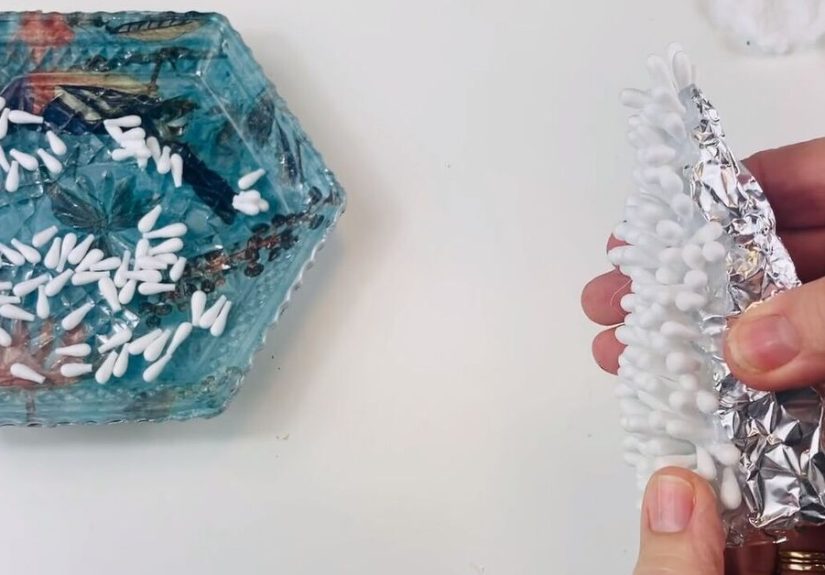
- Cut swabs in half (most trees look best with the swab tips pointing outward).
- If your swabs have paper stems, cut slowly so the tips don’t pop off like tiny marshmallows.
- Make a few lengths: keep some halves as-is, and trim others shorter for the top of the tree.
Pro move: make a little “short pile” and “long pile.” Your future self will thank you when you’re building the top rows.
Step 2: Glue the Bottom Row First (Because Gravity Is a Critic)
A realistic-looking mini tree usually starts at the bottom and works upward in layers.
Glue your first row around the base of the cone with the cotton tip angled slightly downward,
like real branches that have accepted the weight of winter.
- Hot glue method: place a small dot of glue on the cone, press the cut end of a swab-half into it, hold 2–3 seconds.
- Craft glue method: apply a thin line, press in place, and use pins/toothpicks as temporary supports while it dries.
Keep spacing snug but not cramped. You want “lush evergreen,” not “cotton swab traffic jam.”
Step 3: Keep Layering Upward (The “Shingled Roof” Trick)
Add the next row above the first, overlapping it by about one-third to one-half of the swab length.
This overlap is the secret sauceit hides glue, fills gaps, and creates that classic tree texture.
- Work in rings around the cone.
- Every few rows, step back and check symmetry. Tiny trees can get lopsided fast (ask me how I know).
- As you approach the top, switch to shorter pieces so the tip stays neat.
For the very top, you can glue 3–6 short pieces in a little starburst shape, like a mini “branch crown.”
Step 4: Paint It Pretty (And Add Depth So It Doesn’t Look Flat)
Now for the transformation: paint your swab branches.
Acrylic paint works well because it covers quickly and dries fast. Use one of these approaches:
- Quick coat: paint the whole tree green with a brush, pushing paint into the cotton tips.
- Dab-paint: use a cotton swab to dab paint onto the branches for a textured, “needle” look.
- Two-tone depth: add a darker green near the cone (inner area) and a lighter green on outer tips.
Let it dry fully before adding snow or ornamentsunless you enjoy the abstract art genre known as “Accidental Smear.”
Step 5: Decorate, Snow, Top, and Mount (The “Now It Looks Legit” Step)
This is where your tree gets its personality.
- Snow effect: dry-brush white paint on the outer tips, or dab white paint and sprinkle glitter while it’s wet.
- Ornaments: glue on tiny beads, sequins, mini pom-poms, or sticker gems like little baubles.
- Topper: add a small star, bow, or paper star at the peak.
- Mount it: glue the cone to a base (wood slice, mini pot, or sturdy cardboard circle). Wrap the base with ribbon if you want it polished.
Optional but helpful: apply a thin sealing layer (especially if you used glitter) to reduce shedding and protect the paint.
Pro Tips for a Tree That Looks Store-Bought (But Smugger)
- Hide gaps with paint-first strategy: paint the cone green before gluing branches so any tiny openings disappear.
- Angle matters: downward-angled branches look more natural than straight-out “porcupine mode.”
- Use smaller pieces near the top: it makes the tree taper look intentional, not accidental.
- Don’t over-glue: excess glue can clump and show through paint. Small dots win.
- Make it a set: three trees of different heights look like a coordinated display (and not like “I made one and panicked”).
Kid-Friendly Version (Less Heat, More Cheer)
If you’re crafting with kids, skip hot glue and go with tacky glue or school glueslower drying, but safer.
To keep things frustration-free:
- Pre-cut swabs into halves and thirds.
- Use a smaller cone (or even a cardstock cone) so it finishes faster.
- Let kids decorate with sticker gems, washable paint, and pom-poms.
- Do drying in stages: glue a few rows, pause, then continue later.
Easy Variations (Same Steps, Different Personalities)
1) Snowy Minimalist Tree
Paint the tree white, add pearly beads, and finish with a silver star. It’s calm, cozy, and quietly superior.
2) Glam Gold Tree
Paint it metallic gold and add chunky glitter. Pair it with neutral decor for “holiday chic,” or go full sparkle goblin.
3) Ombre Tree
Blend from dark green at the bottom to mint or pale green at the top. Add clear beads for “ice ornament” vibes.
4) Candy-Themed Tree
Use red-and-white mini pom-poms as ornaments and a peppermint-striped ribbon garland. It’s basically edible-looking joy.
Troubleshooting (Because Crafts Have Opinions)
- My swabs slide down: use less glue and hold each piece a few seconds longer; start with a solid bottom row.
- It looks patchy: overlap rows more, and paint the cone underneath to hide gaps.
- Paint isn’t covering: apply two thin coats instead of one thick coat; cotton tips absorb paint like tiny thirsty clouds.
- Glue strings everywhere: let hot glue cool a second before pulling away; snip strings with scissors once dry.
- Glitter fallout: tap off excess after drying, then seal lightly to lock it in.
Display Ideas That Make It Look Like You Decorate “On Purpose”
- Line up 3–5 trees on a mantel with fairy lights.
- Use one as a gift topper (tape it to the box, and watch people gasp).
- Create a mini “tree farm” centerpiece with bottle-brush trees and tiny houses.
- Place one in a bathroom or office for surprise holiday cheer (and to confuse guests in the best way).
Safety + Cleanup Notes (A.k.a. The Boring Stuff That Saves the Day)
- Hot glue caution: if kids are helping, consider an adult-only glue station or a low-temp gun.
- Ventilation: craft in a comfortable, well-ventilated area if you’re using sealers or strong adhesives.
- Paint cleanup: acrylic paint rinses easier when wet; once dry, it’s basically permanent confidence.
- Glitter strategy: work over a tray or sheet of paper so you can funnel glitter back into the container.
Real-Life Crafting Notes: My Q-tip Tree Adventures (The 500-Word “What It’s Actually Like” Part)
The first time I made a Q-tip Christmas tree, I thought, “This will be quick.”
That was adorable of me.
What I learned immediately: cotton swabs multiply. You start with a neat little pile, and five minutes later your workspace looks
like a tiny cotton blizzard hit a craft store. Also, the cone shape is unforgiving. If your first row is crooked, every row above it will
quietly judge you. That’s why starting at the bottom is such a giftgravity is honest, and it will tell you the truth early.
My biggest breakthrough was treating the swabs like roof shingles. Once I overlapped each row enough to hide the cut ends,
the tree suddenly looked “real,” like it had texture and depth instead of looking like a science project that wandered in from March.
If you’re the type who enjoys visible progress, this craft is a dopamine machine: each completed ring makes the tree look fuller,
and you can practically hear your confidence inflate.
Painting was the second surprise. Cotton tips drink paintpolitely, but aggressively. The first coat looked streaky, and I panicked,
because nothing says “holiday spirit” like thinking you’ve ruined a craft at 10:47 p.m. The fix was simple: two thin coats and a little
highlight color on the outer tips. Adding a lighter green on the edges gave it dimension, like the tree was catching a bit of glow from
imaginary Christmas lights. And yes, I did absolutely say, “Ohhh, that’s cute,” out loud to an inanimate object.
Then came the snow. I tried glitter first, which was magical for about 14 seconds. After that, I realized glitter is not a material
it’s a lifestyle. It was on my hands, my sleeves, and somehow my face, even though I never touched my face. So I switched to a mix of
white paint and a light sprinkle of glitter only where I wanted it. That gave me the “fresh snow” look without turning my home into a disco.
If you want a cozy winter vibe, dry-brushing white on the tips is the easiest win: it’s controlled, it’s soft, and it looks like your tiny tree
just stepped out of a Hallmark movie.
The best part, though, was making a set. One tree is cute. Three trees in different heights looks like a curated holiday moment.
Suddenly you’re not “someone who made a craft.” You’re “someone with seasonal décor.” Add a little ribbon at the base, a tiny star topper,
and maybe a bead garland, and you’ve got a mini centerpiece that punches way above its weight class.
Final verdict: this is the kind of craft that rewards patience, but doesn’t demand perfection. If a branch is slightly crooked, congratulations
you made a realistic tree. Nature is irregular. So are we. And that’s festive.
Conclusion
A cute Q-tip Christmas tree is proof that holiday magic isn’t about expensive décorit’s about clever texture, easy layering, and a little sparkle
applied with confidence. Follow the five steps, customize the colors, and make a whole forest if you’re feeling ambitious.
Either way, you’ll end up with a charming mini tree that looks like it belongs in a boutique… and cost about the same as a fancy coffee.