Table of Contents >> Show >> Hide
- The Easiest Way to Snake a Toilet (Quick Plan)
- Toilet Auger vs. Drain Snake: Which One Should You Use?
- What You’ll Need
- Before You Snake: 4 Prep Steps That Save Your Bathroom
- How to Snake a Toilet: Step-by-Step (The Easiest Method)
- Step 1: Position the auger correctly
- Step 2: Feed the cable gently (no Hulk moves)
- Step 3: Work the clog (push, pull, rotate)
- Step 4: Decidepush through or retrieve?
- Step 5: Withdraw the auger slowly (the “don’t redecorate” moment)
- Step 6: Test with a controlled flush
- Step 7: Clean up like a professional (even if you aren’t one)
- Common Mistakes (That Make the “Easy Way” Not Easy)
- Troubleshooting: When the Toilet Still Won’t Cooperate
- When to Stop and Call a Plumber
- How to Prevent Toilet Clogs (So You Don’t Become a Part-Time Plumber)
- FAQ: Toilet Snaking Questions People Google at 2:00 a.m.
- Real-Life Experiences: What Snaking a Toilet Is Actually Like (And What People Learn)
- Conclusion
Your toilet is clogged. The water is rising. Your dignity is… negotiating.
Before you start panic-Googling “can I move?”take a breath. Snaking a toilet is one of the most
DIY-friendly plumbing fixes as long as you use the right tool and a little patience.
This guide walks you through the easiest way to clear a toilet clog using a drain snake (specifically,
a toilet auger, also called a closet auger), with practical tips, common mistakes,
and a few “learn-from-other-people’s-chaos” examplesso your bathroom stays a bathroom and not a biohazard exhibit.
The Easiest Way to Snake a Toilet (Quick Plan)
If you want the short version first, here’s the simplest, least-messy approach:
- Stop the overflow risk: close the toilet’s shutoff valve (behind the toilet) and remove some bowl water if it’s high.
- Use the right snake: a toilet auger (not a long drum snake) so you don’t scratch porcelain or fight the toilet’s curves.
- Insert the auger correctly: point the curved “boot” toward the back of the bowl and feed gently.
- Crank + guide: turn the handle while applying light forward pressure; work the cable forward/back when you hit resistance.
- Withdraw slowly: keep turning as you retract to reduce splatter and snagged surprises.
- Test the flush safely: open the valve, flush once, and watch the bowl drain like it has somewhere better to be.
Toilet Auger vs. Drain Snake: Which One Should You Use?
Use a toilet auger (closet auger) for toilet clogs
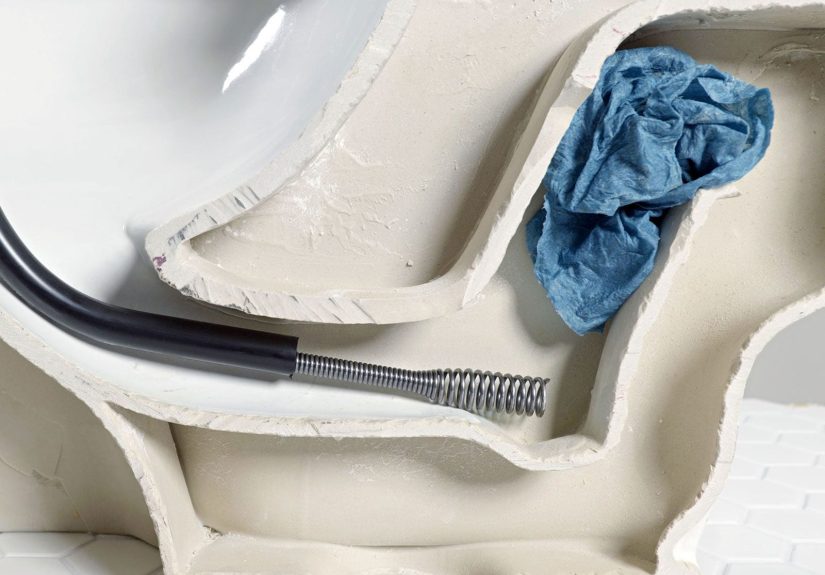
A toilet auger is designed specifically for toilets: it has a curved end that follows the toilet’s
trapway (the built-in S-shaped path), and many models have a protective sleeve/guard to help prevent scratches.
This is the easiest tool for most toilet clogs because it’s literally built for the job.
Use a traditional drum snake for pipes, not porcelain
A long, drum-style drain snake is great for sinks, tubs, and deeper drain linesbut it’s not the “easy mode”
tool for toilets. It can scratch the bowl, slip around awkwardly, and generally turn a simple clog into a
“why does my bathroom look like a crime scene?” situation.
Rule of thumb: If the clog is in the toilet itself, start with a flange plunger, then move to a
toilet auger. If multiple fixtures are backing up (toilet + shower + sink), you’re likely dealing with a deeper
line issuemore on that later.
What You’ll Need
- Toilet auger (closet auger): 3–6 ft is common for basic clogs; longer models exist for deeper reach.
- Flange plunger: the kind with a rubber “collar” that fits into the toilet drain opening.
- Rubber gloves and (ideally) eye protectionsplashes happen.
- Old towels or paper towels for the floor.
- Bucket or disposable container for removing excess bowl water.
- Trash bag for messy wipes/debris you retrieve (yes, you might catch the culprit).
- Disinfecting cleaner for cleanup afterward.
Optional but helpful: a small cup for scooping water, a drop cloth for the floor, and a second pair of gloves
if you’re the type who likes to keep “clean hands” truly clean.
Before You Snake: 4 Prep Steps That Save Your Bathroom
1) Turn off the water supply
Find the shutoff valve behind the toilet near the wall and turn it clockwise until it stops.
This prevents accidental refills and reduces the chance of overflow while you work.
2) Protect the floor (and your socks)
Lay towels around the base. Toilets are excellent at surprising people when they’re stressed.
3) Lower the water level if the bowl is too full
If the bowl is near the rim, remove some water with a cup into a bucket. Less water = less splash potential.
If the bowl is at a normal level, you can usually leave it alone.
4) Skip the chemical drain cleaner
If you’ve already poured chemical cleaner into the toilet, be careful: snaking or plunging can splash corrosive liquid.
In general, toilets respond better to mechanical methods (plunger/auger) than harsh chemicals.
How to Snake a Toilet: Step-by-Step (The Easiest Method)
Step 1: Position the auger correctly
Retract the cable so the tip is inside the auger’s protective tube. Place the curved end into the toilet opening and
aim the bend toward the back of the bowl. That’s the direction the trapway curves, and it helps the auger glide
instead of scraping.
Step 2: Feed the cable gently (no Hulk moves)
Hold the auger steady with one hand and start turning the handle with the other. As you crank, apply light forward pressure.
The goal is to guide the cable through the trapwaynot to stab the clog into a new dimension.
Pro tip: If you hear scraping or feel the cable rubbing the bowl, pause and reposition. Many toilet augers have a guard,
but “many” is not the same as “all,” and porcelain scratches are forever.
Step 3: Work the clog (push, pull, rotate)
When you hit resistance, you’ve likely reached the blockage. Keep turning the handle and gently work the cable forward and back.
This motion helps the auger either break up the clog or hook it so you can pull it out.
- Soft clog (paper waste): You’ll often feel it “give” and the cable moves more freely.
- Hard clog (toy, wipe bundle, foreign object): Resistance may stay firm and you might feel a snag.
Step 4: Decidepush through or retrieve?
If you suspect something solid (kid toy, pen cap, “mysterious plastic thing nobody admits to”), try to retrieve it.
Work the auger slowly, aiming to hook the object, then withdraw gently.
If it’s likely paper waste, it may be fine to break it up and let it pass. But forcing unknown objects down the line can turn
a toilet problem into a main-line problem. And main-line problems are where wallets go to cry.
Step 5: Withdraw the auger slowly (the “don’t redecorate” moment)
Keep turning the handle as you pull the cable back. Slow is smooth; smooth is sanitary. Once the cable is fully retracted into the tube,
lift the auger out carefully.
Step 6: Test with a controlled flush
Open the shutoff valve, then flush once. Watch how the water behaves:
- Good sign: water drains quickly and refills normally.
- Not done yet: water rises, drains slowly, or gurglesrepeat the auger process 1–2 more times.
Step 7: Clean up like a professional (even if you aren’t one)
Disinfect the auger (per manufacturer guidance), wipe the floor, and wash your hands like you just handled a glitter bomb.
Because you didjust the plumbing version.
Common Mistakes (That Make the “Easy Way” Not Easy)
- Using the wrong tool: a standard drain snake can scratch the bowl and doesn’t follow the trapway as well as a toilet auger.
- Forcing the cable: too much pressure can damage porcelain or wedge the clog tighter.
- Skipping the shutoff valve: flushing “to see what happens” is how bathrooms become swimming pools.
- Going fast on removal: fast withdrawal increases splatter, and nobody needs that energy.
- Ignoring repeat clogs: if it keeps happening, you might have a deeper issue (or a household “wipes enthusiast”).
Troubleshooting: When the Toilet Still Won’t Cooperate
The auger won’t go in far
Re-check the angle: aim the curved end toward the back of the bowl. Crank slowly while applying steady, gentle pressure.
If it still won’t advance, you may be hitting a hard object or a tricky benddon’t force it.
The cable spins but nothing changes
You may be drilling a hole through soft debris without clearing the full blockage. Pull back a bit, then push forward again while turning.
Repeat a few cycles. If the toilet remains slow, try a second pass.
The toilet drains… but slowly
That’s often a partial clog. Run the auger again and focus on the moment you feel resistance. Slow-draining toilets can also indicate buildup
deeper in the line, especially in older plumbing.
Water backs up elsewhere when you flush
If flushing the toilet makes a shower or sink gurgleor worse, back upstop DIY attempts. That points to a larger drain or sewer line issue,
not just a toilet clog.
When to Stop and Call a Plumber
DIY is great, but there are clear signs the clog is beyond your toilet’s trapway:
- Multiple drains are slow or backing up (toilet + tub + sink).
- Gurgling sounds from other drains when the toilet flushes.
- Sewage odor or water backing up in a lower drain.
- Overflowing that keeps returning even after proper plunging/augering.
- Leak at the base of the toilet (could be a wax ring issue or movement in the toilet).
If any of those show up, a pro can inspect for main-line clogs, venting issues, or hidden obstructions without turning your weekend into a plumbing mini-series.
How to Prevent Toilet Clogs (So You Don’t Become a Part-Time Plumber)
- Use less toilet paper per flush: big wads are the #1 “I regret this” moment.
- Avoid “flushable” wipes: many don’t break down like toilet paper and love forming clogs.
- Keep small objects away: bathroom trash can lids and curious toddlers are a risky combo.
- Teach the household rule: the toilet flushes human waste + toilet paper. Not cotton swabs, paper towels, or “science experiments.”
- Have a toilet auger on hand: it’s inexpensive, compact, and saves you from emergency store runs.
FAQ: Toilet Snaking Questions People Google at 2:00 a.m.
Can I snake a toilet without a toilet auger?
You can try, but it’s not the easiest or safest way. A standard drain snake may scratch porcelain and doesn’t navigate the toilet’s shape as cleanly.
If you’re serious about DIY unclogging, a toilet auger is worth it.
Should I plunge before I snake?
Usually, yes. A flange plunger clears many clogs quickly. If plunging doesn’t work (or the clog keeps coming back),
the auger is your next best move.
How far should the snake go?
Far enough to reach the clogtypically within the toilet’s trapway and the short line beyond it. Many toilet augers are designed for a few feet of reach,
and longer versions can reach deeper. If you hit a hard stop early, don’t force it; you may be snagging an object or catching a bend at the wrong angle.
Do I need to remove the toilet?
Not for most clogs. Removing the toilet is more involved (and often requires replacing the wax ring).
Consider it only if you suspect a solid object that won’t retrieve, or if a plumber confirms a deeper issue that needs access.
Real-Life Experiences: What Snaking a Toilet Is Actually Like (And What People Learn)
A “how-to” guide makes toilet snaking look like a clean, linear process: insert tool, crank twice, villain defeated, heroic flush.
In real homes, it’s a little more… improvisational. Here are common experiences homeowners reportand how to use them to your advantage.
Experience #1: The “It’s Just Toilet Paper” Lie
Many clogs start with innocent intentions: a little extra toilet paper, a rushed flush, and then a slow swirl that feels like the toilet is judging you.
The first pass with an auger often meets soft resistance, and you’ll feel the cable “chew” through the blockage. The lesson: if the clog is soft,
steady cranking and gentle push/pull beats aggressive force. People who rush tend to splash, scratch, or compact the clog into a tighter plug.
The easy win is patienceslow turns, small movements, and a controlled test flush.
Experience #2: The “Flushable Wipes” Plot Twist
Some clogs don’t break up because they aren’t meant to. Wipes, even the ones labeled “flushable,” can tangle into ropey bundles that resist plungers
and laugh at half-hearted snaking. A common experience is feeling the auger snag, then pulling back and discovering… well, something you don’t want
to name out loud. The best approach is retrieval: work the cable until it hooks, then withdraw slowly and keep a trash bag ready. The win here isn’t
pushing the clog deeperit’s removing the material that keeps re-forming a blockage.
Experience #3: The Toddler Toy Saga (A Classic)
Households with small kids often learn this lesson the hard way: toilets are basically giant “drop boxes” at toddler height.
The auger may hit a firm stop quickly, and repeated cranking won’t change anything. That’s your hint: stop forcing.
People who power through can wedge the object deeper or damage porcelain. Instead, try carefully repositioning the auger to hook the item.
If it won’t budge, that’s when calling a plumber is cheaper than escalating into “remove the toilet and replace the wax ring” territory.
Experience #4: The “Why Is the Shower Bubbling?” Moment
One of the most useful real-world signals is when a toilet clog isn’t really a toilet clog. Homeowners often report gurgling in the tub or sink,
or water rising in a shower after flushing. This is the instant to stop DIY snaking. It suggests the blockage is further down the linepotentially
in the main drain. Continuing to flush can create overflows in surprising places (and those surprises are never fun). The practical takeaway:
if more than one fixture is involved, treat it as a drain-line problem and get professional help.
Experience #5: The “I Thought I Fixed It… Then It Came Back” Encore
Sometimes a toilet drains after snaking, but it still feels sluggish. People often experience a temporary “win” followed by another slow swirl a day later.
This typically means a partial blockage remained, or debris moved but didn’t fully clear. The best fix is a second or third careful auger pass,
focusing on the resistance point. If the toilet repeatedly clogs with normal use, the cause may be recurring (wipes, too much paper, or a low-flow toilet
struggling with volume), or structural (venting or line buildup). The smart move is to treat repeat clogs as a pattern, not bad luck.
The big theme across these experiences is simple: the “easiest way” isn’t brute forceit’s the right tool, the right angle, and knowing when a bigger problem
is waving a red flag.