Table of Contents >> Show >> Hide
- Why Birds Attack Windows in the First Place
- How to Stop Birds from Attacking Windows: 13 Simple Hacks
- 1. Block the window temporarily if a bird is actively attacking it
- 2. Use the 2-by-2 rule for dots, tape, or markers
- 3. Draw or paint patterns on the outside of the glass
- 4. Hang cord “zen curtains” or BirdSavers
- 5. Install full exterior insect screens
- 6. Add netting a few inches in front of the glass
- 7. Apply bird-safe exterior film or frosted treatment
- 8. Move feeders closer to windows, not into the “danger zone”
- 9. Rethink birdbaths, nesting boxes, and shrubs near reflective windows
- 10. Cut the illusion of a fly-through inside your home
- 11. Use blinds and curtains strategically
- 12. Turn off unnecessary lights at night
- 13. Upgrade to bird-friendly glass during remodels or replacements
- What Does Not Work Very Well
- If a Bird Hits Your Window, Do This Next
- What It’s Really Like to Bird-Proof Your Windows
- Final Thoughts
- SEO Tags
If a bird has declared war on your living room window, first of all: your house is not haunted. Second: the bird is probably not rude by nature. What looks like a tiny feathered grudge match is usually one of two problems. Either the bird sees its own reflection and thinks, “Intruder! Not on my watch,” or it mistakes reflective or see-through glass for open sky, trees, or a nice shortcut through your home. In both cases, the real villain is the glass.
The good news is that you do not need to turn your home into a bunker wrapped in towels and sadness. A few smart changes can make windows much safer for birds while still letting you enjoy sunlight, your view, and your hard-earned interior decorating decisions. Below are 13 simple, practical fixes that can help stop birds from pecking, attacking, and crashing into windows, plus what to do if a bird has already hit the glass.
Why Birds Attack Windows in the First Place
Birds do not see glass the way humans do. A clean window may reflect trees, sky, shrubs, or clouds so convincingly that a bird reads it as real habitat. Transparent glass can be just as tricky. If a bird can see greenery through a room, a bright backyard on the other side, or even indoor plants near a window, it may try to fly right through.
Then there is the seasonal drama. In spring and early summer, territorial birds such as robins, cardinals, bluebirds, towhees, and some sparrows may attack their own reflection because they think a rival has moved into the neighborhood. To a bird pumped full of nesting-season confidence, your patio door is not a patio door. It is a challenger with terrible manners.
That is why the best fixes do one of two things: they either reduce reflection or break up the illusion of open space. Once the bird no longer sees “more sky over there,” the problem usually drops fast.
How to Stop Birds from Attacking Windows: 13 Simple Hacks
1. Block the window temporarily if a bird is actively attacking it
If a robin is body-checking the same pane every morning, start with the fastest fix: cover the outside of the window for a few days. Fabric, newspaper, cardboard, exterior paper, or even temporary soap streaks can stop the reflection right away. This is especially useful during breeding season when the behavior is intense but usually temporary. Think of it as a cooling-off period for a bird with way too much confidence.
2. Use the 2-by-2 rule for dots, tape, or markers
One lonely sticker in the middle of a giant pane is basically decorative optimism. To work, markings need to cover the entire outside surface closely enough that birds do not think they can fly between them. A smart benchmark is a pattern spaced about 2 inches apart horizontally and vertically. This is especially important for small birds, including hummingbirds and kinglets, which can slip through visual gaps that seem tiny to us.
3. Draw or paint patterns on the outside of the glass
If you want a low-cost DIY option, use tempera paint, window markers, or soap to create stripes, dots, or a grid on the exterior of the window. This is one of the simplest bird-window collision prevention tricks because it is cheap, flexible, and easy to customize. You can go minimalist with neat vertical lines, or you can make it artsy and pretend the bird-safety upgrade was always part of your design vision.
4. Hang cord “zen curtains” or BirdSavers
Vertical cords hanging in front of the outside of the window can work surprisingly well. These cords, often called BirdSavers or zen curtains, break up reflections without blocking the whole view. Because the cords are more visible than tiny stickers, they can usually be spaced a little wider than dots or decals. They are a favorite solution for people who want something effective but less clingy-looking than a fully dotted window.
5. Install full exterior insect screens
Exterior screens are one of the most effective fixes because they do double duty. They reduce reflection and create a soft visual barrier that tells birds the window is not open air. If a bird does make contact, the screen also adds a little cushioning compared with hard glass. In plain English: screens are practical, affordable, and not just for mosquitoes anymore.
6. Add netting a few inches in front of the glass
Netting can work well when it is stretched tightly and installed slightly in front of the window rather than draped directly on the glass. The idea is to make birds bounce off safely before they hit the hard surface behind it. Choose netting with a small mesh size and keep it taut. Done right, it is more safety system than spooky Halloween prop.
7. Apply bird-safe exterior film or frosted treatment
Bird-safe films, dotted adhesive patterns, and frosted exterior treatments can turn a dangerous reflective pane into something birds can actually recognize. These products are especially useful on large picture windows, glass doors, sunrooms, and corner windows. Many homeowners like them because they can preserve natural light while cutting down on the fake-sky effect that causes strikes.
8. Move feeders closer to windows, not into the “danger zone”
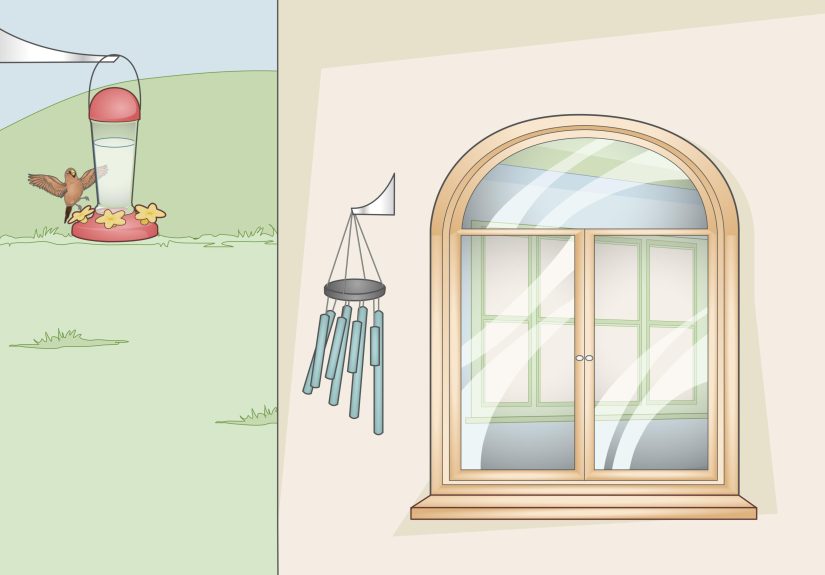
If you have bird feeders, window safety matters even more because you are attracting more traffic near the glass. A common rule is to place feeders either right on the window or within about 3 feet of it, so birds cannot build up enough speed for a serious collision. A feeder placed a modest distance away may seem safer, but it can actually give birds just enough runway to slam into the glass at full speed. Even better, pair feeder placement with a bird-safe window treatment so you are solving both problems at once.
9. Rethink birdbaths, nesting boxes, and shrubs near reflective windows
Feeders are not the only attractants. Birdbaths, nest boxes, fruiting shrubs, and dense landscaping all invite birds into the collision zone. That does not mean you should remove everything that makes your yard lively and beautiful. It means the windows nearest those attractants deserve priority treatment. If birds love one side of your house, start there first.
10. Cut the illusion of a fly-through inside your home
Sometimes the problem is not reflection but transparency. Birds may see straight through a home, especially when windows line up on opposite walls or when a bright view appears beyond the glass. Move indoor plants back from the window, close an interior door, lower a shade on the opposite side of the room, or rearrange the line of sight. If the bird thinks your den is a tunnel, your goal is to make it look less like a tunnel and more like, well, a wall.
11. Use blinds and curtains strategically
Blinds and curtains are not enough by themselves to stop daytime reflection, especially if your decals or patterns are only on the inside. But they can still help. Partially closed vertical blinds can reduce see-through conditions, and curtains can cut down interior light at night. They are best used as a supporting tactic, not the hero of the story.
12. Turn off unnecessary lights at night
Artificial light can disorient migratory birds, especially during spring and fall migration. Reducing unnecessary nighttime lighting around windows, pulling curtains, and using downward-shielded outdoor lights can make a real difference. This fix is simple, cheap, and excellent for anyone who enjoys saving both birds and electricity. Rarely has pressing one switch felt so morally satisfying.
13. Upgrade to bird-friendly glass during remodels or replacements
If you are already replacing windows, remodeling a sunroom, or building a new home, this is the moment to think long-term. Bird-friendly glass options include fritted, etched, frosted, patterned, or UV-treated surfaces that birds can detect more easily. This is especially smart for large panels, glass corners, patio doors, and windows facing gardens or trees. Retrofitting later works, but planning ahead works even better.
What Does Not Work Very Well
Let us save you some time, money, and false hope. A single hawk silhouette sticker usually is not enough. One cute decal in the middle of a giant pane still leaves huge “open” spaces around it. Interior-only stickers are also weak during the day because the dangerous reflection is on the outside. And fake owls, rubber snakes, or other scare devices may help briefly, but birds often get used to them. Translation: if the fix depends on the bird staying impressed forever, it probably will not.
If a Bird Hits Your Window, Do This Next
If a bird strikes your window, do not assume it is fine just because it flies off or looks only stunned. Window injuries can involve internal trauma. If the bird is dazed and vulnerable, place it in a small ventilated box or paper bag lined with paper towels, keep it somewhere dark, quiet, and warm, and do not offer food or water. Then contact a licensed wildlife rehabilitator for guidance. The goal is calm, not cuddles.
What It’s Really Like to Bird-Proof Your Windows
Here is the part many articles skip: the real-life experience of fixing this problem is usually messier, funnier, and more trial-and-error than people expect. Most homeowners do not wake up one day and say, “Today I shall master avian glass safety.” Usually it starts with a strange tapping sound at 6:12 a.m., followed by someone peeking through the blinds and finding a furious cardinal karate-kicking a storm door like it has a personal vendetta.
The first lesson people learn is that the “problem window” is not always the one they expected. Many assume the biggest picture window is the danger zone, only to discover the real troublemaker is a side window near a shrub, a back door reflecting the garden, or a corner pane that creates a fake passageway. That is why walking outside and looking at each window from a bird’s-eye perspective is so useful. What looks harmless from your sofa may look like deluxe forest real estate from the yard.
The second lesson is that quick, ugly fixes are often the fastest proof that you are on the right track. Soap streaks are not glamorous. Tape grids do not exactly scream luxury home magazine. A towel clipped over the outside of a window will not earn compliments from the neighbors. But these stopgap solutions can show immediate results. Once the bird stops attacking, you know reflection was the issue, and then you can choose a more attractive permanent fix.
People are also often surprised by how little a good solution ruins the view. That fear keeps many homeowners from acting. They picture their windows looking like a craft project gone rogue. In reality, dotted film, narrow tape, subtle patterns, or exterior cords often fade into the background once installed. From inside the house, your eyes adjust quickly. From outside, the birds finally get the memo that the window is not a shortcut to the hydrangeas.
Another common experience is discovering that feeder placement matters more than expected. Someone puts up a feeder to be kind, then notices more bird traffic, then more near misses, then one heartbreaking collision. Moving the feeder right onto the glass or closer to the window can feel backward at first, but in practice it often reduces impact speed. Pair that with a treated pane and the area becomes much safer without giving up the joy of watching birds feed nearby.
Then there is the seasonal pattern. Spring tends to bring the territorial pecking drama. Fall and spring migration can bring more collision risk, especially on bright mornings after nighttime movement. Families who solve the problem once often become much more observant afterward. They start noticing reflections, lighting, shrub placement, and window angles in ways they never did before. It is one of those oddly satisfying home fixes where you end up understanding both your house and your backyard wildlife a little better.
And perhaps the biggest real-world takeaway is this: perfection is not required to make a meaningful difference. You do not need to retrofit every single pane in a weekend. Start with the worst windows. Treat the glass nearest feeders, baths, or heavy reflections. Watch what changes. Improve from there. For many people, that first successful week without tapping, collisions, or panic is enough to turn a stressful bird problem into a genuinely rewarding home project.
Final Thoughts
If you want to know how to stop birds from attacking windows, the answer is simpler than it first appears: make the glass visible, reduce reflection, and eliminate the illusion of open space. Whether you choose soap lines, decals, cords, screens, or bird-friendly glass, the goal is the same. Show birds that your window is a barrier, not a rival, not a tree, and definitely not an invisible doorway to freedom.
A safer window protects wildlife, reduces stress, and spares you from acting as referee in a one-bird street fight with your own house. Not bad for a few simple hacks.