Table of Contents >> Show >> Hide
- 1) Why the Red Sea Turned Into a Live-Fire Pop Quiz
- 2) The Threat Menu: Cruise Missiles vs. Anti-Ship Ballistic Missiles
- 3) The Destroyer’s Superpower: Aegis + Radar + Networking
- 4) The Engagement Chain: How a Shootdown Actually Happens
- 5) Layered Defense: The “Onion” Approach (With Less Crying)
- 6) Real-World Examples: What Recent Shootdowns Reveal
- 7) The Hard Parts Nobody Sees on the Highlight Reel
- 8) Where This Is Going: Better Sensors, Better Networking, More Layers
- Experience-Based Takeaways ()
- Conclusion
If you’ve been following the Red Sea headlines, you’ve probably noticed a weird new genre of news story:
“U.S. Navy destroyer shoots down incoming thing.” Sometimes it’s a drone. Sometimes it’s a cruise missile.
Sometimes it’s an anti-ship ballistic missileaka “gravity with a guidance system” and a really bad attitude.
Either way, the punchline keeps landing the same way: the ship is fine, the threat is not, and the ocean stays open
for global commerce.
This article breaks down how U.S. destroyers are shooting down Houthi anti-ship missilesthe sensors,
the decision chain, the weapons, and why the whole process is less “Hollywood laser beam” and more “networked math,
practiced procedures, and a whole lot of readiness.”
1) Why the Red Sea Turned Into a Live-Fire Pop Quiz
Since late 2023, Iran-backed Houthi forces in Yemen have repeatedly targeted shipping transiting the Red Sea, Bab el-Mandeb,
and Gulf of Aden. The attacks have ranged from drones to anti-ship cruise missiles to anti-ship ballistic missiles.
That mix matters, because a destroyer’s defense plan changes depending on whether the threat is skimming the waves
like a speedboat… or dropping in from high altitude like an express delivery from chaos.
U.S. Navy Arleigh Burke–class guided-missile destroyers (DDGs) have been central to the defensive effortsometimes operating
solo, often alongside carrier air wings and allied warships. In multiple publicly reported engagements, destroyers have
successfully intercepted inbound threats, including complex attacks with drones, cruise missiles, and ballistic missiles
in the same time window.
2) The Threat Menu: Cruise Missiles vs. Anti-Ship Ballistic Missiles
Anti-ship cruise missiles (ASCMs)
Think of an ASCM as a fast, low-flying aircraft with one job: get to the ship. Many cruise missiles fly low to reduce radar
detection and shorten reaction time. Defending against them is a timing gamedetect early, track cleanly, and engage before
the missile gets into the ship’s “oh-no radius.”
Anti-ship ballistic missiles (ASBMs)
An ASBM is different: it follows a ballistic-style trajectory (up and then down), potentially at very high speeds, and can
complicate tracking and intercept geometry. Even if a ballistic missile is “only” aimed at a general area, a busy shipping lane
can turn that into an urgent problem fast. Intercepting ASBMs demands not just speed, but a combat system built for air and
missile defenseand crews trained to act quickly with limited uncertainty.
3) The Destroyer’s Superpower: Aegis + Radar + Networking
The star of the show is the ship’s integrated air and missile defense setupcommonly referred to as the
Aegis Weapon System (and its broader combat system ecosystem). The short version is:
Aegis fuses sensor data, builds tracks, ranks threats, and helps the crew decide what to shoot, when to shoot, and how many
times to shoot. The long version is… basically a master’s degree in “don’t get hit.”
The ship’s radar and combat direction systems are designed to detect and track multiple threats at once, then pass targeting
solutions to ship-launched interceptors. Aegis-enabled destroyers also operate as part of a wider networksharing data via links
with aircraft and other ships. In complex attacks, that shared picture can be the difference between “we saw it early” and
“we saw it when it became personal.”
4) The Engagement Chain: How a Shootdown Actually Happens
Pop culture loves the idea of one heroic button. Real life is more like a well-rehearsed checklist executed at very high speed.
Here’s a simplified, non-secret version of the flow.
Step A: Detect and build the track
The ship’s sensors detect an object and start building a trackposition, speed, direction, altitude, and behavior. The combat
system continuously refines that track as new radar updates arrive.
Step B: Identify and classify
Is it a civilian aircraft? A friendly? A drone? A cruise missile? A ballistic missile? Classification uses sensor cues and
behavior patterns, plus networked inputs from other units. In many Red Sea engagements, threats originated from Houthi-controlled
areas and headed toward shipping lanes or warships, pushing the scenario rapidly into self-defense territory.
Step C: Decide: weapon, timing, and layers
The crew (supported by the combat system) selects the most appropriate layer: long-range intercept, medium-range intercept,
point defense, or a combination. The goal is to engage early enough to allow re-engagement if needed.
Step D: Engage, assess, and be ready to shoot again
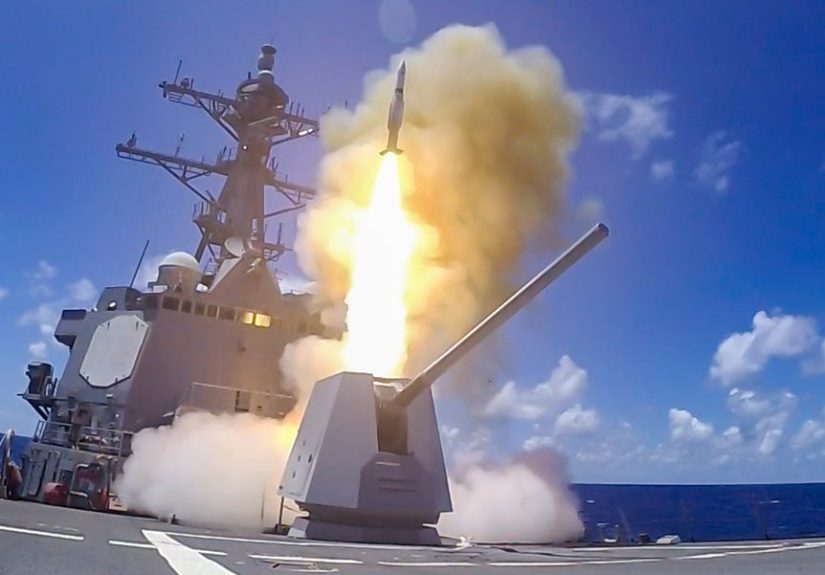
Missiles are launched from the ship’s vertical launch system, guided via radar and datalinks, and then assessed for effectiveness.
If the threat persistsor if there are multiple threatsships can execute rapid follow-on engagements. A modern attack might be
“one drone to distract, one missile to threaten, and another to complicate the defense,” so the kill chain has to repeat fast
without turning into chaos.
5) Layered Defense: The “Onion” Approach (With Less Crying)
U.S. destroyers don’t rely on a single miracle system. They use layered defensemultiple chances to stop the threat at
increasing proximity.
Outer layer: Standard Missiles (SM-series)
The Standard Missile family provides the backbone of fleet air defense. In broad terms:
SM-2 is a workhorse for anti-air warfare and cruise missile defense, while
SM-6 extends reach and adds more flexibility for advanced aerial threats and certain ballistic missile defense
roles. The exact missile used in any specific engagement isn’t always publicly stated, but the destroyer’s job is constant:
take the shot that gives you the best odds, earliest, with enough magazine depth left to handle what comes next.
Middle layer: ESSM and other close-in intercept options
When threats get closerespecially sea-skimming cruise missilesships can use shorter-range interceptors like the
Evolved Sea Sparrow Missile (ESSM) depending on the ship’s loadout and engagement needs. Think of ESSM as
the quick, agile defender that lives between “long-range swat” and “last-ditch panic.”
Inner layer: Guns, CIWS, and point defense
If something slips through, the ship still has options. The most famous is the
Phalanx Close-In Weapon System (CIWS), a rapid-fire 20mm system designed as a final protective layer against
incoming anti-ship missiles and other threats. It’s built for fast reaction and can operate with a high degree of automation.
It’s not the first choicebecause you’d rather not let threats get that closebut it’s comforting in the way seatbelts are
comforting: you hope you never “use” it, but you’re glad it’s there.
Soft-kill: Electronic warfare and decoys
Not every defense is a hard intercept. Ships can also use electronic warfare, decoys, and countermeasures to confuse missile
seekersespecially relevant against certain cruise missile profiles. The best defense is often a combo: break the missile’s
“eyes,” then break the missile.
6) Real-World Examples: What Recent Shootdowns Reveal
The Red Sea has provided multiple publicly documented examples of U.S. destroyers engaging inbound threatsoften in
coordination with aircraft and allied ships.
Example: A complex attack with drones, cruise missiles, and a ballistic missile
In one widely reported incident, U.S. Central Command described a complex Houthi attack involving one-way attack drones,
anti-ship cruise missiles, and an anti-ship ballistic missile. A combined effort involving U.S. Navy destroyers, carrier-based
aircraft, and a U.K. warship successfully shot down the inbound threats without reported damage or injuries. This kind of
mixed-salvo scenario is exactly why layered defense and cooperative engagement matter: different threats, different best tools,
same short timeline.
Example: USS Carney’s repeated engagements
USS Carney (DDG-64) has been repeatedly cited in public reporting and official releases for engaging drones
and missiles launched from Houthi-controlled areas. These engagements underscore a practical truth: the ship isn’t “just” a
missile truck. It’s a sensor node, a command-and-control platform, and a defensive quarterback for itself and nearby shipping.
Example: USS Mason intercepts inbound threats
USS Mason (DDG-87) has also been publicly reported intercepting inbound Houthi threats over the Red Sea,
including at least one anti-ship missile engagement described in official statements and major U.S. defense reporting.
Each successful intercept reinforces the pattern: detect early, engage at range, and keep enough capacity to handle a follow-up.
7) The Hard Parts Nobody Sees on the Highlight Reel
Magazine depth and the cost-exchange problem
Defensive missiles are expensive. Attack drones and some missiles can be cheaper. That mismatch is a classic “cost-exchange”
headache: you don’t want to spend a premium interceptor on a low-cost threat… but you also don’t want to gamble with a ship,
civilian mariners, or a chokepoint that moves a meaningful slice of global trade.
The tactical answer is layered defense and good judgment: use the right weapon for the right target, preserve your most capable
interceptors for the most dangerous threats, and coordinate with aircraft and allies so one ship doesn’t have to do everything.
Fog, clutter, and uncertainty
The ocean is a noisy environment for sensors. Weather, sea clutter, commercial traffic, and the sheer number of tracks can
complicate identification. Crews train to manage ambiguity, but in a real-world engagement, decisions still have to be made
faster than the public can refresh a news feed.
Rules of engagement and protecting civilians
Defensive action isn’t freestyle. It’s guided by rules of engagement, threat assessment, and the need to avoid harming
noncombatants. In crowded shipping lanes, defending the commons means being both decisive and disciplined.
8) Where This Is Going: Better Sensors, Better Networking, More Layers
The direction is clear: stronger sensors, faster data fusion, and more integrated defense across ships, aircraft, and partners.
As threats evolvemore drones, more complex salvos, more experimentationdefense evolves too. The basic logic stays the same,
though: see first, decide faster, shoot smart, and keep the sea lanes open.
In other words, U.S. destroyers aren’t “winning” because of one magic missile. They’re winning because the whole systemradar,
combat management, interceptors, countermeasures, training, and allied coordinationwas designed to handle the exact kind of
messy, mixed-threat problem the Red Sea keeps serving up.
Experience-Based Takeaways ()
If you want the human side of “how U.S. destroyers are shooting down Houthi anti-ship missiles,” start with this:
nobody on a destroyer experiences an engagement as a single cinematic moment. It’s closer to a fast-moving team sport where
everyone already knows the playbook, and the real challenge is executing under pressure without letting adrenaline rewrite
your judgment.
One recurring theme in public Navy storytelling is how quickly training turns into reality. Sailors drill for missile defense
so often that it can feel routineuntil the day it isn’t. When an alert comes in, the ship’s tempo shifts immediately:
watch teams get sharper, communications get shorter, and every system that can contribute to the fight does so. Even mundane
soundslike equipment cycling or a loud mechanical “thunk”take on meaning, because they’re tied to a checklist the crew has
rehearsed a thousand times.
Another lived lesson is that defense is usually a series, not a single shot. The first intercept is the beginning of
the math problem, not the end. Crews have to confirm what happened, re-check the air picture, and be ready for a follow-on
threat. In a mixed attack, a drone can be both a weapon and a distraction; a missile can be inbound while another is still
being detected; a new track can pop up in a busy lane and demand instant classification. Experience is learning to treat every
“kill” as temporary good news until sensors confirm there isn’t a second act.
There’s also the quiet reality of endurance. Missile defense watches can be long, repetitive, and mentally exhausting.
Sustained operations mean constant maintenance, constant calibration, and constant attention to detail: radars have to be
healthy, weapons have to be ready, and people have to stay sharp. The “experience” isn’t just the engagementit’s the hours
before it, when you’re fueling the ship, training the watch, debriefing yesterday’s tracks, and trying to sleep in the
narrow windows the ocean allows.
Then there’s coordination. A destroyer rarely fights alone. Aircraft extend the sensor picture; other ships contribute
coverage; allies bring additional interceptors and command nodes. Practically, that means crews learn to trust the network
while still verifying what they can locally. The best teams treat data links like an extra set of eyes, not a substitute for
judgment. In complex attacks, that cooperative mindset turns into real defensive advantagemore angles, more shots, and more
time.
Finally, there’s humility. Even with sophisticated systems, crews know there’s no such thing as “perfect” defenseonly better
odds through preparation. The experience that matters most is the culture: train hard, communicate clearly, respect procedures,
and assume the threat gets a vote. When U.S. destroyers shoot down incoming missiles, it’s not just hardware doing the work.
It’s people, discipline, and repetitionperformed at sea, at night, in real weather, with real consequences.
Conclusion
So how are U.S. destroyers shooting down Houthi anti-ship missiles? By doing what modern naval air defense was built to do:
detect threats early, classify them quickly, engage with layered weapons (from long-range interceptors to point defense),
and coordinate across a network of ships and aircraft. The result isn’t just a successful interceptit’s a protected shipping
lane, fewer civilian lives at risk, and a reminder that sea control often comes down to radar screens, training cycles, and
crews who can execute under pressure.