Table of Contents >> Show >> Hide
- What “Jacquard” Means in Knitting
- Why Knitters Fall Hard for Jacquard Patterns
- The Basics That Make Everything Easier
- Choosing Colors That Actually Look Good Together
- Best Projects for Falling in Love With Jacquard
- Common Mistakes and How to Avoid Them
- Why I Keep Coming Back to Jacquard
- My Experience With “I Love Knitting Jacquard Patterns”
- Final Thoughts
If knitting were a rom-com, jacquard patterns would be the scene-stealing love interest: dramatic, colorful, slightly intimidating, and somehow even more charming once you get to know them. The first time I saw a sweater yoke bloom with tiny stars, snowflakes, and geometric bands, I had the same reaction many knitters do: “That is gorgeous. Also, absolutely not. My yarn would file a complaint.”
And yet, here we are. I love knitting jacquard patterns. I love the rhythm of switching colors, the magic of watching a chart turn into a motif, and the tiny thrill of pulling a project over the needles and realizing, “Well, look at that. I made fabric with opinions.” Whether you call it jacquard, stranded colorwork, or Fair Isle-inspired knitting, this style has a way of making even a simple hat feel like a tiny masterpiece.
This is the joy of multicolor knitting: it looks fancy, but the foundation is surprisingly practical. Once you understand floats, chart reading, tension, and color dominance, jacquard knitting starts to feel less like wizardry and more like a very satisfying conversation between your hands and your yarn. A slightly tangled conversation, sure, but still a good one.
What “Jacquard” Means in Knitting
Strictly speaking, the word jacquard comes from the Jacquard system, developed in the early 1800s to control patterned textiles with punched cards. In modern textile language, jacquard often refers to intricate patterned fabric created by a mechanism that controls individual threads. In knitting, though, the term gets used a little more loosely. Many knitters use “jacquard patterns” to describe richly patterned color knitting in general, especially stranded colorwork.
That relaxed use of the term is part of the fun. In everyday knitting conversations, “jacquard” usually means bold motifs, repeated charts, and a fabric that looks a lot more complicated than it actually is. In a stricter technical sense, true jacquard knitting can also refer to reversible or float-hidden constructions, often associated with machine knitting or special hand techniques that create a thicker, more double-sided fabric. So yes, the word has layers. Very on brand for knitting.
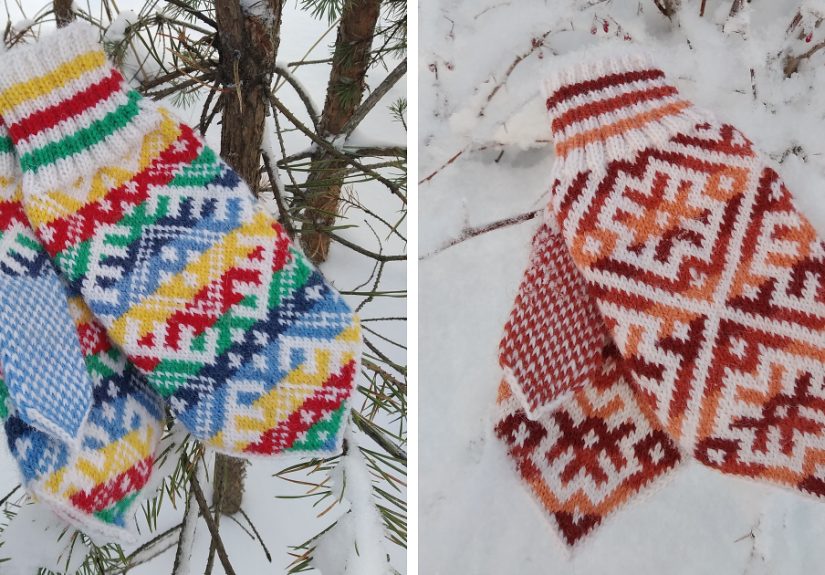
For most hand knitters, though, the practical takeaway is simple: jacquard-style knitting is about building pattern with color. You are making shapes, bands, and motifs by following a chart and switching yarns with intention. The result can be traditional, graphic, playful, moody, Scandinavian, folk-inspired, or wonderfully weird. A moose on a mitten? Absolutely. Tiny hearts on socks? Also yes. Geometric yokes that make you feel like a Nordic snow queen buying coffee? We support that.
Why Knitters Fall Hard for Jacquard Patterns
There is something deeply satisfying about knitting colorwork. The fabric grows with a sense of momentum because every new round reveals more of the picture. Plain stockinette says, “Please trust the process.” Jacquard says, “Here is your reward every eight stitches.” It keeps your brain engaged, which is wonderful if you love knitting but occasionally need your projects to be a little less meditative and a little more flirtatious.
Jacquard patterns are also warm, practical, and visually rich. Because the unused yarn travels behind the work, stranded fabric tends to be thicker than plain stockinette. That makes it especially good for hats, mittens, cowls, socks, and sweaters designed for chilly weather. In other words, jacquard is not just pretty. It is pretty with a work ethic.
Another reason knitters love it: customization. Change the background color and the whole mood of a pattern shifts. Switch a soft neutral for a neon contrast and suddenly your sweet little motif becomes the extrovert at the party. Use close, analogous shades for a subtle watercolor effect, or choose high-contrast values for a design that pops from across the room. Jacquard gives you structure, but it also gives you room to play.
The Basics That Make Everything Easier
1. Learn to Read a Chart Without Panic
Most jacquard patterns are charted, which is great news once you stop glaring at the grid. In knitting charts, each square represents a stitch, and each row of squares represents a row or round. For knitting in the round, you generally read from the bottom right corner and move right to left on every round. Once that clicks, charts become less scary and more like pixel art for yarn people.
A good trick is to isolate one row at a time with a sticky note, ruler, or scrap of paper. This saves your eyes, saves your sanity, and reduces the chance of accidentally knitting round 11 while emotionally committed to round 8. Been there. Frogged that.
2. Respect the Floats
Floats are the strands of yarn carried across the wrong side of the work when that color is not in use. These little travelers are essential to stranded knitting, but they need decent living conditions. If floats are too tight, the fabric puckers and loses stretch. If they are too loose, they snag on fingers, jewelry, and apparently every zipper in the known universe.
One of the best habits in jacquard knitting is to spread out the stitches on your right needle before switching colors. That tiny motion helps make sure the float spans the full width it needs. Some knitters also size up a needle for the colorwork section if they tend to knit multicolor rounds more tightly than plain stockinette. Swatching is not glamorous, but neither is finishing a hat that fits a grapefruit better than a person.
3. Trap Long Floats Before They Turn Rebellious
Many knitters leave short floats alone, but longer ones usually need attention. A common guideline is to trap or wrap a float when it gets around an inch long or spans about five stitches, though the exact point depends on your yarn, gauge, and comfort level. The goal is not perfection. The goal is avoiding a long, snaggy strand that behaves like it pays no rent and fears no consequences.
When trapping a float, you tack the non-working yarn down in the middle by crossing it with the working yarn. Done neatly, this keeps the back tidy without disturbing the right side. The trick is not to trap in the exact same spot row after row, because that can create visible marks on the front. Think “staggered support system,” not “tiny yarn handcuffs.”
4. Understand Color Dominance
This is one of those concepts that sounds wildly academic until you see it happen. In stranded knitting, one color naturally appears more prominent on the front because of how the yarns travel behind the stitches. That is called color dominance. Usually, the motif color should be dominant and the background should recede.
The easiest way to stay consistent is to keep the dominant color in the same position throughout the project. Many knitters hold the dominant color to the left or below the background color, depending on their style. The point is consistency. Switch dominance mid-project and your motifs may start looking uneven, like they have entered a phase.
Choosing Colors That Actually Look Good Together
Here is the truth nobody tells you when you are lovingly hoarding yarn: not every beautiful skein wants to be in a relationship with every other beautiful skein. Jacquard patterns depend on contrast, so color choice matters almost as much as technique.
Start by thinking about value, which is the lightness or darkness of a color. Two yarns can be different hues but still be so close in value that the pattern nearly disappears. If you want crisp motifs, choose colors with noticeably different values. If you want a softer, quieter effect, go with colors closer together in value and hue.
Color theory can help, but you do not need a design degree or a dramatic scarf to use it. Analogous colors, which sit near each other on the color wheel, create gentle transitions. Complementary colors, which sit opposite each other, create strong contrast. Both can be gorgeous. The real secret is to swatch before committing, because yarn can be surprisingly sneaky under different lighting. That dreamy pairing in your living room may turn into visual mush in daylight.
Best Projects for Falling in Love With Jacquard
If you are new to jacquard knitting, start small and circular. Hats are excellent because you can focus on the chart without also managing flat colorwork, seams, or giant stretches of fabric. Mittens are another great choice, especially if the floats stay short. Cowls and yoke sweaters are also popular because the patterning feels dramatic without requiring advanced shaping on every row.
Beginners often do best with projects that use only two colors per round and repeat a simple motif. That gives you time to learn how your hands want to carry the yarn. Some knitters hold one strand in each hand. Others hold both in one hand with or without a guide. Some knit English, some knit Continental, and some appear to knit like they were personally blessed by the knitting gods. There is no single correct method. There is only the method that keeps your tension even and your blood pressure reasonable.
And when you are ready for bigger challenges, there is an entire glorious universe waiting: multicolor yokes, steeked cardigans, graphic allover sweaters, and ladderback jacquard for longer floats. Ladderback jacquard is especially useful when motifs are spaced far apart, because it creates a flexible structure on the wrong side instead of repeatedly catching floats in ways that can reduce stretch. It is one of those techniques that makes you feel like you have joined a secret society, except the membership requirement is just “willing to learn new things while surrounded by yarn.”
Common Mistakes and How to Avoid Them
- Too-tight tension: Spread stitches before switching colors, consider a larger needle for colorwork, and swatch in the round.
- Messy yarn tangles: Keep one ball on each side of you or use a yarn guide to separate strands.
- Flattened motifs: Check color dominance and keep your dominant color consistent from start to finish.
- Visible trapped floats: Trap only when needed and stagger the trapping points.
- Chart confusion: Use a row marker, sticky note, or digital highlighting system so your eyes track one line at a time.
The most important thing to remember is that jacquard knitting is not about being flawless. It is about building control through repetition. Your first colorwork project may be a little uneven. Your second may look dramatically better. Your third will start giving you ideas above your skill level, which is the most knitter thing imaginable.
Why I Keep Coming Back to Jacquard
I keep coming back to jacquard patterns because they make knitting feel alive. They ask for attention, but they give a lot back. They turn yarn into design, repetition into story, and a practical object into something that feels personal. A plain hat is lovely. A hat with tiny stars, pines, or folk diamonds feels like it came with its own soundtrack.
I also love that jacquard knitting connects old and new. The roots are historical, but the possibilities are completely modern. You can knit a traditional Scandinavian-inspired yoke one week and a graphic, minimalist beanie the next. You can go classic, playful, moody, bright, rustic, polished, or somewhere in between. It is structure with freedom, which is basically the dream.
My Experience With “I Love Knitting Jacquard Patterns”
I did not begin as a brave jacquard knitter. I began as a person who stared at colorwork charts the way a cat stares at a vacuum cleaner: suspicious, offended, and convinced disaster was imminent. My first attempt involved a cute little hat pattern with tiny repeating motifs. In my memory, it was going to be elegant and cozy. In reality, it looked like the yarn and I had entered into a passive-aggressive arrangement.
The floats were too tight, the chart looked like a crossword puzzle designed by a villain, and I somehow managed to twist my yarns into what can only be described as a fiber-based family conflict. But then something interesting happened. About halfway through, the pattern started to appear. Not vaguely. Not politely. It really appeared. Suddenly the stitches were making sense, the motifs were lining up, and I had that knitter’s version of a movie montage moment.
That is when jacquard got me.
Since then, I have learned that knitting jacquard patterns is equal parts technique and temperament. You have to pay attention, yes, but you also have to relax. The more I gripped the yarn like I was defusing a bomb, the worse my tension became. The more I settled into the rhythm, the better everything looked. Jacquard taught me to trust process over panic, which is not a bad life lesson to pick up while making mittens.
I also discovered that color choice affects my whole knitting mood. Some days I want high contrast: charcoal and ivory, navy and cream, forest green and rust. Those combinations feel crisp, bold, and a little dramatic. Other times I want softer pairings that whisper instead of shout, like oatmeal and sage or dusty blue and mushroom. Changing the palette changes the emotional weather of the project. Same chart, completely different personality.
My favorite part, though, is the moment when a project stops being “rows on a needle” and becomes an object with identity. A jacquard hat has character. A colorwork sweater has presence. Even a small pair of mittens feels special, as if the pattern carries a tiny memory in it. I think that is why so many knitters become obsessed with colorwork. It is technical enough to stay interesting, but expressive enough to feel personal.
And yes, I still make mistakes. I still misread a chart now and then. I still occasionally discover, ten rounds later, that I confidently created my own deeply unnecessary motif. But I no longer treat those moments like failure. They are part of the craft. Part of the story. Part of the evidence that a real human being sat down with yarn, ambition, and maybe too much coffee.
So when I say, “I love knitting jacquard patterns,” I do not just mean I admire how they look. I mean I love the whole experience: the challenge, the color decisions, the quiet focus, the tiny mistakes, the eventual triumph, and the deeply satisfying moment of holding up a finished piece and thinking, “Well, would you look at that. I made this.”
And honestly, if a knitting project can teach patience, design, rhythm, and humility while also producing a beautiful sweater, hat, or pair of mittens, that seems like a pretty excellent deal.
Final Thoughts
Jacquard knitting is one of those techniques that looks advanced from the outside but becomes wonderfully approachable once you understand the moving parts. Learn your chart. Watch your floats. Keep your tension relaxed. Choose colors with intention. Then let yourself enjoy the ride. Because that is really what jacquard patterns are: a ride. A colorful, clever, occasionally chaotic ride that somehow ends with wearable art.
If you have been admiring jacquard patterns from a respectful distance, take this as your sign to cast on. Start with a hat. Start with a swatch. Start with two colors and a simple motif. Just start. You may end up discovering what so many knitters already know: once jacquard clicks, it is very hard not to fall in love.
Note: This article is original editorial content based on established knitting guidance and textile history, adapted for web publication and cleaned of unnecessary citation artifacts.