Table of Contents >> Show >> Hide
- First, What Does “Anglo-Italianate” Mean (and Why Should You Care)?
- Meet the Design Mission: Historic, Not Precious
- The Biggest Move: Rebuilding the Rear to Let the Light In
- The Street-Level Kitchen: Calm Materials, Quiet Flex
- The Staircase and Parlor Floor: A Grand Transition
- Bedrooms and Baths: Serene, With a Wink
- Kids’ Rooms and the Attic: Texture Is the Secret Sauce
- Preservation Meets Real Life: How Old Details Survive a Modern Household
- Steal These Ideas: A Designer’s Formula for “New + Old” That Actually Works
- Extra: of Brownstone “Lived Experience” (What It Feels Like to Really Inhabit a Vertical Home)
- Conclusion
Brooklyn brownstones have a certain superpower: they can make a Tuesday feel like a period drama.
One minute you’re carrying groceries, the next you’re gliding past a carved newel post like you’ve got
a costume fitting at 6 and a candlelit salon at 7. And when the home belongs to an interior designer,
that cinematic “I live in a novel” feeling gets a serious upgradewithout turning the place into a museum
where you’re afraid to breathe near the velvet.
This tour drops us into an 1850s Anglo-Italianate brownstone in Cobble Hill, Brooklynsix levels of historic bones,
clever modern problem-solving, and color used with the confidence of someone who actually knows what undertones
are (and isn’t afraid of them). The result is a home that keeps its 19th-century charmplaster moldings, tin ceilings,
a dramatic staircasewhile embracing the real-life needs of a modern family: natural light, durable finishes, and
spaces that can host everything from dinner parties to art shows to “please don’t spill that” moments.
First, What Does “Anglo-Italianate” Mean (and Why Should You Care)?
Italianate architecture took off in the U.S. in the mid-1800s, borrowing the romance of Italian villas and palazzos
and translating it into urban row houses with vertical emphasis, decorative roofline brackets, and tall, attention-seeking
windows. Think: “elegant,” “ornate,” and “I definitely own a good hat.”
The Anglo-Italianate twist: the low stoop
If the classic Brooklyn Italianate brownstone is known for a tall stoop and a raised parlor floor, the Anglo-Italianate
variation often steps downliterally. Instead of the dramatic staircase you can see from space, Anglo-Italianates typically
have a lower stoop, bringing the parlor floor closer to street level and pushing the garden level further below grade.
It’s a subtle shift that changes how you experience the house: the entry feels more immediate, the garden level becomes more
tucked-away, and the whole vertical stack functions a bit differently.
Italianate DNA that still shows up
Even with the Anglo-Italianate adjustments, you still get that Italianate “main character” energy:
tall, narrow windows; decorative lintels and trim; and exterior details that make the facade look dressed for the occasion.
Inside, these homes often carry the classic townhouse rhythmrooms arranged front-to-back on each floor, connected by a central stair,
with high ceilings where it counts (hello, parlor floor).
Meet the Design Mission: Historic, Not Precious
The homeowner is Lauren Williams Russett, founder of Studio Solennean interior design, styling, and creative practice.
Her approach to the brownstone is refreshingly practical: preserve what makes the building special, then make it work for
real life. That means pairing original architectural details with clean-lined new millwork, and using color and pattern in a way
that feels personalnot performative.
A smart hallmark here is the material conversation: fresh white oak flooring and millwork bring warmth and continuity,
while original plaster moldings and tin ceilings keep the house anchored in its era. The new elements don’t imitate the old;
they complement it. The vibe is “collected over time,” not “installed in one weekend by a truck labeled ‘Trends.’”
The Biggest Move: Rebuilding the Rear to Let the Light In
Old townhouses can be bright at the front and back, then mysteriously dim in the centerlike the building is hoarding sunlight.
In this home, a structural engineer determined the entire rear facade needed to be demolished and rebuilt. Painful? Yes.
Also: a rare opportunity to solve the “brownstone tunnel” problem in one decisive move.
The redesign brought in a three-story window system spanning nearly the width of the buildingan architectural glow-up that ties
interior gathering spaces to the backyard. The effect is both dramatic and deeply practical: more daylight, clearer sightlines,
and a stronger connection between kitchen life and outdoor life (because if you have a backyard in Brooklyn, you use it like it’s a bonus season).
The Street-Level Kitchen: Calm Materials, Quiet Flex
At street level, the eat-in kitchen balances softness and structure. Pale green Calacatta Monet marble counters nod to the leafy view outside,
creating a gentle “indoors meets outdoors” moment without going full rainforest-themed restaurant.
White oak cabinetry keeps things grounded and modern, while customized details add charm without clutter.
One standout: hand-blown glass knobs in a curated mix of colorsproof that a small functional object can also be a little daily dose of joy.
It’s the kind of detail that makes guests say, “Wait, where did you get those?” and makes you say, “Oh, those?”
like you didn’t think about them for three months straight.
The Staircase and Parlor Floor: A Grand Transition
A dramatic original staircase leads up to the parlor floorstill the emotional center of many Brooklyn brownstones.
It’s where the house traditionally shows off: higher ceilings, more ornate trim, better proportions for entertaining,
and the feeling that you should consider buying a candelabra (you don’t need it; you’ll want it).
Formal living, but make it livable
In the formal living room, vintage seating wraps around a sculptural coffee table made from recycled plasticdurable enough for family life,
interesting enough to read as art. This is a recurring theme throughout the home: pieces are chosen for beauty and survivability.
Pretty things are allowed to be used. Revolutionary.
A family room that embraces color without chaos
Across the landing, the family room leans more casualcurved seating, a bold rug, graphic pillowsand a built-in storage unit
whose cubbies are painted in a saturated blue-green that nods to Copenhagen (a city that clearly holds a special place in the homeowners’ hearts).
It’s a confident color moment that doesn’t fight the architecture; it frames it.
Also: a former utility closet becomes a hidden bar. Not flashyjust smart. In a vertical townhouse, reducing stair trips is a lifestyle.
Convenience is a design feature. So is snacks.
Bedrooms and Baths: Serene, With a Wink
The primary bedroom aims for calmneutral foundations with subtle personality, like colorful embroidery on a light coverlet.
The message is: “Yes, we can rest here.” Not: “Welcome to the Beige Museum of Beige.”
The ensuite leans spa-like, with green tile and a dreamy view into trees. It’s a reminder that bathrooms in old homes can feel surprisingly luxurious
when you treat them as a destination rather than an afterthought.
Workspaces that feel like rooms, not leftovers
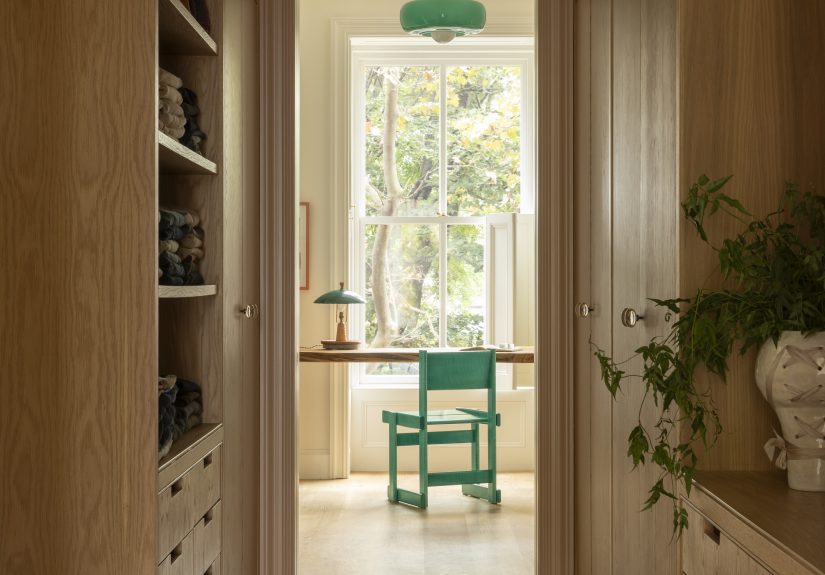
A tucked-away office accessed through the primary suite’s walk-in closet proves that small spaces can still have strong identity:
a punchy green chair, a retro pendant, and enough cohesion to make the room feel intentional.
Kids’ Rooms and the Attic: Texture Is the Secret Sauce
For the child’s bedroom, the design goes whimsical with a mural that can “grow up” as tastes changean excellent long-game move.
Instead of a theme that’s outgrown in six months, the mural becomes a flexible backdrop: the paint colors and textiles can evolve around it.
Up in the attic office, the palette shifts toward bright and white, but texture does the heavy lifting:
zellige tile, a whitewashed wood grain, and a rustic reclaimed-wood floor that adds character without visual noise.
It’s the antidote to sterile minimalismproof that “light” doesn’t have to mean “soulless.”
Preservation Meets Real Life: How Old Details Survive a Modern Household
A historic brownstone is basically a beautiful antique that you also have to cook in. The magic is keeping original featurestin ceilings,
plaster moldings, old staircaseswhile making the house safe, functional, and comfortable. That’s not just aesthetic; it’s a strategy.
Preservation best practices generally favor repairing distinctive features rather than replacing them, and avoiding harsh treatments that damage
historic materials.
Tin ceilings: gorgeous, durable, and not fans of water
Tin (pressed metal) ceilings can be remarkably durable, but they tend to show distress when moisture gets involved:
stains, peeling paint, corrosion, and sagging. The unglamorous truth is that the best “restoration product” is often
fixing the source of water infiltration and controlling humidity before you ever touch a paintbrush.
Plaster: craftsmanship with a price tag
Original plaster walls and moldings are part of what makes a brownstone feel like a brownstone. Restoring them can also be one of the biggest
surprise costs in a renovation, because quality plaster repair is specialized, time-consuming work. The payoff, though, is enormous:
the house keeps its depth, its shadows, its “this place has lived” texture that drywall can’t quite mimic.
Floors and structure: old houses have opinions
In many historic townhouses, floors are charmingly… not level. Correcting that can ripple into baseboards, doors, stairs,
and trimlike pulling one thread and discovering it’s attached to the whole sweater.
This home handled those realities with thoughtful carpentry choices, including custom approaches where needed.
Stoops and facades: maintenance is part of the romance
Outside, brownstone stoops and facades are both iconic and vulnerable. Repairs often involve patching, resurfacing, and careful cleaning.
In landmarked contexts, aggressive methods like sandblasting are commonly prohibited or strongly discouraged; the gentlest effective approach is usually
the goal. Translation: if someone suggests “we’ll just blast it clean,” you’re allowed to clutch your pearls (and then call a preservation-minded pro).
Steal These Ideas: A Designer’s Formula for “New + Old” That Actually Works
1) Let one historic element lead the room
Pick a startin ceiling, original stair, ornate molding, fireplace manteland let it set the tone. Then keep new additions clean and supportive.
2) Use white oak (or another warm wood) as a unifier
In a multi-level townhouse, cohesive wood tones help the home feel continuous rather than chopped into unrelated floors.
3) Add color in “contained” moments
Painted cubbies, a bold rug, a single statement chair, playful hardwarethese are high-impact moves that don’t overwhelm historic architecture.
4) Choose durable “art pieces”
Family life doesn’t mean boring furniture. It means smart materials and rounded edges where it mattersbeauty that can take a hit and keep going.
5) Prioritize light, even if it requires big decisions
The three-story rear window system is the boldest example, but the principle applies at every scale: clearer sightlines, brighter finishes in darker zones,
and layouts that pull you toward daylight.
Extra: of Brownstone “Lived Experience” (What It Feels Like to Really Inhabit a Vertical Home)
Spending time in a Brooklyn brownstone teaches you something you don’t fully grasp from floor plans: vertical living has a personality.
It’s not better or worseit’s just different. Your day becomes a gentle choreography of stairs. You learn where you like to land with coffee,
which floor gets the best morning light, and exactly how many trips you’re willing to make before you start negotiating with yourself
(“Do I really need that charger right now?”).
In an 1850s Anglo-Italianate, that personality is even more specific. The lower stoop can make the entry feel more direct and neighborly.
You’re closer to street life: the rhythms of the block, the seasonal shift in trees, the little theater of Brooklyn errands. At the same time,
the garden level can feel like a quiet hideawaycooler in summer, more tucked-in during winter storms. It’s a private pocket of the house where
you can exhale, even if the city is doing its usual city thing right outside.
Then there’s the sound and texture of old materials. Original staircases have a particular acousticssolid, sometimes slightly creaky, always honest.
Plaster walls don’t behave like new construction; they carry soft shadows, subtle waves, the evidence of time. Tin ceilings add pattern overhead in a way
that feels celebratory, like the house is quietly dressed up even when you’re in sweatpants. These details create atmosphere, but they also demand care.
You get attuned to small signs: a faint water mark, a hairline crack, the kind of thing you’d ignore in a newer home but treat as a meaningful message here.
A brownstone also changes how you host. Instead of one big open box, you have stacked experiences: a lively kitchen, a parlor floor that feels instantly
“occasion-ready,” a top level that can turn into a studio, office, or retreat. Guests move through the house like chapters. And as anyone who’s hosted
in a townhouse knows, the smartest luxury isn’t always a bigger roomit’s a clever support move. A hidden bar near the hangout zone. Storage where you
actually need it. A pantry that prevents your counters from becoming a snack museum.
Renovation stories are practically a neighborhood language in Brooklyn. Talk to enough homeowners and you’ll hear the same themes:
unexpected demolition costs, the artistry (and expense) of plaster repair, the domino effect of leveling floors, and the emotional roller coaster of
opening a wall and discovering a surprise that was not on the mood board. But you’ll also hear why people do it anyway: because when you preserve the soul
of an old house and adapt it for modern life, you get something rarea home that feels both grounded and alive. It doesn’t just look good in photos.
It supports the messy, funny, everyday reality of livingwhile still letting you feel, occasionally, like you should be holding a novel and gazing out a tall window.
Conclusion
This 1850s Anglo-Italianate brownstone in Cobble Hill shows what happens when historic architecture meets a designer who respects the past
but designs for the present. Original plaster moldings, tin ceilings, and a dramatic staircase keep the home rooted in its era. Meanwhile,
a rebuilt rear facade and three-story window system pull daylight deep into the house, and warm white oak millwork creates calm continuity across six levels.
Color appears in confident, curated momentsnever fighting the architecture, always adding personality. In short: it’s preservation with pulse.