Table of Contents >> Show >> Hide
- What Julia Fox Actually Wore And Why It Hit Like A Fashion Alarm
- Why The Internet Went From Shock To Fury In Record Time
- Julia Fox Has Been Building To This Moment For Years
- Was The Dress Too Much, Or Was It Doing Exactly What Couture Is Supposed To Do?
- The Real Reason Barely-There Celebrity Fashion Still Makes People So Mad
- Shock Sells, But So Does Intent
- Experiences Related To The Topic: What It Feels Like To Watch A Julia Fox Fashion Firestorm In Real Time
- Final Take
Julia Fox has never treated the red carpet like a polite little hallway. For her, it is a stage, a billboard, a performance piece, and occasionally a public dare. So when the actress and style provocateur stepped out at a London gala in a barely-there, deconstructed look that seemed to be half power suit, half fashion hallucination, the internet reacted exactly as it always does when Fox enters the chat: with gasps, side-eyes, think pieces, memes, and enough pearl-clutching to stock a vintage costume closet for years.
The now-viral outfit did not just get people talking. It got people spiraling. Some viewers saw a bold work of couture art. Others saw an outfit that looked intentionally unfinished, as if the dressing room had exploded and somehow made it to the red carpet first. Either way, the result was the same: Julia Fox once again became the center of a larger argument about celebrity fashion, body politics, online outrage, and why people lose their minds when a woman refuses to dress for comfort, approval, or anybody’s grandma.
And that is exactly why this look matters. Not because it was “pretty” in a classic Hollywood sense. Not because it was universally flattering, safe, or likely to inspire a thousand prom dupes. It matters because it forced a conversation about what fashion is allowed to be in 2025: elegant, yes, but also ridiculous, theatrical, confrontational, funny, and maybe just a little bit unwell in the most couture way possible.
What Julia Fox Actually Wore And Why It Hit Like A Fashion Alarm
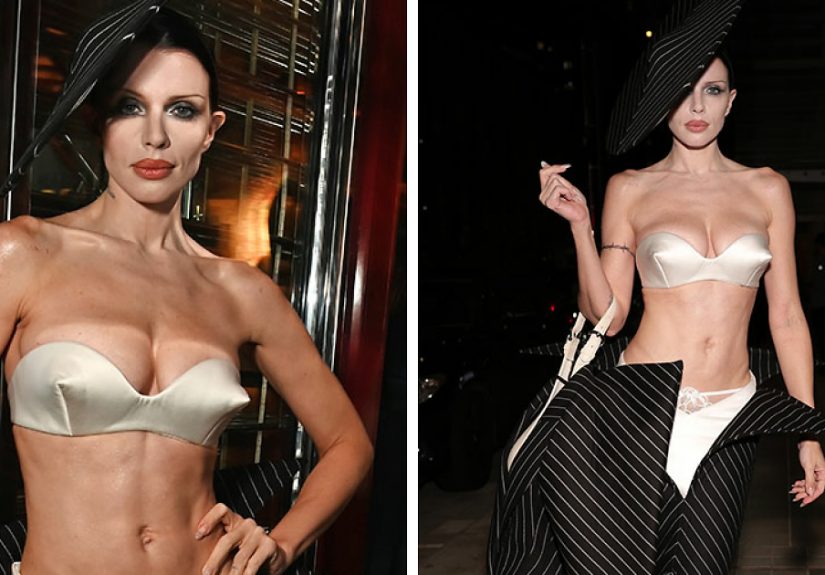
At the Liberatum Cultural Honour Gala in London, Julia Fox arrived wearing a Robert Wun couture look that played with the idea of being “undressed” while technically being very, very dressed. That tension was the whole gimmick, and also the whole genius. The ensemble featured a cone-style bra, a low-slung sculptural pinstripe skirt, a dramatic fascinator-like headpiece, and accessories that leaned heavily into surrealism. The jacket was not simply worn in the normal human way either. In true Fox fashion, it became part prop, part handbag, part punchline.
It was less “here is my gown” and more “here is my thesis statement.” The look borrowed the familiar language of tailoring, then tore it apart before anyone could call it conventional. Pinstripes suggested business. The bra suggested rebellion. The exaggerated shapes suggested that normalcy had left the building several exits ago.
And that, naturally, was enough to send social media into a full-body eye twitch. A revealing look at a gala already gets attention. A revealing look that also mocks the rules of formalwear? That is catnip for the algorithm. Fox did not merely wear a dress. She wore a very online event.
Why The Internet Went From Shock To Fury In Record Time
Julia Fox’s gala outfit hit a familiar cultural nerve. People are often willing to forgive bold fashion when it still follows a recognizable script: sequins, glamour, sexy silhouette, maybe a tasteful cutout if everyone is feeling adventurous. What they do not always forgive is fashion that appears to be laughing at the script altogether.
That is what made this look so divisive. It was not just revealing. It was intentionally strange. It did not ask to be admired quietly from a distance. It demanded a reaction, then stood there while people argued about whether they were looking at brilliance, absurdity, or both. For some critics, the outfit read as attention-seeking. For admirers, that criticism missed the point entirely. Red carpets are built for attention. Wanting to be noticed at a gala is not a scandal. It is practically part of the dress code.
The bigger truth is that audiences tend to get angrier when a celebrity look feels unserious and high-concept at the same time. If a star shows skin in a glamorous gown, people may complain. If a star shows skin while also turning fashion into performance art, some viewers take it personally. Suddenly the conversation becomes less about design and more about morality, decorum, and the ancient internet question: “But why?”
Julia Fox has spent the past few years answering that question with a shrug and another outfit.
Julia Fox Has Been Building To This Moment For Years
Her style has never been about blending in
If this gala look seemed shocking, that may say more about the audience than about Julia Fox. Fox has long described her fashion as something intentional, performative, and meaning-driven. She has talked about providing a “visual service” to the public, which is perhaps the most Julia Fox sentence imaginable and also a surprisingly sharp summary of her brand. She does not dress to disappear into a room. She dresses so the room has something to talk about on the way home.
In more recent comments defending criticism of her clothes, Fox has framed her style as normal within a more art-forward, New York-minded context. Her argument is blunt: if people see theatrical fashion and instantly assume it is madness, maybe they are not spending enough time around theater, museums, fashion shows, or art books. In her view, each outfit carries meaning. Each one is a character. And art, she has said, is supposed to be polarizing.
That philosophy is the key to understanding why the gala look landed the way it did. Fox was not trying to look universally beautiful. She was trying to make a point visually. Whether people loved that point or wanted to throw a virtual cardigan over it was almost beside the point.
The red carpet is her gallery wall
Consider the recent track record. At the 2025 Vanity Fair Oscar Party, Fox wore a sheer Dilara Fındıkoğlu dress with strategically placed hair, creating one of the year’s most talked-about after-party looks. At the 2025 Fashion Trust U.S. Awards, she pivoted from skin-baring spectacle to full-blown theatrical makeup in a hand-painted Marni ensemble that gave clown chic a high-fashion promotion. Soon after, she appeared at the New York City Ballet Fall Fashion Gala in a sculptural Iris van Herpen creation that made her look like a living paper doll from a very expensive dream sequence.
In other words, the Liberatum gala outfit was not some random detour into chaos. It was part of a larger style narrative. Julia Fox keeps returning to the same core idea: fashion does not need to soothe people to be successful. Sometimes it should disturb the wallpaper a little.
Was The Dress Too Much, Or Was It Doing Exactly What Couture Is Supposed To Do?
This is where the debate gets interesting. If you think gala dressing exists mainly to flatter, then yes, Julia Fox’s outfit likely felt excessive. But couture has never been only about flattering. It has also always been about fantasy, silhouette, exaggeration, surrealism, and craftsmanship that turns clothing into spectacle.
Robert Wun’s work often lives in that tension between elegance and disruption. The designer is known for sculptural, conceptual pieces that look like garments caught in the act of transforming. Fox, meanwhile, is one of the few celebrities who consistently understands how to wear an idea instead of just a label. That combination makes sense, even if it is not the sort of thing people want to see at a black-tie event while nibbling tiny appetizers and pretending they understand contemporary culture.
What made the outfit memorable was not simply its minimal coverage. Plenty of stars wear sheer looks. Plenty of stars embrace the naked dress trend. What made this one stick was that it was both revealing and self-aware. It looked like a power suit mid-mutation. It poked fun at authority dressing while still borrowing its language. It said, “Yes, I know what formalwear is. I just do not feel like obeying it tonight.”
And honestly, in a celebrity landscape where so much red carpet fashion feels exhaustingly optimized, that kind of weirdness has value.
The Real Reason Barely-There Celebrity Fashion Still Makes People So Mad
When people claim to be angry about a revealing celebrity outfit, the outfit is not always the only issue on trial. Often, what bothers viewers is the confidence behind it. A woman showing up visibly unconcerned with public approval can still provoke a bigger reaction than the clothes themselves. Add in fame, beauty, irony, and a clear understanding of how media cycles work, and the outrage machine practically starts itself.
Fox also occupies a very specific place in pop culture. She is not trying to be the sweet, universally adored movie star in a tasteful column gown. She is closer to a downtown art project with a publicist. She is messy on purpose, glamorous in a sideways way, and often funnier than people give her credit for. That makes her difficult to package neatly, which in turn makes her easy to criticize.
There is also the wider context. In 2025, “naked dressing” remained a dominant red carpet theme, big enough that it even sparked renewed dress-code chatter at major festivals. The trend itself is not new, but the cultural response to it keeps evolving. One year it is celebrated as fearless. The next year it is treated like proof civilization is circling the drain. The truth is less dramatic: fashion is in a cycle where exposure, illusion, tailoring, and irony keep colliding, and Julia Fox happens to be one of the most visible faces of that collision.
Shock Sells, But So Does Intent
It would be easy to dismiss the entire moment as publicity bait. Julia Fox wears outrageous thing, internet screams, article published, everybody goes home. But that explanation is a little too lazy. The better reading is that Fox understands the entertainment value of a well-aimed style disruption and is unafraid to use it.
That does not make the fashion empty. It makes it effective.
Celebrity dressing today is no longer just about the event in the room. It is about the photo, the headline, the repost, the ten-second video clip, the comment war, the group chat, and the opinion column that arrives after the smoke clears. In that environment, a safe look can disappear in an hour. An audacious one can dominate the news cycle. Fox knows that. More importantly, she seems to enjoy knowing that.
So yes, her gala outfit sparked shock. Yes, it sparked fury. But it also sparked attention, interpretation, analysis, and debate. In fashion terms, that is not failure. That is impact.
Experiences Related To The Topic: What It Feels Like To Watch A Julia Fox Fashion Firestorm In Real Time
There is now a very specific modern experience attached to a Julia Fox red carpet moment, and it unfolds almost like clockwork. First comes the image drop. You are scrolling casually, maybe half-awake, maybe pretending to answer emails, and suddenly there she is in something that looks impossible, impractical, and somehow fully committed. Your brain does a double take. Is it a dress? Is it a concept? Is it both? Before you can fully process the architecture of the outfit, the comments begin flooding in.
Then comes the second experience: collective overreaction as spectator sport. Some people are delighted. Some are baffled. Some act as if they personally have been inconvenienced by a celebrity wearing a cone bra near a gala. The funniest part is how familiar the cycle has become. Everyone knows what is happening, and yet everybody still jumps in like this is the first time fashion has ever been weird in public. Screenshots multiply. Memes arrive. Armchair stylists declare civilization over. Fashion people start explaining that the silhouette is actually brilliant. Non-fashion people respond with digital panic. It is basically the Met Gala comment section in miniature.
There is also a strangely entertaining tension between irritation and fascination. Plenty of viewers claim to hate the look, but they cannot stop looking at it. That is the Julia Fox effect in a nutshell. Her outfits are not always conventionally aspirational, but they are almost always sticky. They stay in your head. They demand to be revisited. You might roll your eyes, but you will still zoom in. You might say the outfit is absurd, but you will still remember it three days later while struggling to recall what anyone else at the event wore.
For fashion fans, the experience can be even more layered. There is the rush of seeing a celebrity actually take a risk in an era when so many stars feel managed to the point of wallpaper. There is the pleasure of decoding references, spotting the designer’s intention, and understanding that an outfit can be ugly-pretty, funny-serious, and confrontational-alluring all at once. Julia Fox often gives that audience something richer than simple beauty. She gives them material.
For everyone else, the experience is often a lesson in how celebrity culture works now. Outfits are no longer just clothes. They are content engines. They launch mini debates about taste, class, feminism, body autonomy, and attention. That may sound dramatic, but it is also why these moments travel so far. People are not just reacting to fabric. They are reacting to what the fabric seems to say.
And maybe that is why Julia Fox keeps winning this strange little game. She understands that in the internet era, the most memorable fashion does not quietly enter the room. It barges in, steals a canapé, starts a fight in the comments, and leaves everyone else looking underdressed and a little bit boring.
Final Take
Julia Fox’s barely-there gala dress was never going to please everyone, and that was probably the point from the moment the outfit left the sketchbook. The look was strange, confrontational, sharply styled, and designed to provoke a response. It did. Mission accomplished.
Whether you see the ensemble as brilliant couture theater or a very fashionable cry for chaos, one thing is hard to deny: Julia Fox understands modern celebrity style better than many of her critics. She knows fashion is no longer judged only by elegance. It is judged by memorability, conversation, and the ability to cut through a saturated culture in one image. Her Liberatum gala outfit did all three without breaking a sweat, though it may have broken a few group chats.
In the end, the loudest outrage around the dress says less about Julia Fox than it does about the discomfort many people still feel when fashion stops trying to be agreeable. Fox is not asking for permission to be tasteful. She is asking whether taste itself has gotten too boring. After this gala, the answer seems to be: people are furious, fascinated, and very much paying attention.