Table of Contents >> Show >> Hide
- Was Tesla Really Designing a Vertical Takeoff Airplane?
- Inside the Patent: How Tesla’s Vertical Takeoff Was Supposed to Work
- The Hardware: Wings, Seating, and a Turbine Heart
- What Tesla Got Right (And What Physics Side-Eyed Immediately)
- Why It Stayed on Paper
- From Tesla’s Patent to Real VTOL: Tiltrotors, Ospreys, and Today’s eVTOL Rush
- Myth vs. Patent: Not Anti-GravityJust Ambition
- Takeaways: What Tesla’s Helicopterplane Still Teaches
- Conclusion
- of Experience: How to “Live With” Tesla’s VTOL Idea Today
- SEO Tags
Nikola Tesla is the kind of historical character who attracts two types of fans: the “I love alternating current” crowd,
and the “he secretly built a flying saucer in a hotel room” crowd. Today we’re hanging out somewhere in the middle
with a real, documented Tesla aviation idea that sounds like science fiction but lives firmly in the filing cabinets of U.S. patent history.
In 1928, Tesla patented a concept for a vertical takeoff and landing aircraftbasically a machine that could rise straight up,
then tip forward and fly like a conventional airplane. He called it a “helicopterplane,” which is either charmingly direct or what happens
when a genius inventor runs out of patience for marketing meetings.
Was it practical? Not really. Was it interesting? Absolutely. And if you’ve been watching the modern eVTOL boom and thinking,
“This feels like the future… and also like a slightly nervous blender,” Tesla’s paper aircraft makes an excellent historical mirror.
Let’s unpack what he designed, why he designed it, what he got shockingly right, and where physics politely asked him to take a seat.
Was Tesla Really Designing a Vertical Takeoff Airplane?
Yesat least on paper. Tesla’s late-career aviation work includes two related U.S. patents issued in January 1928:
one describing a method of aerial transportation and another describing the apparatus to carry it out.
Together, they outline a vehicle that takes off vertically under propeller thrust, transitions by tilting, and cruises supported by wings.
The “helicopterplane,” in plain American English
Picture a compact, boxy biplane-like frame that can stand nearly upright on the ground. When the engine spins up, a propeller provides
enough thrust to lift the whole craft straight into the air. Once it reaches a safe height, the vehicle gradually tilts forward so the wings
start generating lift, and the propeller’s job shifts from “keep me from meeting the sidewalk” to “push me along like a normal airplane.”
That combinationvertical takeoff plus airplane-style cruiseis exactly the promise behind many VTOL and “powered-lift” concepts today.
Tesla was aiming at a problem pilots and operators still care about: runways are great, until you don’t have one.
Inside the Patent: How Tesla’s Vertical Takeoff Was Supposed to Work
Step 1: Stand tall, push air down, go up
Tesla’s idea starts with the craft oriented so the wings (or “foils,” as the patent language calls them) are nearly vertical at rest.
The propeller axis is also vertical, so thrust points straight upward. In theory, that allows a clean liftoff without a runway roll.
If you’re thinking “That’s basically a helicopter,” Tesla thought so toothen immediately started listing why helicopters (as imagined at the time)
had problems.
Step 2: Tilt and transition (the tricky part)
After climbing, the pilot would use elevator controls to gradually tilt the vehicle. As the craft tips, the wings begin acting like wings again,
producing lift from forward motion. Meanwhile, the propeller’s “vertical” contribution decreases as it shifts toward forward thrust.
Tesla was especially focused on managing that handoffkeeping total lift roughly steady as the aircraft changes attitude.
In modern terms, he was describing transition control: the same heartburn that keeps VTOL engineers awake and coffee companies profitable.
Step 3: Cruise like an airplane, land like a magician reversing the trick
In cruise, Tesla’s machine behaves more like a conventional airplane, with wings carrying the load and the propeller providing forward thrust.
For landing, the process reverses: slow down, tip the craft back toward vertical, and use propeller thrust to control descent.
It’s an elegant sequenceon paper. In the air, “paper elegant” is often followed by “metal complicated.”
The Hardware: Wings, Seating, and a Turbine Heart
A compact “box” with two planes
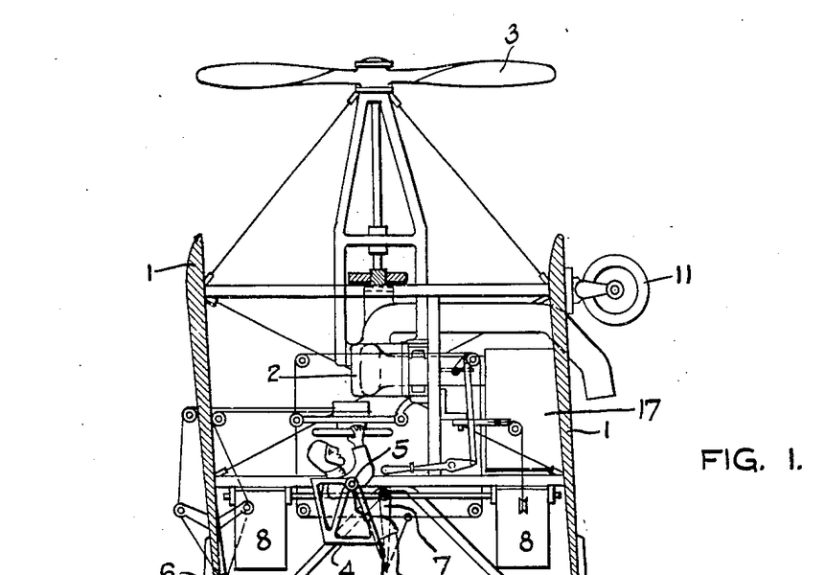
Tesla’s apparatus patent describes a structure with two wings rigidly joined, sized to be compactclose to a square footprint for smallness.
He even suggests omitting the tail, or making it retractable, to keep things tidy. The drawings look less like a sleek fighter and more like a
cleverly braced platform with wings attachedpractical in mindset, if not in aesthetics.
The rotating-seat detail that feels oddly modern
One of the most human parts of Tesla’s design is also one of the most memorable: the seats are suspended on pivots so the operator and passengers
could rotate through about 90 degrees. That way, if the craft is upright for takeoff, the people inside don’t have to be upright like lawn darts.
Tesla clearly cared about the “tiny detail” of not terrifying your customers before you even leave the ground.
Why Tesla wanted turbines (and why VTOL loves power-to-weight)
Tesla argues the aircraft needs a very light, powerful prime moverthen points to his own turbine design as a strong candidate.
That instinct is hard to argue with. Vertical takeoff is brutally honest about physics: if your power-to-weight ratio isn’t there,
you don’t “sort of” lift off. You just make extremely expensive noise.
Historically, turbine engines became central to high-performance vertical flight concepts because turbines deliver strong power for their weight.
Tesla’s instinctpair VTOL ambitions with turbine-like power densitywas forward-looking even if his specific implementation wasn’t.
What Tesla Got Right (And What Physics Side-Eyed Immediately)
He was early to the tilt-rotor/tilt-wing party
The big ideavertical lift, then tilt into efficient forward flightmatches the core logic of tiltrotor aircraft that arrived decades later.
Some aviation historians have noted Tesla’s concept resembles later tilt-rotor and tilt-wing developments, at least in theoretical layout.
If nothing else, he was thinking in the same “best of both worlds” direction.
He understood the runway bottleneck
Tesla explicitly frames the runway requirement as a barrier to commercial aviation: you need speed to generate lift, and speed demands space.
Remove the runway, and suddenly the airplane stops being an “airport-only” creature. That’s basically the same promise that modern
urban air mobility loves to pitchjust with more lithium batteries and fewer mustaches.
He appreciated the “move more air slower” efficiency idea
Tesla draws on classic propulsion reasoning: for a given thrust, moving a larger mass of air at a lower velocity can be more power-efficient
than blasting a small mass of air very fast. That’s why rotor disks get big, and why helicopters don’t usually use tiny propellers spinning at
ridiculous speeds (unless your goal is a dramatic soundtrack).
So why didn’t it fly?
Because hovering is not impressed by optimism. Tesla’s own method patent spends time describing how helicopter-like machines can become unstable
when tilted, and how they may oscillate or plunge in disturbed air. Ironically, those concerns also underline why his compact platform
would have been so difficult to control in hover and transition.
There’s also the unglamorous issue of torque. A single large propeller wants to spin the aircraft body in the opposite direction.
Tesla mentions countermeasures like counter-rotating elements, but designing stable vertical flight is a whole discipline, not a footnote.
Modern rotorcraft stability involves rotor size, disk loading, control authority, gyroscopic effects, and (in many designs) sophisticated
control systems. Tesla did include conventional control surfaces for airplane-like flight, but hovering is a different beast with different teeth.
Why It Stayed on Paper
Timing matters. By 1928, Tesla was late in life, financially strained, and no longer operating with the kind of lab support that powered his
earlier breakthroughs. Building experimental aircraft is expensive, risky, and very good at turning “vision” into “invoice.”
Without funding, a team, and sustained testing, even strong concepts remain drawings.
And to be fair: many brilliant aviation ideas in the early 20th century never left paper. The difference is that Tesla’s name makes every
unbuilt sketch feel like a lost chapter of a superhero origin story.
From Tesla’s Patent to Real VTOL: Tiltrotors, Ospreys, and Today’s eVTOL Rush
The XV-15: proving transition can be tamed
Decades after Tesla’s patents, tiltrotor research became real hardware. NASA’s work with the Bell XV-15 helped demonstrate that an aircraft
could take off vertically, hover, and transition into fast forward flight with airplane-like cruise efficiency. The XV-15 programinitiated in
the 1970s and flown in NASA research in the 1980swas a major stepping stone for later designs.
The Osprey: a loud, complicated proof of concept that actually ships
The Bell-Boeing V-22 Osprey (and variants like the CV-22) embodies the “helicopter plus airplane” promise: vertical takeoff and landing qualities
paired with longer range and higher speed than a typical helicopter. It’s not a simple aircraft, but it’s an existence proof that the transition
Tesla described can be engineeredat great cost, with great complexity, and with a very serious maintenance manual.
Modern “powered-lift” and eVTOL: Tesla’s question, new answers
Today’s wave of electric VTOL vehiclesair taxis, cargo lifters, and other runway-independent conceptshas pushed regulators to clarify categories.
The FAA describes “powered-lift” as aircraft capable of vertical takeoff, vertical landing, and low-speed flight, then airplane-like cruise flight.
That definition is basically Tesla’s pitch, updated for the age of batteries, distributed propulsion, and noise complaints from everyone who lives
within two miles of anything fun.
The technology is different, but the dream is similar: safer access, more flexible takeoff/landing, and a new layer of mobility that isn’t chained
to long runways. Tesla didn’t invent modern eVTOLbut he certainly asked the same foundational question: “What if airplanes didn’t need to run first?”
Myth vs. Patent: Not Anti-GravityJust Ambition
What Tesla actually described
Tesla’s “vertical takeoff airplane” is not an anti-gravity craft. It’s not a reactionless drive. It’s not a secret electromagnetic saucer.
It’s a mechanically propelled VTOL concept: propellers, wings, control surfaces, and a high-power engine (ideally turbine-like).
The patents read like an inventor trying to bridge helicopter-like lift and airplane-like cruise with the tools of his time.
Why the wilder myths keep attaching themselves anyway
Tesla’s real accomplishments were huge, his public persona was theatrical, and his later years were filled with grand predictions.
That combination is basically catnip for folklore. When people hear “Tesla” and “flying machine,” they mentally skip the propeller drawings and
jump straight to glowing discs. The truth is less paranormaland more interesting for engineersbecause it shows exactly where imagination
meets constraints.
Takeaways: What Tesla’s Helicopterplane Still Teaches
1) Vision is cheap; transition is expensive
The hardest part of VTOL isn’t the elevator pitch. It’s the transition between flight regimes, where stability, control, and efficiency all argue
with each other at once. Tesla identified the transition idea early, but didn’t have the test infrastructure to iterate toward reality.
2) Power-to-weight is the bouncer at the VTOL club
Tesla was right to obsess over a lightweight, powerful engine. VTOL doesn’t negotiate with underpowered designs.
Whether it’s turbines or electric motors, the math is unforgiving.
3) A “wrong” design can still be historically valuable
Even if Tesla’s helicopterplane wouldn’t have flown as drawn, it captures an early attempt to unify vertical lift and efficient cruise.
It’s a snapshot of problem-solving: clear target, bold approach, incomplete execution. That’s not a failure storyit’s an innovation story.
Conclusion
Nikola Tesla’s vertical takeoff airplane is best understood as a brilliant sketch at the edge of what early 20th-century aviation could support.
He wasn’t secretly hiding a miracle engine; he was trying to solve a practical bottleneckrunwaysusing wings, propellers, and a high-power engine.
He anticipated the appeal of runway-independent flight and the logic of tilting from vertical lift to horizontal cruise, concepts that later became
real in tiltrotors and are now being reimagined in the eVTOL era.
If nothing else, Tesla’s helicopterplane reminds us that the future arrives in two stages: first as a drawing, then as a long list of engineering
problems. And occasionally, as a seat that swivels 90 degrees so your passengers don’t spend takeoff wondering if gravity has filed a complaint.
of Experience: How to “Live With” Tesla’s VTOL Idea Today
You don’t need a hangar or a billionaire’s budget to have a surprisingly hands-on experience with Tesla’s vertical takeoff airplane concept.
In fact, the most useful “experience” starts exactly where Tesla did: with the drawings and the logic. Pull up the patent illustrations and
give yourself five quiet minutes to trace the sequencevertical climb, gradual tilt, forward cruise. You’ll feel your brain do the same thing
engineers still do today: translate a story into forces. Where is thrust pointing now? Where is lift coming from now? What happens if wind nudges
the craft mid-transition? That mental simulation is the first real rite of passage into VTOL thinking.
Next, try the museum-and-documentary route, because it adds something a patent can’t: scale. Reading about “vertical takeoff” is one thing;
seeing real VTOL and tiltrotor hardware is another. Even a short virtual deep dive into NASA’s tiltrotor history makes Tesla’s challenge feel more
concrete: the reason rotor disks get large, the reason transitions are tested for years, the reason “it hovered once” is not the same as “it’s a product.”
You come away with a respectful appreciation for every unglamorous test flight that turns a sketch into a survivable vehicle.
If you want an experience with a little more “hands,” build (or watch) a small RC tiltrotor or tilt-wing model. You’ll quickly learn why Tesla’s
paper sequence is the easy part. Models make the transition problem visible: tilt too fast and you lose lift; tilt too slow and you waste power;
get the center of gravity wrong and the aircraft behaves like a shopping cart with one rebellious wheel. Even when the model is stabilized by modern
flight controllers, you can feel the design’s sensitivity. It’s a safe, affordable way to understand why Tesla’s compact platform would have needed
careful control solutions that simply weren’t available in 1928.
For a more modern angle, follow the emerging “powered-lift” and eVTOL ecosystem like a curious adult, not a hype sponge. The most interesting
experience is noticing the repeating pattern: big promises, then the slow grind of certification, noise rules, pilot training, and operational realities.
When you read about vertiports, you’ll realize Tesla didn’t just imagine a new aircrafthe implicitly imagined new infrastructure.
When you hear about pilot rating categories, you’ll recognize that hybrid flight creates hybrid training needs.
Finally, do the most Tesla thing possible: keep it playful. Treat the helicopterplane as a conversation starter at the intersection of history and
engineering. Ask friends, “Would you ride in a machine that takes off standing up?” Then watch them negotiate internally between wonder and terror.
That reactionthe human side of new flighthas always been part of the story. Tesla designed swiveling seats for a reason. The technology moves fast,
but passengers still like feeling like upright mammals.