Table of Contents >> Show >> Hide
- Why Space Hacks Happen in the First Place
- The Classic Space Hacks That Earned Their Legendary Status
- Not Every Space Hack Begins as an Emergency
- Why Short Video Recaps Keep Bringing These Stories Back
- What Earth Can Learn from the Long Tradition of Space Hacks
- Experiences Related to “Short Video Recaps A Long Tradition Of Space Hacks”
- Conclusion
Short video recaps love a good space story because space is already dramatic before anyone adds music, captions, or a thumbnail with a shocked face. Take one astronaut, one impossible problem, and one suspiciously ordinary object like a toothbrush or some duct tape, and suddenly you have internet gold. But beneath the snack-size storytelling is something much bigger: a long, very real tradition of space hacks.
For decades, astronauts, engineers, and flight controllers have solved mission-threatening problems with whatever was on hand. Sometimes that meant adapting hardware in the middle of a crisis. Sometimes it meant patching software on the fly. And sometimes it meant doing something so gloriously low-tech that it sounds like a prank, such as using floating tea leaves to find an air leak aboard the International Space Station. The joke writes itself, but the engineering is no joke at all.
This is why the best short video recaps work. They do not just celebrate clever fixes. They reveal the culture of human spaceflight itself: prepare obsessively, trust the team, improvise carefully, and never assume the universe will follow your checklist just because your checklist is laminated.
Why Space Hacks Happen in the First Place
Space missions are built on planning. Every maneuver is rehearsed, every tool is chosen for a reason, and every contingency gets its own stack of procedures thick enough to make a college textbook feel insecure. Yet space remains rude. Hardware breaks. Dust gets everywhere. Fasteners jam. Air leaks appear. Switches short out. When that happens, crews cannot exactly stop by a hardware store or order overnight shipping.
That reality is what makes space hacks different from ordinary DIY problem-solving. These are not casual “let’s see what happens” experiments. They are disciplined acts of improvisation in a place where errors are expensive, supplies are limited, and bad ideas can become documentaries with sad music. A real space hack is not reckless. It is creative engineering under pressure.
That mindset has defined human spaceflight from Apollo to the Space Shuttle to the ISS. The tools have changed. The stakes have not.
The Classic Space Hacks That Earned Their Legendary Status
Apollo 13 and the “Square Peg in a Round Hole” Problem
If space hacks had a hall of fame, Apollo 13 would be in the lobby, smiling modestly while everyone else applauded. After the oxygen tank explosion in April 1970, the lunar module became a lifeboat for three astronauts. The problem was that it had been designed to support two men for about two days, not three men for roughly four. Carbon dioxide began building up, and the available lithium hydroxide canisters from the command module did not fit the lunar module’s system.
The solution was a makeshift adapter built from materials already on board, including plastic bags, cardboard, and tape. It was ugly, improvised, and beautiful in the only way that matters: it worked. This was not merely a famous fix. It became the template for how people think about emergency innovation in space. The lesson was clear. You do not need a perfect part when you can build the right function.
The Apollo 13 rescue story still gets compressed into dramatic little clips today, and fair enough. It deserves the highlight reel. But what those short recaps sometimes miss is that the hack succeeded because of deep systems knowledge on the ground and calm execution in the spacecraft. The magic was not the duct tape. The magic was the team.
Apollo 14 and the Software Patch That Saved a Moon Landing
Hardware gets a lot of attention because tape looks better on camera than software logic. But Apollo 14 delivered one of the coolest digital-era space hacks of all time. Before landing, a faulty abort switch in the lunar module threatened to send false abort commands to the onboard computer. That is a bad time for a switch to become creatively expressive.
Engineers on the ground came up with a workaround that effectively patched the guidance computer so it would ignore the false signal during descent. The fix was radioed up, entered manually, and it worked. Apollo 14 went on to make an exceptionally precise landing.
This episode matters because it shows that “space hack” does not always mean jury-rigged hardware. Sometimes the tool is logic. Sometimes the emergency fix looks less like a roll of tape and more like a master class in calm programming under absurd pressure. In the age of short video explainers, this story deserves more love because it proves software heroics were part of spaceflight long before modern coders started naming bugs after cartoon animals.
Apollo 17 and the Lunar Rover Fender Fix
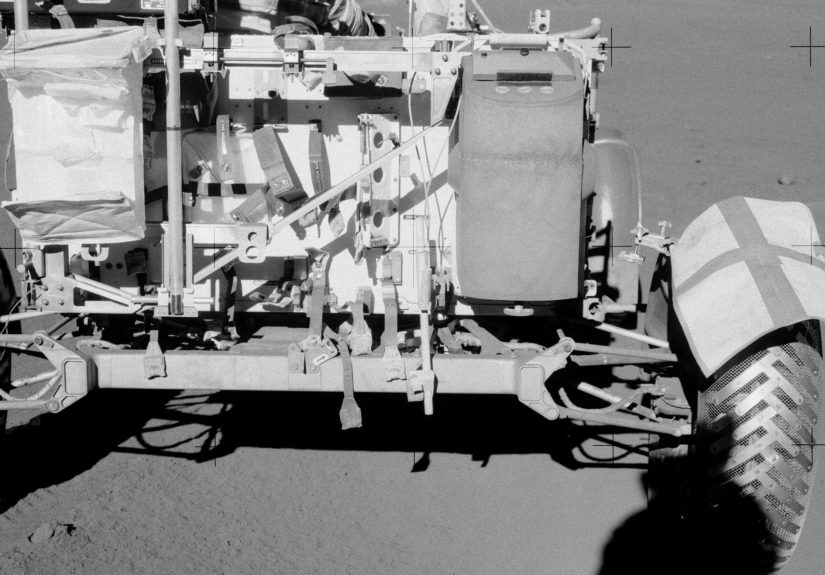
Apollo 17 supplied another classic. During the mission, part of the lunar rover’s fender came off, which meant the vehicle started throwing up heavy sprays of lunar dust. Moon dust is not cute. It is abrasive, clingy, and deeply committed to ruining everyone’s day. Too much dust could coat equipment, overheat systems, and create serious trouble for suits and instruments.
The answer was a field repair made from lunar maps, clamps, and duct tape. Mission Control worked out the method, the crew assembled it, and the rover got a functional new fender. It was not elegant in a showroom sense, but on the Moon, “works” is an elite aesthetic.
This hack is one reason space history continues to thrive in short-form video. It has everything: danger, absurd materials, high stakes, and the kind of visual before-and-after that social platforms adore. Yet it also captures a deeper truth. Space exploration has always depended on adaptability as much as hardware.
The $2 Toothbrush That Helped Save an ISS Repair
Fast-forward to the International Space Station and the tradition continued in wonderfully humble fashion. During a 2012 effort to install a Main Bus Switching Unit, astronauts ran into trouble with a stubborn bolt and debris in the receptacle. The repair mattered because the station’s power-routing hardware is not exactly decorative.
The eventual fix involved improvised cleaning tools, including a modified toothbrush used during a spacewalk to help clear debris. On Earth, an old toothbrush already lives a weird second life cleaning tile grout, bike gears, and the occasional keyboard keycap. In orbit, it got promoted to power-system support staff.
This is the kind of story that thrives in a short recap because it is instantly relatable. Viewers do not need a degree in aerospace engineering to appreciate the phrase “they fixed the space station with a toothbrush.” But the real takeaway is more sophisticated: even on a giant, permanently crewed laboratory, repairs often depend on flexible thinking and tool repurposing, not just formal procedure.
Tea Leaves and the Hunt for an Air Leak
In 2020, crews aboard the ISS tracked down a stubborn air leak in the Russian segment using floating tea leaves. Yes, actual tea leaves. After more formal methods narrowed the search area, the drifting particles helped reveal how air was moving in microgravity and pointed the crew toward the leak location.
It sounds almost comic, and that is part of why people love the story. Space station engineers have access to advanced systems, sensors, cameras, and diagnostic tools. But when the moment called for a simple airflow visualization trick, a tea bag stepped into the spotlight like an unexpected supporting actor stealing the whole movie.
The point is not that space agencies should replace instruments with kitchen supplies. The point is that smart improvisation often comes from recognizing physical principles, then using the simplest workable method available. In that sense, the tea-leaf leak hunt belongs in the same lineage as Apollo’s great fixes.
Not Every Space Hack Begins as an Emergency
Some of the most important space hacks are less cinematic. They are the quiet, daily adaptations that make life in orbit possible. The ISS has been continuously inhabited since 2000, and that kind of long-duration living turns every ordinary task into a design challenge. How do you store tools that want to float away? How do you keep cables organized? How do you stop simple routines from becoming slapstick?
The answer often involves an ongoing ecosystem of Velcro, clips, restraints, straps, bungee cords, and improvised organization. Spaceflight has a long history of relying on these humble helpers. NASA documentation and images from shuttle missions show just how normal it is for astronauts to use practical restraints and repurposed objects to keep things under control in microgravity.
That is why “space hack” should not be understood only as a crisis response. It is also a survival style. In orbit, good enough can be brilliant when it is safe, repeatable, and effective. A clever stowage solution that prevents a tool from drifting away at the wrong moment may never trend online, but it absolutely counts.
Life Support Is Basically an Ongoing Masterclass in Adaptation
The most impressive long-term hack may be the station itself. Living in space requires crews to treat water, manage air, store waste, maintain equipment, and keep a closed environment functioning year after year. NASA’s water recovery systems have steadily improved, and the station’s Environmental Control and Life Support System recently demonstrated the ability to recover around 98 percent of the water brought into the system.
That is not a one-off MacGyver moment. It is a giant institutional hack in the best sense of the word: redesigning everyday life so that limited resources go farther. Recycled water, compact systems, repair culture, maintenance-friendly tools, and careful reuse all reflect the same underlying principle found in the famous emergency stories. In space, sustainability is not trendy branding. It is operational reality.
Why Short Video Recaps Keep Bringing These Stories Back
Short-form videos are good at turning technical history into memorable stories. A three-minute explainer can introduce viewers to Apollo 13, the lunar rover fender repair, or the toothbrush EVA faster than a traditional documentary and with far fewer slow zooms over patriotic brass music. For younger audiences especially, short recaps can be the front door to deeper interest in engineering and space history.
They also work because the stories are wonderfully human. Space programs are often framed as monuments of precision, but hacks reveal the human layer inside the machine. They show that even the most advanced missions depend on judgment, teamwork, and the ability to think sideways when the obvious path is blocked.
Still, the best recap videos should be seen as appetizers, not the whole meal. A clever thumbnail can tell you a toothbrush helped repair the ISS. It cannot fully explain the engineering culture that made astronauts comfortable modifying a tool in the first place, or the years of design lessons that taught NASA how to support in-orbit repairs. The short version is fun. The long version is where the real wisdom lives.
What Earth Can Learn from the Long Tradition of Space Hacks
There is a reason these stories keep resonating beyond the space community. They contain lessons that work perfectly well on Earth. Build systems that can be repaired. Train people to understand principles, not just procedures. Keep tools flexible. Respect simple solutions. And never underestimate the value of calm people who know how a system actually works.
Space hacks also remind us that innovation is not always shiny. Sometimes it looks like a patched filter, a rewritten sequence, a taped-up fender, or a toothbrush promoted above its original job description. The public tends to celebrate invention as the creation of something new. Space history teaches an equally useful truth: invention can also mean recombining what you already have when the situation changes faster than the plan.
That is why the tradition matters. The stories are entertaining, yes. They are also a record of how exploration really works when theory meets reality and reality refuses to be cooperative.
Experiences Related to “Short Video Recaps A Long Tradition Of Space Hacks”
One reason this topic lands so well with readers and viewers is that it combines two very different experiences at once. On one side, there is the modern experience of discovering space history through short videos. You are scrolling, half-distracted, maybe pretending to do something productive, and suddenly a creator says astronauts once fixed a life-or-death problem with tape, maps, tea leaves, or a toothbrush. That contrast is irresistible. Space is supposed to feel futuristic and untouchable. A humble object from your bathroom or kitchen collapsing the distance between “ordinary life” and “orbital crisis” makes the story instantly memorable.
On the other side, there is the actual lived experience of a space hack, and that experience is much less cute than the recap makes it seem. In real missions, these moments arrive wrapped in stress, uncertainty, limited time, and the knowledge that there may not be a backup plan for the backup plan. Astronauts are not grinning because they have become accidental influencers for the duct tape lobby. They are concentrating because a bad decision in orbit can multiply fast. The remarkable thing is not that the materials look ordinary. It is that the people involved stay disciplined while using them.
There is also a powerful emotional experience built into these stories for everyone watching from Earth. Space hacks make exploration feel human-sized. Rocket launches, mission architecture, and life-support systems can seem abstract to the general public. But a repair assembled from familiar objects gives people a way in. Suddenly, space is not just about massive budgets, giant engines, and pristine labs. It is also about resourcefulness, teamwork, and the universal experience of trying to make something work when it really, really does not want to cooperate.
That may be why these stories have such staying power. They do more than entertain. They reassure. They tell us that exploration is not powered by perfection alone. It is powered by prepared people who can think clearly when reality gets messy. That is a comforting lesson whether you are talking about astronauts in orbit, engineers in Mission Control, or regular people trying to fix a problem on a Tuesday afternoon with one screwdriver, a flashlight, and rising concern.
Short video recaps capture the spark of that feeling. Longer articles preserve the depth. Put them together, and you get the full experience of the topic: the wow factor of the quick story, followed by the deeper appreciation that these were not random lucky saves. They were the result of training, design knowledge, and a culture that respected both procedure and adaptability. That is the real tradition of space hacks. It is not chaos. It is competence under pressure, occasionally wearing the disguise of a tea bag.
Conclusion
Short video recaps may be giving space hacks a fresh audience, but the tradition itself is old, serious, and deeply woven into the history of human spaceflight. From Apollo 13’s improvised carbon-dioxide adapter to Apollo 14’s software patch, from Apollo 17’s rover fender fix to the ISS toothbrush repair and tea-leaf leak hunt, these stories reveal the same truth again and again: exploration belongs to people who can adapt.
That is the lasting appeal of this topic. It is not just about clever objects or dramatic emergencies. It is about a mindset. Space rewards preparation, but it also rewards flexible intelligence when reality refuses to cooperate. Short clips can introduce that idea in a few entertaining minutes. The longer history shows why it matters so much.