Table of Contents >> Show >> Hide
- What Does It Mean to Say the Universe Is Expanding Faster?
- The Two Main Ways Scientists Measure Cosmic Expansion
- Then James Webb Showed Up
- Why This Matters More Than It Sounds
- Could Dark Energy Be the Culprit?
- Other Ideas Scientists Are Testing
- So, Is the Universe Really Expanding Faster Than We Thought?
- What Happens Next?
- Conclusion
- A Human Experience of a Faster-Expanding Universe
For a while, cosmology had the vibe of a very confident person explaining directions while holding the map upside down. Scientists knew the universe was expanding. Then they learned it was expanding faster. Then they realized that today’s universe may be expanding faster than their best model predicted. At that point, the cosmos stopped being a tidy lecture slide and became a full-blown mystery with suspense, rival camps, and enough jargon to make a graduate student reach for extra coffee.
At the center of this story is the Hubble constant, the number astronomers use to describe how fast space is stretching right now. In simple terms, it tells us how quickly galaxies move away from one another as the universe expands. The bigger the number, the faster the expansion. That value matters because it helps scientists estimate the age of the universe, understand how cosmic structures formed, and test whether the standard model of cosmology still deserves its gold star sticker.
Here is the problem: different methods for measuring the universe’s expansion rate do not agree. One set of measurements, based on the early universe and the cosmic microwave background, points to a value around 67 to 68 kilometers per second per megaparsec. Another set, based on stars and supernovae in the nearby universe, tends to land around 70 to 76, with many famous measurements clustering near 73. That gap might look tiny, but in physics, a small mismatch can be the scientific equivalent of hearing a smoke alarm in the next room.
What Does It Mean to Say the Universe Is Expanding Faster?
First, a quick reality check: galaxies are not all flying through empty space like popcorn kernels in a microwave. Space itself is stretching. A classic comparison is raisin bread dough rising in the oven. As the dough expands, each raisin sees the others moving farther away. The raisins are not trying to leave the loaf; the loaf is growing. The universe works in a somewhat similar way, only with fewer carbs and dramatically more dark energy.
When astronomers say the universe is expanding faster than we thought, they do not mean someone just found a speedometer taped to a galaxy. They mean the measured present-day expansion rate appears higher than the value predicted by studying conditions in the early universe and then running the math forward using the standard cosmological model, often called Lambda-CDM. If those numbers stubbornly refuse to match, then either one set of measurements is off, or the model is missing something important.
The Two Main Ways Scientists Measure Cosmic Expansion
1. The early-universe method
This method starts with the cosmic microwave background, the faint afterglow of the Big Bang. Missions and experiments that study this ancient light let scientists infer what the universe was like when it was very young. From there, cosmologists use the standard model to calculate what the Hubble constant should be today. Measurements from major projects such as Planck and the Atacama Cosmology Telescope have favored values near the high 60s.
This approach is powerful because the early universe was comparatively simple. It was hot, dense, and weird in a mathematically useful way. But this method is still model-dependent. It does not directly measure today’s expansion rate. It infers it. If the model is incomplete, the final answer could be beautifully precise and still slightly wrong. Science is rude like that.
2. The late-universe method
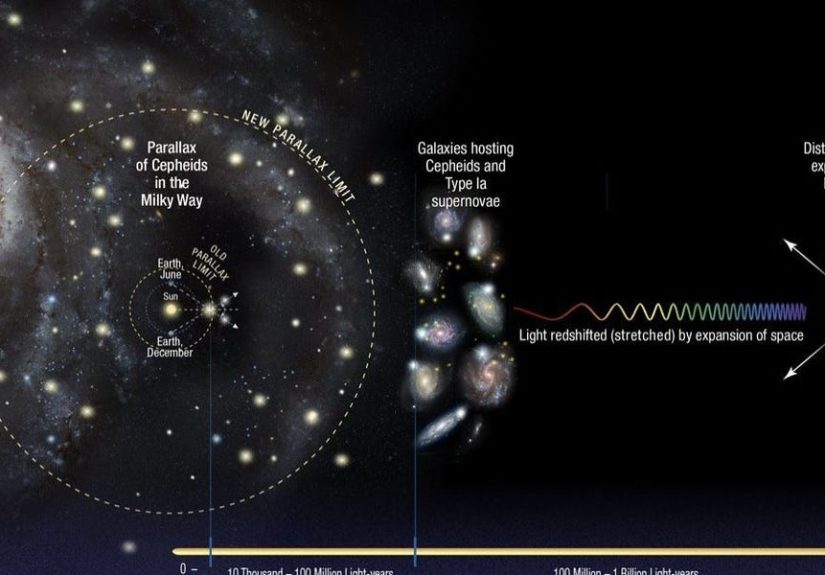
This method looks at objects astronomers can observe more directly in the relatively nearby universe. It relies on what is called the cosmic distance ladder. First, researchers measure distances to nearby stars, especially Cepheid variable stars, whose brightness changes in a predictable way. Those stars help calibrate the distances to galaxies. Then astronomers use Type Ia supernovae, which behave like standard candles, to extend those measurements much farther out into space.
That late-universe approach has repeatedly produced higher values for the Hubble constant. For years, critics wondered whether hidden errors were skewing the results. Maybe crowded star fields made Cepheids look brighter or dimmer than they should. Maybe the ladder had a shaky rung. Maybe the universe was not broken; maybe the measuring tape was.
Then James Webb Showed Up
The James Webb Space Telescope entered this debate like a new detective in the final season of a prestige drama. Because Webb can see with sharper infrared detail than Hubble in key situations, astronomers hoped it could test whether crowding and other subtle issues were contaminating distance measurements.
And what happened? Webb complicated things in the most cosmology-approved way possible.
Some high-profile Webb studies backed the case that the local measurements are real and that the universe’s present-day expansion rate really does look faster than expected. That strengthened the famous Hubble tension, the name given to the disagreement between early- and late-universe estimates.
But other Webb-based analyses, especially work associated with Wendy Freedman and the Chicago-Carnegie Hubble Program, suggested a lower value closer to about 70 kilometers per second per megaparsec. That does not fully erase the tension, but it does shrink the drama a bit. In other words, Webb did not slam the case shut. It gave scientists better evidence and a more refined argument.
So where are we now? The most honest answer is this: astronomers agree more than before on some of the distance measurements, but not yet on the final cosmic verdict. That is progress, even if it is the kind of progress that still causes panel discussions to run overtime.
Why This Matters More Than It Sounds
The Hubble constant is not just a nerdy number for people who own telescope mugs. It is tied to some of the biggest questions in science. If the standard cosmological model cannot reconcile these measurements, then something fundamental may be missing from our picture of reality.
That “something” could involve dark energy, dark matter, or new physics in the early universe. It could mean there was an extra burst of energy shortly after the Big Bang. It could mean dark energy is not constant after all. It could even point to subtle effects from phenomena that have not been fully accounted for yet. None of these options are small edits. They would be more like rewriting a chapter in the cosmic instruction manual, assuming the universe ever included instructions in the first place.
Could Dark Energy Be the Culprit?
Possibly. Dark energy is the catch-all name for whatever is causing the universe’s expansion to accelerate. Scientists know it behaves as though empty space has its own kind of repulsive energy, but they do not know exactly what it is. That is a small issue only if you consider “what is most of the universe doing?” a minor detail.
Recent DESI results have added more intrigue. DESI, the Dark Energy Spectroscopic Instrument, is building an enormous 3D map of the universe using millions of galaxies and quasars. Some recent analyses suggest that dark energy may not be perfectly constant over time. If that hint holds up, it could affect how cosmologists interpret the expansion history of the universe and maybe even help explain why different methods disagree.
That said, cosmologists are not yet throwing Lambda-CDM out the window. DESI’s data, taken alone, are still broadly consistent with the standard model. The tension appears when multiple datasets are combined. So we are not at “rewrite all textbooks immediately” territory. We are at “circle this in red pen and keep checking” territory.
Other Ideas Scientists Are Testing
Gravitational waves
Collisions between neutron stars and black holes create ripples in spacetime called gravitational waves. These events can act as “standard sirens,” giving astronomers a new way to estimate cosmic distances without relying on the traditional distance ladder. This method is still developing, but it is exciting because it offers an independent check. Scientists love independent checks almost as much as they love acronyms.
Strongly lensed supernovae
When a massive galaxy bends the light from a supernova behind it, astronomers can sometimes see multiple images of the same explosion arriving at different times. Measuring those delays can reveal the expansion rate of the universe. These events are rare, but they are considered one of the most promising ways to break the tie between competing measurements.
New early-universe physics
Some researchers are exploring ideas such as early dark energy or even primordial magnetic fields that could change how the infant universe behaved before the cosmic microwave background was released. If the early universe expanded a bit differently than current models assume, the lower inferred value of the Hubble constant might need revision. These ideas are fascinating, but none has become the clear winner yet.
So, Is the Universe Really Expanding Faster Than We Thought?
At the moment, the safest answer is yes, according to several major late-universe measurements, but the full story is still being worked out. The apparent faster expansion is real enough to remain one of the biggest puzzles in modern cosmology. Yet the exact size of the mismatch, and whether it signals brand-new physics or a still-hidden measurement issue, remains unsettled.
That is not a weakness of science. It is science doing its job in public. The measurements are getting better. The arguments are getting sharper. The uncertainty is becoming more precise, which sounds like a joke but is actually a major achievement. Every new telescope, every better calibration, and every independent method pushes the field closer to an answer.
What Happens Next?
The next few years should be especially interesting. NASA’s Nancy Grace Roman Space Telescope is expected to survey huge areas of the sky far faster than Hubble. Euclid is also contributing to the effort to understand dark energy and cosmic structure. DESI will continue expanding its map of the universe. Gravitational-wave astronomy will keep maturing. And Webb, despite already stirring the pot, will keep delivering more data.
If these tools converge on the same answer, cosmologists may finally settle whether the Hubble tension is a measurement problem, a modeling problem, or a sign that the universe is once again refusing to fit into our neat little equations. Frankly, betting against the universe’s ability to be weird has not been a winning strategy so far.
Conclusion
The idea that the universe is expanding faster than we thought is not just a catchy headline. It is a real scientific tension with big consequences. On one side are early-universe measurements that imply a slower expansion rate. On the other are late-universe measurements, many strengthened by Hubble and Webb, that point to a faster one. Add in DESI’s hints about evolving dark energy, and cosmology suddenly looks a lot less settled than the textbooks promised.
That may sound unsettling, but it is also thrilling. We are living in a moment when the universe is not just being observed; it is being cross-examined. The result could be a stronger version of the standard model, a deeper understanding of dark energy, or an entirely new piece of physics. Either way, the cosmos is giving scientists a rare gift: a mystery big enough to matter and precise enough to chase.
A Human Experience of a Faster-Expanding Universe
There is also a more personal side to this topic, and it is one reason the story resonates far beyond physics departments. Most people first meet the universe as a feeling before they meet it as a formula. It happens during a quiet walk at night, on a rooftop under a thin slice of moon, or while staring up from a backyard chair that was supposed to be used for “just five minutes.” You look at the stars and feel something almost impossible to name: awe, tiny panic, curiosity, wonder, and a weird urge to ask questions nobody around you is prepared to answer.
When people hear that the universe is expanding faster than we thought, the reaction is rarely, “Ah yes, interesting tension in late-time cosmological inference.” It is more like, “Wait, what do you mean faster?” That response matters. It reminds us that science is not just a collection of expert conclusions. It is also an invitation to think bigger than daily life usually allows. Bills, meetings, traffic, laundry, mystery leftovers in the refrigerator; all of it shrinks for a second when you realize the fabric of space itself is still unfolding.
There is something deeply human about trying to measure that. Astronomers do not get to stretch a ruler across the cosmos. They work with flickers of light, subtle timing, redshifts, and mathematical models that translate ancient signals into modern understanding. It is a triumph of patience. A Cepheid star brightens and dims. A supernova flashes in a distant galaxy. A ripple in spacetime reaches Earth after a collision that happened hundreds of millions of years ago. From those clues, people build a history of everything. That is both technical and poetic, which is a pretty elite combination.
The topic also changes how many of us experience the night sky. Once you know the universe is expanding, the stars stop feeling like a static ceiling and start feeling like part of a living history. Once you know that scientists are arguing over whether expansion is faster than expected, the sky gets even stranger. It becomes a place where certainty is unfinished. The dots overhead are no longer just pretty. They are evidence.
And maybe that is the best part of this whole story. The universe is not done surprising us. Even after centuries of astronomy, after Hubble, after Nobel Prizes, after space telescopes so advanced they sound like science fiction props, we are still finding cracks in our understanding. That does not make the universe less beautiful. It makes it more alive. A faster-expanding universe is not just a puzzle for cosmologists. It is a reminder that reality is bigger, weirder, and more dynamic than our first explanations. For anyone who has ever looked up and felt both small and lucky to be here, that is not bad news at all. That is the thrill of still not knowing everything.