Table of Contents >> Show >> Hide
- Why the 2016 contest still stands out
- Grand Prize Winner: “Winter Horseman” by Anthony Lau
- The category winners that defined the contest
- Other standout winners that added depth to the gallery
- What made these travel photos so effective
- Why the 2016 winners still matter in today’s photography culture
- The experience of looking through the 2016 winners
- Conclusion
If one photo contest could make you want to pack a bag, charge a camera battery, and dramatically whisper “I should really travel more,” it was the 2016 National Geographic Traveler Photo Contest. Technically, National Geographic officially presented it as the 2016 National Geographic Travel Photographer of the Year Contest, but whatever name you use, the result was the same: a gallery full of images so good they made ordinary vacation pictures look like accidental screenshots.
The 2016 winners did more than show pretty places. They captured weather, motion, silence, architecture, wildlife, and human life with the kind of timing that makes you suspect the photographers either had incredible instincts or made a private deal with the universe. From a horseman charging through the mist of Inner Mongolia to foxes racing across snow in Japan, the winning images proved that travel photography is not just about where you go. It is about how deeply you see once you get there.
What made this contest especially memorable was its balance. The winning photographs did not all lean on one formula. Some were dramatic and cinematic. Others were quiet and geometric. Some revealed the harshness of climate, while others turned everyday moments into visual poetry. Together, the winners turned travel into something larger than tourism. They made it feel like storytelling.
Why the 2016 contest still stands out
The 2016 competition recognized images taken within the previous two years and grouped entries into three categories: People, Cities, and Nature. That structure mattered. It reminded viewers that travel is not just mountains and sunsets. It is also street corners, rituals, routines, architecture, and those brief moments when a place reveals its personality before disappearing back into the crowd.
National Geographic’s judges reviewed thousands of entries before selecting the final winners, and the contest also carried real prestige. This was not an internet popularity contest where the loudest social media caption wins. It was a curated recognition of visual storytelling, technical skill, and emotional impact. In other words, you needed more than a filter and a dream.
The judges also helped define the contest’s tone. The panel included Anne Farrar, National Geographic Travel’s director of photography, along with photographer Corey Arnold and photographer-filmmaker Foster Huntington. That mix of editorial experience and visual storytelling helped shape a set of winners that felt polished without feeling predictable.
Grand Prize Winner: “Winter Horseman” by Anthony Lau
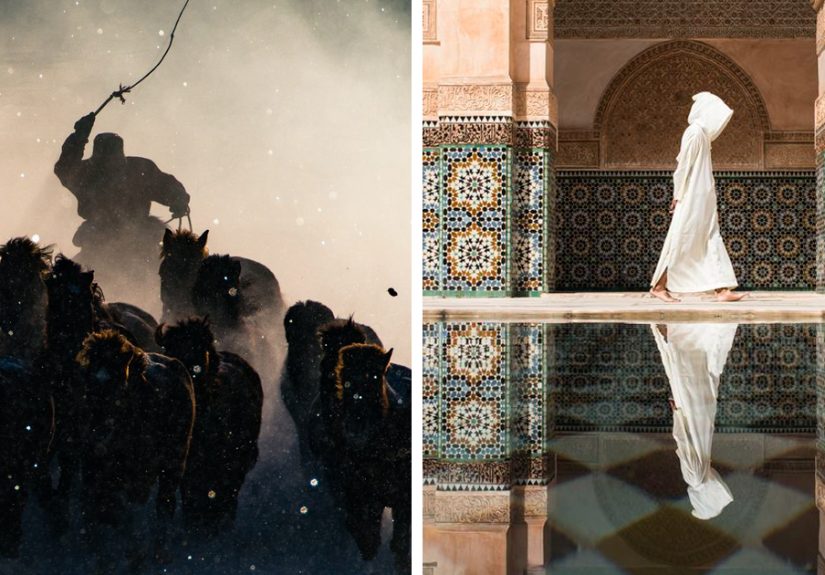
The grand prize went to Anthony Lau of Hong Kong for “Winter Horseman”, a striking image taken in Inner Mongolia. It also won first place in the People category, which feels almost unfair in the best way. Winning one major honor is impressive. Winning two is the photography equivalent of walking into karaoke night and somehow sounding like a headliner.
The photograph shows a horseman and herd emerging through morning mist on a freezing plain. Snow, motion, and atmosphere all work together so seamlessly that the image feels half documentary, half legend. It is not simply a record of a person on horseback. It is a portrait of endurance, landscape, and timing all at once.
Part of what made “Winter Horseman” unforgettable was the way it turned harsh weather into visual drama. Lau captured the rider in a moment that feels both real and mythical, as if the scene had been waiting for centuries for someone to point a lens at it. According to National Geographic’s coverage, he made the shot after an early morning hike while traveling back for breakfast, when he spotted riders showing off their skills. That detail matters because it reveals one of photography’s oldest truths: the best image often happens right when people think the work is over.
There is also a deeper travel story inside the frame. The picture is rooted in place. You can feel the cold, the remoteness, and the relationship between people and landscape. That is what separates strong travel photography from pretty wallpaper. “Winter Horseman” does not just show Inner Mongolia. It suggests what life there feels like.
The category winners that defined the contest
People: Anthony Lau, “Winter Horseman”
The People category winner was the same image that took grand prize, and for good reason. This photograph is a masterclass in visual hierarchy. The horseman is small enough to emphasize the power of the environment, yet strong enough to command the entire scene. It celebrates human presence without pretending humans are bigger than nature. That balance is rare, and it gives the photo its emotional weight.
Cities: Takashi Nakagawa, “Ben Youssef”
In the Cities category, Takashi Nakagawa of Tokyo won first place for “Ben Youssef”, photographed at the Ben Youssef Madrasa in Marrakesh, Morocco. If Anthony Lau’s grand prize image was all weather and momentum, Nakagawa’s winner was its elegant opposite: calm, composed, and mathematically satisfying.
The photograph turns architectural space into a study of stillness and symmetry. Even though the location is famous and often photographed, Nakagawa waited for the right moment to make the scene feel serene rather than crowded. That patience shows. The image has breathing room. It allows the viewer to appreciate texture, shape, and light without visual chaos barging in like an uninvited tour bus.
“Ben Youssef” also reflects one of the smartest lessons in travel photography: cities do not need to be loud to be memorable. Sometimes the strongest urban image is not a skyline with ten million lights. Sometimes it is a quiet passage, a human figure placed just right, and a building that suddenly feels like music you can see.
Nature: Hiroki Inoue, “Wherever You Go, I Will Follow You!!”
The Nature category winner was Hiroki Inoue’s “Wherever You Go, I Will Follow You!!”, shot in Hokkaido, Japan. The image shows two red foxes racing through snow, and it is impossible to look at it without smiling at least a little. That does not mean the photo is cute in a throwaway way. It means it is alive.
The success of this image comes from movement and emotional suggestion. The foxes appear connected, playful, and purposeful, and the snowy setting gives them just enough contrast to pop without losing softness. It feels spontaneous, but the composition is strong enough to remind you that spontaneity in photography often arrives only after skill, patience, and probably a lot of very cold waiting.
Among the 2016 National Geographic travel photo winners, Inoue’s image may be the most immediately accessible. Even viewers who know nothing about camera technique understand it instantly. Two animals. One moment. A clean background. A burst of joy. Sometimes great photography does not need a long speech; it just needs excellent timing and a scene that knows exactly what it is doing.
Other standout winners that added depth to the gallery
The broader lineup of winners and recognized entries gave the contest real range. Second- and third-place images across the categories proved that the 2016 competition was not top-heavy. The gallery had depth, variety, and a refreshing refusal to repeat itself.
In Nature, Massimiliano Bencivenni’s “Double trapping”, photographed in the Brazilian Pantanal, delivered a more dramatic wildlife moment. It was the kind of image that makes nature look both beautiful and mildly terrifying, which, to be fair, is often accurate. In the same category, Victor Lima’s “Lagunas Baltinache (Atacama Desert)” brought a surreal landscape mood, showing moonlit salt ponds in northern Chile with an otherworldly atmosphere.
In People, Yasmin Mund’s “Rooftop Dreams, Varanasi” transformed an urban sleeping scene in India into a layered human tableau. Instead of going for spectacle, the photo focused on an intimate truth: in intense heat, everyday life adapts, and adaptation can become visually remarkable. Mattia Passarini’s “Remote life at -21 degree”, showing a Kinnaura tribeswoman carrying wood in northern India, added another kind of human story. It was less about drama and more about resilience.
In Cities, Wing Ka H.’s “Silenced” captured a university dormitory scene in Guangzhou, China, turning repetition and social commentary into a strong urban image. Jeremy Tan’s “Celestial Reverie”, featuring lightning near Komtar Tower in George Town, Malaysia, leaned more theatrical, proving that city photography can be as electric as any landscape shot. Yes, that pun absolutely wrote itself.
The honorable mentions also helped round out the contest. Kathleen Dolmatch’s “Divide” offered a striking aerial perspective over Manhattan and Central Park. Dotan Saguy’s “Muscle Beach Gym” captured Venice Beach with energy and physicality. John Rollins’s “Bears on a Berg” delivered a powerful Arctic wildlife scene that emphasized scale and vulnerability at the same time.
What made these travel photos so effective
They favored storytelling over postcard perfection
A lot of travel imagery aims to say, “Look how beautiful this place is.” The 2016 National Geographic winners went further. They asked better questions: What is happening here? Who lives like this? What mood does this place create? Why does this moment matter? That shift turned the images into stories instead of decoration.
They understood timing
Every winning photo depended on timing. The rider charges through mist. The foxes move in sync. The architectural scene empties just enough. The rooftop sleepers align into a pattern. Good composition matters, of course, but timing is what gives these images pulse. A second earlier or later, and several of them might have become merely nice instead of memorable.
They used place as character
In the best travel photography, location is not background wallpaper. It behaves like a character with its own mood, voice, and presence. That is exactly what happened here. Inner Mongolia feels severe and elemental. Marrakesh feels disciplined and elegant. Hokkaido feels alive and playful. Varanasi feels intimate and adaptive. The places are not passive. They actively shape the story.
They balanced technique with emotion
The 2016 contest winners were technically strong, but they never felt sterile. They had structure, contrast, atmosphere, geometry, and visual rhythm, yet they also left room for feeling. That is a difficult balance. Too much polish and an image becomes cold. Too much sentiment and it becomes sloppy. These photographs avoided both traps.
Why the 2016 winners still matter in today’s photography culture
Nearly a decade later, the 2016 National Geographic Traveler Photo Contest winners still hold up because they came from observation rather than gimmick. In an era where countless travel images are edited into oblivion or built around the same social-media-friendly formula, these photographs still feel grounded. They are dramatic, yes, but not fake-dramatic. They are beautiful, but not desperate for attention.
They also remind modern photographers that originality does not always mean finding a location no one has ever visited. It can mean seeing a known place with unusual clarity. Marrakesh was not undiscovered in 2016. Neither was Venice Beach, Varanasi, or the Atacama Desert. The winning photographers succeeded because they brought perspective, patience, and precision.
That may be the biggest lesson from the contest. Great travel photography is not a race to the farthest destination. It is a practice of noticing. The camera matters. The lens matters. The editing matters. But the eye behind the viewfinder still matters most.
The experience of looking through the 2016 winners
There is a special kind of experience that happens when you spend real time with the 2016 winning images instead of just scrolling past them like digital wallpaper. At first, you notice the obvious things: snow, symmetry, foxes, lightning, rooftops, distant architecture, dramatic weather. But the longer you look, the more the gallery begins to feel less like a contest and more like a passport made of emotions.
You start with Anthony Lau’s “Winter Horseman,” and the first sensation is cold. Not the fake, air-conditioned kind. The real kind. The kind that bites your face, stiffens your hands, and makes the entire world look sharper because survival has entered the chat. Then you notice how tiny the rider seems against the landscape, and suddenly the image is not just beautiful. It feels humbling. Travel, in that moment, is not leisure. It is endurance, skill, and movement across a place that does not care whether you packed enough layers.
Then the mood changes. Takashi Nakagawa’s “Ben Youssef” slows everything down. Your breathing slows with it. The geometry feels measured, elegant, almost meditative. You can practically hear the hush of a courtyard where footsteps matter and light becomes architecture’s favorite accessory. It is the visual equivalent of finding one calm room in a loud city and deciding to stay there longer than planned.
By the time you reach Hiroki Inoue’s foxes in Hokkaido, something else happens: delight. Pure, unembarrassed delight. That image has motion, yes, but it also has playfulness, and that matters. Not every great travel photograph has to announce its importance with thunder and solemnity. Sometimes wonder arrives on four paws, sprinting across snow like it knows it is stealing the show.
The other winning images deepen the experience even more. “Rooftop Dreams, Varanasi” makes you think about heat, adaptation, and the intimate patterns of ordinary life. “Silenced” introduces repetition and tension. “Lagunas Baltinache” adds a dreamlike pause, the kind of scene that makes you wonder whether the Earth occasionally shows off on purpose. “Muscle Beach Gym” and “Divide” shift the energy again, pulling the viewer into urban spectacle and design.
What makes the full experience memorable is that the gallery keeps changing your emotional temperature. You move from awe to calm, from curiosity to joy, from admiration to reflection. That emotional variety is rare. Many contests produce technically impressive winners. Fewer produce a sequence of images that actually feels like travel itself: unpredictable, layered, exhausting, beautiful, and occasionally ridiculous in the best way.
Looking through these photos also creates a quiet challenge for the viewer. They make you want to look harder at your own world. Maybe not because you expect to win a global photo contest tomorrow, but because the winners prove that moments become extraordinary when someone pays serious attention. A rider in snow. A pair of foxes. A still courtyard. A rooftop at dawn. The lesson is simple and surprisingly generous: wonder is out there, but it usually rewards patience before applause.
Conclusion
The winners of the 2016 National Geographic Traveler Photo Contest earned their place not just because they were visually stunning, but because they understood what travel photography is supposed to do. It should transport the viewer, yes, but it should also reveal something true about the world. Anthony Lau, Takashi Nakagawa, Hiroki Inoue, and the other standout winners created images that did exactly that.
They showed that the best travel photos are not merely souvenirs with better lighting. They are acts of observation. They capture motion, patience, culture, landscape, and human experience in ways that stay with viewers long after the screen goes dark. Nearly a decade later, the 2016 winners still feel fresh because they are built on strong storytelling rather than trends. And that, unlike a badly overedited vacation sunset, never goes out of style.