Table of Contents >> Show >> Hide
- Edible gold leaf, explained like you’re ordering dessert
- Is it actually gold… or just “gold-ish” sparkle?
- Is edible gold leaf safe to eat?
- Does edible gold leaf have a taste (or any benefits)?
- Common types of edible gold (and what each is good for)
- How to use edible gold leaf without it flying into another dimension
- How to buy edible gold leaf (and avoid the “non-toxic” trap)
- Storage and shelf life
- When you might want to skip edible gold
- The bottom line
- Real-World Experiences With Edible Gold Leaf (The Extra )
You’ve seen it: a cupcake wearing a tiny gold tuxedo, a cocktail with “floating flecks,” a chocolate truffle that looks like it has a tiny trust fund.
Edible gold leaf is the culinary equivalent of putting on sunglasses indoorsunnecessary, dramatic, and somehow still kind of fun.
But what is it, really? Is it safe? Does it taste like luxury? (Spoiler: it tastes like… nothing.)
Edible gold leaf, explained like you’re ordering dessert
Edible gold leaf is real gold that’s been made thin enough to rest on food as a decoration.
It’s used mostly as a garnishthink sheets, flakes, or little fragmentsbecause gold is considered “biologically inert,” meaning it typically passes through the digestive tract without being absorbed.
Is it actually gold… or just “gold-ish” sparkle?
The key word is edible-quality. Food-safe gold used in cooking is generally high purity (commonly in the 22–24 karat range), because lower-karat gold contains more other metals and can be less safe to ingest.
In other words: the gold on your dessert is not the same “gold” as a cheap craft leaf, a random decorative powder, or jewelry alloyed with other metals.
Bon Appétit specifically warns that non-edible gold products may contain metals such as copper or brass, which you don’t want in your snack life.
Is edible gold leaf safe to eat?
For most people, small amounts of high-purity, food-grade gold used as a garnish are generally considered low-risk because gold is chemically inert and is unlikely to be digested or absorbed in meaningful amounts.
Purity matters more than “vibes”
“Edible” is a labeling and materials question, not a manifestation exercise.
Multiple cooking references emphasize that edible gold should be very pure (often 22–24 karats) and that cheaper/impure versions can contain contaminants.
The U.S. regulation plot twist (yes, there’s paperwork)
Here’s where things get a little less sparkly and a little more “federal register.”
In the FDA’s Regulatory Status of Color Additives database, “Gold” is listed as Delisted with status notes indicating it was formerly exempt from certification and has no current listed use (the entry shows “Use: None, formerly Cosmetics”).
The FDA also notes broadly that for a substance to be used as a color additive in the U.S., it must be authorized by regulation (21 CFR Part 73, 74, or 82).
At the same time, mainstream food reporting has noted the U.S. doesn’t have clear, specific guidelines on gold consumption as food, largely because it’s not a common nutrition staple and there’s limited data.
A scientific review on PubMed Central similarly notes that the FDA has not approved gold as a food additive and that no statement on edible gold has been issued (as discussed by the authors in the context of their work).
Practical takeaway: if you’re a home cook, treat edible gold leaf like you treat fireworksbuy the legit version, follow labeling, and don’t improvise.
If you’re a food business, the safe move is to confirm compliance with your local health department and applicable FDA rules rather than assuming “everyone’s doing it” is a legal strategy.
What research says (and what it doesn’t)
Most everyday use involves microscopic sheets/flakes that are swallowed in tiny amounts, and the expected effect is “no effect.”
But scientists have looked at particle behavior more closely: a 2023 mouse study on food-grade gold additive (E175) reported changes in gut microbiota and intestinal immune markers that were generally low and “mostly appeared to be nontoxic” at dose ranges relevant to human exposure, while higher doses raised more concerns.
That doesn’t mean your birthday macaron is a science experimentbut it does support the common-sense rule that gold leaf is best treated as an occasional garnish, not a daily multivitamin.
Does edible gold leaf have a taste (or any benefits)?
Edible gold leaf is famously flavorless and odorless. It’s used for appearanceglam, shine, “I brought my own red carpet”not for taste or nutrition.
It also has essentially no nutritional value; the point is aesthetic. If you want a garnish that tastes like something, try toasted nuts. If you want a garnish that says “I am the moment,” try gold leaf.
Common types of edible gold (and what each is good for)
“Edible gold leaf” is often used as an umbrella term, but the glittery world has subcategories:
- Loose leaf sheets: delicate sheets you tear into smaller pieces; great for truffles and small accents.
- Transfer leaf sheets: mounted to paper to help you cover larger surfaces (like a cake) more neatly.
- Flakes / glitter: sprinkle-friendly pieces for cupcakes, candies, and cocktails.
- Dust / luster-style powder: brush-on shimmer for chocolate, cookies, or the rim of a glass (but only if it’s labeled edible).
- Petals: small, placeable pieces you can position with tweezers when you want precision.
How to use edible gold leaf without it flying into another dimension
Set up like you’re defusing a tiny, shiny bomb
Gold leaf is so thin it can blow away from a small gust of air (including your own breath) and it sticks to skin if touched.
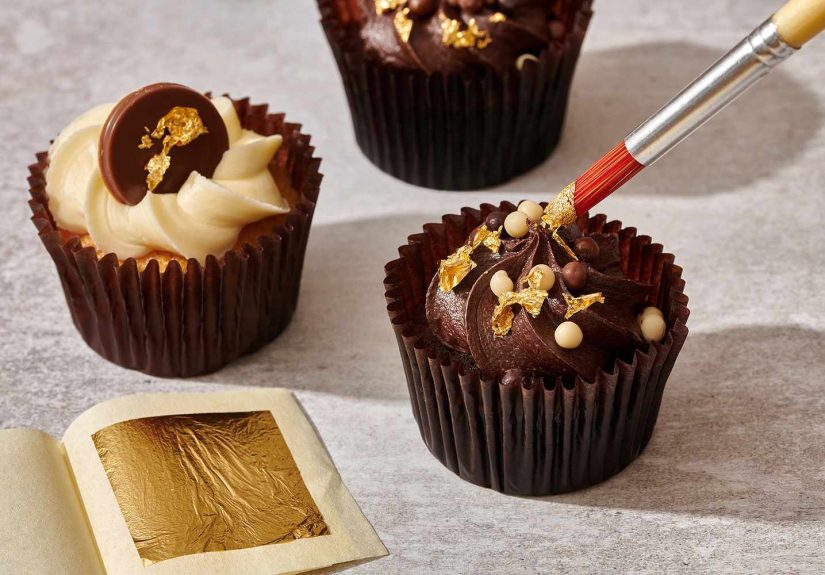
That’s why pastry references recommend tools like a clean, dry brush, tweezers/tongs, and even a razor blade or paring knife to move sheets without tearing them into confetti.
Pick the right surface (gold leaf is clingy)
Gold leaf adheres best to slightly tacky surfacesthink buttercream that’s set but still “grabby,” a thin layer of melted chocolate that has started to firm, or a light glaze.
If the surface is wet-wet, the leaf can crumple; if it’s totally dry, the leaf may not stick where you want it.
Timing matters: add it at the end
Most home and professional uses add edible gold as a finishing touchafter baking, after chilling, after the messy work is done.
It’s decoration, not a cooking ingredient you toss into the pot like oregano.
Drinks: the “floating fleck” method
Flakes are commonly used by bartenders for a visual effect in cocktailstiny flecks that catch the light and make your drink look like it has a publicist.
If you’re doing this at home, remember: use a clean tool, avoid humidity, and keep the container closed between pinches (gold leaf is basically a drama queen with a wind allergy).
Specific examples (so it’s not just theory)
- Cupcakes: A classic use is topping frosted cupcakes with small fragments or flakes for a “special occasion” finishFood Network even includes edible gold leaf as part of a decorated cupcake presentation.
- Chocolate truffles: Press a torn piece onto the surface with a dry brush; truffles are forgiving and look instantly upscale.
- Sushi and savory: Edible gold sometimes shows up on savory dishes like sushi or risotto when chefs want an extravagant look.
- Party cakes: For larger coverage, transfer leaf helps you apply sheets over a broader area (less ripping, fewer tears… yours and the gold’s).
How to buy edible gold leaf (and avoid the “non-toxic” trap)
If you remember one thing, make it this: “non-toxic” does not automatically mean edible.
The FDA has specifically warned that some decorative glitters and dusts are marketed for foods even when they are not intended to be eaten, and that edible versions should be labeled and include an ingredients list.
What to look for when buying:
- Clear “edible” labeling and an ingredient list (especially for dusts/glitters).
- High purity (commonly 22–24 karat) to reduce risk of unwanted metals.
- A food-use source (specialty baking supply retailers) rather than random craft leaf; even The Spruce Eats notes sheets can appear in art supply stores, so you must confirm edible quality if buying outside cooking channels.
Storage and shelf life
Gold leaf is delicate but it’s not perishable in the usual sense.
The Spruce Eats notes an indefinite shelf life and recommends storing sheets flat in an airtight container in a cool, dry place, with flakes also kept cool and dry.
When you might want to skip edible gold
Even though edible gold is generally treated as inert, it’s still smart to be cautious in a few situations:
- Metal sensitivities: Some people may be hypersensitive and experience irritation or rash in rare cases (food reporting has noted this as a possible downside for sensitive individuals).
- Unverified products: If it’s “decorative,” missing an ingredient list, or only says “non-toxic,” don’t put it directly on food.
- Kids and high-frequency use: Not because gold leaf is known to be dangerous, but because “glittery garnish” is not a dietary group, and research on regular intake is limited.
The bottom line
Edible gold leaf is real gold used as a food decorationusually in sheets or flakeschosen for shine, not flavor.
When it’s truly food-grade and high purity, it’s widely described as biologically inert and likely to pass through the body without being absorbed.
The main risks aren’t “gold poisoning,” but buying the wrong product (craft leaf, mislabeled dusts, unknown metals) or assuming every sparkle belongs on a cupcake.
Treat it like a special-occasion garnish, buy carefully, and let it do what it does best: make ordinary food look like it’s attending a gala.
Real-World Experiences With Edible Gold Leaf (The Extra )
The first time you open a booklet of edible gold leaf, you learn an immediate and humbling truth:
gold leaf does not “sit” on your counter so much as it exists in a constant state of almost leaving.
It’s so thin that normal human activitiesbreathing, blinking too aggressively, thinking about turning on a ceiling fanfeel like threats.
The Spruce Eats points out that a small gust of air (yes, including your breath) can send sheets drifting away, and that it will stick to skin if you touch it.
That checks out with basically every home baker’s story: the moment your fingers get involved, the gold decides it loves you more than your dessert.
Most people find their “gold leaf success rate” skyrockets the moment they stop trying to be brave and start using tools.
Tweezers, small tongs, and a clean, dry brush are not optional accessoriesthey are the difference between “luxury finish” and “why is my forearm glittering.”
The Spruce Eats even recommends having tools ready, including a brush and a blade/knife for moving sheets.
In practice, the brush becomes your best friend: it lets you coax a torn piece into place, flatten edges, and gently press it into frosting without shredding it into anxious sparkles.
Another common experience: edible gold leaf makes you reconsider your relationship with moisture.
If your buttercream is too wet or your glaze is still runny, the leaf can wrinkle, clump, or look patchyless “Versailles” and more “crumpled receipt.”
But if the surface is too dry, the leaf may not adhere where you want it, and you’ll end up chasing it around like a tiny metallic tumbleweed.
People who get great results usually apply gold at the very end of decorating, when surfaces are set but still slightly tacky.
That aligns with the broader idea that gold leaf is primarily a finishing garnish, not a cooking ingredient.
In cocktails, first-timers often describe the effect as “magical… for about 10 seconds,” and then they realize the secret is restraint.
A few flecks look like a celestial event; dumping in a bunch can look like your drink is shedding.
The Spruce Eats notes flakes are used for that glimmering look on top of sweets and in alcoholic drinks, which matches what bartenders tend to do: a light hand, placed intentionally.
And then there’s the “I did this to impress someone” category of gold leaf experiences.
Epicurious describes an opera singer who uses edible gold leaf because it can mean less irritation in performance makeup, and then carries that idea into dessert garnishing when he wants to wow guests.
That’s basically edible gold leaf’s true job description: it’s not there to add flavor, nutrients, or culinary structure.
It’s there to create a moment.
When it works, people genuinely do the little pauseeyes widen, phones come out, and suddenly your ordinary chocolate tart is having a very public main-character era.
The most consistent “real-world” lesson is simple: edible gold leaf is easy to eat, but it takes practice to place.
Once you accept that it’s delicate, tool-dependent, and dramatically allergic to wind, it becomes surprisingly fun.
Not because gold makes food taste better (it doesn’t), but because it makes the whole experience feel like a celebrationeven if the celebration is just “Tuesday, but fancy.”