Table of Contents >> Show >> Hide
- Why Running DOOM on an 8088 Sounds Almost Impossible
- What Is Doom8088?
- How Can an 8088 Run DOOM at All?
- Why the 8088 Was Such a Tough Target
- The “Can It Run DOOM?” Tradition
- Doom8088 Versus Original DOOM
- Why This Matters for Retro Computing
- Specific Examples of Smart Compromises
- What Doom8088 Says About the Original Game
- Should You Try Doom8088?
- Experience Section: What It Feels Like to Watch an 8088 Run DOOM
- Conclusion
Note: This article is written for web publication and is based on verified technical information from public documentation, developer notes, and retro-computing community discussions.
For decades, “Can it run DOOM?” has been the internet’s favorite hardware stress test, joke, ritual, and mild form of technological mischief. We have seen DOOM run on microcontrollers, handhelds, odd displays, tiny screens, and gadgets that were never invited to the LAN party. But one machine always seemed like a bridge too far: the Intel 8088-based PC.
That has changed. Thanks to Doom8088, a clever port by developer Frenkel, the answer to “Will an 8088 run DOOM?” is now a proud, slightly wheezing, delightfully nerdy yes. It will not run like a 486 gaming rig. It will not make your retro PC suddenly feel like a demon-blasting supercomputer. But it runs, and in the world of vintage computing, that is the kind of sentence that deserves a standing ovation and maybe a fresh CMOS battery.
Why Running DOOM on an 8088 Sounds Almost Impossible
To understand why this achievement matters, you need to remember what the Intel 8088 was. The 8088 powered the original IBM PC era, including machines that ran at around 4.77 MHz. It had a 16-bit internal architecture but an 8-bit external data bus, which made it cheaper and practical for early PC designs, but not exactly a natural home for fast texture-mapped action games.
Original DOOM arrived in 1993 from id Software and was designed for a very different class of computer. A 386 processor and several megabytes of RAM were the realistic entry point. A 486 made the game feel much more comfortable. By comparison, an 8088 is from a world of green phosphor monitors, floppy drives, PC speaker chirps, and patience. Lots of patience.
That is what makes DOOM on 8088 such a fascinating technical flex. It is not just another port to modern hardware with more power than the original PC. It is the opposite: a famous 1993 game being dragged backward onto hardware from the early 1980s and somehow persuaded to show up for work.
What Is Doom8088?
Doom8088 is a source port of DOOM designed for 16-bit DOS computers, including machines with an 8088 or 286 processor. It is based on GBADoom, which itself is a port of PrBoom for the Game Boy Advance. That lineage matters because GBADoom already had to survive in a low-memory environment. Doom8088 takes that idea and pushes it into even stranger territory.
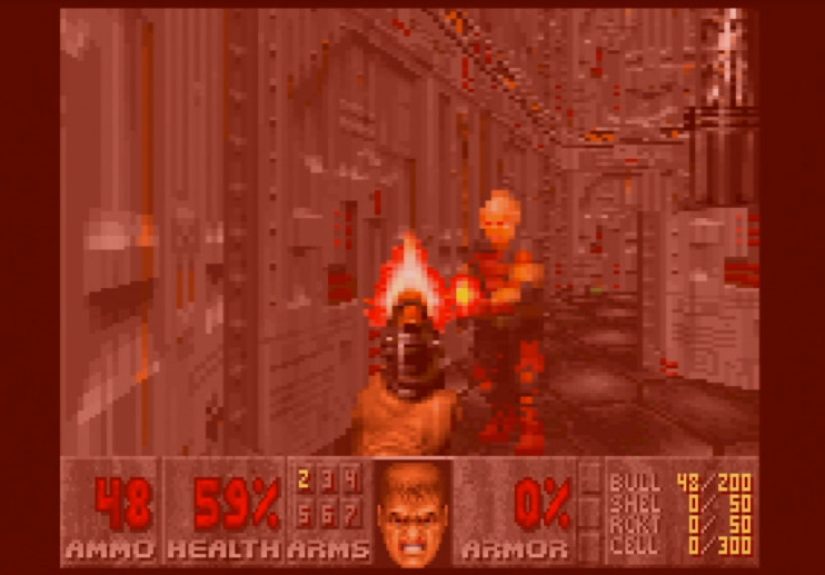
The project supports multiple old PC graphics standards, including MDA, CGA, EGA, VGA, and MCGA. That alone is enough to make vintage PC fans lean closer to the screen. DOOM on VGA is expected. DOOM on CGA feels like someone challenged history to a wrestling match and history lost by technical knockout.
The Big Trade-Offs
Of course, Doom8088 is not a full, luxurious, everything-included DOOM experience. This is not the version you install when you want buttery gameplay, high-resolution textures, silky audio, and modern conveniences. It is more like fitting a jet engine into a shopping cart and then discovering the cart technically moves.
The port makes major compromises. It supports only DOOM 1 Episode 1. It removes or limits features such as music, saving and loading, multiplayer, PWAD support, mouse and joystick support, and texture-mapped floors and ceilings. PC speaker sound effects replace the richer audio setups that players associate with Sound Blaster-era DOS gaming. In other words, the game survives by traveling light.
Those sacrifices are not flaws in the spirit of the project. They are the entire reason it works. On an 8088, every byte matters. Every frame is expensive. Every feature has to justify its seat on the bus, and the bus is already crowded.
How Can an 8088 Run DOOM at All?
The short answer is: carefully. The longer answer is: by reducing expectations, trimming features, and borrowing from a port designed for constrained hardware. Doom8088 does not simply take the original DOS executable and ask an 8088 to “try harder.” That would be like asking a bicycle to tow a semi-truck because both technically have wheels.
Instead, the port uses a modified codebase that is friendlier to low-memory systems. It can use EMS memory as an upper memory block and XMS memory as a RAM drive when available, helping reduce some of the crushing pressure from slow storage access. Early coverage noted that the game relied heavily on disk access and could be extremely slow, but the important point remains: the game loop can be made to function on hardware that once seemed out of reach.
It Is Running, But Is It Playable?
This is where definitions become funny. If you define “playable” as smooth, responsive, and comfortable, an 8088 running DOOM is probably not your dream gaming setup. If you define “playable” as “the game starts, the world appears, input works, enemies exist, and the machine has not burst into philosophical despair,” then yes, it is playable.
Retro-computing projects often live in that wonderful gray area between practicality and proof of concept. Nobody expects Doom8088 to replace a real 386 or 486 DOS gaming machine. The point is not convenience. The point is that a machine once dismissed as far too weak can now join the “it runs DOOM” club.
Why the 8088 Was Such a Tough Target
The Intel 8088 has a unique place in PC history. IBM chose it for the original IBM PC partly because it made practical use of existing 8-bit support chips while still offering a path into the 16-bit x86 software world. That decision helped shape the IBM-compatible PC ecosystem that eventually dominated personal computing.
But the same design choices that made the 8088 attractive in 1981 make it painful for a game like DOOM. The 8-bit external data bus limits how quickly the processor can move data. The original PC graphics options were not built for fast first-person action. Memory is segmented and cramped. Storage is slow. Audio is basic. The machine is charming, historic, and deeply allergic to modern assumptions.
DOOM, meanwhile, was a technical showcase of its time. It used textured environments, fast rendering tricks, responsive controls, and a flexible WAD file structure that helped make modding famous. It pushed the PC gaming world forward. Asking the 8088 to run it is like asking a rotary phone to join a video call. The miracle is not that it looks perfect. The miracle is that it answers.
The “Can It Run DOOM?” Tradition
The reason this story catches attention is bigger than one port. DOOM has become a cultural benchmark because it is old enough to be understandable, open enough to be portable, and iconic enough for people to care. Once id Software released source code, developers and hobbyists began treating DOOM as a playground for experiments.
Some ports are practical. Others are art projects wearing a compiler badge. DOOM has appeared on tiny devices, unusual displays, microcontrollers, and machines that were absolutely not designed with first-person shooters in mind. Each successful port adds another joke to the pile, but it also proves something serious: good software architecture, community curiosity, and persistence can keep a game alive far beyond its original commercial lifespan.
Doom8088 Versus Original DOOM
Comparing Doom8088 with original DOOM is a little unfair, but useful. The original DOS game was intended for 32-bit x86 machines, especially 386 and 486 systems. It expected VGA graphics, more RAM, and a processor capable of handling the game’s rendering demands at a reasonable pace.
Doom8088, by contrast, is a survival build. It keeps the recognizable identity of DOOM while stripping away features that would overwhelm the target machines. The goal is not perfect preservation. The goal is translation. It answers the question: “What would DOOM look like if it had to survive in the narrow alleyways of early PC hardware?”
What You Gain
You gain bragging rights, historical curiosity, and the joy of watching old hardware do something it was never supposed to do. You also gain a better appreciation for the engineering behind both DOOM and early PCs. When a modern computer runs DOOM, it barely notices. When an 8088 runs DOOM, every frame feels negotiated.
What You Lose
You lose smoothness, features, audio richness, and many conveniences. You may also lose a little patience while waiting for scenes to update. But that is part of the fun. Doom8088 is not about speedrunning. It is about witnessing a tiny historical rebellion.
Why This Matters for Retro Computing
Projects like Doom8088 are more than novelty. They teach modern developers and hardware fans how constraints shape design. Today, many applications assume abundant memory, fast storage, powerful GPUs, and processors with multiple cores. The 8088 offers none of that luxury. It forces the developer to think about data movement, memory layout, rendering cost, and feature prioritization with ruthless clarity.
That is why retro-computing challenges remain valuable. They are playful, but they are also educational. Running DOOM on an 8088 is a reminder that software can often go farther than expected when developers are willing to rethink assumptions. It also shows how open-source code, fan documentation, and community testing can extend the life of classic games in surprising ways.
Specific Examples of Smart Compromises
One smart compromise is limiting the supported content. By focusing on DOOM 1 Episode 1, the port avoids the enormous burden of supporting everything from the full game, sequels, mods, and custom WAD files. This keeps the project focused and makes the target more realistic.
Another compromise is dropping music. That may sound painful to anyone who loves DOOM’s soundtrack, but audio costs resources. On vintage machines, especially with minimal sound hardware, simpler PC speaker effects make much more sense.
The graphics compromises are equally important. Removing texture-mapped floors and ceilings reduces rendering complexity. Supporting low-color modes makes the port more flexible across old display hardware. The result may look strange to players raised on modern GPUs, but on an 8088-class machine, strange is often another word for successful.
What Doom8088 Says About the Original Game
One reason DOOM keeps returning in new forms is that its core design is strong. The game’s identity does not depend entirely on modern visual polish. Even when stripped down, slowed down, or squeezed into unlikely hardware, it remains recognizable. Corridors, movement, enemies, doors, pickups, and tension still create the DOOM feeling.
That resilience is rare. Many games are locked to their original context. DOOM, however, became a kind of software fossil that still moves. Every port reveals a different skeleton of the original design. Doom8088 reveals the leanest version: a game reduced to what can survive inside early x86 constraints.
Should You Try Doom8088?
If you own an old PC, a compatible setup, or enjoy DOS experimentation, Doom8088 is absolutely worth exploring. Go in with the right expectations. You are not installing it for the smoothest DOOM experience. You are installing it because the phrase “DOOM on an 8088” sounds like a dare, and someone actually answered the dare.
For casual players, a modern source port like Chocolate Doom, Crispy Doom, PrBoom+, or GZDoom will be far more enjoyable. For retro hardware enthusiasts, though, Doom8088 offers something those ports cannot: the thrill of making a historically underpowered system perform a tiny miracle.
Experience Section: What It Feels Like to Watch an 8088 Run DOOM
Watching DOOM run on an 8088 is less like playing a normal game and more like observing a tiny museum exhibit come alive. You know the machine is old. You know it should not be doing this. And yet there it is, drawing a world that belongs to a later generation of PCs. It feels a bit like seeing a typewriter send an email.
The first experience is surprise. The screen updates slowly, but the recognizable DOOM layout appears. The interface feels familiar. The movement may be sluggish, but the atmosphere is there. You start thinking less about frame rate and more about the audacity of the project. A modern player might laugh at the speed. A retro enthusiast laughs too, but with respect.
The second experience is patience. On newer systems, DOOM is immediate. You press a key and the game responds. On an 8088-class system, you become aware of the machine working. You can almost imagine the CPU pushing each byte uphill in uncomfortable shoes. That slowness changes the mood. Instead of rushing forward, you study each scene. You notice how much visual information DOOM communicates with limited geometry and textures.
The third experience is appreciation. Doom8088 makes you respect the original IBM PC era and the developers who worked with tight limits every day. Early PC programmers were not spoiled by giant memory pools or hardware acceleration. They had to make small decisions matter. Seeing DOOM squeezed into that world is a reminder that optimization is not just a technical skill; it is a creative act.
The fourth experience is humor. There is something wonderfully silly about making an 8088 run DOOM. Nobody needed this to happen. The world was not waiting for a practical 8088 DOOM workstation. But the internet, hobbyist culture, and retro computing are powered by exactly this kind of “because we can” energy. It is the same spirit that makes people restore old hardware, write new drivers for forgotten machines, and benchmark computers older than their parents’ favorite mixtapes.
The fifth experience is nostalgia, even if you never owned an 8088. Doom8088 compresses several eras into one moment: the birth of the IBM-compatible PC, the rise of DOS gaming, the explosion of DOOM culture, and the modern open-source preservation scene. It is a tiny time machine with a very loud PC speaker.
Most importantly, Doom8088 proves that retro computing is not only about preserving the past exactly as it was. Sometimes it is about asking playful questions the original designers never had reason to ask. Could this machine do more? Could this old CPU surprise us? Could a game famous for pushing 1990s PCs be rebuilt for hardware that predates it by more than a decade?
Now we know the answer. Yes, an 8088 can run DOOM. Slowly, strangely, and with heroic compromises, but yes. And honestly, that makes it even better.
Conclusion
Will an 8088 run DOOM? Today, the answer is yes, thanks to Doom8088. It is not the fastest way to play id Software’s classic, nor the most comfortable, nor the most complete. But it is one of the most charming demonstrations of what dedicated developers can do with old hardware, open code, and a stubborn refusal to accept “impossible” as the final answer.
Doom8088 turns a long-running internet joke into a real retro-computing milestone. It celebrates the IBM PC legacy, the flexibility of DOOM’s code family, and the playful engineering culture that keeps vintage machines relevant. In a world obsessed with faster chips and bigger specs, there is something beautiful about watching an 8088 crawl through DOOM and proudly earn its place in the club.