Table of Contents >> Show >> Hide
- 1. Pete Davidson for Taco Bell Breakfast
- 2. Steve Carell for Brown’s Chicken
- 3. Jerry Seinfeld for Microsoft
- 4. Ryan Reynolds for Push Pop
- 5. Jason Alexander for McDonald’s McDLT
- 6. Matt LeBlanc for Heinz Ketchup
- 7. Luke Wilson for AT&T
- 8. Tina Fey for Mutual Savings Bank
- 9. John Goodman for Mennen Skin Bracer
- 10. Paul Rudd for Super Nintendo
- 11. Joseph Gordon-Levitt for Pop-Tarts
- 12. Mila Kunis for Lisa Frank
- 13. Bryan Cranston for Preparation H
- 14. Whoopi Goldberg for Poise
- 15. Jack Black for Pitfall!
- Why Cringeworthy Commercials Are So Fun to Rewatch
- Experience Notes: What These Ads Teach Content Creators, Brands, and Viewers
- Conclusion
- SEO Tags
Every comedy legend has a few skeletons in the career closet. Some are failed sitcom pilots. Some are forgotten wigs. Some are commercials so awkward they feel like they were written by a vending machine with stage fright. But before fame, awards, sitcom glory, superhero suits, or late-night applause, many performers did what working actors do: they booked the job, hit their mark, smiled at the product, and hoped America needed ketchup, burgers, aftershave, cereal, or an extremely specific breakfast wrap.
That is what makes cringeworthy celebrity commercials so entertaining. They are tiny time capsules of ambition. They show talented performers trapped inside jingles, forced enthusiasm, questionable fashion, and ad concepts that probably sounded “youthful” in a conference room. The result is comedy gold, even when the commercial itself was not trying to be funny.
Below are 15 comedy performers who starred in commercials that became awkward, dated, bizarre, or accidentally hilarious. Some were early-career stepping stones. Others were famous-person brand deals that went sideways. All of them prove one comforting truth: even the funniest people in show business have had to sell something weird on camera.
1. Pete Davidson for Taco Bell Breakfast
Pete Davidson’s Taco Bell breakfast campaign was built around an apology: the chain had supposedly gone too far with wild breakfast ideas and wanted to simplify things with the Breakfast Crunchwrap. On paper, that is not a bad premise. Davidson’s comedy persona is casual, self-aware, and slightly chaotic, which should have made him a good fit for a brand that once asked America to consider tacos as morning food.
The cringe came from the execution. In some versions, Davidson appears sleepy, under-rehearsed, and intentionally rough around the edges. That may have been the point, but viewers online were not exactly writing love letters to the campaign. The ad became a reminder that “relatable” and “why is he chewing at me through the screen?” are separated by a very thin tortilla.
2. Steve Carell for Brown’s Chicken
Before Steve Carell became Michael Scott, the world’s most confidently incorrect boss, he appeared in a 1989 commercial for Brown’s Chicken. It is a wonderfully local, cheerful, old-school fast-food ad, and Carell brings the same committed energy that later made him famous. The difference is that instead of managing Dunder Mifflin, he is selling chicken with the clean-cut intensity of a man who believes poultry can heal the nation.
The commercial is cringeworthy mostly because it is so aggressively wholesome. The hair, the rhythm, the smiles, and the sales pitch all belong to a world where cholesterol-free messaging could be delivered with theatrical urgency. Carell survives it because even in a dated ad, he looks like someone who understands the assignment a little too well.
3. Jerry Seinfeld for Microsoft
Jerry Seinfeld and Bill Gates in a Microsoft commercial should have been a pop-culture event. Instead, the 2008 ads confused viewers who expected sharp comedy and received a strange little sitcom about shoes, shopping, and computer-adjacent vibes. Microsoft reportedly spent heavily on the campaign, and Seinfeld’s involvement attracted enormous attention.
The problem was not that the ad was unwatchable. The problem was that nobody could tell what it wanted them to feel. Was it absurdist branding? A warm-up joke? A philosophical experiment conducted inside a discount shoe store? Seinfeld’s entire comedy style is about noticing small oddities, but here the commercial itself became the oddity. It was memorable, expensive, and very, very awkward.
4. Ryan Reynolds for Push Pop
Long before Ryan Reynolds became the king of smirking superhero sarcasm and self-aware advertising, he appeared in a 1990s Push Pop commercial that is almost painfully of its era. The ad leans hard into colorful street style, candy attitude, and the kind of “cool kid” energy that adults in marketing departments often imagine teenagers have.
Reynolds is not bad in it. In fact, part of the fun is seeing his future charm trying to escape from inside a plastic candy tube. The cringe comes from the commercial’s forced hipness. Everything about it says, “We understand the youth,” which is usually the fastest way to prove that no one in the room has spoken to a young person since 1987.
5. Jason Alexander for McDonald’s McDLT
Jason Alexander’s McDLT commercial is one of the great artifacts of pre-fame celebrity advertising. Before George Costanza became a monument to insecurity, Alexander sang and danced about a burger designed to keep the hot side hot and the cool side cool. That phrase alone deserves a museum exhibit.
The ad is cringeworthy in the grand Broadway tradition: huge smiles, big movement, and a level of burger enthusiasm usually reserved for lottery winners. Yet it also shows why Alexander became a star. He commits completely. He does not wink at the camera or coast through the jingle. He performs as if the fate of sandwich engineering depends on him. Honestly, respect.
6. Matt LeBlanc for Heinz Ketchup
Matt LeBlanc’s Heinz ketchup commercial features the future Joey Tribbiani as a smooth young guy trying to make ketchup look seductive. The setup involves a hot dog, a bottle of Heinz, and the famous slow-pour patience associated with the brand. It is simple, but the commercial treats ketchup like it has its own romantic subplot.
What makes it cringe is not LeBlanc. He is charismatic, relaxed, and clearly camera-ready. The awkwardness comes from the ad’s attempt to make waiting for ketchup seem cool. There is only so much mystery one condiment can carry. Still, the spot offers a preview of the lovable confidence that later made LeBlanc a sitcom favorite.
7. Luke Wilson for AT&T
Luke Wilson’s AT&T commercials arrived during a heated wireless-ad battle with Verizon. AT&T needed a spokesperson who could push back against competitor claims with confidence. Wilson, known for his laid-back charm and dry delivery, brought a calmer energy than the campaign probably required.
That mismatch created the cringe. Wireless network wars are dramatic in advertising, full of maps, claims, counters, and corporate chest-thumping. Wilson looked like he had wandered into the conflict while looking for a quieter movie set. His relaxed persona is part of his appeal, but in these ads, the vibe sometimes felt less “commanding spokesperson” and more “friendly guy explaining phones because someone handed him cue cards.”
8. Tina Fey for Mutual Savings Bank
Tina Fey’s 1995 Mutual Savings Bank commercial is a delightful blast of mid-’90s awkwardness. Before Saturday Night Live, 30 Rock, and her status as a comedy-writing icon, Fey appeared in a bank ad built around wordplay about saying “hi” and earning “high” interest. Yes, the pun is doing a lot of heavy lifting. No, the pun did not stretch first.
The commercial is cringeworthy because it is so earnest. The outfit, the haircut, the staging, and the financial enthusiasm all feel like they were assembled from a drawer labeled “regional commercial energy.” But Fey’s intelligence still peeks through. She is already precise, already readable, and already capable of making stiff material seem human.
9. John Goodman for Mennen Skin Bracer
John Goodman’s Mennen Skin Bracer commercial is pure late-1970s advertising theater. The product is aftershave, the mood is rugged freshness, and Goodman appears in a spot famous for the slap-and-slogan style of the brand’s campaign. It is short, memorable, and hilariously physical.
The cringe comes from how dramatically aftershave is treated. Modern viewers are used to sleek grooming ads, but this one feels like facial care crossed with a pep talk from a gym coach. Goodman, however, already has presence. Even in a small commercial role, he looks grounded and funny, which is exactly the combination that later made him so beloved.
10. Paul Rudd for Super Nintendo
Paul Rudd’s 1991 Super Nintendo commercial has become internet-famous for one major reason: Paul Rudd appears to have barely aged. The ad shows him in an abandoned drive-in setting, dramatically playing video games on a giant screen while early-’90s style explodes around him.
It is cringeworthy in the best possible way. The leather-jacket coolness, the smoky atmosphere, the intense gaming faces, and the overblown mood make the ad feel like someone tried to sell a console by directing a music video for rebellious mall teens. Rudd’s natural likability survives the fog machine. If anything, the ad proves his superpower: he can look charming even while pretending a video game controller is a sacred instrument.
11. Joseph Gordon-Levitt for Pop-Tarts
Joseph Gordon-Levitt appeared in a Pop-Tarts commercial as a child actor, long before his adult career in comedy, drama, and indie favorites. The ad is cute, colorful, and packed with breakfast-commercial cheer. It also has that slightly strange quality many food ads have when they ask children to deliver lines that no child has ever naturally said at a kitchen table.
The cringe is gentle here. Gordon-Levitt is charming, and the commercial is more adorable than embarrassing. Still, watching a future serious actor sell toaster pastries with maximum sincerity is a reminder that Hollywood careers often begin with sugar frosting and a parent in the background pretending this is a normal morning.
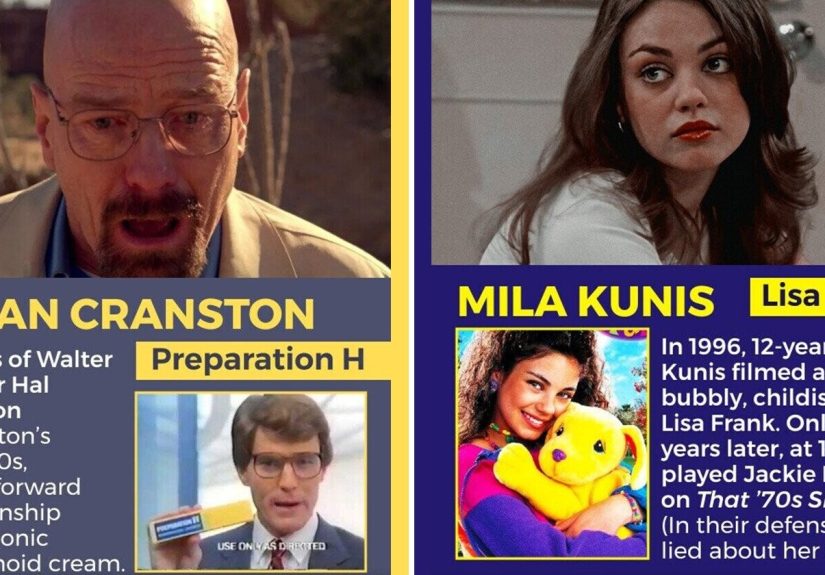
12. Mila Kunis for Lisa Frank
Mila Kunis’s Lisa Frank commercial is a neon explosion of 1990s kid culture. Before That ’70s Show made her famous, Kunis appeared in an ad for the rainbow-colored school-supply empire that decorated countless binders, folders, stickers, and childhood dreams.
The commercial is cringeworthy only because Lisa Frank’s aesthetic was designed to be maximum everything: dolphins, glitter, colors, animals, fantasy, and happiness dialed up until the room needs sunglasses. Kunis fits the spot well, but the ad is such a concentrated blast of preteen energy that modern viewers may need a glass of water afterward.
13. Bryan Cranston for Preparation H
Bryan Cranston’s Preparation H commercial is one of the funniest career-before-fame examples because of the contrast. Later, audiences would know him as Hal in Malcolm in the Middle and Walter White in Breaking Bad. Earlier, he was calmly and professionally talking about hemorrhoid relief cream.
The ad is not wild or chaotic. That is what makes it funny. Cranston treats the copy with total seriousness, which is exactly what a commercial actor is supposed to do. There is no irony, no smirk, no escape hatch. Just a skilled performer lending dignity to a product category most actors probably do not dream about while studying theater. It is awkward, but it is also a master class in commitment.
14. Whoopi Goldberg for Poise
Whoopi Goldberg’s Poise campaign took a direct, comedic approach to light bladder leakage, with Goldberg portraying famous women from history in webisodes and ads. The intention was serious: reduce stigma around a common issue. The execution, however, leaned into character comedy in a way that some viewers found bold and others found deeply awkward.
The campaign is interesting because the cringe is not simply “celebrity sells personal-care product.” It is more complicated than that. Goldberg used humor to make a taboo subject less intimidating, which is very much in line with what comedians often do. Still, seeing historical figures folded into a bladder-leakage campaign is the kind of concept that makes you imagine the pitch meeting and whisper, “How many coffees had they had?”
15. Jack Black for Pitfall!
Jack Black’s early commercial for the Atari 2600 game Pitfall! is a treasure for fans of before-they-were-famous ads. As a young performer, Black brings enthusiasm to a video game spot full of jungle danger, retro graphics, and early-1980s excitement about home gaming.
The commercial is cringeworthy mostly because technology ages faster than fashion and almost as fast as slang. What once looked adventurous now looks charmingly primitive. But Black’s energy is unmistakable. Even as a kid, he had the spark of someone who could make ordinary material feel loud, alive, and slightly unhinged in the best way.
Why Cringeworthy Commercials Are So Fun to Rewatch
Cringeworthy commercials work because they collapse the distance between celebrity mythology and regular work. We tend to imagine successful performers arriving fully formed, already polished, already selective, already above weird jobs. Old commercials destroy that illusion in 30 seconds. They show future stars doing the same thing every beginner does: saying yes, trying hard, and hoping the check clears.
There is also something charming about watching talented people trapped by the trends of their time. Nobody can defeat a bad vest, a forced rap jingle, a giant hairstyle, or a slogan that was focus-grouped into nonsense. Tina Fey cannot out-write the bank pun while she is inside the bank pun. Paul Rudd cannot stop the Super Nintendo ad from looking like a moody arcade prophecy. Jason Alexander cannot make the McDLT concept less strange; he can only sing harder. That is the beauty of it.
These ads also remind us that cringe is not the opposite of talent. Sometimes it is proof of professionalism. A less disciplined actor might phone in a silly commercial. A future star often commits completely. Steve Carell sells chicken like it matters. Bryan Cranston gives Preparation H the full respect of a courtroom statement. Matt LeBlanc makes ketchup wait-time look like a lifestyle choice. Their commitment is what makes the ads funny now and probably what helped them keep getting hired then.
For comedy performers especially, commercials can be useful training. A commercial demands speed. You have seconds to create a character, land a tone, and make an audience remember a product. That is not so different from sketch comedy, sitcom acting, or stand-up timing. The stakes are different, but the muscles overlap. You learn how to be readable instantly. You learn how to sell a joke, even when the joke is really a sandwich container.
The other lesson is that embarrassment ages differently from failure. Many of these commercials were not failures at all. Some did exactly what they were supposed to do. They made people notice a product. They gave an actor screen time. They became memorable enough to survive online decades later. The cringe comes from context: fashion changed, pacing changed, audience taste changed, and celebrity identities changed. Once you know Ryan Reynolds as a master of meta-advertising, his Push Pop spot becomes funnier. Once you know Whoopi Goldberg as an EGOT-winning performer, her Poise characters feel more surreal. Once you know Jack Black as a full-volume comedy force, his Atari commercial feels like an origin story.
Experience Notes: What These Ads Teach Content Creators, Brands, and Viewers
Looking back at these cringeworthy commercials is not just a celebrity guessing game. It is also a useful lesson in how advertising works, why some campaigns age badly, and why performers often matter more than the script. Anyone who creates web content, brand campaigns, YouTube videos, social posts, or product pages can learn from these tiny awkward masterpieces.
First, authenticity cannot be faked with slang alone. The Push Pop commercial with Ryan Reynolds, for example, is memorable because it tries so hard to sound young and cool. That is the danger of chasing a demographic from the outside. Audiences can tell when language is being worn like a costume. The better approach is to build a clear idea, use natural speech, and let the performer bring personality instead of forcing “coolness” into every frame.
Second, celebrity casting only works when the performer’s energy matches the message. Luke Wilson is funny, likable, and calm, but a corporate network battle needed sharper urgency. Jerry Seinfeld is a brilliant observational comic, but the Microsoft campaign placed him inside a vague concept that left viewers wondering what exactly was being sold. Star power opens the door; clarity keeps people in the room.
Third, commitment can rescue weak material. Jason Alexander’s McDLT ad is ridiculous, but he performs it with such total belief that it becomes unforgettable. Bryan Cranston’s Preparation H spot is awkward because of the product category, yet he handles it with professional seriousness. That is a valuable reminder for writers and marketers: if the premise is odd, do not apologize halfway through. Either sharpen the joke or play it straight with confidence.
Fourth, cringe can become an asset over time. A commercial that feels dated today may become nostalgic tomorrow. Paul Rudd’s Super Nintendo ad is filled with early-’90s moodiness, but that is exactly why people still share it. Mila Kunis’s Lisa Frank commercial is almost aggressively colorful, yet it captures the exact feeling of a specific era. The details that seem excessive now are the same details that make the content memorable.
Finally, these commercials show that careers are built one imperfect job at a time. Nobody begins with total control over tone, lighting, script, wardrobe, and cultural legacy. Performers build skill by working. Brands experiment by taking risks. Viewers forgive awkwardness when they sense effort, charm, or a real human being underneath the pitch. That is why these ads still matter. They are not just embarrassing clips from the past. They are proof that even comedy icons had to survive strange scripts, loud jingles, and product close-ups before becoming the people audiences quote, stream, and celebrate.
Conclusion
Cringeworthy commercials are the entertainment industry’s baby photos: awkward, revealing, and impossible not to enjoy. The 15 comedy performers on this list all stepped into strange advertising moments, whether they were unknown actors trying to break in or established stars lending their fame to a risky campaign. Some ads were cheesy. Some were confusing. Some were oddly brilliant. But all of them show the same thing: comedy talent can survive almost anything, including breakfast wraps, burger jingles, bank puns, aftershave slaps, and candy commercials trying desperately to be hip.
In the end, these ads are not career stains. They are proof of range, hustle, and timing. Before the awards, franchises, sitcoms, and iconic characters, there was the commercial gig. And sometimes, that awkward little ad becomes funnier with every passing year.
SEO Tags
Note: This article is written for web publication in standard American English, with original wording, SEO-friendly structure, and no unnecessary source-link clutter in the HTML body.