Table of Contents >> Show >> Hide
- Why SNL Movies So Often Go Wrong
- 16 Failed Attempts to Make A Hilarious SNL Movie
- 1. Coneheads (1993)
- 2. It’s Pat (1994)
- 3. Stuart Saves His Family (1995)
- 4. Blues Brothers 2000 (1998)
- 5. A Night at the Roxbury (1998)
- 6. Superstar (1999)
- 7. The Ladies Man (2000)
- 8. MacGruber (2010)
- 9. Hans & Franz: The Girly Man Dilemma
- 10. Bill Swerski’s Superfans
- 11. Coffee Talk
- 12. Sprockets
- 13. The Ambiguously Gay Duo
- 14. Key Party
- 15. Stefon: The Movie
- 16. The Saturday Night Live Movie
- What These SNL Movie Failures Actually Teach Us
- on the Experience of Watching the SNL Movie Experiment Crash, Burn, and Occasionally Moonwalk
- Conclusion
Turning a Saturday Night Live sketch into a movie sounds easy in the same way building a canoe sounds easy when you are standing in a craft store. You think, “How hard can it be?” Then three hours later you are knee-deep in glue, regret, and one very questionable design choice. That, in a nutshell, is the history of the SNL movie experiment.
The show has given American comedy some genuine big-screen winners. The Blues Brothers proved that a bit from Studio 8H could become a full-scale movie event, and Wayne’s World remains the gold standard for sketch-based adaptation. But once Hollywood saw that lightning strike, it kept carrying kites into thunderstorms. Again. And again. And, because optimism is apparently stronger than memory, again.
This article looks at 16 failed attempts to make a hilarious SNL movie. Some of these projects were released and belly-flopped. Some became cult curiosities. Some died in development before they could embarrass themselves in public. A few were not complete disasters, but they still failed to become the kind of enduring comedy classic studios were clearly chasing. Together, they reveal the same painful truth: a funny five-minute sketch is not automatically a funny 95-minute film.
Why SNL Movies So Often Go Wrong
The problem is not talent. SNL has never lacked talent. The problem is structure. A sketch can survive on one killer premise, one absurd voice, or one unforgettable entrance. A movie needs escalation, stakes, character arcs, and enough story fuel to keep the engine running after the opening laugh. Too many SNL adaptations confuse recognizability with depth. Audiences laugh when a character pops in for three minutes on live TV; they start checking the runtime when that same character repeats the same trick for an hour and a half.
Timing also matters. Sketch comedy is built for the moment. It thrives on cultural freshness, surprise, and repetition in controlled doses. By the time a movie gets written, financed, cast, marketed, and released, the joke may already be wheezing. Add studio notes, inflated expectations, and the dangerous assumption that catchphrases count as plot, and suddenly what looked like comedy gold starts sounding like a head-bobbed remix of bad decisions.
16 Failed Attempts to Make A Hilarious SNL Movie
1. Coneheads (1993)
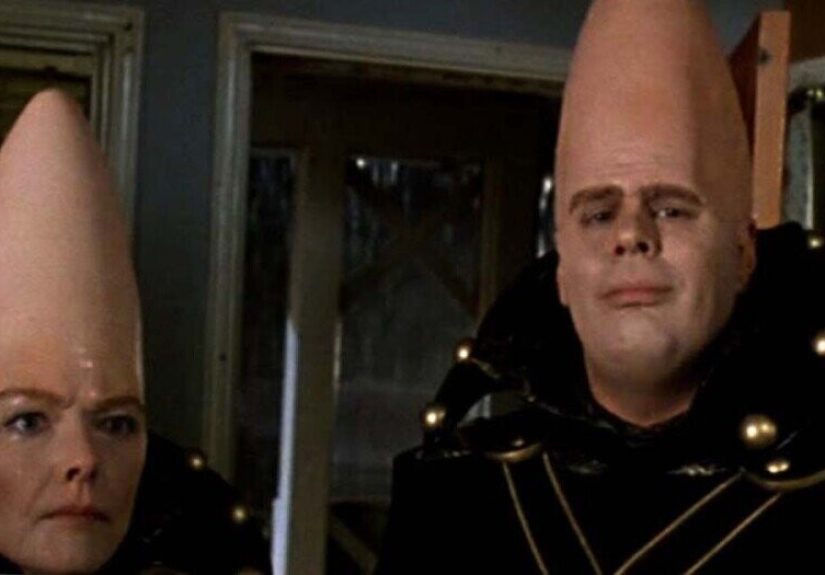
On paper, Coneheads had a fighting chance. The sketch was iconic, Dan Aykroyd and Jane Curtin returned, and the supporting cast looked like an SNL reunion with bonus chaos sprinkled on top. The problem was simple: the original joke worked best as a bizarre intrusion, not a fully expanded suburban sci-fi story.
The movie is not completely devoid of charm, but it feels like a feature-length attempt to explain a punchline that never asked for explanation. The Coneheads were funniest when they showed up, acted deeply weird, and left. The movie kept them around long enough for the novelty to wear off and the audience to start wondering whether this whole thing should have stayed on television.
2. It’s Pat (1994)
It’s Pat is the cautionary tale people bring up whenever someone gets too excited about adapting a sketch. The premise on SNL was already narrow: people could not determine Pat’s gender, and their discomfort became the joke. Stretched into a movie, that thin premise became even thinner, then brittle, then almost dust-like.
Its legacy now is less “misguided comedy” and more “how did anyone think this was enough?” The movie also became one of the most notorious commercial wipeouts in SNL film history. It is the cinematic equivalent of telling the same awkward joke louder, slower, and with more expensive lighting.
3. Stuart Saves His Family (1995)
Al Franken’s Stuart Smalley was a wonderfully precise parody of self-help culture. He was needy, sincere, and deeply funny in small doses. The movie, however, tried to deepen him by surrounding him with a dysfunctional family melodrama, and that choice made the comedy strangely heavy.
This is one of the more interesting failures because it aimed higher than most sketch adaptations. It wanted heart. It wanted emotional consequence. It wanted to be about something. Admirable goals, sure, but the more serious it became, the less it felt like the sharply ridiculous character people had enjoyed on SNL. The result is a movie that is more earnest than hilarious, which is not exactly what anyone buys a ticket for in this genre.
4. Blues Brothers 2000 (1998)
The original Blues Brothers succeeded because it was larger than a sketch. It had musical muscle, anarchic energy, and the once-in-a-generation chemistry of Dan Aykroyd and John Belushi. Making a sequel without Belushi was always going to feel like trying to start a garage band after misplacing the garage.
Blues Brothers 2000 is not a complete creative vacuum, but it never escapes the feeling of imitation. The music remains enjoyable, yet the movie often plays like a tribute act impersonating a tribute act. It is a textbook example of how studios sometimes mistake brand recognition for the actual spark that made a first movie special.
5. A Night at the Roxbury (1998)
The Roxbury Guys were perfect sketch creatures: overdressed, underaware, and hilariously committed to the bit. The joke was their rhythm, their confidence, and their total inability to read a room. That formula could easily support three minutes. Eighty-plus minutes? That is another matter.
The film tries to build a whole world around two human bobbleheads and a Haddaway song. There are scattered laughs and a kind of goofy late-’90s sincerity that some viewers now find charming. But the movie still feels like a nightclub line that never moves. You arrive excited, stand there too long, and eventually realize the whole evening was mostly posture.
6. Superstar (1999)
Molly Shannon’s Mary Katherine Gallagher is one of the great all-in physical comedy performances in SNL history. The character is a walking car crash of nerves, Catholic guilt, and theatrical ambition. That is precisely why she worked so well in sketches: she exploded, embarrassed herself, and vanished before the gimmick wore out.
Superstar makes the classic adaptation mistake of assuming more exposure equals more fun. Instead, it turns a high-voltage comic performance into a repetitive loop. Shannon remains fearless, but even fearless performers need material that evolves. Watching the film is like seeing a brilliant sparkler forced to behave like a space heater.
7. The Ladies Man (2000)
Leon Phelps had exactly what a late-night sketch character needs: a voice, a rhythm, a ridiculous confidence level, and a comic point of view. What he did not have was the dramatic architecture to carry a movie. Once the lisping charm and smirky innuendo are extended to feature length, the seams start showing almost immediately.
This is one of those films that helps explain why the SNL movie pipeline slowed down. It felt less like a fresh comedy and more like an executive forcing a catchphrase to pull a wagon uphill. Tim Meadows did what he could, but charisma cannot replace story forever.
8. MacGruber (2010)
MacGruber is the oddball of the list because its failure was initially commercial more than cultural. When it opened in theaters, it landed like a thrown cinder block. But over time, it developed a cult reputation and earned a second life among comedy fans who appreciated how deranged it really was.
Still, in its original moment, it absolutely counted as another failed attempt to launch an SNL movie phenomenon. Audiences expecting a broad, easy parody got something nastier, stranger, and much more committed to blowing up its own hero. Ironically, that may be why the movie ages better than several of its predecessors. It failed as a mainstream hit but succeeded later as a cult object. That is still failure, just with better lighting in hindsight.
9. Hans & Franz: The Girly Man Dilemma
This unmade project has become legendary because the creative team behind it was absurdly strong and Arnold Schwarzenegger was supposed to be part of the fun. Dana Carvey, Kevin Nealon, Conan O’Brien, and Robert Smigel are not exactly the sort of people you ignore when they start pitching nonsense about Austrian bodybuilders.
But once Schwarzenegger backed away, the movie collapsed. The concept may actually have been too ambitious for its own good: part show-business satire, part musical, part meta-comedy. In other words, exactly the kind of swing that either becomes a cult masterpiece or a glorious studio migraine. Hollywood never found out which.
10. Bill Swerski’s Superfans
Da Bears sketch is beloved because it is specific. Hyper-specific, even. The accents, the Chicago energy, the sports-bar confidence, the ritual nonsense of fans talking as if cholesterol were a birthright: all of it works beautifully in bursts.
But that same specificity may have limited the movie version. A script existed, and live readings kept the idea alive, yet the project never reached theaters. That makes sense. A sketch about football guys yelling over each other can be comic gold in a tight format; as a feature, it risks becoming a very long commercial for sausage and regional loyalty.
11. Coffee Talk
Mike Myers’s Linda Richman was one of the most memorable talk-show hosts in SNL history, and the sketch delivered catchphrases that practically came pre-packaged for the 1990s. But that very familiarity may have doomed the movie adaptation. The sketch’s rhythm depended on interruption, surprise, and short-form escalation.
By the mid-1990s, studios had already been burned by underperforming SNL films, and caution set in fast. Coffee Talk became one of the casualties. Probably for the best. You can adore a character, quote a character, even impersonate a character in a kitchen while overcooking onions, and still not need 100 minutes of that character in a theater.
12. Sprockets
Another Mike Myers near-miss, Sprockets centered on Dieter, the chilly, artsy German host whose humor came from severe commitment to a ridiculous persona. Universal pushed for the movie. Myers famously hesitated. And honestly, his hesitation was the wisest thing anyone did in the history of SNL development hell.
He reportedly questioned whether the concept could work as a full-length film, and that self-doubt sounds less like indecision and more like creative self-preservation. The sketch was stylish, weird, and quotable. But quotable is not the same as expandable. Sometimes the smartest failed attempt is the one that notices the cliff before driving off it.
13. The Ambiguously Gay Duo
As an animated TV Funhouse bit, The Ambiguously Gay Duo was sharp, satirical, and deliberately overplayed. The joke was baked into the style. It spoofed old superhero cartoons while winking at censorship, panic, and subtext with a giant neon arrow.
A feature was rumored for years, but it never happened. That was probably wise. The sketch’s comedic mechanism was strong but narrow, and the longer it ran, the more likely it was to become repetitive or tonally clumsy. Some ideas are funniest when they stay stylized and slightly out of reach, like forbidden fruit or affordable movie tickets.
14. Key Party
This is one of the strangest entries because it was reportedly based on a one-off sketch. Right away, that should have set off alarms large enough to be seen from space. At least recurring SNL characters arrive with audience familiarity and tested rhythm. A one-off sketch trying to become a movie is like a garage band booking a stadium because one cousin clapped extra hard.
The project never gained meaningful traction, which suggests someone eventually looked at the premise, looked at the calendar, looked at reality, and quietly backed out of the room. The failure here was developmental optimism. Hollywood occasionally mistakes “possible” for “necessary.”
15. Stefon: The Movie
Now this one hurts, because Stefon is brilliant. Bill Hader’s nightclub oracle of human nonsense became iconic for a reason. The writing was tight, the delivery was unpredictable, and the character thrived on the chemistry of live performance, especially opposite Seth Meyers.
But that is also why a movie likely would not have worked. Stefon is best experienced as a glitter bomb tossed into Weekend Update, not as a protagonist required to sustain plot mechanics. Even the people involved seemed to sense that. The idea was floated, laughed about, and left behind. That is less a failure of imagination than a rare case of comic self-awareness.
16. The Saturday Night Live Movie
If you ever needed proof that the SNL movie boom nearly ate itself alive, here it is: a proposed film literally called The Saturday Night Live Movie. Not a movie based on one sketch. Not a movie built around one breakout character. Just the whole brand, hauled into a screenplay like a bag of props dumped onto a studio floor.
The concept reportedly existed, with serious comedy writers attached, but it never became a real thing. Thank heaven for small mercies. The title alone sounds like a parody of development madness. It also serves as the perfect final symbol of the era: when studios believed the letters “SNL” were enough to conjure a feature by themselves.
What These SNL Movie Failures Actually Teach Us
The biggest lesson is not that SNL characters cannot become movies. Clearly, they can. The real lesson is that a successful sketch movie needs more than popularity. It needs a world that expands naturally, a story engine stronger than a catchphrase, and characters who become more interesting when placed under pressure. Wayne’s World worked because Wayne and Garth were not just funny; they had a friendship, a culture, a point of view, and a conflict that could stretch without tearing. Many of the failures on this list had only the first ingredient.
There is also a business lesson hiding underneath the hairspray and bad studio instincts. Hollywood often chased SNL movies as if they were pre-sold franchises. But comedy is not an action figure. Recognition gets people in the door; it does not keep them there. When studios treated sketches like intellectual property first and comic ecosystems second, the results were usually awkward, overlong, and weirdly airless.
on the Experience of Watching the SNL Movie Experiment Crash, Burn, and Occasionally Moonwalk
There is a very specific experience that comes with watching an SNL movie, especially one of the less-loved entries, and it starts with hope. Hope is crucial. Hope tells you that a character who kills on live television can absolutely carry a film. Hope watches the trailer and says, “You know what? This could work.” Hope remembers the best moments from the sketch and mentally fills in the rest with imaginary laughs that the actual movie has not yet earned. Hope is a sweet, trusting fool.
Then the movie starts, and for the first ten minutes you are often still on board. The costumes are right. The voice is right. The catchphrase lands. A supporting actor you like appears and your confidence rises. “See?” you tell yourself. “This was unfairly judged.” Then minute 23 arrives, and the realization creeps in like a parking ticket under a windshield wiper: this character may not have a second gear.
That is the strange emotional arc of the weaker SNL films. They are not usually dead on arrival. In fact, many of them begin with a little spark of recognition-based joy. The audience is rooting for them. People want them to work. There is affection in the room. But affection is not momentum, and once the film runs out of fresh ways to use the character, the air starts leaking out. Suddenly every scene feels like a sketch premise standing in line for a story that never shows up.
At the same time, there is something weirdly lovable about these failures. They are often sincere. Even when they misfire, they are rarely cynical in the boring corporate sense. They are usually the work of funny people trying, sometimes desperately, to build a larger world around something they know audiences already enjoy. That effort can be touching. You can feel performers straining to turn repetition into escalation, shtick into narrative, and a late-night bit into a cinematic event. Watching that happen is part comedy, part archaeology.
The experience gets even stranger years later. Some SNL movie failures soften with time. On cable, on streaming, or at 1:00 a.m. with friends who understand the assignment, even a clumsy adaptation can become fun again. Its flaws become part of the appeal. The awkward pacing, the bizarre cameos, the overcommitted performances, the soundtrack choices that smell faintly of a specific decade; all of it starts to feel less like failure and more like evidence. Evidence of an era when comedy studios believed almost anything could be spun into a movie if the audience already knew the voice.
That is why the SNL movie experiment remains fascinating. It is not just a record of what failed. It is a record of how comedy culture kept trying to industrialize spontaneity. Sometimes it produced classics. More often it produced gloriously lopsided curiosities. And as frustrating as those movies can be, they remain impossible to ignore, because every one of them carries the same irresistible question: what if this one actually works? That question, more than any catchphrase, is what kept the whole strange enterprise alive.
Conclusion
The history of SNL movies is not just a list of bombs, cult oddities, and abandoned scripts. It is a running case study in how comedy changes when it leaves the sketch format behind. The failures on this list all teach the same lesson from different angles: a memorable character is only the beginning. To become a truly hilarious SNL movie, a project needs story, surprise, and the confidence to be more than a stretched-out reminder of something that was once funny at 12:47 a.m.
And yet, for all the misfires, the experiment remains oddly lovable. Every new adaptation starts with the same dangerous but beautiful idea that maybe, just maybe, lightning can strike Studio 8H twice. Usually it does not. But the possibility keeps comedy fans watching, quoting, and foolishly believing that the next big-screen sketch might finally be more Wayne’s World than cautionary tale.