Table of Contents >> Show >> Hide
- Why Measuring Cabinet Hinges Correctly Matters
- Way 1: Measure the Overlay on Overlay or Semi-Concealed Hinges
- Way 2: Measure the Cup and Bore Pattern on Concealed European Hinges
- Way 3: Measure the Leaf Size on Surface-Mount, Flush, or Butt Hinges
- How to Tell Whether Your Cabinets Are Overlay, Inset, or Full Overlay
- Other Measurements That Can Save Your Project
- Quick Checklist Before You Buy Replacement Cabinet Hinges
- Simple Measuring Tools That Make the Job Easier
- Final Thoughts
- Real-World Experiences Measuring Cabinet Hinges the Hard Way
If you have ever stood in the hardware aisle holding a mystery hinge like it was an artifact from a lost civilization, welcome. You are among friends. Cabinet hinges look deceptively simple until it is time to replace one. Then suddenly you are dealing with overlay, inset, cup size, leaf width, mounting plates, and the sneaky possibility that your “quick repair” has become a minor detective story.
The good news is that measuring cabinet hinges is not hard once you know what kind of hinge you are dealing with. In most cases, you can figure it out with a tape measure, a ruler, a pencil, and a calm heart. The even better news? You do not need to memorize a hardware catalog the size of a phone book. You just need to know three simple ways to measure cabinet hinges, depending on the hinge style sitting on your cabinet door.
In this guide, you will learn how to measure overlay hinges, concealed hinges, and traditional surface-mount or butt hinges. You will also learn which extra details matter when buying replacement cabinet hinges, how to avoid common measuring mistakes, and why one tiny fraction of an inch can be the difference between a perfect fit and a door that closes like it is mad at you.
Why Measuring Cabinet Hinges Correctly Matters
Cabinet hinges are not one-size-fits-all. Two hinges can look nearly identical and still behave very differently once installed. One might work on a full overlay door, another on an inset cabinet, and a third might need a specific cup bore or mounting plate height. That is why accurate measuring matters.
When you measure cabinet hinges correctly, you can:
- buy the right replacement the first time,
- avoid crooked doors and uneven gaps,
- save yourself from drilling unnecessary holes,
- match the way the door opens and closes, and
- keep your DIY project from spiraling into a dramatic monologue.
Before you measure anything, identify your cabinet style. Ask these quick questions:
- Is the cabinet face-frame or frameless?
- Does the door sit over the cabinet opening or inside it?
- Is the hinge visible when the door is closed or mostly hidden?
- Does the door have a drilled cup in the back for a European hinge?
Once you know what you are looking at, the measuring method gets much easier.
Way 1: Measure the Overlay on Overlay or Semi-Concealed Hinges
This is the most common method for older kitchen cabinets, bathroom vanities, and many face-frame cabinets. If the door covers part of the cabinet opening when closed, you are usually dealing with an overlay hinge. In plain English, the overlay is how much the cabinet door overlaps the cabinet opening or frame.
What You Need
- Tape measure or ruler
- Pencil or painter’s tape
- A steady hand and maybe coffee, but not too much coffee
How to Measure Overlay
- Close the cabinet door fully.
- Make a light pencil mark or place a small piece of tape along the hinge-side edge where the door covers the cabinet frame or opening.
- Open the door.
- Measure from the inside edge of the cabinet opening or frame to the mark you made.
That measurement is your cabinet door overlay. Typical overlay sizes often land around common increments such as 1/4 inch, 3/8 inch, 1/2 inch, or larger, depending on the cabinet and hinge style. If your measurement is just a hair off, do not panic. Hardware is often designed around standard sizes, so a result that is very close to a common fraction usually points you in the right direction.
When This Method Works Best
Use this method for:
- face-frame cabinets,
- semi-concealed hinges,
- wraparound or partial wrap hinges,
- surface-mounted overlay hinges, and
- many replacement hinge situations where the old hinge is still installed.
Example
Let’s say the hinge-side of your cabinet door overlaps the frame by 1/2 inch. That means you likely need a 1/2-inch overlay hinge. Not “sort of close.” Not “that one looked shiny and hopeful.” A real 1/2-inch overlay model.
Common Mistakes to Avoid
- Measuring from the outside edge of the face frame instead of the inside opening
- Guessing the overlay by eye
- Ignoring whether the cabinet is full overlay, partial overlay, or inset
- For wrap hinges, measuring decorative parts instead of the actual functional overlay point
If your cabinet door is not overlay at all and sits flush inside the opening, skip to the inset discussion later in this article. Inset cabinets play by their own rules, because of course they do.
Way 2: Measure the Cup and Bore Pattern on Concealed European Hinges
If you open the cabinet door and see a round metal cup recessed into the back of the door, you have a concealed hinge, often called a European hinge. These are common on modern cabinets because they are adjustable, sleek, and mostly hidden when the door is closed.
For this style, the overlay still matters, but the hinge itself also needs specific physical measurements. That is why this method focuses on the cup size, cup depth, and boring pattern.
What to Measure
- Diameter of the cup hole
- Depth of the cup hole
- Distance from the edge of the door to the cup hole
- Opening angle, if needed
- Overlay or inset application
- Mounting plate style and height, if replacing just one part
Step-by-Step
1. Measure the Cup Diameter
The round hole bored into the back of the door is the hinge cup. On most cabinet doors, the standard concealed hinge cup is 35 mm. Measure straight across the circle to confirm. Some specialty hinges use different sizes, but 35 mm is the main character in this story.
2. Measure the Cup Depth
Use a ruler or depth gauge to measure how deep the cup hole is. This is important when matching replacement hinges, especially if your door is thinner than usual or has decorative routing on the front. A common cup depth is around 11 to 13 mm, depending on the hinge model.
3. Measure the Distance from the Door Edge to the Cup
This measurement helps identify the boring pattern. Measure from the edge of the door to the edge or centerline of the cup hole, depending on the manufacturer’s specification. If you are replacing an existing hinge, taking a photo and writing down that measurement is smart. Future you will be grateful.
4. Check the Overlay or Inset Type
Even concealed hinges still need to match the cabinet application. Is the door full overlay, partial overlay, or inset? A full overlay hinge on an inset door is a recipe for frustration and possibly interpretive dance.
5. Note the Opening Angle
Many concealed hinges open somewhere around 105 to 120 degrees, while specialty versions may open wider. If your cabinet sits near a wall, refrigerator, or another door, opening angle matters more than you think.
When This Method Works Best
Use it for:
- frameless cabinets,
- modern kitchen cabinets,
- soft-close hinges,
- clip-on hinges,
- Blum-style or similar European hinges, and
- any cabinet door with a bored cup hole.
Pro Tip
If you are replacing only the hinge and not the door, keep the old hinge nearby while shopping. Matching a concealed hinge by memory is like trying to remember the exact face of a stranger you saw once in line at the grocery store. Possible? Maybe. Reliable? Not really.
Way 3: Measure the Leaf Size on Surface-Mount, Flush, or Butt Hinges
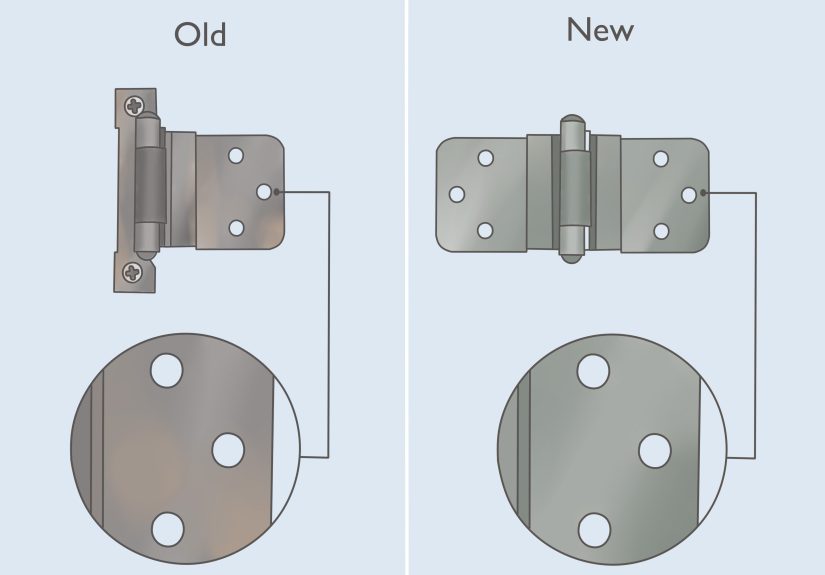
Traditional cabinet hinges do not always use overlay labels or cup bores. Some attach directly to the cabinet and door with two flat metal leaves. These include surface-mount hinges, flush hinges, butt hinges, and some decorative inset hinges.
For these hinges, the key is measuring the actual hardware dimensions.
What to Measure
- Overall hinge height
- Overall open width
- Width of each leaf
- Screw-hole spacing
- Corner shape if mortised
- Offset or crank, if present
How to Do It
- Remove the hinge from the cabinet if possible.
- Lay it flat on a table.
- Measure the height from top to bottom.
- Open the hinge flat and measure the total width across both leaves.
- Measure one leaf width if needed.
- Count and measure the spacing of the screw holes.
- Note whether the hinge is straight, offset, decorative, or self-closing.
If the hinge is mounted in a recess, also check whether the corners are square or rounded. That small detail can matter when swapping out mortised hardware.
When This Method Works Best
Use it for:
- inset cabinet doors,
- older cabinets,
- decorative visible hinges,
- butt hinges, and
- surface-mount hinges with no cup bore.
Example
If your hinge measures 2 1/2 inches tall and 2 inches wide when open, you would shop for that size first, then match finish, screw pattern, and function. Pretty? Nice. Correct size? Non-negotiable.
How to Tell Whether Your Cabinets Are Overlay, Inset, or Full Overlay
Before you buy anything, make sure you understand how the door sits on the cabinet.
Overlay Cabinets
The door overlaps the cabinet opening. This is very common. The amount of overlap is the overlay measurement.
Full Overlay Cabinets
The doors cover most of the cabinet front, leaving minimal gaps. These are common in modern kitchens and often use concealed hinges.
Inset Cabinets
The door sits inside the cabinet frame opening, flush with the front when closed. These often require inset hinges or special hinge configurations. Inset cabinets look elegant, but they are less forgiving when measurements are sloppy.
Other Measurements That Can Save Your Project
The hinge itself is not always the whole story. When shopping for cabinet hinge replacement, also check these details:
Door Thickness
Some hinges work only within a certain door thickness range. This is especially important for concealed hinges.
Number of Hinges Per Door
Larger and heavier doors may need more than two hinges. Standard doors often use two, but taller or heavier doors may require a third for support.
Soft-Close vs. Self-Close
These are not the same thing. Soft-close slows the door down at the end. Self-close pulls the door shut with spring tension. If you love peaceful kitchens and dislike door slamming, this detail matters.
Mounting Plate Compatibility
On many concealed hinges, the hinge arm and mounting plate work together. Replacing one without checking the other can create alignment problems that make you question all your life choices.
Quick Checklist Before You Buy Replacement Cabinet Hinges
- Cabinet type: face-frame or frameless
- Door style: overlay, full overlay, partial overlay, or inset
- Hinge type: concealed, semi-concealed, surface-mount, flush, or butt
- Overlay measurement or inset application
- Cup diameter and depth for European hinges
- Leaf size and screw-hole pattern for traditional hinges
- Door thickness
- Opening angle
- Finish and style
Simple Measuring Tools That Make the Job Easier
You do not need a fancy workshop to measure cabinet hinges, but a few simple tools help:
- tape measure,
- combination square,
- small ruler with metric and imperial markings,
- calipers for precise cup measurements,
- painter’s tape,
- pencil, and
- your phone camera for reference photos.
That last one is underrated. Take photos before removing the hinge. Future trips to the hardware store are easier when you can zoom in on the original setup instead of relying on your memory, which is probably busy thinking about twelve other things.
Final Thoughts
Learning how to measure cabinet hinges is one of those handy homeowner skills that pays off immediately. The trick is not to treat every hinge the same. Some are measured by overlay. Some are measured by cup size and boring pattern. Others are measured by leaf dimensions and screw layout. Once you match the measuring method to the hinge type, the whole process becomes much less mysterious.
If you remember nothing else, remember this: first identify the hinge style, then measure the part that actually controls fit. For overlay hinges, measure overlay. For concealed hinges, measure the cup and application. For traditional hinges, measure the hardware itself. That is how you go from “Why are there 400 hinge options?” to “Ah, yes, I need this exact one.”
And that, dear DIY friend, is the difference between a smooth cabinet upgrade and an afternoon spent arguing with a crooked door.
Real-World Experiences Measuring Cabinet Hinges the Hard Way
The funniest thing about cabinet hinges is that most people do not think about them until one starts sagging, squeaking, loosening, or refusing to close properly. Then suddenly that tiny piece of metal becomes the star of the home improvement show. I have seen more than one beginner walk into a store with a hinge in one hand and total optimism in the other, only to discover there are roughly one million versions that look almost the same.
One of the most common real-world mistakes happens with overlay hinges. Someone removes the old hinge, measures the visible part, buys a replacement that “looks right,” and only later realizes the important measurement was the overlay, not the decorative wing. The result is usually a cabinet door that sits too far in, too far out, or overlaps the neighboring door like it is trying to start a boundary dispute. Once you have seen that happen, the pencil-mark method starts to look absolutely brilliant.
Concealed hinges create a different kind of adventure. On paper, they seem easy because they are modern and adjustable. In reality, they can be sneaky. A homeowner may measure the cup diameter correctly at 35 mm, feel very confident, and still end up with the wrong hinge because the overlay, mounting plate, or opening angle does not match the original setup. That is why experienced DIYers tend to write everything down. Cup size alone is helpful, but cup size plus overlay plus plate style is what actually gets you home with the correct hardware.
Older cabinets add another layer of fun. You open the door expecting a standard surface-mount hinge and instead discover an offset decorative hinge installed sometime during what appears to be the reign of disco. In those cases, measuring overall height and width is only the beginning. You also need to study the screw holes, the offset, and the way the door sits in relation to the frame. It can feel a little like antique forensics, but it is still manageable if you go slowly.
One especially useful real-world habit is taking photos before removing anything. Not one photo. Several. Take one of the door closed, one of it open, one of the hinge from the side, and one of the mounting area. When you are standing in front of replacement options later, those photos can save you from buying something that is technically a hinge but spiritually all wrong.
Another good lesson from experience: old cabinets are not always square, and old hinge screws are not always loyal. Sometimes a hinge replacement problem is partly a hinge problem and partly a stripped screw-hole problem. If the door has been sagging for a while, the best replacement hinge in the world will not perform miracles unless the mounting area is still solid.
In the end, measuring cabinet hinges gets easier the moment you stop rushing it. The people who get the best results are rarely the people with the fanciest tools. They are the ones who check the cabinet style first, use the right measurement method, write down the details, and resist the urge to “just eyeball it.” That approach may not sound glamorous, but it is how you turn a frustrating hardware errand into a genuinely satisfying fix.