Table of Contents >> Show >> Hide
- Why Smart Companies Still Ship Spectacular Mistakes
- Failed Products and Services
- New Coke (Coca-Cola)
- Edsel (Ford)
- Crystal Pepsi (Pepsi)
- Colgate Kitchen Entrees (Colgate)
- Gerber Singles (Gerber)
- Harley-Davidson Perfume (Harley-Davidson)
- Arch Deluxe (McDonald’s)
- OK Soda (Coca-Cola)
- Zune (Microsoft)
- Kin Phones (Microsoft)
- Google Glass (Google)
- Fire Phone (Amazon)
- Juicero Press (Juicero)
- Galaxy Note 7 (Samsung)
- Apple Newton (Apple)
- Virtual Boy (Nintendo)
- Betamax (Sony)
- Segway (Segway)
- HP TouchPad (HP)
- Google Stadia (Google)
- Marketing Campaign Failures and Brand Missteps
- Rollout Disasters and Strategic Faceplants
- How to Avoid Becoming Example #35
- on the “Human Side” of a Corporate Faceplant
- Conclusion
Big brands love to say they “listen to customers.” Then they launch a product nobody asked for, run a campaign that sets the internet on fire (the bad kind),
or roll out a “small change” that somehow turns into a full-blown corporate group project in apology-writing.
This list isn’t here to dunk on anyone for sport (okay, maybe a little). It’s here because failed products and marketing campaign failures are some of the best
real-world case studies for brand strategy. These are the moments when otherwise smart companies forgot a basic truth:
customers don’t buy your intentionsthey buy your experience.
Why Smart Companies Still Ship Spectacular Mistakes
1) Success creates blind spots
When you’ve won for years, you start believing your internal excitement is market demand. You confuse “We can build it” with “People will care.”
That’s how product launch disasters are born: not from stupidity, but from overconfidence with great PowerPoint transitions.
2) Research can lie (especially when you ask the wrong questions)
Focus groups can tell you something tastes good, looks modern, or feels premium. They can’t always measure
emotional attachment, trust, identity, and habitaka the stuff that actually pays your bills.
3) Rollouts fail where reality lives
Warehouses, call centers, app stores, and retail aisles don’t care about your brand manifesto. A rollout is a stress test:
operations, messaging, and user experience all collide at once. If one part breaks, the whole thing becomes a meme.
Failed Products and Services
-
New Coke (Coca-Cola)
The taste tests said yes. The public said “absolutely not,” loudly, repeatedly, and with the passion usually reserved for sports teams.
Lesson: when a brand becomes part of someone’s identity, you can’t A/B test away emotional attachment. -
Edsel (Ford)
Ford poured huge money into a new car line, only to learn that hype doesn’t fix unclear positioning, awkward design perceptions, and timing.
Lesson: if the “why” isn’t obvious to customers, your marketing budget becomes an expensive fog machine. -
Crystal Pepsi (Pepsi)
Clear cola sounded futuristicuntil people tried it and realized “novel” isn’t the same as “better.”
Lesson: a product gimmick can win attention, but it rarely wins loyalty without a real, repeatable advantage. -
Colgate Kitchen Entrees (Colgate)
When a toothpaste brand tries to sell dinner, the brain short-circuits. Even if the food is fine, the association isn’t.
Lesson: brand extensions only work when the new category feels like a natural next stepnot a jump scare. -
Gerber Singles (Gerber)
Baby food credibility didn’t translate into adult convenience meals. People didn’t feel “nurtured,” they felt… concerned.
Lesson: your strongest brand equity can become your biggest barrier in the wrong aisle. -
Harley-Davidson Perfume (Harley-Davidson)
The brand sells rebellion, chrome, and the open roadso a fragrance line felt like dressing a motorcycle in a tuxedo.
Lesson: licensing deals can print money, but they can also print confusion. -
Arch Deluxe (McDonald’s)
McDonald’s tried to go “grown-up gourmet,” but customers came for familiar comfort, not a burger with an identity crisis.
Lesson: know what job customers hire your brand to doand don’t fire yourself. -
OK Soda (Coca-Cola)
Intentionally ironic branding aimed at Gen X vibes, but it landed as confusing and hard to love.
Lesson: being “too clever” can be the fastest way to become forgettable. -
Zune (Microsoft)
It wasn’t terrible hardware. It was just competing against a cultural juggernaut (the iPod ecosystem) with no compelling “switch” reason.
Lesson: competing on “also me” is not a strategy. -
Kin Phones (Microsoft)
A social-first phone arrived late to a market already sprintingand didn’t offer enough to justify its existence.
Lesson: timing and platform ecosystems matter as much as product design. -
Google Glass (Google)
A “computer on your face” sounded like the future until privacy fears and social awkwardness showed up at the same party.
Lesson: adoption isn’t only about technology readinessit’s about social acceptance. -
Fire Phone (Amazon)
Amazon built a phone that wanted you to shop, but people wanted a phone that wanted to be a great phone.
Lesson: a product that serves the company more than the customer rarely becomes a daily habit. -
Juicero Press (Juicero)
A high-priced “smart” juicer lost its mystique when people realized the juice packs could be squeezed by hand.
Lesson: if your core value proposition can be replaced by two human hands, your pricing model is in danger. -
Galaxy Note 7 (Samsung)
A premium flagship became synonymous with recall headlines. Even if your broader brand survives, trust takes a hit.
Lesson: in high-stakes products, safety and reliability are the real “features.” -
Apple Newton (Apple)
Ahead of its time, but not ready for prime timeespecially with recognition errors that became a punchline.
Lesson: “innovative” is only a compliment when it’s also usable. -
Virtual Boy (Nintendo)
A bold attempt at immersive gaming, undercut by discomfort and a limited experience.
Lesson: if the product makes the customer feel worse than before they used it, the retention curve will be dramatic. -
Betamax (Sony)
A technically respected format lost the format war. Market dynamics and partnerships can outweigh specs.
Lesson: ecosystems win when categories standardize. -
Segway (Segway)
Massive hype promised city transformation; reality delivered a niche device with unclear everyday need.
Lesson: a “revolutionary” product still needs a simple, boring, repeatable use case. -
HP TouchPad (HP)
An iPad competitor arrived without an iPad-level app ecosystem, then famously spiraled into discount chaos.
Lesson: hardware alone doesn’t beat platforms; software gravity is real. -
Google Stadia (Google)
Cloud gaming had promise, but customers worried about ownership, longevity, and commitmentthen the shutdown confirmed their fears.
Lesson: trust is a feature, especially when you’re asking people to buy into a new delivery model.
Marketing Campaign Failures and Brand Missteps
-
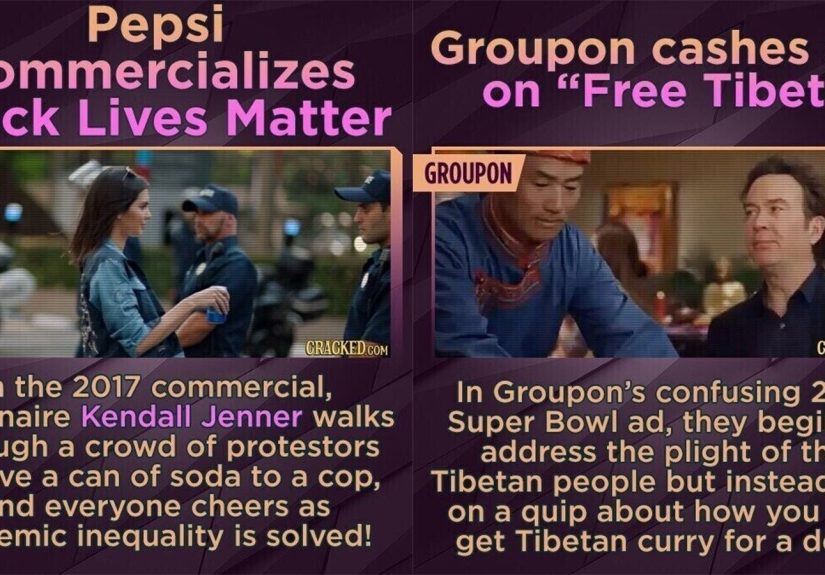
“Live for Now” Kendall Jenner Ad (Pepsi)
The campaign tried to borrow the language of activism and got hit with instant backlash for feeling tone-deaf.
Lesson: if you’re going to enter serious cultural territory, “vibes” are not enoughauthenticity and context matter. -
“Race Together” (Starbucks)
Encouraging conversations about race is meaningful. Asking baristas to kick-start it on coffee cups put employees in an unfair spot and felt forced.
Lesson: good intentions don’t excuse bad executionor misplaced labor. -
The Gap Logo Redesign (Gap)
A new logo debuted, the internet revolted, and the brand retreated fast.
Lesson: identity changes need a plan, a story, and a rollout that respects what people already love. -
Tropicana’s Packaging Redesign (Tropicana)
A “cleaner” look made it harder for shoppers to find the product and recognize what they trusted.
Lesson: packaging is navigation. If you break the map, you break the sale. -
Beacon (Facebook)
An ad system that surfaced off-platform activity triggered privacy outrage and became a cautionary tale.
Lesson: data-driven growth hacks can backfire when customers feel surveilled instead of served. -
“Fair and Square” Pricing (J.C. Penney)
Simplifying prices sounded rationaluntil shoppers who were trained to hunt deals felt like the fun (and urgency) disappeared.
Lesson: “better economics” can still be a worse experience if it fights customer behavior. -
#UpForWhatever Controversy (Bud Light)
A slogan meant to be playful got criticized for messaging that people found irresponsible, leading to a quick pullback.
Lesson: humor is risky when the subject touches safety, consent, or social issuesyour margins for error shrink fast. -
Dove’s 2017 Social Ad Backlash (Dove)
A short video ad was widely criticized as racially insensitive, prompting an apology and removal.
Lesson: diverse review isn’t “nice to have”it’s quality control for modern marketing.
Rollout Disasters and Strategic Faceplants
-
Qwikster (Netflix)
Netflix planned to split DVD and streaming into separate brands and experiences; customers hated it, and Netflix reversed course.
Lesson: don’t add friction during a trust-sensitive pricing or product transitionpeople will leave before they “understand the vision.” -
Target Canada Expansion (Target)
Huge expectations met empty shelves and operational headaches, and the whole expansion ended quickly.
Lesson: retail rollouts don’t fail in theory; they fail in supply chains, data, staffing, and store-level reality. -
Apple Maps Launch (Apple)
A high-profile replacement rolled out with issues that forced public apology vibes.
Lesson: if you replace a beloved default, your new default must be better on day oneor your brand takes the blame. -
Microsoft Tay (Microsoft)
An AI chatbot learned from the internet a little too literally and was taken offline fast.
Lesson: moderation, safeguards, and abuse testing are not optional when you launch products that interact with the public. -
Windows Vista (Microsoft)
Security and interface changes weren’t the problem; the pain was performance, compatibility, and user fatigue with prompts.
Lesson: even good upgrades fail when they feel like punishment. -
Quibi (Quibi)
Premium short-form video launched with huge funding and talentthen shut down after failing to find product-market fit.
Lesson: in a crowded market, you can’t buy your way past a weak habit loop.
How to Avoid Becoming Example #35
- Run a pre-mortem: Assume the launch failed. Write down why. Fix the top three before you ship.
- Protect the “recognition layer”: If you change packaging, UI, pricing, or names, keep familiar cues.
- Build a rollback plan: If the rollout breaks trust, speed matters more than pride.
- Stress-test operations: Warehouses, support, onboarding, and edge cases should be rehearsed like game day.
- Do inclusive creative review: Diverse perspectives reduce blind spots and prevent avoidable harm.
on the “Human Side” of a Corporate Faceplant
If you’ve ever been anywhere near a launch team, you know the emotional arc of a rollout is basically a three-act play:
optimism, adrenaline, and thenif things go wrongan “oh no” moment so loud it’s practically audible on Slack.
It usually starts small. A few confused comments. A spike in customer support tickets. A social post that picks up speed in the wrong direction.
Someone says, “Let’s monitor it.” That sentence is the corporate equivalent of hearing a scary noise in a movie and deciding to “just check the basement.”
Then comes the war room. The same people who spent months polishing launch copy are suddenly writing emergency FAQs at 11:47 p.m.
The product team is trying to reproduce the bug. The comms team is trying to reduce the blast radius. The executives are asking,
“How did we not see this?” while everyone politely avoids saying, “Some of us did,” out loud.
If you’re lucky, the failure is containedbad messaging, confusing pricing, an awkward name. If you’re not, it’s operational:
empty shelves, broken onboarding, an app that doesn’t work, or a policy change that feels like betrayal.
The weird part is how quickly certainty flips. A week earlier, everyone had a slide about “delighting the customer.”
Now the customer is very much not delighted and is expressing that fact in all caps, with screenshots.
You learn fast that brand trust is like oxygen: invisible when you have it, urgent when you don’t.
This is why rebranding failures sting so much. It’s not just aesthetics; it’s identity. People don’t want to feel
like their favorite product has been swapped while they weren’t looking.
Inside the company, the “post-launch narrative” starts forming immediately. Teams search for a single causeone bad decision, one overlooked detail.
But most big failures aren’t one mistake; they’re a chain of small ones. Research that asked the wrong question.
A timeline that got compressed. A warning that sounded “unlikely.” A pilot that didn’t include the messiest user segment.
A rollout plan that assumed best-case behavior from the public, the press, and the internet (which is adorable, honestly).
And yet, there’s a productive side to living through itbecause nothing clarifies priorities like a public lesson.
The smartest organizations treat a flop as a systems problem, not a scapegoat hunt. They fix how decisions get made:
clearer ownership, stronger review gates, better abuse testing, more realistic operational rehearsals, and permission to say,
“This isn’t ready,” without getting socially penalized for it.
The healthiest kind of “failure experience” ends with a simple rule: next time, build for the customer’s reality,
not the brand’s fantasy. Because the market doesn’t grade on effort. It grades on what shows up on the shelf, on the screen,
and in someone’s lifeat 7 a.m., in a hurry, with zero patience for your internal roadmap.
Conclusion
Every example here has its own plot twists, but the pattern is consistent: failed products, corporate PR disasters, and botched rollouts happen
when companies drift away from customer expectations, overestimate novelty, or underestimate friction.
The upside? These are fixable problemsif you build feedback loops that are honest, operational plans that are real, and marketing that respects context.
Your goal isn’t perfection. It’s resilience: launch with humility, learn fast, and keep trust intact.