Table of Contents >> Show >> Hide
- Before You Fall in Love: Two Quick Reality Checks (Safety + Style)
- 35 Stair Railing Ideas, Organized by Look and Level of Drama
- 1) Two-tone classic (painted spindles + stained rail)
- 2) All-black railing for instant definition
- 3) Soft-white railing to brighten a dark stairwell
- 4) High-gloss handrail for a subtle “wow” (and easy wipe-downs)
- 5) Limed oak or whitewashed wood for breezy coastal style
- 6) Warm walnut stain to make the staircase feel custom
- 7) Color-pop newel posts (tiny risk, big personality)
- 8) Swap chunky spindles for slimmer profiles
- 9) Square iron balusters for modern farmhouse polish
- 10) “Basket” or “knuckle” iron details for traditional charm
- 11) Reclaimed wood handrail for character you can’t fake
- 12) Beefy craftsman newels for architectural “weight”
- 13) Classic turned newels with updated balusters
- 14) Continuous wall handrail (simple, clean, and space-saving)
- 15) Horizontal cable railing for an open, modern feel
- 16) Vertical cable for a cleaner, more code-friendly look
- 17) Framed glass panels (modern, sturdy, family-friendly)
- 18) Minimal or “invisible” glass railing for maximum light
- 19) Steel plate railing for an industrial edge
- 20) Perforated metal or mesh for texture without heaviness
- 21) Floating stair + minimalist rail for gallery-like calm
- 22) Vertical wood slat railing for a modern “privacy screen” effect
- 23) Geometric pattern balusters for instant personality
- 24) Art Deco-inspired rail details
- 25) Curved railing for elegance (even on a straight stair)
- 26) Mixed materials: wood rail + metal balusters
- 27) Mixed materials: wood rail + glass panels
- 28) Make the newel a statement (oversized or sculptural)
- 29) Add integrated stair lighting along the rail or wall
- 30) Go “tone-on-tone” for a calm, designer look
- 31) Contrast the stair wall with the railing for a bold outline
- 32) Update only what you touch: replace the handrail (keep the rest)
- 33) Consider acrylic or plexiglass panels for a lighter look
- 34) Add a “cap rail” wide enough for styling (with caution)
- 35) Treat the railing like furniture: coordinate with nearby pieces
- How to Choose the Right Idea for Your Home (Without Regret)
- Personal Experiences: What I’ve Learned From Real Stair Railing Upgrades (About )
- Conclusion
Stair railings are the jewelry of your staircase. Sure, they’re there for safetybut they’re also one of the first
things your eyes lock onto when you walk into a foyer. And unlike ripping out a kitchen, a railing refresh can be a
surprisingly high-impact way to change the whole vibe of your home (without living off paper plates for three weeks).
Whether you’re aiming for warm and traditional, modern and airy, or “I just want it to stop squeaking and looking
tired,” these stair railing ideas can help you turn a pass-through stair into a design moment.
Before You Fall in Love: Two Quick Reality Checks (Safety + Style)
1) Make sure it’s comfortable to hold
The most gorgeous railing in the world is useless if it’s awkward to gripespecially for kids, guests, and anyone
carrying laundry like it’s an Olympic event. If your design uses a wide top rail as a guard, you may still need a
separate graspable handrail depending on your layout and local rules.
2) Keep openings kid-safe (and code-friendly)
If your home has little ones (or frequent visitors who behave like little ones), pay attention to spacing. In many
jurisdictions, guard infill openings are limited so a small sphere can’t pass through. Always check local amendments
and permitting requirements before you commit to a specific pattern.
35 Stair Railing Ideas, Organized by Look and Level of Drama
1) Two-tone classic (painted spindles + stained rail)
This is the gateway makeover: bright spindles and newels for crisp contrast, with a stained handrail for warmth.
It works in traditional, farmhouse, and transitional homesand it forgives scuffs better than an all-white rail.
2) All-black railing for instant definition
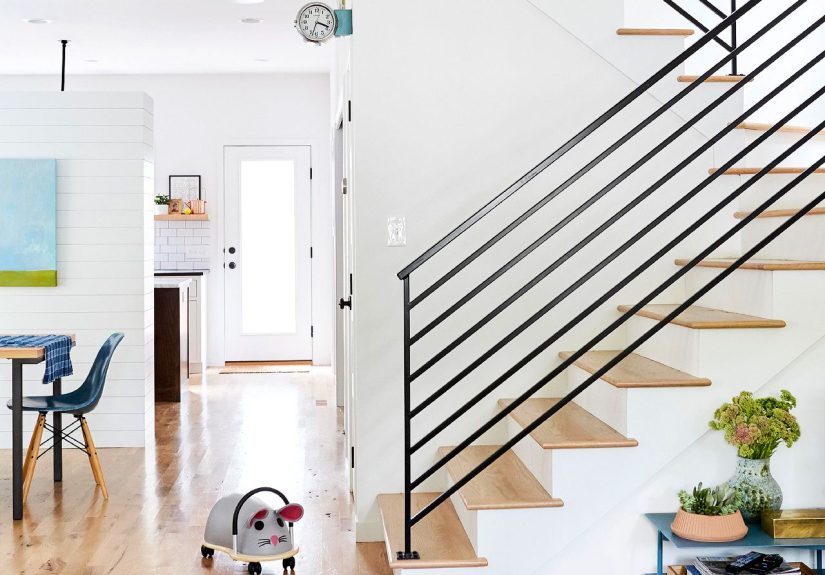
Black rail + black balusters can make even a builder-basic staircase look tailored. Pair it with warm wood treads to
keep it from feeling harsh, or go full monochrome for modern drama.
3) Soft-white railing to brighten a dark stairwell
If your stairs live in a shadowy hallway, a light railing can bounce visual “light” even before you add actual
lighting. It’s the interior-design equivalent of opening the blinds.
4) High-gloss handrail for a subtle “wow” (and easy wipe-downs)
A satin or semi-gloss is standard, but a high-gloss rail can feel unexpectedly luxeespecially in older homes with
traditional profiles. Bonus: fingerprints wipe off faster.
5) Limed oak or whitewashed wood for breezy coastal style
Want “beachy” without turning your foyer into a seashell souvenir shop? Lightened wood tones on the rail (with
neutral walls) deliver that airy vibe without going theme-y.
6) Warm walnut stain to make the staircase feel custom
Walnut tones read rich and intentional. They also play nicely with black metal balusters, creamy walls, and brass
lightingaka the “I hired a designer” starter pack.
7) Color-pop newel posts (tiny risk, big personality)
Keep the rail neutral, then paint only the newel posts in a deep colornavy, forest green, charcoal plum. It’s
like adding statement earrings to a simple outfit.
8) Swap chunky spindles for slimmer profiles
Replacing thick, turned balusters with slimmer square wood or metal can instantly modernize a stairwithout changing
the whole geometry. The staircase feels lighter and less “busy.”
9) Square iron balusters for modern farmhouse polish
Square black iron balusters are the MVP of staircase updates: affordable, widely available, and compatible with both
rustic and modern interiors. They’re also visually cleaner than ornate scrollwork.
10) “Basket” or “knuckle” iron details for traditional charm
If your home leans classic, small decorative iron elements can add a tailored look without going full castle.
Use them sparinglythink accents, not a whole marching band.
11) Reclaimed wood handrail for character you can’t fake
A reclaimed rail brings natural variationknots, grain shifts, subtle imperfectionsthat reads authentic. Pair it
with simple balusters so the wood can be the star.
12) Beefy craftsman newels for architectural “weight”
Larger, squared-off newel posts make a staircase feel grounded and intentional. Great for Craftsman homesand also
for newer homes that need more architectural detail.
13) Classic turned newels with updated balusters
You don’t have to erase history. Keep original newels (especially if they’re beautiful), then modernize the infill
with simpler balusters. Old + new can look curated, not confused.
14) Continuous wall handrail (simple, clean, and space-saving)
In tight staircases, a sleek wall-mounted handrail can reduce visual clutter. Choose a comfortable profile and match
the finish to nearby hardware for a cohesive look.
15) Horizontal cable railing for an open, modern feel
Cable railings are popular for a reason: they preserve sightlines. They’re especially effective in open-plan homes
where you want the staircase to feel like part of the space, not a divider.
16) Vertical cable for a cleaner, more code-friendly look
Vertical cable keeps the airy vibe while reducing the “ladder effect” concern some people have with horizontal runs.
It can feel crisp and architecturalespecially with a wood cap rail.
17) Framed glass panels (modern, sturdy, family-friendly)
Glass panels keep things bright and spacious. Framed systems feel slightly more practical and durable for busy homes,
while still delivering that sleek, high-end look.
18) Minimal or “invisible” glass railing for maximum light
If you want the staircase to disappear (in a good way), low-profile glass makes your treads and surrounding details
the focus. It’s like switching from a bulky frame to a clean edge-to-edge screen.
19) Steel plate railing for an industrial edge
Think solid (or cutout) steel panels instead of balusters. This works beautifully in lofts, modern homes, and spaces
with concrete, brick, or black-framed windows.
20) Perforated metal or mesh for texture without heaviness
Perforated panels and metal mesh can feel contemporary but still warmespecially when paired with wood. It’s a great
middle ground between “open” and “solid.”
21) Floating stair + minimalist rail for gallery-like calm
If your staircase is already open and modern, keep the railing visually quietthin metal, slim wood, or glassso the
structure can shine without visual noise.
22) Vertical wood slat railing for a modern “privacy screen” effect
Wood slats can create a beautiful rhythm and add privacy in open foyers. It’s especially striking when slats extend
floor-to-ceiling, turning the stair into an architectural feature wall.
23) Geometric pattern balusters for instant personality
Use repeating squares, rectangles, or angled shapes to add a graphic element. This suits mid-century and modern
interiorsand it looks custom even when it’s kit-based.
24) Art Deco-inspired rail details
If your home has vintage roots, lean in with stepped profiles, symmetrical geometry, and glossy finishes. It’s
glamwithout requiring a feather boa at the top landing.
25) Curved railing for elegance (even on a straight stair)
You don’t need a grand spiral to get movement. A subtly curved handrail or softened transitions can make the stair
feel more refined, especially in traditional or European-inspired spaces.
26) Mixed materials: wood rail + metal balusters
This combo is popular because it works almost everywhere. Wood adds warmth, metal adds crisp contrast. The result:
balanced, timeless, and easy to coordinate with lighting and hardware.
27) Mixed materials: wood rail + glass panels
Want warmth and openness? A wood top rail with glass infill gives you both. It’s ideal when you want modern
sightlines but don’t want the space to feel cold.
28) Make the newel a statement (oversized or sculptural)
A bold newel post can anchor the entire staircase. Consider a chunky square newel, a turned sculptural form, or even
a newel with a subtle cap detail that echoes your home’s trim.
29) Add integrated stair lighting along the rail or wall
Lighting can elevate a stair from “functional” to “premium.” Soft step lights or subtle rail-adjacent lighting
improves safety and looks amazing in the evening.
30) Go “tone-on-tone” for a calm, designer look
Match the railing color to the wall color for a blended, quiet effect. This is a secret weapon in smaller spaces
where contrast can feel choppy. Let the runner or artwork bring the interest.
31) Contrast the stair wall with the railing for a bold outline
Do the opposite: choose a high-contrast railing against the wall so the stair reads crisp and intentional. This can
help with visibility in dim stairwells, too.
32) Update only what you touch: replace the handrail (keep the rest)
If your budget is tight, swap the handrail for a more modern profile and refinish it. It’s the part you interact
with every dayso it’s where a small upgrade feels big.
33) Consider acrylic or plexiglass panels for a lighter look
Acrylic can mimic glass while being lighter. It’s a contemporary option that keeps sightlines open and can work well
in playful, modern homes (especially where weight or shatter concerns matter).
34) Add a “cap rail” wide enough for styling (with caution)
A wider top rail can look substantial and even give you a ledge for décor at a landingbut keep it tasteful and safe.
Think minimal objects, not a knickknack parade that tumbles during vacuum day.
35) Treat the railing like furniture: coordinate with nearby pieces
The most elevated stair designs feel intentional because they repeat finishes: black rail + black light fixture,
walnut rail + walnut console, brass accents echoed in hardware. Cohesion is what makes a staircase feel “designed.”
How to Choose the Right Idea for Your Home (Without Regret)
Match the railing to your home’s “fixed” elements
Your floors, door styles, baseboards, and window trim don’t change as easily as décor. If you pick a railing finish
that speaks the same language as those elements, your staircase will look like it belongs.
Think about maintenance like a grown-up (future you will be grateful)
Gloss shows fingerprints. Matte hides smudges. White shows scuffs. Black shows dust. Glass shows… everything when
the sun hits it at the wrong angle. Choose based on your real life, not your fantasy life.
Don’t skip sturdiness
A railing should feel rock-solid in your hand. If you’re changing newels or infill, proper fastening and layout
matter. A beautiful railing that wiggles is basically a decorative suggestion, not a safety feature.
Personal Experiences: What I’ve Learned From Real Stair Railing Upgrades (About )
I used to think stair railings were like socks: necessary, usually boring, and only noticeable when something goes
wrong. Then I started paying attention during open houses and remodel tours. The homes that felt “finished” almost
always had one thing in commonstair railings that looked intentional. Not necessarily expensive. Just thoughtful.
One memorable house had a simple staircase with plain wood treads, but the railing was black metal with a warm wood
handrail. That tiny contrast made the whole entry feel polished, like the owners had a plan instead of a pile of
leftover choices. It taught me a big lesson: a railing is basically an outline for your staircase. If the outline is
sharp, the whole drawing looks better.
I also learned that “small update” doesn’t always mean “easy update.” Painting spindles sounds harmlessuntil you’re
crouched on a stair with painter’s tape stuck to your elbow, wondering why you have so many emotions about primer.
The best experience I’ve seen (and the smoothest results) came from treating the railing like trim work: clean well,
sand what needs sanding, prime properly, then use a durable paint. The payoff is real, though. When you repaint
yellowed spindles to a crisp white (or switch everything to a modern black), the staircase stops looking tired.
The most surprising transformation I witnessed was a “keep the newels, swap the infill” upgrade. The homeowner loved
their original newel postsbig, traditional, full of characterbut the dated, ornate spindles made the stair feel
heavy. By swapping spindles for simple square balusters, they kept the home’s history while removing the visual
clutter. The staircase suddenly felt like a classic piece wearing modern shoes. That combopreserving what’s special
while editing what’s noisyended up being the smartest design approach in the whole project.
Cable and glass railings were my next “aha” moment. In photos, they look effortless. In person, the best ones feel
like they’re barely there, which makes a space look bigger. But I also learned that real life has fingerprints,
especially at the exact height where a hand naturally lands. If you love glass, you’ll want a realistic plan for
cleaning (and maybe avoid placing it where sunlight turns every smudge into a spotlight).
Finally, the most valuable experience-based tip: decide what you want your staircase to do. Do you want it to be a
statement piece that steals attention the second you walk in? Or do you want it to fade into the background so the
art, runner, or architecture gets the spotlight? Once you answer that, choosing between bold contrast, mixed
materials, or a quiet tone-on-tone railing becomes much easier. And when you’re not guessing, your home looks
confidentlike it knows what it’s doing (even if you’re still figuring it out, one paint sample at a time).
Conclusion
The best stair railing ideas aren’t just trendythey’re the ones that match your home’s architecture, fit your daily
life, and feel sturdy enough to trust with a laundry basket and a bad attitude. Whether you go two-tone and classic,
sleek and modern with glass, or warm and updated with wood-and-metal, a railing refresh can make your staircase look
intentional, elevated, and quietly impressive every single day.