Table of Contents >> Show >> Hide
- How Chinese Last Names Work
- Why So Many People Share the Same Chinese Surnames
- 55+ Most Common Chinese Last Names and Their Meanings
- Common Chinese Last Names in Everyday Life
- Mandarin, Cantonese, and Overseas Spellings
- How to Read the Meaning of a Chinese Surname
- Beautiful Chinese Last Names With Nature Meanings
- Powerful Chinese Last Names From States and Dynasties
- of Personal Experience and Practical Reflection
- Conclusion
Chinese last names are tiny time capsules. Some point to ancient kingdoms, some to noble titles, some to landscapes, animals, colors, occupations, or family legends so old they practically need their own museum lighting. And yet, despite China’s enormous population and long history, a surprisingly small group of surnames is shared by hundreds of millions of people. In other words, if you meet someone named Wang, Li, Zhang, Liu, or Chen, you are not discovering a rare cultural unicornyou are meeting a member of one of the world’s biggest surname clubs.
This guide explores 55+ of the most common Chinese last names and their meanings, with helpful notes on pronunciation, cultural background, and why some names look totally different in English depending on whether they came through Mandarin, Cantonese, Hokkien, Teochew, Hakka, or another Chinese language. Think of it as a friendly field guide to Chinese surnamesminus the dusty encyclopedia smell.
How Chinese Last Names Work
In Chinese naming tradition, the family name usually comes first, followed by the given name. So in the name Wang Wei, “Wang” is the surname and “Wei” is the given name. This is the reverse of the usual American English order, where the family name comes last. Most Chinese surnames are one character long, though compound surnames such as Ouyang, Zhuge, and Shangguan also exist.
Another important detail: the “meaning” of a Chinese surname is not always a simple translation. A character may literally mean “king,” “plum,” or “yellow,” but as a surname it can also refer to an ancient state, a clan ancestor, a place name, an official title, or a historical event. So yes, Wang means “king,” but that does not mean every Wang family is walking around with a crown in the attic. Though honestly, that would be excellent storage-room drama.
Why So Many People Share the Same Chinese Surnames
Chinese surnames are highly concentrated. The top surnamesespecially Wang, Li, Zhang, Liu, and Chenare shared by enormous populations. This concentration developed through thousands of years of clan history, migration, imperial administration, regional settlement, and the spread of Han Chinese family lines. Some surnames became common because they were linked to powerful states or noble families. Others spread as people adopted names from places where they lived or from ancestors they honored.
Regional pronunciation also matters. The same character can become different English spellings. 陈 is usually Chen in Mandarin, Chan in Cantonese, and Tan in Hokkien or Teochew. 李 may appear as Li or Lee. 黄 may become Huang, Wong, Ng, or other forms depending on language and migration history. This is why Chinese last names in the United States can look wonderfully varied even when the original Chinese character is the same.
55+ Most Common Chinese Last Names and Their Meanings
The following list includes common Mandarin spellings, simplified Chinese characters, pinyin pronunciation, and plain-English meaning or origin notes. Many of these surnames also have traditional forms or regional spellings, but the table keeps the focus clear and copy-friendly.
| # | Last Name | Chinese | Pinyin | Meaning or Origin |
|---|---|---|---|---|
| 1 | Wang | 王 | Wáng | King, ruler, or royal; one of the most common Chinese surnames. |
| 2 | Li | 李 | Lǐ | Plum or plum tree; often spelled Lee overseas. |
| 3 | Zhang | 张 | Zhāng | To open, stretch, or draw a bow; a classic major surname. |
| 4 | Liu | 刘 | Liú | An ancient surname connected with old clan and royal lines. |
| 5 | Chen | 陈 | Chén | Old, displayed, or arranged; also tied to the ancient State of Chen. |
| 6 | Yang | 杨 | Yáng | Poplar or willow-like tree; widely used across China. |
| 7 | Huang | 黄 | Huáng | Yellow; also linked with the ancient Huang state and Yellow River imagery. |
| 8 | Zhao | 赵 | Zhào | Name of an ancient state; historically associated with nobility. |
| 9 | Wu | 吴 | Wú | Ancient State of Wu; common in eastern and southern China. |
| 10 | Zhou | 周 | Zhōu | Complete, encircle, or the Zhou dynasty/state. |
| 11 | Xu | 徐 | Xú | Slowly, calmly, or gently; also an ancient state name. |
| 12 | Sun | 孙 | Sūn | Grandchild or descendant; a deeply family-centered meaning. |
| 13 | Ma | 马 | Mǎ | Horse; short, strong, and easy to remember. |
| 14 | Zhu | 朱 | Zhū | Vermilion or bright red; also an ancient clan name. |
| 15 | Hu | 胡 | Hú | Beard or ancient northern peoples; also used as a surname for several origins. |
| 16 | Guo | 郭 | Guō | Outer city wall; linked to fortified settlements. |
| 17 | He | 何 | Hé | What or why; as a surname, it has historical and regional origins. |
| 18 | Lin | 林 | Lín | Forest; a nature-inspired surname common in southern China and Taiwan. |
| 19 | Gao | 高 | Gāo | Tall, high, or noble in height. |
| 20 | Luo | 罗 | Luó | Net, gauze, or to gather; also an ancient state name. |
| 21 | Zheng | 郑 | Zhèng | Ancient State of Zheng; a major historical surname. |
| 22 | Liang | 梁 | Liáng | Beam, bridge, or roof support; also a dynastic and state name. |
| 23 | Xie | 谢 | Xiè | To thank, decline, or wither; often spelled Tse or Hsieh historically. |
| 24 | Song | 宋 | Sòng | Song dynasty or ancient State of Song. |
| 25 | Tang | 唐 | Táng | Tang dynasty or ancient Tang state; a name with imperial sparkle. |
| 26 | Xu | 许 | Xǔ | To allow or promise; also the ancient State of Xu. |
| 27 | Han | 韩 | Hán | Ancient State of Han; also connected with the Han people and dynasty. |
| 28 | Feng | 冯 | Féng | To gallop or rely on; an old surname with several origin stories. |
| 29 | Deng | 邓 | Dèng | Ancient State of Deng; common in southern China. |
| 30 | Cao | 曹 | Cáo | Class, group, or ancient state; famous from Three Kingdoms history. |
| 31 | Peng | 彭 | Péng | Associated with drums, sound, and ancient clan legends. |
| 32 | Zeng | 曾 | Zēng | Once, already, or formerly; also linked to the ancient State of Zeng. |
| 33 | Xiao | 萧 | Xiāo | Mugwort or a reed-like plant; also connected to ancient place names. |
| 34 | Tian | 田 | Tián | Field or farmland; beautifully practical, like a surname wearing work boots. |
| 35 | Dong | 董 | Dǒng | To supervise or manage; historically linked to official responsibility. |
| 36 | Yuan | 袁 | Yuán | An ancient surname, sometimes associated with garments or clan origins. |
| 37 | Pan | 潘 | Pān | Connected with ancient places and water-related origins. |
| 38 | Yu | 于 | Yú | At, in, or from; a simple character with deep historical use. |
| 39 | Jiang | 蒋 | Jiǎng | Linked to an ancient state and plant-related meanings. |
| 40 | Cai | 蔡 | Cài | Ancient State of Cai; also linked to divination grasses in old usage. |
| 41 | Yu | 余 | Yú | Surplus, remaining, or “I/me” in classical usage. |
| 42 | Du | 杜 | Dù | Birchleaf pear; also means to prevent or stop. |
| 43 | Ye | 叶 | Yè | Leaf; poetic, natural, and very recognizable. |
| 44 | Cheng | 程 | Chéng | Journey, rule, procedure, or measurement. |
| 45 | Su | 苏 | Sū | Revive, awaken, or perilla plant; also tied to places. |
| 46 | Wei | 魏 | Wèi | Ancient State of Wei; also suggests towering greatness. |
| 47 | Lü | 吕 | Lǚ | Ancient state name and musical pitch association. |
| 48 | Ding | 丁 | Dīng | Adult male, nail, or fourth heavenly stem. |
| 49 | Ren | 任 | Rèn | To appoint, trust, or hold office. |
| 50 | Shen | 沈 | Shěn | To sink or deep; also an ancient clan/place name. |
| 51 | Yao | 姚 | Yáo | Beautiful or good-looking in older interpretations; also tied to legendary ancestry. |
| 52 | Lu | 卢 | Lú | Black, hut, or ancient vessel-related meanings depending on context. |
| 53 | Jiang | 姜 | Jiāng | Ginger; one of the oldest Chinese surnames. |
| 54 | Cui | 崔 | Cuī | High, lofty, or steep; a surname with elegant altitude. |
| 55 | Zhong | 钟 | Zhōng | Bell, clock, or vessel; often spelled Chung in older romanization. |
| 56 | Tan | 谭 | Tán | Ancient State of Tan; also associated with discussion or speech. |
| 57 | Lu | 陆 | Lù | Land, shore, or continent; also the number six in formal contexts. |
| 58 | Wang | 汪 | Wāng | Vast water or a deep pool; different from 王 Wáng. |
| 59 | Fan | 范 | Fàn | Model, pattern, or example; also a place-based surname. |
| 60 | Jin | 金 | Jīn | Gold or metal; also associated with the Jin dynasty and regions. |
Common Chinese Last Names in Everyday Life
Some Chinese surnames are so common that they function almost like cultural shorthand. In English, “Smith and Johnson” might represent ordinary family names. In Chinese, names like Zhang San and Li Si can be used in examples the way Americans might say “John Doe” or “Jane Smith.” The surname Zhang is so familiar that it practically walks into the room before you finish saying it.
Still, common does not mean boring. Li may mean “plum,” but it is also connected to major historical figures and royal families. Tang and Song instantly echo two of China’s most famous dynasties. Lin means “forest,” giving it a soft, natural feel. Ma means “horse,” which is wonderfully directno committee meeting required.
Mandarin, Cantonese, and Overseas Spellings
One reason Chinese last names can confuse English speakers is romanization. Mandarin pinyin is now the standard in mainland China, so 王 is written Wang, 李 is Li, and 张 is Zhang. But many overseas Chinese communities use spellings shaped by Cantonese, Hokkien, Teochew, Hakka, Taishanese, or older systems such as Wade-Giles.
That is why Chen, Chan, and Tan can point to the same character: 陈. Likewise, Huang may appear as Wong or Ng, while Li may appear as Lee, Lei, or Lay. These spellings are not “wrong.” They are linguistic postcards from different regions and migration routes. A surname’s English spelling may tell you something about family history, dialect background, or where the family settled overseas.
How to Read the Meaning of a Chinese Surname
1. Look at the character, not only the English spelling
English spellings can merge different Chinese surnames. For example, “Wang” may refer to 王, meaning “king,” or 汪, meaning “vast water.” “Lu” may represent 卢 or 陆. Without the Chinese character, you are looking at the suitcase tag, not the suitcase.
2. Remember that surnames are historical, not just literal
Many Chinese last names come from ancient states such as Chen, Zheng, Cai, Wei, Song, Tang, and Zhao. In these cases, the surname’s importance is often historical rather than purely dictionary-based. The meaning is not only “what the character means,” but also “where the family line may have come from.”
3. Treat origin stories with care
Chinese surname origins are rich, but they can also be layered. One surname may have several origin branches, and two families with the same character may not share the exact same ancestor. Genealogy, clan records, regional histories, and ancestral villages can all add detail. Translation is a good doorway; family research is the whole house.
Beautiful Chinese Last Names With Nature Meanings
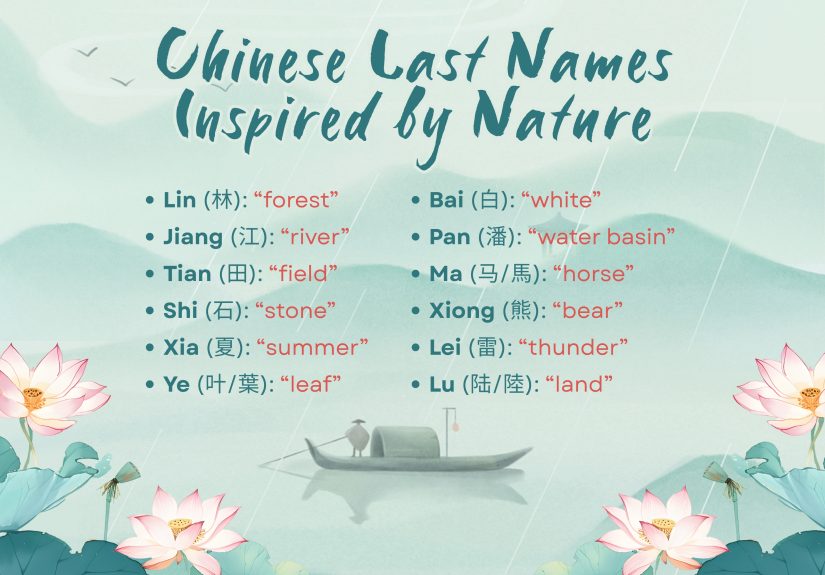
Several common Chinese surnames feel especially poetic in English. Lin means forest, Ye means leaf, Tian means field, Ma means horse, Jiang can mean ginger, Huang means yellow, and Jin means gold. These names are simple, visual, and easy to remember. They also show how Chinese characters often carry compact imagery. One character can feel like a tiny painting with a pronunciation attached.
But again, do not assume a person experiences their surname as a cute nature label. A person named Lin may not introduce themselves as “Hi, I’m Forest.” That would be memorable, yes, but possibly not the vibe at a parent-teacher conference. The best approach is to appreciate the meaning without turning it into a nickname unless invited.
Powerful Chinese Last Names From States and Dynasties
Many common Chinese surnames are tied to states, kingdoms, or dynasties. Zhao, Chen, Song, Tang, Han, Wei, Cai, Zheng, and Deng all carry historical weight. These names remind us that surnames often formed from geography and political identity. If an ancestor lived in, served, ruled, or descended from a certain state, the state name could become a family name.
This gives Chinese last names an epic quality. Some sound like they belong in a family tree, a history book, and a palace drama all at once. That does not mean every bearer of the name has a royal backstory, but it does show how family names can preserve ancient cultural memory long after borders, capitals, and dynasties have changed.
of Personal Experience and Practical Reflection
Learning about Chinese last names often starts with curiosity, but it quickly turns into a lesson in respect. One of the most useful experiences is noticing how easy it is to misread a Chinese name if you only apply Western naming habits. For example, when an English speaker sees “Chen Wei,” the instinct may be to assume “Wei” is the surname because it appears last. But in standard Chinese order, Chen is the family name. That one small switch can affect how you address someone in class, at work, in an email, or during an interview.
Another real-world experience comes from seeing the same surname appear in different English forms. At first, it can feel confusing that Li and Lee, Chen and Chan, Huang and Wong, or Xu and Hsu may be connected through language history. But once you understand dialects and romanization, the confusion becomes fascinating. It is like discovering that a family name has traveled with luggage stickers from Guangdong, Fujian, Hong Kong, Taiwan, Singapore, Malaysia, Vietnam, and the United States. Each spelling tells part of a migration story.
For writers, teachers, and content creators, Chinese surnames also teach an important SEO lesson: accuracy matters more than decoration. It may be tempting to write “Wang means king, so Wang families are royal,” but that is too simplistic. A better explanation says that Wang literally means king or ruler, while the surname has several historical origins and is now one of the most common family names in China. That difference may look small, but it separates useful content from fortune-cookie writing wearing a fake mustache.
In social situations, surname knowledge can make conversations warmer. If someone shares their Chinese name and you recognize the family name, you can ask thoughtful questions: “Is that Chen as in 陈?” or “Do you spell Lee from 李?” The key is to be curious, not pushy. Names can be personal. Some people love talking about family history; others just want coffee and no surprise genealogy interview before 9 a.m.
For people researching ancestry, the surname is often the first breadcrumb. It may lead to a village, a clan association, a family genealogy book, or an ancestral hall. However, because many Chinese surnames are extremely common, a surname alone is usually not enough to trace a family line. You may need Chinese characters, dialect pronunciation, ancestral hometown, immigration records, and family stories. “My surname is Zhang” is a starting point, not the finish line. It is like saying, “I’m looking for someone named John”helpful, but the search party is going to need snacks.
The biggest takeaway is that Chinese last names are both common and deeply meaningful. They are everyday identifiers, but they also carry echoes of ancient states, landscapes, occupations, virtues, and migrations. Whether you are naming a character, researching your roots, studying Mandarin, building an educational article, or simply trying not to call someone by the wrong part of their name, understanding Chinese surnames gives you a more respectful and interesting way to connect with Chinese culture.
Conclusion
Chinese last names may be short, but they are not small. A single character can hold history, geography, family identity, pronunciation changes, and centuries of cultural memory. The most common Chinese surnamesWang, Li, Zhang, Liu, Chen, Yang, Huang, Zhao, Wu, Zhou, and many moreshow how names can travel across dynasties, regions, languages, and oceans while still keeping their roots.
If you are learning Mandarin, writing about Chinese culture, researching genealogy, or simply trying to understand why one surname can appear as Chen, Chan, or Tan, the best rule is simple: look for the Chinese character, respect the family-name-first order, and avoid reducing names to cute literal translations. A Chinese surname is not just a label. It is a family headline, and sometimes it has been running for more than two thousand years.