Table of Contents >> Show >> Hide
- Trick #1: Go Light, Go Cohesive (a.k.a. Stop “Chopping Up” the Room)
- Trick #2: Use One “Big” Mirror (or Two Smart Ones) to Multiply Light
- Trick #3: Swap a Shower Curtain for Clear Glass (Goodbye, Visual Wall)
- Trick #4: Layer Lighting (Because One Ceiling Light Is a Mood, Not a Plan)
- Trick #5: Choose Large-Format Tile (Fewer Lines = Bigger Feel)
- Trick #6: Float the Vanity (and Anything Else You Can) to Show More Floor
- Trick #7: Build Storage Into the Walls (So Your Counters Can Breathe)
- Trick #8: Fix the “Flow” (Doors, Sightlines, and Layout Tweaks)
- Experience-Based Add-On: What These Tricks Look Like in Real Bathrooms (About )
- 1) The windowless powder room that always feels gloomy
- 2) The tiny full bath with a shower curtain that chops the room in half
- 3) The family bathroom with too many bottles, toys, and towels
- 4) The narrow bathroom where the door swing steals the only standing spot
- 5) The “it’s cute but busy” bathroom with lots of small tile and high-contrast grout
- Conclusion: The Small-Bathroom “Bigger” Checklist
Small bathrooms have a special talent: they can feel cramped even when they’re clean, cute, and technically obeying all known laws of physics.
The good news is designers don’t fight tiny bathrooms with magicthey use optics. Light. Sightlines. Fewer visual “speed bumps.”
And yes, the occasional mirror that quietly doubles as a confidence booster.
After comparing advice that shows up again and again across major U.S. home and design outlets (think: practical pros, design magazines, and renovation
veterans), one theme is loud and clear: your bathroom doesn’t need more square footageit needs fewer interruptions.
Below are eight designer-approved tricks that make a small bath feel more open, calmer, and (dare we say) almost roomy.
Trick #1: Go Light, Go Cohesive (a.k.a. Stop “Chopping Up” the Room)
High contrast is dramatic… and also great at making a small bathroom feel like it’s been sliced into tiny visual cubes. Designers often recommend
keeping walls, trim, and major surfaces in a tight color family so your eye travels smoothly instead of stopping at every edge.
A soft white, warm off-white, pale gray, or gentle “spa” tone can bounce light around and reduce that boxed-in feeling.
How to use it (without turning your bathroom into a blank lab)
- Pick one main shade and repeat it across walls and large elements (vanity, shower tile, or even the ceiling).
- Keep undertones consistent (warm with warm, cool with cool) so the room reads as one calm space.
- Add contrast in small doses: hardware, a framed art print, a hand toweltiny accents, not giant color blocks.
If you love bold color, you don’t have to break up with itjust stop letting it start fights between the floor and the walls.
Use one saturated “moment” (like a vanity or wallpaper) and keep surrounding surfaces quieter.
Trick #2: Use One “Big” Mirror (or Two Smart Ones) to Multiply Light
Mirrors don’t just reflect your eyeliner progressthey reflect light and extend sightlines. A larger mirror can visually “push” the wall back,
making the room feel deeper. This is why designers keep recommending oversized mirrors, wide mirrors, or mirrored medicine cabinets that do
double duty: storage + sparkle.
Designer moves that work especially well in small bathrooms
- Go wide: a mirror that spans most (or all) of the vanity width feels expansive and intentional.
- Go tall: a taller mirror pulls the eye upward, which helps a low ceiling feel less… low.
- Go recessed: a mirrored medicine cabinet that sits in the wall reduces clutter and adds reflection.
- Go “two mirrors”: in tight layouts, paired mirrors can reflect different angles and boost brightness.
Pro tip: if your lighting is dim, a bigger mirror won’t fix everythingbut it will make the light you do have work harder.
(Mirrors: the overachievers of bathroom design.)
Trick #3: Swap a Shower Curtain for Clear Glass (Goodbye, Visual Wall)
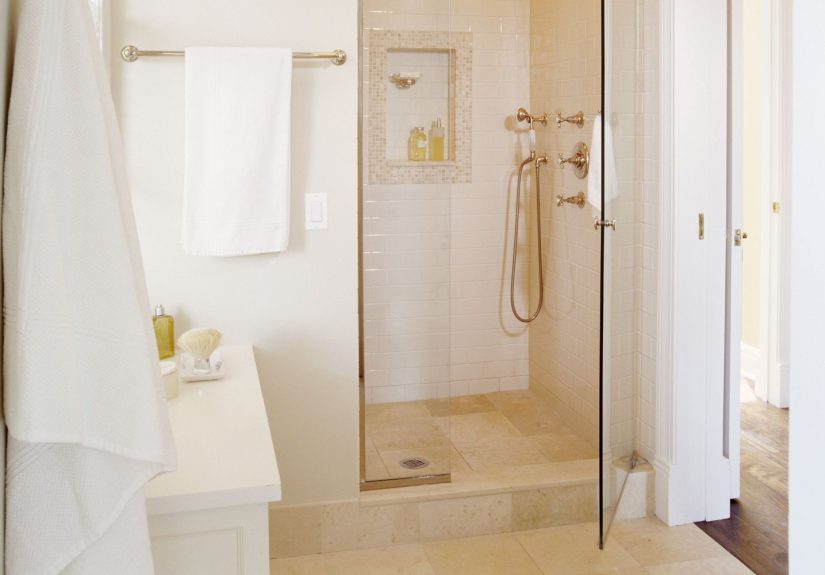
In a small bathroom, a shower curtain can act like a room divider you didn’t ask for. Clear glassespecially a frameless or low-profile enclosure
keeps the sightline open, so you can see the full depth of the room. That uninterrupted view is a big part of why glass showers are a go-to trick
in tight spaces.
How to get the “open” look without constant squeegee therapy
- Choose clear glass (not heavy frosting) to keep the enclosure visually light.
- Minimize metal: slimmer frames or frameless styles feel less busy.
- Match finishes: if you have black hardware, repeat it once or twicedon’t mix a whole metal buffet.
- Plan for maintenance: a good ventilation fan and a quick wipe-down routine prevent water spots from stealing your shine.
If you’re renovating, a curbless or low-threshold shower can also help because your flooring reads as one continuous plane.
That’s a subtle trick with a big payoff.
Trick #4: Layer Lighting (Because One Ceiling Light Is a Mood, Not a Plan)
Bad lighting makes small bathrooms feel smallershadows flatten the space and highlight every corner that’s already feeling tight.
Designers often recommend a layered approach: ambient light, task light, and (if you want to get fancy) a little accent glow.
Bonus: good lighting makes the mirror more flattering. Your future selfies will send thank-you notes.
A simple lighting recipe for a small bath
- Task lighting at the mirror: sconces on both sides reduce harsh shadows on your face.
- Even overhead lighting: a flush or semi-flush fixture works well when ceiling height is limited.
- Soft accent lighting: under-vanity LED strips or a backlit mirror add depth at night.
- Dimmers: the easiest upgrade for flexibility (bright for cleaning, softer for winding down).
Bulb choice matters, too. Many renovation guides suggest staying in a “clean but not icy” rangeoften around
3,000K to 4,000Kfor bathrooms, since it reads bright and crisp without feeling like an interrogation room.
(Unless you’re actively trying to confess to crimes in the mirror. In that case, carry on.)
Trick #5: Choose Large-Format Tile (Fewer Lines = Bigger Feel)
Tiny tile can be adorable. It can also create a grid of grout lines that makes a room feel busierand smallerbecause your eye gets stuck counting
lines like it’s taking a math test. Large-format tile reduces visual clutter by minimizing grout breaks, which helps walls and floors read as broader,
calmer surfaces.
Tile details designers obsess over (because they work)
- Go bigger than you think: 12×24-inch tile is a common “sweet spot” for small bathrooms.
- Match grout color closely: contrasty grout highlights lines; similar grout softens them.
- Run tile to the ceiling in showers: it elongates the wall and feels more custom.
- Keep patterns simple (or use one strong pattern once): too many competing motifs can shrink the room visually.
If you love smaller tile (hello, classic hex or penny tile), consider using it as an accentlike a shower niche back wallwhile keeping the
main surfaces quieter.
Trick #6: Float the Vanity (and Anything Else You Can) to Show More Floor
Designers love floating vanities for small bathrooms because they reveal more flooring, and your brain interprets visible floor area as “more space.”
It’s a simple illusion: the room’s footprint feels bigger when you can actually see it.
Floating doesn’t have to mean flimsy
- Choose the right depth: a slightly slimmer vanity can improve circulation in tight aisles.
- Pick clean lines: minimalist doors and fewer fussy details reduce visual weight.
- Consider wall-mounted faucets if your layout allowsmore counter space, less clutter.
- Use a toe-kick trick: if you can’t float the vanity, a recessed toe-kick still helps it feel lighter.
Another “float” option: wall-hung toilets. They’re sleek, modern, and they expose more floor. Just note this is usually a bigger renovation
decisionbest handled with a pro.
Trick #7: Build Storage Into the Walls (So Your Counters Can Breathe)
Clutter is the fastest way to make a small bathroom feel like a crowded elevator. Designers aren’t saying you should own fewer things
(though… maybe your 14 half-used hair products are plotting something). They’re saying you should store them smarter.
Built-in or recessed storage keeps essentials handy without stealing visual space.
High-impact storage upgrades that don’t scream “storage”
- Recessed shower niches: stash bottles without adding bulky caddies.
- Mirrored medicine cabinets: storage + reflection in one neat rectangle.
- Wall shelves with a purpose: one or two intentional shelves beat a crowded counter every time.
- Matching containers: decanting products into uniform bottles reduces visual chaos.
When surfaces are clear, the room feels calmer, cleaner, and biggerbecause there’s less “stuff” breaking up the lines.
In small bathrooms, visual simplicity is basically interior design cardio.
Trick #8: Fix the “Flow” (Doors, Sightlines, and Layout Tweaks)
Sometimes the bathroom isn’t smallit’s just fighting itself. A door that swings into your knees, a vanity that blocks the walkway, or a bulky
fixture that interrupts the view can make the whole space feel tighter than it needs to be.
Designers focus on maintaining clear pathways and long sightlines so the room feels open the moment you step in.
Layout tweaks that can make a huge difference
- Switch to a pocket door (or a door that swings out) to free up interior space.
- Choose compact fixtures that fit the room’s scaleoversized pieces can crowd a small footprint.
- Keep the floor as continuous as possible: fewer transitions help the room read larger.
- Use vertical emphasis: tall mirrors, vertical patterns, or higher-hung art draw the eye upward.
If you’re starting from scratch, aligning fixtures along one wall can simplify plumbing and improve circulation. But even without a full renovation,
addressing door swing and “traffic jams” can deliver a surprisingly big upgrade.
Experience-Based Add-On: What These Tricks Look Like in Real Bathrooms (About )
Reading design tips is one thing. Living with a tiny bathroomwhere the towel bar feels like it was installed by a mischievous raccoonis another.
Here are a few common, real-world scenarios and how these tricks typically play out when people actually use the space every day.
1) The windowless powder room that always feels gloomy
This is the classic “I can’t tell if my shirt is navy or black in here” bathroom. The biggest improvement usually comes from
layered lighting and reflective surfaces. Swapping a single overhead light for a brighter fixture plus mirror-side
sconces can instantly reduce shadows. Pair that with a wide mirror and a soft, cohesive wall color, and the room stops feeling like a cave.
People often report that the space feels cleaner even when nothing else changedbecause good lighting makes everything look more intentional.
2) The tiny full bath with a shower curtain that chops the room in half
When homeowners replace a fabric curtain with a clear glass shower door, the “before and after” effect is dramatic.
It’s not that the bathroom magically grewyour eye just isn’t stopped by an opaque barrier anymore. The shower becomes part of the room instead of a
separate compartment. If the shower tile is also kept simple (or carried to the ceiling), the room feels taller and more seamless.
This comboglass + simplified tileoften delivers the most “Wow, this is bigger” reaction for the money.
3) The family bathroom with too many bottles, toys, and towels
Small bathrooms get messy fast because they have nowhere to hide the daily chaos. The fix isn’t always more storageit’s
smarter storage. Recessed niches in the shower, a mirrored medicine cabinet, and a couple of labeled bins under the sink can reduce
countertop clutter. When counters clear, the room looks larger because the horizontal surfaces read as open space again.
A small habit that helps: keep only what’s used daily out, and store backups elsewhere. The bathroom doesn’t need to host your entire supply chain.
4) The narrow bathroom where the door swing steals the only standing spot
This one feels personal the first time you bonk into the door while carrying laundry. A pocket door (or a door that swings out)
can be a game-changer because it gives you back functional floor areano optical illusion required.
If a door change isn’t possible, people often improve flow by choosing a slimmer vanity or a wall-mounted option that exposes more floor,
so the path through the room feels less pinched.
5) The “it’s cute but busy” bathroom with lots of small tile and high-contrast grout
The room can feel visually loud, even if it’s stylish. Switching to large-format tile (or at least using a grout color that blends
more closely) reduces the “grid” effect. If replacing tile is too big a project, a similar win can come from simplifying what’s in the sightline:
a calmer paint color, a bigger mirror, fewer countertop items, and one statement moment (like wallpaper on a single wall) instead of multiple patterns
competing at once. The result is a bathroom that reads as designednot crowded.
Conclusion: The Small-Bathroom “Bigger” Checklist
Making a small bathroom look bigger isn’t about tricking people into thinking you have a hidden spa wing. It’s about giving the eye fewer obstacles:
softer contrast, better lighting, cleaner lines, and a layout that doesn’t pick fights with gravity.
If you want the quickest wins, start with (1) a bigger mirror, (2) better lighting, and (3) decluttering with smarter storage.
If you’re renovating, level up with glass, large-format tile, and floating fixtures. Mix and match based on budget, and remember:
the most “expensive-looking” bathrooms often do one thing really wellthey feel calm.