Table of Contents >> Show >> Hide
- The Hubble Ultra Deep Field: A Cosmic Time Capsule (and a Stress Test for Your Eyes)
- The Plot Twist: 72 Galaxies Were “There,” But Not Really “Seen”
- How Can a Galaxy Hide From Hubble?
- Why “Nearly as Old as the Universe” Sounds Dramatic (and What It Actually Means)
- What Makes These 72 Galaxies “Strange”?
- Why Finding 72 More Galaxies in One Tiny Patch Matters (A Lot)
- How the Discovery Was Made: The “Spectrum Per Pixel” Trick
- So… Are There Even More Hiding in There?
- What This Means for the Story of Galaxy Evolution
- Experience Section: What It Feels Like to Go Looking for Ancient Galaxies
- Conclusion: The Universe Is Not Done Surprising Us
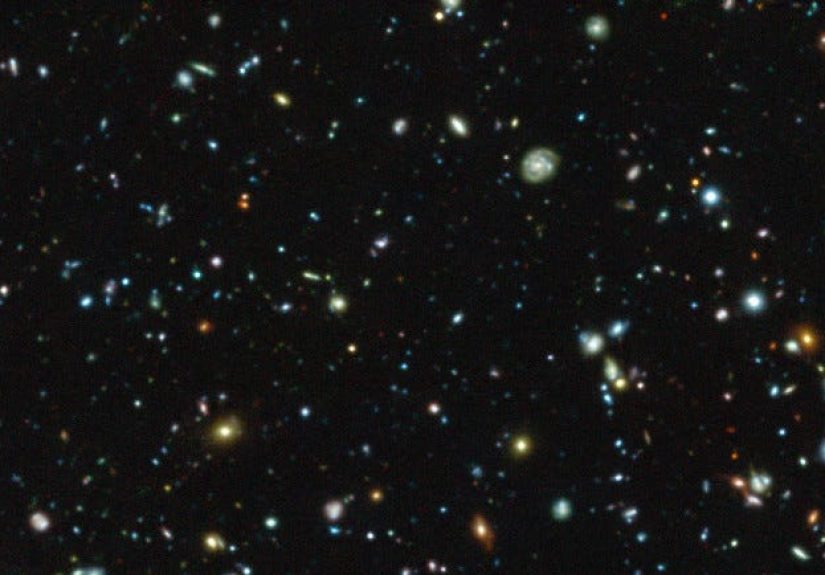
If you’ve ever zoomed into a famous Hubble image and thought, “Yep, that’s definitely everything,” the universe would like a word. In 2017, astronomers revisited the legendary Hubble Ultra Deep Fieldarguably the most overachieving “small patch of sky” in historyand found 72 additional galaxies that were basically photobombing the data the whole time… while also somehow staying invisible. It’s the cosmic equivalent of discovering your family photo has 72 extra cousins no one mentioned.
These galaxies aren’t “new” in the sense that they just formed (they’ve been around for a very, very long time). They’re “new” because we only just learned how to spot themthanks to a powerful technique called spectroscopy and an instrument named MUSE on the Very Large Telescope in Chile. Together, they revealed faint galaxies from the early universe that Hubble’s famous picture didn’t clearly show. And yes, many of them are so distant that we see them as they were when the universe was less than a billion years old. That’s “nearly as old as the universe” in headline languagewithout actually breaking physics.
The Hubble Ultra Deep Field: A Cosmic Time Capsule (and a Stress Test for Your Eyes)
The Hubble Ultra Deep Field (HUDF) is a deep-space image of a tiny region of sky in the constellation Fornax. Hubble stared at it for roughly a million seconds (about 11 days of total exposure time) and produced a view containing nearly 10,000 galaxies. It’s often described as a “core sample” of the universelike drilling into Earth’s crust to read history, except the crust is spacetime and the drill is a space telescope with zero chill.
The HUDF mattered because it showed galaxies across a huge range of cosmic time. Some are relatively “nearby” (still millions or billions of light-years away), while others are so far that we see them from an era when galaxies were smaller, messier, and still figuring themselves out. If modern galaxies are neatly organized bookstores, many early galaxies are more like a garage after a moving day: clumpy, chaotic, and full of surprises.
The Plot Twist: 72 Galaxies Were “There,” But Not Really “Seen”
Here’s the fun part: astronomers didn’t just take a better photo and suddenly spot 72 more smudges. Instead, they used a different way of reading the light. Hubble is phenomenal at imagingcapturing incredibly sharp pictures in selected wavelength bands. But some galaxies are so faint in those bands that they barely register as objects, even in the deepest Hubble exposures.
Enter MUSE (Multi Unit Spectroscopic Explorer), an instrument mounted on ESO’s Very Large Telescope (VLT). MUSE doesn’t just record “how bright” each pixel is. It records a spectrum for each point in the imagemeaning it measures how much light is arriving at many different wavelengths. In other words, Hubble can show you the crowd. MUSE can also tell you what everyone is saying, how fast they’re moving, and whether they’re whispering in a wavelength Hubble didn’t focus on.
Using MUSE, the team measured spectroscopic information for about 1,600 galaxies in the HUDF region and, in the process, identified 72 sources that didn’t have clear Hubble counterparts in the imaging catalogs. These were galaxies hiding in plain sightnot because Hubble “missed” them, but because they were playing the universe’s favorite game: be extremely faint until someone invents a better method.
How Can a Galaxy Hide From Hubble?
1) Because it’s faint in “normal” light, but loud in one specific line
Many of the newly identified galaxies are strong Lyman-alpha emitters. Lyman-alpha is a specific wavelength of ultraviolet light produced when electrons in hydrogen atoms drop to a lower energy level (hydrogen being, you know, kind of a big deal in the universe). Young, star-forming galaxies can generate lots of this emission because hot, massive stars pump energy into the surrounding gas.
The catch: Lyman-alpha starts in the ultraviolet, and Earth’s atmosphere blocks most UV from reaching ground-based telescopes. But the universe has a workaround: cosmic expansion redshifts light. The farther a galaxy is, the more the expansion stretches its emitted light to longer wavelengthsshifting UV emission into visible or near-infrared wavelengths where instruments like MUSE can detect it. So a galaxy can be almost invisible in broad-band imaging but still pop out in spectroscopy as a bright emission line.
2) Because imaging and spectroscopy “win” in different ways
Imaging is great at showing you shape and structurespiral arms, mergers, star-forming knots, and so on. But if a galaxy’s overall “continuum” light is too faint, it may not be confidently detected as an object in an image catalog, even if the pixels contain a whisper of it. Spectroscopy, meanwhile, can detect a galaxy by its signature line even when the rest of the galaxy is basically a ghost.
That’s why this discovery feels like galaxies “hiding in a Hubble photo.” The photons were always there. It’s just that the loudest clue wasn’t the kind of clue the original image was optimized to highlight.
Why “Nearly as Old as the Universe” Sounds Dramatic (and What It Actually Means)
Let’s be precise without ruining the fun. When we say we found galaxies “nearly as old as the universe,” we don’t mean the galaxies have been aging quietly since the Big Bang like cosmic antiques in a glass cabinet. We mean the light we see left them a very long time ago.
The universe is about 13.8 billion years old. The HUDF includes galaxies seen from a time when the universe was under a billion years oldmeaning their light has been traveling for over 12 billion years. In plain English: you’re not seeing a galaxy as it “is” today; you’re seeing it as it was when the universe was still in its early chapters.
That’s also why early galaxies often look strange. The universe back then was busy: gas was cooling, gravity was pulling matter together, star formation was firing up, and galaxies were merging like it was a buy-one-get-one-free sale on cosmic real estate.
What Makes These 72 Galaxies “Strange”?
“Strange” doesn’t necessarily mean they look like alien emojis (although some early-universe objects do have that vibe). In this case, “strange” is often shorthand for:
- Hard to see in normal imaging (extremely faint continuum light)
- Strong emission lines that reveal them in spectroscopy
- Very distant (high redshift), placing them in the early universe
- Small and irregular, as many young galaxies were
Many are likely compact, low-mass star-forming systems. Some may be part of the era known as the epoch of reionizationwhen the first generations of stars and galaxies ionized the hydrogen fog that filled the early universe, making space more transparent to ultraviolet light. Galaxies from that era matter because they help answer a big question: what sources actually reionized the universe?
Why Finding 72 More Galaxies in One Tiny Patch Matters (A Lot)
1) It improves the census of the early universe
Deep fields aren’t just pretty pictures; they’re data sets used to estimate how many galaxies exist at different epochs. Adding 72 faint galaxiesespecially ones that are tough to detect with traditional imaginghelps refine measurements of the faint end of the galaxy population. That’s where a lot of the action may have been during reionization, because many small galaxies together could produce enormous amounts of ionizing radiation.
2) It shows why spectroscopy is a superpower
Spectroscopy can reveal distance (via redshift), chemical clues (which elements are present), and motion (how gas and stars move within a galaxy). The MUSE survey didn’t just add 72 objects; it also produced an unusually rich set of spectra for hundreds to thousands of faint galaxies in the HUDF region. That’s like upgrading from “I can see the city skyline” to “I have a full directory of everyone’s addresses, travel speed, and favorite wavelength.”
3) It’s a preview of how modern astronomy really works
Astronomy is increasingly about combining strengths: Hubble’s crisp imaging, ground-based telescope collecting power, spectroscopy, and now machine learning tools that sift archives for anomalies. The “72 hidden galaxies” story is a classic example of why old data can produce new science: the universe didn’t change; our ability to interpret the light did.
How the Discovery Was Made: The “Spectrum Per Pixel” Trick
MUSE is an integral field spectrograph. Instead of taking a spectrum for one object at a time (slow) or only along a narrow slit (limiting), it records spectra across a 2D fieldcreating a 3D data cube: two dimensions of space plus one dimension of wavelength.
In the HUDF observations, this allowed astronomers to search for emission lines (especially Lyman-alpha) across the field and identify galaxies that were too faint for standard imaging-based detection methods. In the technical literature, the team describes “blind searches” for emission line sources and notes that the 72 galaxies were sources without HST counterparts at extremely faint magnitudes.
And yes, it’s delightfully ironic: some of the deepest images ever taken still had “hidden” galaxies, because they weren’t hiding in the dark. They were hiding in the data format.
So… Are There Even More Hiding in There?
Probably. If one new technique found 72, other techniques can find different populationsdusty galaxies visible in infrared, line emitters visible in different spectral ranges, or faint objects discovered by stacking and statistical methods. And that’s before we even talk about the James Webb Space Telescope, which is built to go after faint, high-redshift galaxies in the infrared with terrifying competence.
The deeper point is that “the deepest image” is never truly final. It’s a snapshot of our current tools, not a hard limit of reality. The universe has a long-standing policy of being bigger than our methods.
What This Means for the Story of Galaxy Evolution
Finding more faint galaxies at high redshift strengthens the idea that the early universe contained a vast population of small, actively star-forming systemsmany of which may be hard to see without the right wavelength coverage or spectral sensitivity. These galaxies are building blocks. Over cosmic time, mergers and accretion can transform small clumps into larger, more structured galaxieseventually producing spirals and ellipticals we recognize today.
It also highlights a key theme in galaxy evolution: what you see depends on how you look. A galaxy that seems “missing” in one band might be bright in another. A galaxy that seems “quiet” in an image might be actively forming stars but obscured by dust. And a galaxy that looks like a tiny dot might be surrounded by a much larger halo of gas that only shows up through faint emission.
Experience Section: What It Feels Like to Go Looking for Ancient Galaxies
There’s a particular kind of wonder that hits when you first interact with a deep-field image the way astronomers do: not as a poster, but as a place you can explore. Most people start the same wayzoom in, get overwhelmed, zoom in again. At some point, your brain stops counting galaxies and starts noticing personalities. “That one’s a spiral.” “That one looks like two galaxies mid-argument.” “That one is just a red smudge that clearly knows something I don’t.”
The HUDF is especially good at making you feel small in a productive way. The field is tinyso tiny it feels like a practical joke that it can contain nearly 10,000 galaxies. It’s like pointing a straw at the sky and discovering the straw is full of cities. Once that lands, it changes how you look at the night sky in general. You stop seeing “empty” space. You start seeing “space I haven’t zoomed into yet.”
Now imagine hearing that 72 galaxies were “hiding” in that image all along. The experience isn’t just aweit’s a mild existential giggle. Because you realize the universe doesn’t only challenge our sense of scale; it challenges our sense of completeness. Even when we think we’ve looked as deeply as possible, we might be missing entire populations simply because we didn’t ask the right question of the light.
For students or amateur skywatchers, this story can be oddly motivating. You don’t need to own a telescope the size of a building to understand what’s happening. You can experience the logic: light carries information; methods decide which information becomes visible. A deep-field image is like a book written in multiple languages at once. Hubble lets you read a few languages beautifully. MUSE shows up and says, “Cool, but did you try reading the footnotes that only appear in ultraviolet translated into near-infrared?”
If you’ve ever tried spotting a faint object through a backyard telescopesomething that’s “there” but only appears with averted visionthis discovery feels familiar. You learn that seeing isn’t just about brightness; it’s about technique. You shift your gaze slightly. You use a different filter. You wait for steadier air. On the professional scale, spectroscopy is the upgraded version of that moment: not just staring harder, but changing the rules of detection.
And the emotional payoff is real. When you read that these galaxies existed when the universe was under a billion years old, you’re not just absorbing a factyou’re time traveling with your eyes. You’re looking at hydrogen lighting up under young stars, in systems that may later merge, grow, and eventually become the kinds of galaxies where planets form and someone, somewhere, invents a telescope to look backward and wonder. It’s a loop. A beautiful one. Also: a reminder that the universe is extremely comfortable being more interesting than our first drafts.
Conclusion: The Universe Is Not Done Surprising Us
The “72 strange galaxies” headline works because it captures a genuine scientific truth: even in the most famous deep-space images ever made, there are discoveries waitingnot necessarily for a bigger mirror, but for a smarter approach. By combining Hubble’s imaging with MUSE’s spectroscopic power, astronomers uncovered faint, distant galaxies likely rich in Lyman-alpha emission, offering new clues about early star formation and the universe’s transition out of its dark ages.
So the next time you see a Hubble deep-field image and think it looks “finished,” remember: it’s not a final answer. It’s a starting point. Somewhere in that sea of galaxies, there may still be more hidingquietly glowing in the wavelength you haven’t asked for yet.