Table of Contents >> Show >> Hide
- Can You Download a Photo from 500px for Free?
- How to Download a Photo from 500px for Free in 11 Steps
- Step 1: Go to the official 500px website
- Step 2: Search for the photo you want
- Step 3: Identify the photographer and the specific image page
- Step 4: Look for a download button or creator-provided file link
- Step 5: Read the image description, caption, and usage notes
- Step 6: Check whether the image is licensed, copyrighted, or openly reusable
- Step 7: If the terms are unclear, contact the photographer
- Step 8: Save proof of permission or license details
- Step 9: Download the image through the official option
- Step 10: Rename and organize the file properly
- Step 11: Use the photo only within the allowed terms
- What Not to Do
- Common Situations and the Best Response
- Experiences People Commonly Have When Downloading Photos from 500px
- Final Thoughts
- SEO Tags
Note: This guide explains how to download a photo from 500px for free only when the photographer has clearly allowed it or when the image is offered under terms that permit free use. It does not cover bypassing restrictions, removing watermarks, or using shady third-party download tools. In other words: we are taking the legal road, not the “internet goblin” road.
If you have ever fallen into a 500px rabbit hole, you already know the problem. You open one beautiful landscape, then another, then a moody black-and-white portrait, then suddenly it is 1:12 a.m. and you are emotionally committed to a photo of a lonely lighthouse in Iceland. Naturally, the next question is: can you download a photo from 500px for free?
The honest answer is: sometimes, yesbut only if the creator has enabled a free download, shared the file through an approved link, or given you permission to use it. A lot of images on 500px are protected, licensable, or intended for viewing rather than free reuse. So if you want to do this the smart way, the goal is not just getting the file onto your laptop. The goal is downloading it without creating copyright headaches later.
This guide walks through a clean, practical, beginner-friendly method. You will learn how to check whether a 500px photo is actually available for free download, how to verify what “free” means, and how to save the image the right way. You will also learn what not to do, because “I found a Chrome extension” is not usually the opening line of a success story.
Can You Download a Photo from 500px for Free?
Yes, but not every image. On 500px, many photographers use the platform to showcase work, build a portfolio, and license images. That means some photos may be available only for viewing, some may require a paid license, and some may be downloadable only if the photographer intentionally offers that option.
This is the key distinction that confuses a lot of readers: free download is not the same thing as free use. You might be allowed to save a preview, comp, or shared file for personal reference, but that does not automatically mean you can post it on your blog, print it on a flyer, use it in an ad, or upload it somewhere else. If there is one sentence worth taping to your monitor, it is this one.
So before you click anything, you need to answer two questions:
First, did the photographer allow you to download it?
Second, did the photographer allow you to use it in the way you plan to use it?
If the answer to either question is unclear, slow down. The internet will survive an extra two minutes while you verify the terms.
How to Download a Photo from 500px for Free in 11 Steps
-
Step 1: Go to the official 500px website
Start on the real 500px website, not on a random “500px downloader” page that looks like it was designed during a power outage. Using the official site helps you see the actual photo page, the photographer’s profile, and any download or licensing details attached to the image.
-
Step 2: Search for the photo you want
Use the search bar, browse categories, or open a direct link to the image. Once you find the photo, click into the full photo page. Avoid judging permissions from a thumbnail, feed view, or cropped preview. Those views are often missing the context that matters.
-
Step 3: Identify the photographer and the specific image page
Before you even think about downloading, confirm the creator’s name and make sure you are on the individual photo page. This matters because a photographer may offer different permissions for different images. One photo may be available for personal use, while another is part of a licensing portfolio.
-
Step 4: Look for a download button or creator-provided file link
This is the big moment. If the photographer has enabled downloads or shared an approved file link, that is your green light to continue checking the terms. If there is no visible download option, that usually means you should not try to force the issue through browser tricks, source-code digging, or third-party tools.
Think of it this way: if the front door is locked, the legal solution is not to start climbing through the digital window.
-
Step 5: Read the image description, caption, and usage notes
A lot of people skip this part, and then act shocked when they discover “free to download” did not mean “free to use in my Etsy shop.” Read the caption, description, or profile notes carefully. Some photographers state whether the image is for personal wallpaper use only, educational use, editorial use, or reuse with credit.
If the photographer lists extra conditions, follow them. A free image with conditions is still not a free-for-all.
-
Step 6: Check whether the image is licensed, copyrighted, or openly reusable
If the photo is part of a licensing setup, you may see signals that it is intended for paid use rather than free downloading. On the other hand, if the photographer explicitly grants free reuse, references a Creative Commons license, or gives written permission, you have a much stronger basis for downloading and using it.
Here is a practical rule: if you cannot tell what rights you have, assume you need clarification.
-
Step 7: If the terms are unclear, contact the photographer
This step is wildly underrated. A short, polite message can solve the whole problem. Something like: “Hi, I love this image. May I download and use it on my noncommercial blog with credit?” is often enough. It is professional, respectful, and much better than gambling on a vague assumption.
Also, written permission is useful later. Memory is fuzzy. Screenshots are forever.
-
Step 8: Save proof of permission or license details
If the photographer grants permission, or if the image page clearly states the terms, save a screenshot or copy the language into your project notes. If the permission later changes, you will want a record of the terms that applied when you downloaded the file. This is not paranoia. This is grown-up internet behavior.
-
Step 9: Download the image through the official option
Once permission is clear, use the official download button or approved file link. If size options are offered, choose the one that matches your allowed use. For example, a lower-resolution file may be fine for a presentation or mood board, while a larger file may only be appropriate if the creator specifically allowed it.
Do not use unofficial downloaders, extension-based scraping tools, or “inspect element” methods. Those tactics may bypass the creator’s intended controls, and they are a bad fit for any article that wants to stay respectable for more than eight minutes.
-
Step 10: Rename and organize the file properly
After downloading, rename the file in a way that helps you remember where it came from. Include the photographer’s name, image title if available, and a note about the permission. For example: sunrise-dunes-jane-smith-personal-use-with-credit.jpg.
This sounds boring until three months later, when you are staring at a folder called “final-final-actual-final-use-this-one” and questioning every life choice that led you there.
-
Step 11: Use the photo only within the allowed terms
Downloading the image is the easy part. Using it correctly is the part that matters. If the creator allowed personal use only, do not turn around and use it in marketing. If credit is required, add credit. If modifications are not allowed, do not crop, filter, or remix it beyond the stated terms.
At this point, you have not only downloaded a photo from 500px for freeyou have done it in a way that will not come back to bite your project later.
What Not to Do
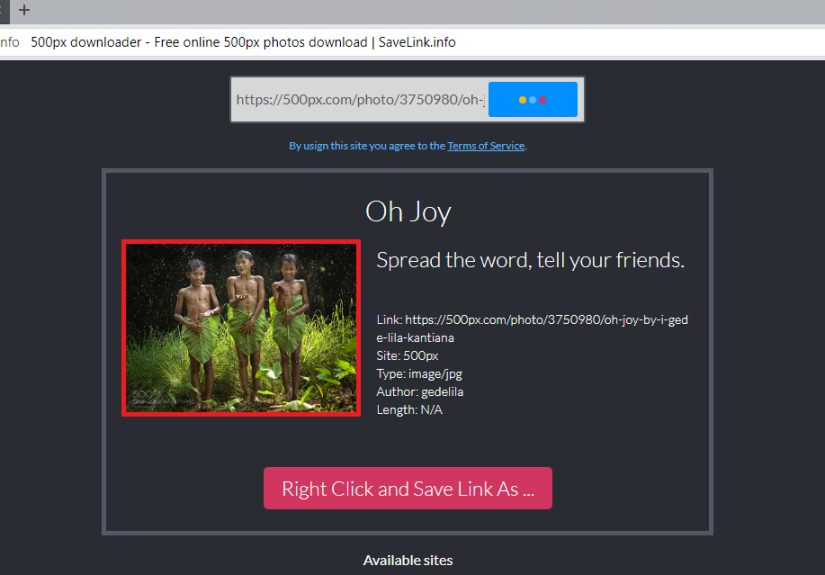
Do not use “500px downloader” websites blindly
These tools promise easy downloads, but they often ignore the creator’s permissions and can expose you to copyright trouble or low-quality files. Some are simply harvesting traffic. Others are doing exactly what the photographer did not authorize.
Do not remove watermarks
If a file is watermarked, that is not a challenge. It is a message. It usually means the preview is not meant to be used as a finished asset. Removing a watermark is a fast way to transform a simple image search into a very bad idea.
Do not assume “I credited the photographer” solves everything
Credit is good. Credit is polite. Credit is not a substitute for permission when permission is required. You cannot borrow someone’s car by saying nice things about the paint job.
Do not confuse personal download with commercial rights
Saving an image to your desktop is one thing. Using it in a client campaign, printed merchandise, or monetized content is something else entirely. Always separate the act of download from the rights of reuse.
Common Situations and the Best Response
There is no download button
That usually means the image is not being offered for free download. Your best move is to contact the photographer or look for licensing options.
The image says “free,” but the usage is not clear
Treat “free” as incomplete information. Free for whatpersonal use, classroom use, editorial use, or all reuse with attribution? Clarify before proceeding.
You only need the image as inspiration
Then you may not need to download it at all. Bookmark the page, save the URL in your mood board, or ask the photographer whether a reference copy is allowed.
You want the image for a blog post or YouTube thumbnail
That is a public-facing use. Check permissions carefully. Public reuse is where many casual mistakes turn into real complaints.
Experiences People Commonly Have When Downloading Photos from 500px
One of the most common experiences people have with 500px is assuming the platform works like a free wallpaper site. They land on a stunning photo, do not see any giant warning signs, and think, “Well, it is online, so it must be fair game.” Then reality arrives wearing sensible shoes. 500px is built around photographers showing and licensing original work, so the experience quickly shifts from casual browsing to rights-checking. For beginners, this can feel unexpectedly formal. For professionals, it feels normal.
Another common experience is confusion over what “download” actually means. Some users only want to save a photo as desktop wallpaper or reference inspiration, while others want to repost it on a blog, use it in a social media graphic, or print it in a brochure. Those are very different use cases, but people often lump them together. That is where trouble starts. A file that is okay to save for private viewing may not be okay to publish anywhere else. Many users learn this only after they have already built the image into a project.
There is also the classic experience of finding a gorgeous photo, realizing there is no obvious download button, and then being tempted by internet hacks. This is the crossroads where common sense and impatience wrestle dramatically under fluorescent lighting. Some people go hunting for source-code tricks, browser extensions, or downloader sites. Others pause, message the photographer, and discover that asking nicely often works better than playing amateur cyber-ninja. The second group usually sleeps better.
Writers, marketers, students, and designers also share a similar lesson: recordkeeping matters. People often think permission is just a casual yes in a message, but six weeks later they cannot remember which image was approved, what kind of use was allowed, or whether credit was required. The simple habit of saving screenshots, file names, and usage notes can save a lot of confusion later. It is not glamorous, but neither is apologizing over email because you used the wrong image in a newsletter.
Finally, many users walk away from the experience with a better understanding of digital etiquette. Downloading a photo from 500px for free is not really about “getting around” the platform. It is about recognizing that photographers are not vending machines for beautiful pixels. They are creators. When users respect thatby checking terms, asking permission, and crediting properlythe whole process becomes easier, cleaner, and far more professional. And as bonus outcomes go, “not accidentally starting a copyright mess before lunch” is an excellent one.
Final Thoughts
If you want to download a photo from 500px for free, the smartest approach is also the simplest: use the official photo page, check whether the creator has enabled downloading or granted permission, verify the usage terms, and save proof of what you are allowed to do. That is the difference between a clean, confident workflow and a mess built on assumptions.
The best part is that this approach works whether you are a student grabbing a reference image, a blogger looking for visuals, or a designer trying to stay on the right side of copyright. No gimmicks. No workaround circus. Just a clear process that respects the photographer and protects your project.