Table of Contents >> Show >> Hide
There are two ways to revisit Disney. The first is the cozy way: hum a song, quote a sidekick, and pretend your adult responsibilities are just temporary villains that will disappear after one key change, one dramatic ballad, and a really supportive animal friend. The second way is much less comforting, and much more interesting. That is the route this illustrator takes.
Instead of asking what classic Disney stories would look like with shinier special effects or bigger marketing budgets, this reimagining asks a sharper question: what would these worlds actually feel like if they were dropped into 2017, a year powered by smartphones, social-media habits, environmental anxiety, public conversations about identity, and a growing sense that modern life was equal parts dazzling and exhausting? Suddenly, fairy tales stop floating above reality and start bumping into it headfirst.
That is what makes this concept so compelling. It is not just fan art. It is cultural commentary wearing mouse ears. The familiar princes, princesses, animals, and dreamers are still recognizable, but now they have to deal with problems no magic wand can quietly edit out. A prince can miss the moment because he is glued to a screen. Ariel can discover that “under the sea” is less charming when pollution crashes the party. Peter Pan can learn that wonder has a hard time competing with modern home security. The result is funny, clever, a little dark, and surprisingly accurate.
And yes, that word matters: accurate. Not accurate in the sense of “this is exactly what Disney Studios would have filmed frame by frame,” but accurate in the way satire often is. It exaggerates just enough to reveal what the culture already knows. If Disney movies had been spiritually rebuilt for 2017, they would not just look modern. They would feel interrupted. More connected, maybe. More self-aware, definitely. But also more distracted, more commercial, and more tangled up in the problems of the real world. No offense to enchanted forests, but even they would have needed better Wi-Fi.
The Artist Behind the Viral Reimagining
The illustrator most closely associated with this viral idea is Tom Ward, whose “Alt Disney” series took beloved Disney imagery and pushed it into a modern, socially aware frame. That is an important detail, because the appeal of the series is not built on random shock value. Ward understood that Disney characters are visual shorthand. You do not need a paragraph of explanation to know who Cinderella, Ariel, or Mowgli are. They arrive with emotional baggage already packed, which lets a single image do a shocking amount of storytelling.
That storytelling is where the project gets its bite. The viral headline says “movies,” but the artwork works scene by scene, character by character, using iconic moments from Disney history as pressure points. It borrows the emotional memory of the originals, then inserts a modern problem like a pin into a balloon. Pop. There goes the fantasy. In its place is something more uncomfortable and, honestly, more memorable.
This is why the series spread so quickly. People were not just sharing pretty drawings. They were sharing recognition. The images made viewers laugh first, then wince a second later when the joke landed. That delayed reaction is the secret sauce. It is the same reason political cartoons work, the same reason satire survives every algorithm, and the same reason your favorite meme can sometimes feel more honest than an entire think piece.
Why This Idea Hit So Hard in 2017
The timing was almost suspiciously perfect. By 2017, Disney was already deep into a new wave of live-action and live-action-style reimaginings. The studio’s own messaging around Beauty and the Beast emphasized that it was refashioning a classic story for a contemporary audience, and the movie became a huge commercial event. In other words, the culture was already primed to ask what Disney looks like once nostalgia gets updated, polished, and sold back to grown-up fans.
That context matters. Ward’s illustrations were not arriving in a vacuum. They showed up at a moment when audiences were already debating how much change is too much change, whether modern updates deepen a classic or flatten it, and why familiar intellectual property feels so irresistible in the first place. Disney was giving audiences official updates wrapped in glamour, romance, and prestige production design. Ward offered the unofficial version, stripped of polish and loaded with side-eye.
That contrast is part of the fun. Official remakes tend to modernize in a careful, brand-safe way. They add a little more agency here, a little more backstory there, maybe freshen up a costume, sharpen a joke, and call it a day. Ward’s version is what happens when you skip the brand meeting and let the culture barge directly into the castle. It is less “be our guest” and more “please explain your screen-time report.”
When Fairy Tales Met the Smartphone Era
One of the strongest threads in these reimaginings is distraction. It is the 2017 disease that somehow became a lifestyle. In this version of Disney, technology is not a neutral tool humming in the background. It changes behavior. It hijacks attention. It interrupts romance, adventure, and even destiny itself.
That is why the modernized Cinderella imagery lands so well. A fairy tale usually builds toward eye contact, recognition, a suspended moment of wonder. Replace that with texting, scrolling, or digital indifference, and the whole emotional machine sputters. Suddenly the problem is not whether the glass slipper fits. The problem is whether anyone is emotionally present enough to notice the foot.
The same goes for Arthur from The Sword in the Stone. In a classic story, the hero misses nothing because the world is crackling with possibility. In a 2017 update, the hero can miss everything because the screen in his hand has become more urgent than the miracle in front of him. It is funny because it is ridiculous. It is effective because it is plausible. A shocking amount of modern life can be summarized as “the magic happened, but we were looking down.”
Even the lighter images make the same point. Pinocchio using his nose as a selfie stick is undeniably funny, but the joke works because it captures a truth about 2017 culture: everything, even identity, had become content. The camera is no longer documenting life. It is directing it.
When Disney Magic Ran Into Real-World Problems
The darker side of the series is where it becomes more than clever. It becomes pointed. Environmental harm, animal cruelty, captivity, and pollution all show up in ways that feel uncomfortably natural once the fantasy barrier is removed.
Ariel’s world, for example, has always relied on the promise that the ocean is beautiful, musical, and teeming with life. But modern audiences do not have the luxury of seeing the sea as pure fantasy anymore. Pollution changed that. So when a reimagined Ariel is placed near oil, waste, or environmental damage, it does not feel like a stretch. It feels like the plot catching up with reality.
The same logic applies to the animal-centered stories. Classic Disney often gives animals charisma, dignity, and emotional depth. That is part of why audiences connect to them so strongly. But once you transplant those same beloved creatures into the actual systems humans have built, the mood changes fast. Circus captivity, chains, poaching, and exploitation are horrifying on their own. They become even more effective when filtered through characters viewers associate with innocence and comfort.
This is where the illustrator’s method becomes especially smart. He is not lecturing from a distance. He is using the emotional credibility of childhood favorites to smuggle serious subjects into mainstream attention. You can scroll past one more article about pollution. It is harder to scroll past Scuttle and Ariel when the joke is sitting in the middle of an ecological mess.
Gender, Identity, and the Updated Disney Lens
Another reason these pieces felt timely in 2017 is that they tapped into conversations about gender roles, body expectations, and identity politics that were already everywhere. Disney heroines have always been cultural lightning rods. People adore them, critique them, update them, cosplay them, defend them, and project entire dissertations onto their sleeves.
Ward’s reimagined Alice, for instance, turns a surreal fantasy into a comment about body image and modern pressure. The visual joke works because 2017 was drenched in wellness culture, diet messaging, performance femininity, and the exhausting expectation that women should always be optimizing themselves, preferably while smiling. Welcome to Wonderland, where even the absurd has a calorie count.
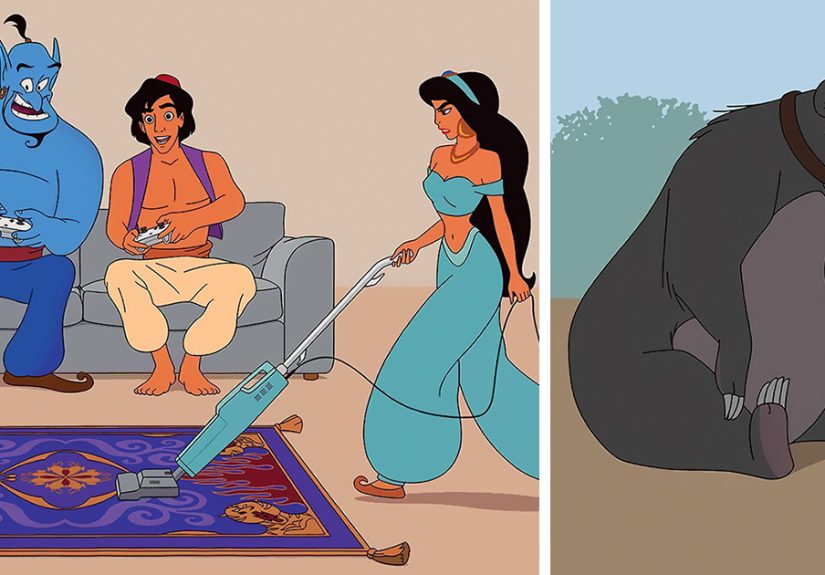
Then there is the sly commentary around household labor and social expectations. A modernized Jasmine dealing with domestic imbalance while the boys are busy enjoying themselves is a joke with enough truth in it to sting. It turns a princess fantasy into a snapshot of familiar frustration. No dragon required.
At the same time, some of the images offer a more hopeful kind of update. The Pride-themed reinterpretation involving characters from Beauty and the Beast suggests that a modern Disney world could also mean more openness, more visibility, and more honesty about identity. That balance matters. The project is not simply saying that modernity ruins everything. It is saying modernity reveals everything, including progress.
What These Reimaginings Get Right About Disney
Here is the clever twist: these illustrations work because they actually respect Disney storytelling. They understand the grammar of it. Disney is built on instantly readable visuals, emotional clarity, archetypes, and high-contrast stakes. Ward borrows that visual language and uses it against itself in the most entertaining way possible.
That means the images do not feel random, and they do not feel mean for the sake of being mean. They feel like alternate scenes from a parallel production pipeline where the mandate was not simply “make it current” but “make it confront the world as it is.” And once you start thinking in those terms, the whole concept becomes weirdly persuasive.
Because if Disney movies were really made through the emotional lens of 2017, they would absolutely carry more anxiety. They would still want romance, spectacle, and hope, of course. This is Disney, not a two-hour lecture with a talking raccoon. But they would also have to wrestle with connectivity, climate fear, social identity, image culture, and the low-grade burnout of modern life. The happily-ever-after would still be there. It would just arrive after a few app notifications.
Would Disney Actually Look Like This If It Were Made in 2017?
Literally? Not exactly. Official Disney remakes are too polished, too strategic, and too globally calibrated to lean this dark. They are designed to refresh the familiar, not blow it up. But emotionally and culturally, this illustrator’s version may be closer to the truth than any official remake ever wants to be.
That is because the real question is not whether Disney would have made Ariel swim through pollution or whether Arthur would canonically ignore Excalibur for a screen. The real question is whether modern audiences now read old stories through contemporary fears. Absolutely they do. We cannot unsee what we know. We cannot unknow our relationship with technology, our unease about the environment, or our instinct to test every old story against current values.
In that sense, this reimagining is accurate in the deepest way possible. It captures how viewers changed. And once viewers change, stories change with them, whether studios admit it or not.
The Experience of Looking at Disney Through a 2017 Filter
Spending time with artwork like this creates a very specific emotional experience, and it is not the one people usually expect from Disney-inspired imagery. First comes recognition. Your brain lights up because it knows the visual code immediately. You do not need a title card to identify Ariel, Cinderella, or Peter Pan. You arrive with years of built-in emotional context, which is exactly why the work can move so fast. Then comes the turn. Something is off. The colors still feel playful, the compositions still look storybook-ready, but the meaning has changed. Suddenly you are not revisiting childhood. You are measuring the distance between childhood fantasy and adult reality.
That gap is where most of the experience lives. It can be funny, because the images are often wickedly clever. A selfie-stick Pinocchio is the kind of joke that deserves a slow clap. An ignored miracle because of a phone screen? Too real. A princess rerouted into modern body-image anxiety? Painfully sharp. But the humor is never completely comfortable. It catches in your throat. The laughter comes with a side of, “Wow, that is kind of bleak,” which is exactly why it stays with you longer than safer, cuter fan art.
There is also something oddly intimate about the experience. Disney stories are not just movies people watched once. For many viewers, they are early emotional architecture. They helped define romance, courage, beauty, heroism, friendship, and what it means to want more than the life you have. So when an illustrator rewires those same stories to reflect social-media obsession, ecological damage, or gender fatigue, it does not feel like abstract commentary. It feels personal. The images are not merely criticizing the world. They are testing the promises those stories once made.
That is probably why people share this kind of work so aggressively. It gives them a language for a feeling they already have but may not have articulated: the sense that adulthood often looks like a badly lit sequel to the hopeful stories we were raised on. The castles are still there, metaphorically speaking, but now they need software updates and a better recycling policy.
At the same time, the experience is not purely cynical. That is important. The best pieces in this kind of series do not mock Disney from a superior distance. They still seem fascinated by the emotional power of the originals. In fact, they depend on that power. Without affection for the source material, the whole thing would collapse into cheap irony. Instead, the work feels like a complicated conversation with childhood itself. It says, “These stories mattered. They still matter. But now let’s see what happens when they walk into the same world we do.”
And maybe that is the deepest reason the concept works. It does not destroy wonder. It stress-tests it. It asks whether enchantment can survive a cynical age, whether innocence can still communicate anything useful, and whether familiar characters can help us talk about uncomfortable truths more honestly than realism sometimes can. The answer, surprisingly, seems to be yes. They can. And when they do, the result is stranger, darker, and more emotionally intelligent than you might expect from a viral Disney remix on the internet.
Final Thoughts
“Illustrator Accurately Reimagines What Disney Movies Would Look Like If They Were Made In 2017” sounds at first like a fun piece of pop-culture fluff. Then you look closer. What makes the idea memorable is not just its novelty. It is the way it transforms nostalgia into a mirror.
These reimaginings capture a moment when Disney, audiences, and internet culture were all renegotiating the same question: how do you modernize a beloved fantasy without losing the thing people loved in the first place? The official answer was glossy live-action spectacle. The illustrator’s answer was sharper, funnier, and arguably more honest. If Disney movies had truly been made through the emotional and social lens of 2017, they would not just have looked newer. They would have looked more aware, more anxious, more political, and much less protected from reality.
Which is why the artwork still resonates. It proves that the most powerful updates are not always the ones with the biggest budget. Sometimes all it takes is one brilliantly twisted image to show that the kingdom changed, the audience changed, and maybe the fairy tale had to change too.