Table of Contents >> Show >> Hide
- The Building Had a Job Before It Had a Vibe
- Why Old Town Chinatown Is the Right Setting for This Story
- Historic Architecture Meets Boutique Hotel Ambition
- What Makes The Society Hotel Feel So Portland
- Inside the Rooms: Minimalism Without the Cold Shoulder
- The Rooftop Is Where the Past and Present Shake Hands
- Why This Hotel Conversion Works Better Than a Typical “Hip” Makeover
- What This Rebirth Says About Portland Travel
- The Experience: What It Feels Like to Stay in a Former Seafarers’ Home
- Conclusion
Some buildings age like milk. Others age like denim: a little faded, a little frayed, and somehow much cooler because of it. In Portland, Oregon, one former seafarers’ home falls firmly into the second category. What began in the early 1880s as a refuge for sailors arriving in a rough-and-tumble port city has been transformed into one of the most character-rich places to stay in Old Town Chinatown. Today, that historic address lives on as The Society Hotel, a boutique stay that mixes old brick, cast-iron swagger, and minimalist style with the kind of social energy Portland does especially well: coffee in the morning, rooftop hangs by afternoon, and stories in every corner by night.
If that sounds like a handsome real-estate fairy tale, it sort of is. But unlike most glow-up stories, this one comes with actual grit. The building was never meant to be precious. It was built to be useful. It served working sailors, survived changes in the neighborhood, slipped into disrepair, and then got a second life through adaptive reuse. That journey is what makes the hotel more than another trendy address with nice lighting and good branding. It feels rooted. And in a hospitality world full of places trying very hard to seem authentic, rooted is a powerful word.
This is the story of how a former mariners’ home became a hipster hotel in Portland, OR, and why the transformation works so well. It is also a reminder that the best boutique hotels do not just sell a bed for the night. They sell atmosphere, memory, and a sense that the building itself has something to say.
The Building Had a Job Before It Had a Vibe
Long before anyone described a hotel as “curated,” Portland was a waterfront city fueled by shipping, trade, and movement. Sailors came into town with money in their pockets, limited options for safe lodging, and more than a few people ready to separate them from both. That is where the Portland Seamen’s Friend Society entered the picture. The organization aimed to provide a better kind of temporary housing for mariners, offering an alternative to the more exploitative side of waterfront life.
The building that would become The Society Hotel was created for exactly that purpose. In its earliest life, it served as a mariners’ home or boardinghouse: a practical, respectable place for sailors to stay. That origin story matters because it explains why the building feels so natural as a hotel today. It did not need a wildly imaginative reinvention. Hospitality was already in its bones.
Over time, like many old urban buildings, the property cycled through different identities. It reportedly also served other neighborhood functions, including as a social and cultural gathering space connected to Portland’s Chinese community. Those layers are part of what gives the place its emotional texture now. The building is not frozen in one era. It carries traces of many.
Why Old Town Chinatown Is the Right Setting for This Story
You could drop a stylish boutique hotel into a polished neighborhood and call it a day. Portland chose a more interesting route. The Society Hotel sits in Old Town Chinatown, the city’s oldest neighborhood and one of its most historically complex. This district is close to the Willamette River, Union Station, downtown, the Pearl District, and a long list of Portland institutions, from Lan Su Chinese Garden to classic old bars and busy weekend markets.
That location gives the hotel an edge. Old Town Chinatown is not a blank canvas dressed up for tourists. It is layered, imperfect, central, and loaded with memory. The streets still reveal Portland’s older commercial DNA, especially in the historic cast-iron buildings that define much of the district. Staying here feels less like checking into a generic lifestyle hotel and more like stepping into the city’s long argument with itself: old versus new, grit versus polish, preservation versus reinvention.
For travelers who like neighborhoods with a pulse, that tension is a feature, not a bug. The area gives you access to the Portland, Oregon sign, food spots, nightlife, transit, and some of the city’s most recognizable historic streetscapes. It is a district that asks you to look twice. The Society Hotel fits because it does the same thing.
Historic Architecture Meets Boutique Hotel Ambition
A Cast-Iron Survivor
One of the most compelling things about the building is its architectural pedigree. Portland is famous for having one of the largest collections of cast-iron architecture in the United States outside New York City, and this property belongs to that story. The Mariners Building is noted for its cast-iron front and Italianate character, which immediately gives it more visual depth than your average modern hotel box.
That old-school facade does a lot of heavy lifting. It tells you, before you even walk in, that this place existed before hotel brands started naming paint colors after herbs. It also helps anchor the property within the broader architectural history of Old Town. The result is that the hotel feels distinctive not because it is loud, but because the building already had presence.
A Smart Adaptive Reuse Project
The smartest thing the renovation did was resist the temptation to sand the building down into bland perfection. Instead of trying to erase age, the project leaned into it. Exposed brick, tall windows, and visible traces of the structure’s older life give the interiors a quiet confidence. The design does not scream. It smirks. That is often a better look.
Reports on the conversion describe a substantial renovation effort that brought the neglected building back into use while preserving defining historic elements. The restoration did not simply make the property prettier. It made it viable. That includes the practical work guests rarely romanticize, such as safety upgrades and structural improvements, along with the hospitality-facing details people absolutely do notice, like communal spaces, room variety, and a rooftop deck.
This is what good adaptive reuse looks like. It respects the building’s original logic while making it function for contemporary life. Nothing feels fake-old or aggressively trendy. The style lands in that sweet spot where minimalism and history actually cooperate.
What Makes The Society Hotel Feel So Portland
Plenty of hotels have design. Fewer have personality. The Society Hotel has both, and much of that comes from how it balances affordability, style, and social space. From the beginning, the concept stood out because it offered multiple ways to stay: hostel-style bunk accommodations for budget-minded travelers, private rooms with shared baths for people who want charm without the premium price tag, and suites for guests who prefer more privacy.
That mix is clever for more than financial reasons. It broadens the guest experience. A place with bunk rooms, private rooms, a café-lounge, and a rooftop deck naturally attracts a wider range of people than a conventional boutique hotel. Solo travelers, couples, friend groups, weekend wanderers, and architecture nerds can all plausibly end up under the same roof. That creates a kind of social hum that feels very Portland and very unlike the sealed-off quiet of luxury properties designed mainly for shutting the world out.
The lobby café helps seal the deal. Rather than functioning only as a waiting room with expensive chairs, it operates as a genuine gathering place. Coffee, pastries, drinks, casual meals, and large shared tables make the ground floor feel lived in. Guests can settle in by the windows, post up with a book near the fire, or wander upstairs to the rooftop for a broader view of the city. It is casual, welcoming, and just polished enough to make you feel cooler than you actually are while ordering espresso. A generous service, frankly.
Inside the Rooms: Minimalism Without the Cold Shoulder
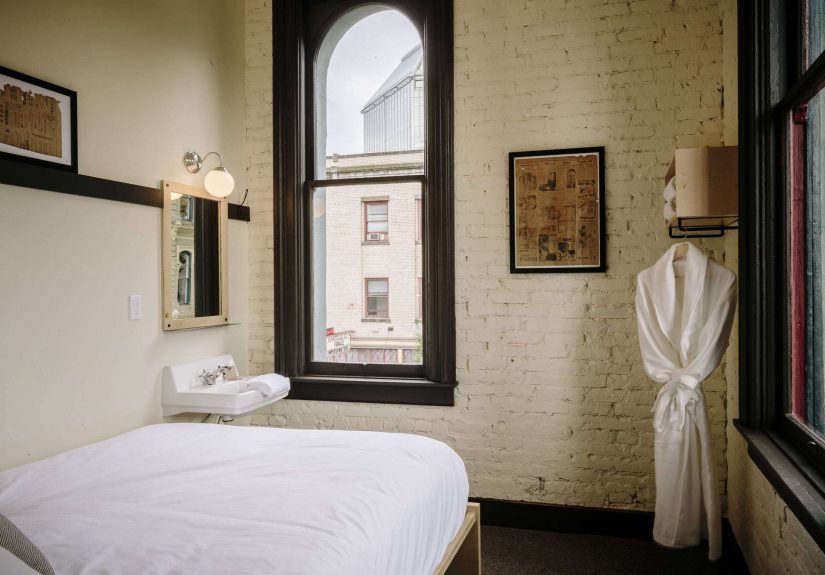
The room design is often described as spare, bright, and Scandinavian-leaning, but that can make it sound more severe than it really is. In practice, the look works because it allows the building’s bones to stay visible. Brick walls, big windows, clean linens, and restrained furniture let the architecture breathe. The effect is cozy rather than cluttered.
That restraint also suits the building’s original purpose. A mariners’ home was never about lavish decoration. It was about rest, shelter, and utility. The updated interiors echo that spirit in a modern language. Even the smaller rooms feel intentional, not apologetic. They offer what travelers actually need, then let the atmosphere do the rest.
Guests who choose shared-bath options tend to be rewarded with a stronger sense of place and a more accessible rate, while suites add extra flexibility and privacy. The variety is part of the appeal. Instead of forcing everyone into one “ideal” hotel experience, The Society Hotel allows travelers to choose the version that fits their budget and comfort level.
The Rooftop Is Where the Past and Present Shake Hands
Every good adaptive-reuse hotel needs one place where the transformation becomes emotionally obvious. At The Society Hotel, that place is the rooftop. Here you are, standing above one of Portland’s oldest neighborhoods, looking out over downtown, the river, historic streets, and nearby landmarks, while hanging out on a deck that would have sounded utterly absurd to the building’s first residents.
And yet it works. Perfectly. The rooftop does not betray the building’s history; it extends it. The original structure was made for people in transit, people arriving and departing, people with one eye on the city and another on the horizon. A rooftop deck in Portland’s Old Town Chinatown carries that same sense of outlook. It invites pause, perspective, and a little weather-based humility, because this is Oregon and your perfect sunset may absolutely be accompanied by a dramatic cloud performance.
More practically, the rooftop makes the hotel memorable in a crowded travel market. Plenty of historic hotels can offer charm. Fewer can offer charm plus skyline views plus the satisfaction of sipping a drink above a district that still feels fiercely itself.
Why This Hotel Conversion Works Better Than a Typical “Hip” Makeover
Let’s be honest: the phrase hipster hotel can inspire both delight and eye-rolling. Sometimes it means a place with two succulents, one Edison bulb, and a deep commitment to charging you fourteen dollars for toast. But when the label is applied to The Society Hotel, it works because the cool factor is built on real context.
This is not a synthetic vibe pasted onto a forgettable structure. The building already had a story, and the neighborhood already had identity. The renovation succeeded because it amplified those things instead of steamrolling them. It respects the reality that travelers increasingly want meaningful places to stay, not just efficient ones. They want local character. They want design with a narrative. They want buildings that feel as if they belonged somewhere before they became Instagram-friendly.
The Society Hotel also understands something many boutique hotels miss: style is more persuasive when it leaves room for ordinary life. People can grab coffee, sit in the lounge, meet friends, head out to explore the neighborhood, come back, and wind down on the rooftop. It behaves like part hotel, part social living room, part urban lookout. That flexibility gives it staying power.
What This Rebirth Says About Portland Travel
Portland has long attracted travelers who care about food, design, neighborhoods, independent businesses, and places with a little personality. The Society Hotel speaks directly to that audience. It does not feel flashy in the traditional luxury sense. It feels intentional. The luxury here is not marble everywhere. It is the chance to sleep inside a preserved piece of city history without sacrificing comfort or style.
That makes the hotel especially appealing to travelers who want to understand Portland through its built environment. You do not just visit the city from here; you inhabit a fragment of its history. The cast-iron facade, the old urban grid, the surrounding cultural landmarks, and the adaptive-reuse story all combine to make the stay feel interpretive in the best possible way.
It is also a useful example of how historic preservation can stay commercially relevant. Restoring a building is one thing. Giving it a viable new purpose is another. In this case, a former mariners’ home has become a hospitality concept that still echoes its original role: welcoming travelers into the city. That is not just good branding. That is poetic continuity.
The Experience: What It Feels Like to Stay in a Former Seafarers’ Home
There is a particular kind of thrill that comes from staying in a place where the walls clearly predate your luggage by more than a century. At The Society Hotel, that thrill starts before check-in. You approach a historic building in Old Town Chinatown, notice the proportions, the cast-iron confidence, the sense that this structure has watched Portland reinvent itself again and again, and you realize your trip has already become more interesting than a standard hotel stay.
Inside, the mood shifts from city grit to quiet warmth. The lobby and café do not feel staged for a brochure. They feel like places people actually want to use. Someone is typing on a laptop. Someone else is nursing coffee by the window. Another guest is probably trying to look mysterious while casually researching where to get dumplings. The room key lands in your hand, and suddenly you are part of the building’s latest chapter.
Then there is the room itself. Maybe it is a snug private room with brick peeking through and daylight pouring in through tall windows. Maybe it is a suite with a bit more elbow room. Maybe you chose the bunk option because you are smart, adventurous, and suspicious of spending half your travel budget on square footage you will only use while unconscious. Whatever the setup, the charm comes from the same place: the rooms feel edited, not stripped; calm, not boring. They let the building do some of the talking.
The best hotels subtly shape your day, and this one does that well. Morning begins with coffee downstairs and a sense that you are waking up inside Portland rather than at a safe corporate distance from it. You step outside and the neighborhood is right there: history, transit, old storefronts, cultural landmarks, the city’s contradictions, the whole wonderfully complicated package. By afternoon, after walking the district or heading toward downtown, the hotel starts pulling you back in. Not because you need to hide, but because it has become part of the trip itself.
And then the rooftop. That is where the stay turns cinematic. You look out over Old Town Chinatown, toward the river and the city beyond, and you understand why this building’s reinvention feels so satisfying. It is not merely preserved. It is active again. A place built for transient lives has become, once more, a place where travelers gather, rest, swap impressions, and look outward. The original sailors who needed shelter and the present-day guests who want a memorable Portland stay are separated by time, taste, and probably a dramatic difference in luggage quality, but they share one thing: arrival.
That emotional continuity is what elevates the experience. You are not just sleeping in a cool hotel in Portland, OR. You are inhabiting a building that still knows how to welcome people. In a travel landscape crowded with polished sameness, that feels rare. And honestly, pretty hip.
Conclusion
The rebirth of a seafarers’ home as a hipster hotel in Portland, OR works because it never loses sight of the original building beneath the stylish update. The Society Hotel succeeds as a boutique destination, but it also succeeds as a preservation story, a neighborhood story, and a Portland story. Its cast-iron facade, historic purpose, adaptable room options, social café, and rooftop deck all combine to create something many hotels aim for but few achieve: a stay with genuine character.
In the end, the real magic is not that an old mariners’ home became trendy. It is that the building remained legible through the trend. You can still feel the practical hospitality that shaped it in the first place. Only now, instead of sailors arriving from the waterfront, the guests are design lovers, weekend travelers, coffee seekers, and curious city explorers. Different crowd. Same warm welcome. Better lighting.