Table of Contents >> Show >> Hide
- Introduction: Somehow, LEGO Fixed What Star Wars Wouldn’t Touch
- Why the Sequel Trilogy Left Fans Wanting More
- What LEGO Star Wars Does Differently
- The FinnPoe Moment: Tiny Animation, Big Fan Reaction
- Why “Going Full Gay” Works as a Jokeand a Critique
- How LEGO Humor Improves the Sequel Trilogy’s Tone
- Finn, Poe, and the Power of Character Chemistry
- The Game’s Bigger Strength: It Lets Star Wars Breathe
- Does LEGO Star Wars Really “Fix” the Sequel Trilogy?
- Why Fans Still Care About FinnPoe
- Related Experience: Playing the Sequel Trilogy the LEGO Way
- Conclusion: The Brick Side of the Force Wins
Note: This article is written from real public information about LEGO Star Wars: The Skywalker Saga, official game details, review coverage, and fan discussion around Finn, Poe, queer subtext, and the sequel trilogy. The phrase “going full gay” is treated here as a pop-culture headline about fan interpretation, not as an insult or a claim that the game officially changes Star Wars canon.
Introduction: Somehow, LEGO Fixed What Star Wars Wouldn’t Touch
There are many ways to describe LEGO Star Wars: The Skywalker Saga. It is a massive action-adventure game. It is a toy-box version of all nine mainline Star Wars films. It is a collectathon so large that your map icons may start breeding when you are not looking. But one of its funniest, strangest, and most weirdly satisfying achievements is this: it gives the sequel trilogy something the movies flirted with, dodged, buried under sand, and then quietly pretended never happened.
Yes, we are talking about Finn and Poe.
When Star Wars: The Force Awakens introduced Finn, a stormtrooper who breaks away from the First Order, and Poe Dameron, the Resistance pilot with enough charisma to power a small moon, fans immediately noticed the chemistry. The jacket. The rescue. The banter. The way Poe named Finn. The way Finn looked at Poe like he had just discovered both freedom and cheekbones in the same afternoon. A popular fan reading was born: FinnPoe, also known as Stormpilot.
The sequel trilogy never made that relationship romantic. Instead, the films moved the characters apart, redirected possible love interests, and ended with a blink-and-you-miss-it same-sex kiss between background characters. For many viewers, that felt less like bold representation and more like Disney dropping a pride sticker on a star destroyer and hoping nobody asked follow-up questions.
Then came LEGO Star Wars: The Skywalker Saga, released in 2022 by TT Games, Warner Bros. Games, the LEGO Group, and Lucasfilm Games. It retells all nine Skywalker films through LEGO humor, with more than 300 playable characters in the original release, over 100 vehicles, and 23 planets to explore. It is not official sequel-trilogy canon. It is not a romance simulator. It does not include a dramatic Finn/Poe wedding on Yavin 4, officiated by a confused C-3PO. But through a cheeky start-menu animation and a playful understanding of character chemistry, it gives fans a version of the sequel era that feels warmer, funnier, and oddly more emotionally honest.
Why the Sequel Trilogy Left Fans Wanting More
The Star Wars sequel trilogy had enormous potential. The Force Awakens brought back the franchise with new heroes, new villains, and the familiar thrill of X-wings screaming across the screen. Rey had mystery. Finn had one of the best setups in modern Star Wars: a stormtrooper rejecting fascism from the inside. Poe had instant swagger. Kylo Ren had family trauma, Force powers, and the emotional stability of a cracked lava lamp.
But across The Last Jedi and The Rise of Skywalker, the trilogy struggled to keep its character arcs aligned. Finn’s stormtrooper origin did not receive the deep exploration it deserved. Poe’s role shifted depending on the movie’s needs. Rey’s parentage changed direction. Palpatine returned with the narrative elegance of someone remembering homework existed five minutes before class.
The Finn and Poe issue fits into that larger problem. Their bond was one of the freshest parts of The Force Awakens. It was energetic, affectionate, and easy to read as something deeper than standard action-movie buddy banter. Both characters were men shaped by war, identity, loyalty, and escape. A romance between them could have been meaningful, not just because it would have made history for Star Wars, but because it made emotional sense.
Instead, the movies backed away. Finn spent much of The Last Jedi on a separate adventure with Rose Tico. The Rise of Skywalker hinted at Poe’s past with Zorii Bliss. The trilogy still gave Finn and Poe friendship, but it never committed to the romantic possibility fans saw so clearly. The result was not simply “fans did not get their ship.” The deeper frustration was that Star Wars seemed afraid of its own subtext.
What LEGO Star Wars Does Differently
LEGO Star Wars: The Skywalker Saga does not fix the sequel trilogy by rewriting every plot hole. It does not explain the First Order’s financing plan, give Snoke a coherent résumé, or make “Somehow Palpatine returned” sound like anything other than a group project panic attack. What it does is more LEGO-like: it compresses, exaggerates, and jokes until the emotional shape of the story becomes clearer.
LEGO adaptations have always understood something important about Star Wars. The saga is mythic, yes, but it is also deeply silly. This is a universe where a tragic father-son confrontation can happen two films after a tiny green wizard steals a lamp and giggles in a swamp. LEGO does not weaken Star Wars by making it ridiculous. It reveals the ridiculousness that was already sitting there in a robe, waiting for its cue.
In The Skywalker Saga, the sequel trilogy benefits from that approach. The game moves quickly. It turns melodrama into slapstick. It turns exposition into visual jokes. It lets players explore sequel-era locations like Jakku, Takodana, Ajan Kloss, Canto Bight, and Exegol without forcing every beat to carry the pressure of franchise destiny. The game’s humor softens the trilogy’s rough edges because LEGO is not trying to win an argument on the internet. It is trying to make a minifigure fall over in a funny way.
The FinnPoe Moment: Tiny Animation, Big Fan Reaction
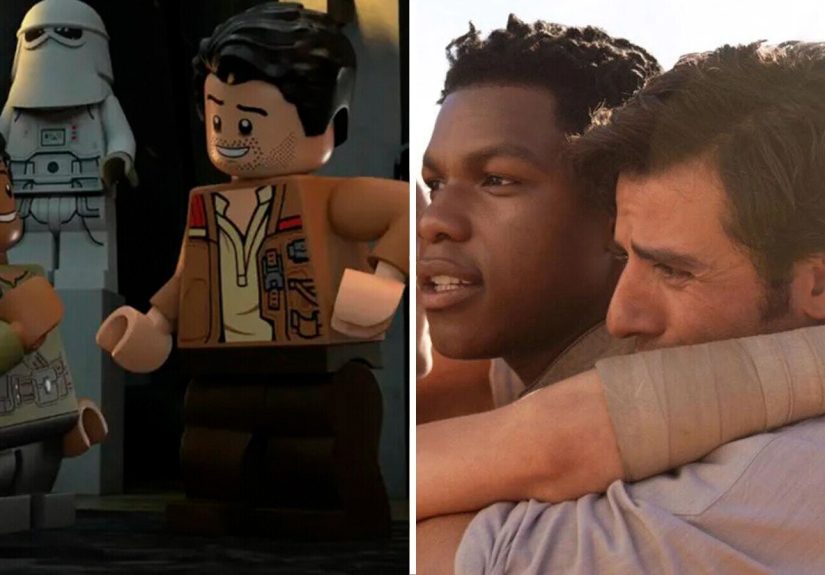
The most discussed Finn/Poe moment in LEGO Star Wars: The Skywalker Saga does not even come from a traditional story mission. It appears in the game’s character-filled menu animation. Fans noticed that Finn moves away from Rose and toward Poe, after which Poe puts his arm around Finn. In another beat, Captain Phasma attempts to place a stormtrooper helmet on Finn, and Poe protects him. It is short, goofy, and staged with the kind of exaggerated body language LEGO games use best.
Is it official confirmation that Finn and Poe are married, own a droid together, and argue over whose turn it is to clean the Millennium Falcon cupholders? No. But it is also not nothing. Visual comedy works through implication. The joke lands because audiences understand the existing fan conversation. The animation winks at FinnPoe fans without needing a line of dialogue, which is extremely LEGO and extremely effective.
That is why the moment spread quickly across gaming and pop-culture sites. Fans were not reacting only to a cute pose. They were reacting to years of buildup, disappointment, and corporate hesitation. The LEGO game gave them a playful version of what the films refused to imagine openly. In a franchise where canon can become a battlefield, a start-menu gag somehow felt like a tiny act of emotional repair.
Why “Going Full Gay” Works as a Jokeand a Critique
The phrase “going full gay” is intentionally loud. It is not subtle. It is the headline equivalent of Chewbacca kicking open a door while wearing rainbow sunglasses. But beneath the joke is a real critique: mainstream blockbusters often enjoy queer-coded chemistry while avoiding queer commitment.
Hollywood has a long history of using charged same-sex dynamics for energy, humor, and emotional intensity, then retreating into plausible deniability when audiences ask whether the characters might actually be queer. In the sequel trilogy, Finn and Poe’s chemistry was strong enough to spark years of fan art, essays, memes, and shipping debates. That did not happen because viewers hallucinated a romance out of thin air. It happened because the performances had warmth, tension, and immediacy.
LEGO’s version works because it leans into that audience awareness. It does not deliver a speech about representation. It does not stop the game so Yoda can say, “Gay rights, support them we must.” It simply stages Finn and Poe with affectionate, flirty body language and lets the joke breathe. That is why it feels bolder than it technically is. The game understands that sometimes a wink can say more than a press release.
How LEGO Humor Improves the Sequel Trilogy’s Tone
The sequel movies often had humor, but not all of it aged gracefully. Poe’s prank-call-style exchange with General Hux in The Last Jedi divided viewers. Some loved the irreverence; others felt it sounded too modern for Star Wars. The LEGO game, however, exists in a world where irreverence is the native language. A yo-mama-style joke may feel strange in live-action Star Wars, but in LEGO Star Wars, it is just another Tuesday.
That tonal difference matters. LEGO can make Kylo Ren’s tantrums funnier because he is literally a tiny plastic man with helmet issues. It can make Rey’s heroic destiny less heavy by surrounding it with exploding bricks and absurd side quests. It can make Palpatine’s return feel less like narrative malpractice and more like the galaxy’s worst pop-up ad. “The Emperor has returned. Click here to unsubscribe.”
The sequel trilogy’s biggest weakness is that it often wants to be mythic, nostalgic, modern, funny, tragic, and surprising at the same time. LEGO simplifies the emotional menu. It says: here are the characters, here are the jokes, here are the planets, go have fun. That simplicity makes the sequel material easier to enjoy.
Finn, Poe, and the Power of Character Chemistry
One reason fans responded so strongly to FinnPoe is that the relationship begins with action and trust. Poe is captured. Finn needs a pilot. They escape together. In that escape, Finn chooses a new life, and Poe gives him a name. That is not a small gesture. For a former stormtrooper known as FN-2187, being called Finn is a rebirth.
From a storytelling perspective, that is fertile ground for romance, brotherhood, or any deeply intimate bond. The sequel trilogy chose friendship, which is valid. Friendship can be powerful. But the films did not always give that friendship enough room to evolve. LEGO’s little menu animation is funny because it understands the emotional shorthand: Finn feels safe with Poe. Poe protects Finn. Their body language is affectionate. Fans fill in the rest because the movies already trained them to care.
That is not “just shipping.” It is audience literacy. Viewers recognize chemistry. They notice when a story builds a bridge and then refuses to cross it.
The Game’s Bigger Strength: It Lets Star Wars Breathe
Beyond the Finn/Poe conversation, LEGO Star Wars: The Skywalker Saga succeeds because it turns Star Wars into a playground. Players can start from any trilogy, explore planets, collect Kyber Bricks, unlock character classes, fly ships, and revisit famous scenes with a lighter heart. This freedom is especially helpful for the sequel trilogy, which has remained one of the most divisive parts of the franchise.
In the game, players do not have to litigate every creative decision. They can run around as Rey, Finn, Poe, BB-8, Kylo Ren, or dozens of other characters. They can smash objects for studs, chase collectibles, and enjoy the locations as spaces rather than arguments. Jakku becomes a sandbox instead of a nostalgia debate. Exegol becomes a creepy LEGO lightning rave. Canto Bight becomes, well, still Canto Bightbut now with more bricks to break, which helps.
The result is a sequel trilogy experience that feels less defensive. The game does not ask players to approve every movie choice. It asks them to play. That difference is huge.
Does LEGO Star Wars Really “Fix” the Sequel Trilogy?
Strictly speaking, no. A video game adaptation cannot repair every structural problem in three blockbuster films. It cannot give Finn the full ex-stormtrooper revolution arc many fans wanted. It cannot rebuild the trilogy’s planning from the ground up. It cannot make every viewer suddenly agree on Rey, Kylo, Luke, Snoke, Rose, or Palpatine.
But emotionally? Yes, it fixes something.
It fixes the stiffness. It fixes the fear of playfulness. It fixes, for a few seconds at least, the refusal to acknowledge that Finn and Poe had romantic energy. It fixes the sequel trilogy by treating its characters less like brand assets and more like toys in the best sense: flexible, expressive, and open to imagination.
That is the secret power of LEGO. A LEGO story is never final. You build it, break it, rebuild it, and make Darth Vader ride a tiny scooter if that is what the afternoon requires. In that creative space, Finn and Poe can stand closer. Rey can be funnier. Kylo can be more ridiculous. The galaxy can loosen its collar.
Why Fans Still Care About FinnPoe
Fans still care because representation matters, but also because good chemistry matters. FinnPoe became popular at the intersection of both. It offered the possibility of a major same-sex romance in one of the biggest film franchises in history, but it also felt narratively natural. Nobody had to force the idea into the story with a hydraulic press. It was already there in the performances, the dialogue, and the emotional setup.
That is why a small LEGO gag could become news. The moment was not important because it changed canon. It was important because it acknowledged an audience conversation that had been alive since 2015. It said, in plastic body language, “Yes, we saw it too.”
For queer fans and allies, that kind of acknowledgment can feel both joyful and bittersweet. Joyful because it is funny, cute, and validating. Bittersweet because it reminds everyone how little it would have taken for the films to do something braver. Sometimes the tiniest LEGO hand on a LEGO shoulder carries more emotional weight than a blockbuster’s carefully managed “historic” background kiss.
Related Experience: Playing the Sequel Trilogy the LEGO Way
Playing the sequel trilogy section of LEGO Star Wars: The Skywalker Saga feels a bit like cleaning a messy room by turning everything into confetti. The problems are still technically there, but suddenly you are smiling. The game does not demand that you sit quietly and accept every plot turn as sacred scripture. It gives you a lightsaber, a blaster, a pile of studs, and permission to laugh.
The first thing that stands out is how much better the sequel characters feel when they are allowed to be playful. Finn is naturally suited to LEGO comedy because his entire arc begins with panic, improvisation, and moral courage. He is brave, but he is also constantly reacting to absurd situations, which makes him perfect for slapstick. Poe works because he is confident enough to be ridiculous. A LEGO Poe can smirk, pose, crash, flirt, and still look like he thinks everything is going according to plan. BB-8, of course, was practically born to be a LEGO character. He is already a rolling toy with anxiety.
The sequel planets also benefit from the game’s structure. Jakku becomes more than “Tatooine, but with fresher wreckage.” It becomes a place to explore, climb, collect, and poke around in. Takodana has a cozy storybook feel. Canto Bight works better when treated as a shiny playground full of visual gags rather than a heavy political detour. Even Exegol, one of the more rushed locations in The Rise of Skywalker, becomes entertaining when its gothic drama is filtered through LEGO’s habit of turning doom into a punchline.
The Finn/Poe energy adds another layer to that experience. Once you notice the menu animation, it changes the mood. It makes the sequel era feel more generous, as if the game is quietly opening a door the films left shut. You may not be playing a romantic storyline, but you are playing in a version of Star Wars that understands why fans wanted one. That awareness makes the game feel less corporate and more human, even though everyone on screen is made of plastic.
The best sessions come when you stop worrying about canon and start treating the game like a giant Star Wars toy chest. You can run missions, ignore missions, replay scenes, unlock characters, or wander around collecting bricks while dressed as someone completely inappropriate for the moment. That freedom is healing in a fandom often exhausted by debates. For a few hours, nobody has to argue about whether the sequel trilogy was brilliant, terrible, misunderstood, or cursed by committee. You can simply enjoy the characters, laugh at the jokes, and let Finn and Poe stand a little closer than Disney ever allowed them to stand on the big screen.
Conclusion: The Brick Side of the Force Wins
LEGO Star Wars: The Skywalker Saga does not replace the sequel trilogy, but it does reveal a better way to enjoy it. By embracing humor, speed, exaggeration, and fan-aware character moments, the game smooths out some of the trilogy’s roughest edges. Its treatment of Finn and Poe is not official romantic canon, but it is meaningful because it understands what audiences saw: affection, chemistry, and a story possibility that the films declined to pursue.
In the end, the LEGO version “fixes” the sequels not by solving every plot problem, but by restoring a sense of fun and imagination. It lets Star Wars be strange again. It lets fans laugh. It lets characters breathe. And, in one small but memorable animation, it lets Finn and Poe share the kind of affectionate closeness that launched a thousand shipssome of them X-wings, some of them romantic, all of them powered by pure fandom fuel.
Sometimes the galaxy does not need another superweapon. Sometimes it just needs two tiny plastic men, a knowing wink, and the courage to go full gay.