Table of Contents >> Show >> Hide
- What You’ll Learn
- Why 1 Hz Is a Deceptively Hard Target
- What the 2025 One Hertz Challenge Was Really Testing
- How a Candle Becomes an Oscillator
- The Candle Clock, Upgraded (And Slightly Roasted)
- Turning Messy Flame Behavior Into a Usable Time Base
- Engineering Lessons Hidden Inside a Candle Flame
- Bonus: Experiences From the “Flaming Oscillator” Mindset (About )
- Conclusion
If you’ve ever stared at a candle flame long enough to forget what day it is, congratulations: you’re already qualified for the
One Hertz Challenge mindset. The premise is beautifully simplemake something that “ticks” at 1 Hz
(one beat per second)and then immediately discover that “simple” is just science’s way of saying, “I’m about to humble you.”
In 2025, one of the most delightfully unhinged entries flipped timekeeping history on its head: instead of using a candle’s steady burn
to measure time like an old-school candle clock, it used the candle’s flickera rhythmic, synchronized oscillationthen derived a
clean one-second pulse from fire. Yes, fire. We’ve officially entered the “thermodynamics can wear a wristwatch” era.
Why 1 Hz Is a Deceptively Hard Target
One hertz sounds like the easiest frequency on Earth. It’s literally “once per second.” You can blink at it. You can tap your finger at it.
You can think you’re doing it and be wrongquietly, consistently wrongbecause humans are great at confidence and not-so-great at calibration.
Here’s the twist: time is one of the most strictly defined concepts in science. The modern second is tied to an atomic transition
(the famous cesium frequency), which is why your phone clock can casually outperform a 17th-century king’s entire timekeeping department.
So when you decide to make a 1 Hz oscillator, you’re really deciding how you want to wrestle with:
- Stability (does it keep the same tempo?)
- Drift (does it slowly wander as conditions change?)
- Noise (does it jitter, hiccup, or “kinda” pulse?)
- Measurement (can you prove it’s 1 Hz, not “vibes-based timing”?)
The best part of the One Hertz Challenge is that it turns all of that into a creative constraint. Some people go ultra-precise (crystals,
divider chains, disciplined clock sources). Others go gloriously physical (pendulums, escapements, rolling balls). And thenbecause the universe
loves varietysomeone goes, “What if time… but candle?”
What the 2025 One Hertz Challenge Was Really Testing
At face value, the challenge is “make 1 Hz.” In practice, it’s a design Rorschach test:
Do you optimize for accuracy? Simplicity? Beauty? Weirdness? Minimal parts? Maximum storytelling?
The entries that stand out usually do two things at once:
- They respect the physics (because reality is non-negotiable and keeps receipts).
-
They reinterpret the idea of a clocknot just “a thing that counts seconds,” but “a device that
turns the passage of time into a signal humans can feel.”
That’s why the flaming oscillator entry hit so hard. It didn’t just hit 1 Hz; it made you re-think what qualifies as a “clock source.”
It also quietly reminded everyone that a candle is not just wax and ambianceit’s a complex fluid-and-combustion system that happens to smell like nostalgia.
Safety note: Because we’re talking about open flame, this is a “learn from the idea” topicnot a “go try this in your bedroom” topic.
Fire and electronics are both unforgiving, and together they become a chaotic duo with strong “villain origin story” potential.
How a Candle Becomes an Oscillator
Most modern candles are engineered to burn steadily. The wick, wax blend, and geometry are designed to balance fuel delivery and airflow so the flame
doesn’t flicker dramatically. Flicker is usually treated as a problem: it looks messy, it smokes, and it makes people blame the air conditioning.
But under certain conditions, flames can behave like nonlinear oscillators. Put multiple candles close enough that their flames interact,
and something surprising can happen: the flames begin to couple and oscillate together, often in sync. Instead of random flutter,
you get a rhythmlike a tiny combustion choir rehearsing for a one-note concert.
Why three candles?
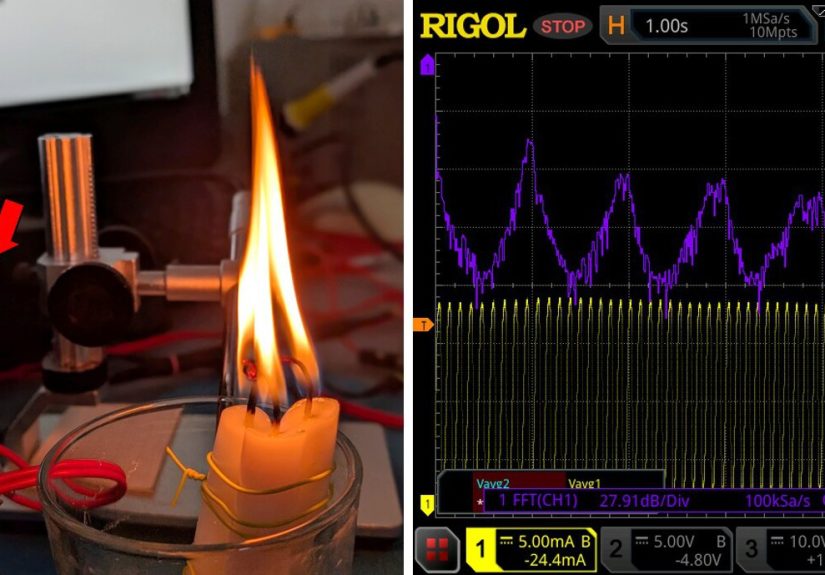
In the well-known 2025 entry, a small bundle of candles produced a fairly stable flicker frequency around ~10 Hz (ten pulses per second).
That frequency is interesting because it’s not “electronics fast” and not “human slow.” It’s right in that sweet spot where you can observe it,
measure it, and then divide it down into a crisp one-second beat.
Researchers have studied candle flame oscillations and synchronization for years (yes, candle science is real science), and the frequency behavior
depends strongly on physical parameters like gravity and flame size. That means a flame oscillator isn’t “perfect,” but it can be surprisingly consistent
under stable conditionsstable enough to become a playful time base.
The Candle Clock, Upgraded (And Slightly Roasted)
A traditional candle clock is beautifully low-tech: you mark a candle with evenly spaced lines, then read time by how far it burns.
It’s timekeeping by controlled disappearance. Very poetic. Very “medieval productivity guru.”
The 2025 flaming oscillator flips the concept:
- Classic candle clock: time comes from burn rate (slow, steady consumption).
- Flaming oscillator clock: time comes from flame dynamics (fast, rhythmic oscillation).
That’s the “new take.” Instead of treating flicker as the enemy, it recruits flicker as the metronome. It’s like discovering your “unreliable”
friend is actually perfectif you only invite them to events that start late.
A quick reality check on old fire-based timekeeping
Historically, fire clocks weren’t just candle clocks. Various cultures used burning materials (including incense) to track time, often because
fire-based methods worked indoors and at night. The broad idea was always the same: find something that changes predictably, then mark it.
What’s different in 2025 is the instrumentation mindset: instead of marking wax, you extract a signal and process it.
Turning Messy Flame Behavior Into a Usable Time Base
The core engineering challenge isn’t “make a candle flicker.” It’s “turn that flicker into a signal a circuit can trust.”
In the highlighted project, the early approach used light detection (a phototransistor) to capture brightness oscillationsstraightforward, readable,
and conceptually clean.
Then came the clever twist: capacitive sensing. Instead of relying on light, the design treated the flame region like part of a changing
electrical environment. Flames contain ionized gases and behave differently from plain air in ways that can be sensed electrically. By measuring small
changes in capacitance, you can infer oscillations without an optical sensor.
Why capacitive sensing feels like magic (but isn’t)
Capacitive touch on phones and microcontroller boards works because your body changes an electrostatic field. The hardware measures tiny changes in
capacitance and decides, “Aha, human detected.” The same family of ideasdetecting minute capacitance changescan be applied to other situations where
the environment is shifting in a measurable way.
Importantly, describing this is not the same as recommending that anyone replicate a flame experiment. The concept is what matters:
extract a periodic signal from a physical phenomenon, then condition it (filter, threshold, shape), then
divide it down to 1 Hz.
From ~10 Hz to 1 Hz: the art of dividing time
Once you have a stable ~10 Hz rhythm, you can derive 1 Hz by counting cycles (for example, every ten pulses becomes one “second tick”).
In digital electronics, this is the same principle used when a watch crystal frequency is divided down into one-second steps.
The difference is that crystals are famously well-behaved, while flames are… emotionally expressive.
That mismatch is exactly why this entry is so fun: it forces the designer to build a little “truth serum” for the signalnoise rejection,
thresholding, and sanity checksso that one second stays one second even when the physical world tries to improvise.
Engineering Lessons Hidden Inside a Candle Flame
The flaming oscillator story is entertaining, but it’s also a crash course in practical engineering thinking. A few big takeaways show up again and again
when you turn “real phenomena” into “digital time”:
1) A clock source is only as good as its environment
Air currents, temperature changes, and subtle geometry differences can change flame behavior. If the oscillation depends on physical parameters, then the
“system” includes the room. That’s not a flaw; it’s a reminder that physics doesn’t stop at the edge of your circuit board.
2) Measurement is part of the design, not an afterthought
If you can’t measure frequency cleanly, you can’t claim 1 Hzonly “approximately one-ish.” The best projects treat measurement like a feature:
signal capture, filtering, and verification are all deliberate choices.
3) Constraints are creativity engines
A one-hertz goal is restrictive enough to make people inventive, but open enough that wildly different approaches are valid. That’s why the challenge
becomes a gallery of philosophies: precision-first builds sit right next to poetic builds, and both are “correct” in their own way.
4) The second is a concept with layers
On one end, the second is defined at a national metrology level, tied to atomic phenomena. On the other end, the second is the blink of an LED,
the thump of a heartbeat, the tiny satisfaction of watching something tick. The One Hertz Challenge connects those layersand the candle project makes
that connection feel almost theatrical.
Bonus: Experiences From the “Flaming Oscillator” Mindset (About )
People who fall down the “one hertz via weird physics” rabbit hole tend to describe the experience the same way: part science fair, part detective story,
and part stand-up comedy where the punchline is always, “Oh, that’s why engineers drink coffee.”
The first experience is usually wonder. Not the dramatic kindmore like the quiet shock of realizing a candle can behave rhythmically
instead of randomly. You expect chaos. You get a pattern. Your brain immediately tries to assign meaning to it, like it’s spotting faces in clouds.
The difference is that the pattern is measurable, repeatable, and stubbornly real.
Then comes the humility phase. The signal you thought was “clean” turns out to be a messy blend of real oscillation, environmental noise,
and occasional nonsense. You learn to respect thresholds. You learn that filtering isn’t cheatingit’s translation. You start thinking like a diplomat
between two countries: the physical world speaks analog, your microcontroller speaks digital, and you’re writing the subtitles.
Somewhere in the middle, there’s a moment of absurd joy: when an output finally ticks like a proper second.
It doesn’t matter if it’s an LED blink, a click, a line on an oscilloscope, or a counter incrementing. It feels like you convinced reality to keep an
appointment. One second arrives. Then another. Then another. And you realize you’re not “just making a clock”you’re building a relationship with error,
drift, and probability.
That’s when the “candle clock” idea stops being a novelty and becomes a metaphor. A candle clock is literally time melting away in front of you.
A flame oscillator is time pulsingalive, visible, dynamic. Both are reminders that timekeeping isn’t only about precision; it’s also about perception.
Watching a flame “tick” makes time feel physical in a way quartz crystals never will, even if quartz wins the accuracy trophy every single time.
Finally, there’s the storytelling payoff. The best maker experiences aren’t only about the end result; they’re about the trail of
small discoveries: noticing what changes the rhythm, learning what “stable” really means, and recognizing that even a lowly candle has hidden structure.
You walk away with a new respect for everyday phenomenaand a slightly stronger urge to look at household objects and ask, “Could this be a sensor?”
If the One Hertz Challenge has a secret curriculum, this is it: it teaches you to see the world as a set of signals waiting to be interpretedsome clean,
some chaotic, and some (apparently) on fire.
Conclusion
The 2025 flaming oscillator entry didn’t just deliver a 1 Hz tickit delivered a fresh perspective on time itself. It connected ancient “fire clocks”
to modern signal processing, turned flicker into a feature, and reminded everyone that engineering can be rigorous without losing its sense of play.
A candle clock measures time by what disappears. A flaming oscillator measures time by what repeats. Either way, you come away with the same truth:
timekeeping is less about fancy parts and more about choosing a phenomenon you can trustand then proving you can trust it.