Table of Contents >> Show >> Hide
- Why Scalping Became One of the Frontier’s Darkest Symbols
- Fact #1: Scalping Was Not Unique to Native Americans
- Fact #2: Colonial and Frontier Governments Sometimes Put a Price on Scalps
- Fact #3: Scalping Was Tied to Land, Expansion, and Frontier Warfare
- Fact #4: Women, Children, and Civilians Were Not Always Spared
- Fact #5: Native Nations Did Not All Practice Scalping the Same Way
- Fact #6: White Settlers, Colonial Figures, and Guerrillas Also Took Scalps
- Fact #7: Scalping Was Also a Tool of Propaganda
- Fact #8: The Legacy Did Not End When the Frontier Closed
- What These Horrific Facts Really Tell Us
- Experiences of Life Around Scalping on the American Frontier
The American frontier has a habit of showing up in pop culture like a dust-covered action movie: big sky, bigger hats, and a suspicious shortage of historical nuance. But when you strip away the dime novels, movie myths, and chest-thumping legends, the real story of scalping on the American frontier is darker, more complicated, and far more unsettling than the old clichés suggest. It was not simply a “Wild West” horror performed by one side against another. It was a practice tied to imperial wars, land seizure, revenge, bounty systems, racial propaganda, and the brutal economics of frontier violence.
That complexity matters. For generations, frontier storytelling treated scalping as proof that Native people were inherently savage. Real history says otherwise. The practice appeared in many parts of the world, was shaped by colonial warfare in North America, and was used by Native warriors, colonial forces, militias, settlers, and guerrillas in different times and places. In other words, the frontier was not a morality play with clean costumes and cleaner consciences. It was a long conflict over land and power, and scalping became one of its ugliest symbols.
Why Scalping Became One of the Frontier’s Darkest Symbols
On the frontier, violence had a practical side and a theatrical side. Scalping could function as a trophy, a warning, proof of a kill, or a piece of evidence used to collect payment. That last part is especially chilling. Once governments and military leaders connected body parts to cash rewards, frontier violence gained a bureaucratic edge. The act was no longer only personal or tribal or retaliatory. It could also become transactional.
And that is what makes the history so grim. The American frontier was not just a place where people fought. It was a place where violence could be counted, priced, displayed, and retold until it hardened into myth.
Fact #1: Scalping Was Not Unique to Native Americans
One of the most persistent myths in American history is that scalping was a uniquely Native American practice. It was not. Historians and museum sources have long pointed out that scalp-taking existed in other parts of the world and cannot be pinned on a single people as though they invented it in a fit of cinematic villainy. On the North American frontier, the practice took shape within a larger world of colonial warfare, imperial rivalry, and cultural exchange.
That does not mean every group practiced it in the same way, or with the same meaning. It means the old frontier stereotype collapses under inspection. European empires, colonial militias, and settlers participated in scalp-taking too. The frontier was not divided into “civilized people” on one side and “barbaric people” on the other. It was a violent borderland where many groups adopted cruel methods under pressure, fear, and revenge.
Fact #2: Colonial and Frontier Governments Sometimes Put a Price on Scalps
This is where the story turns from brutal to bureaucratically brutal. In several frontier conflicts, authorities offered scalp bounties or rewarded people for bringing in scalps as proof of enemy deaths. That policy transformed violence into paperwork. A scalp could become a receipt.
During wars between European powers in North America, leaders sometimes encouraged Native allies to attack enemy settlements, and accusations of scalp payments surfaced in propaganda and official complaints. By the War of 1812, the image of British officers effectively rewarding Native fighters for American scalps had become powerful enough to appear in political cartoons and public outrage. Whether used as policy, rumor, or both, the association between scalp-taking and government reward was deeply embedded in frontier conflict.
The most notorious example came later in the West. In California during and after the Gold Rush, anti-Native violence escalated so dramatically that local communities and state-backed campaigns effectively turned Native people into targets. Settlers, militias, and so-called “Indian hunters” pursued Native communities, and bounties on Native heads or scalps became part of a broader campaign of dispossession and killing. That is not fringe history. That is American history, and it belongs in the file labeled things we should stop pretending were accidental.
Fact #3: Scalping Was Tied to Land, Expansion, and Frontier Warfare
Scalping did not happen in a vacuum. It flourished in places where empires and settlers were contesting land already occupied by Native nations. The French and Indian War, the Revolutionary frontier, the War of 1812, the California Gold Rush, and the Indian Wars all grew out of the same basic struggle: who controlled territory, resources, movement, and sovereignty.
On paper, frontier violence was often described as defense. In practice, it was frequently part of expansion. Settlers moved in. Native communities resisted. Militias retaliated. Raids produced counterraids. Rumors amplified fear. Newspapers inflated atrocities. Politicians used the panic to justify more troops, harsher policies, and more settlement. In that environment, scalping became both an act of violence and a political message.
It also became a way to dehumanize opponents. Once a war is narrated as a fight against monsters, almost any response starts looking acceptable to the people doing the narrating. That was true on the frontier, and it is one of the bleakest lessons the period leaves behind.
Fact #4: Women, Children, and Civilians Were Not Always Spared
Another horrific truth about scalping on the American frontier is that frontier violence often did not stop at armed men. Bounty systems and retaliatory raids could target entire communities. Public-history sources on colonial New England and later western violence make clear that scalp bounties were sometimes directed against Native men, women, and children alike. That fact alone destroys the old fantasy that this was always formal combat between combatants.
Frontier conflict often blurred every line a modern reader hopes would exist. Settlements included families. Villages included elders and children. Raiding parties struck homes, farms, camps, and travelers. Captives could be exchanged, adopted, held, or killed depending on the conflict and the people involved. There was no neat battlefield fence. On the frontier, the war could follow a person home.
That helps explain why stories of scalping spread so quickly and lingered so long. They were terrifying not only because of the act itself, but because they suggested that ordinary life had become unsafe. Once that fear took root, rumor did the rest.
Fact #5: Native Nations Did Not All Practice Scalping the Same Way
Talking about “the Native American view” of scalping is like talking about “the European view” of cooking. It is too broad to be useful and too lazy to be accurate. Indigenous North America included hundreds of nations with different military traditions, spiritual beliefs, political structures, and relationships to colonial powers. Some groups practiced scalp-taking in certain wars. Some did so rarely. Some appear not to have emphasized it at all. Even within the same nation, practices could change over time depending on enemy pressure, alliance systems, or access to European markets and weapons.
This point matters because frontier myth flattened Native people into a single threatening image. But the historical record does not support that simplification. For example, accounts related to Apache history note that scalping was not a defining or especially common Apache practice in the way later popular culture liked to imply. Likewise, family history surrounding famous Native leaders sometimes directly contradicts the idea that every warrior kept scalps as trophies. The frontier stereotype was broad, lazy, and politically useful. That does not make it true.
Fact #6: White Settlers, Colonial Figures, and Guerrillas Also Took Scalps
If the frontier had a talent, it was producing hypocrisy at industrial scale. Anglo-American culture often presented scalp-taking as proof of Native barbarity while celebrating or excusing similar acts by colonists and settlers. One of the clearest examples is Hannah Duston, the colonial woman who killed and scalped Native captors in 1697 and later became a folk hero in New England memory. Her story was not buried in shame. It was commemorated.
Move forward into the nineteenth century and the pattern continues. During the Civil War’s guerrilla fighting on the Missouri-Kansas border, irregular fighters associated with Bloody Bill Anderson reportedly took human scalps and displayed them as trophies. This was not a Native frontier war at all. It was white-on-white guerrilla violence in the American borderlands, and it shows just how false the old racial story really was.
The ugly truth is that scalp-taking on the frontier was not the signature of one race. It was the signature of a violent world where cruelty was often rewarded and remembered selectively.
Fact #7: Scalping Was Also a Tool of Propaganda
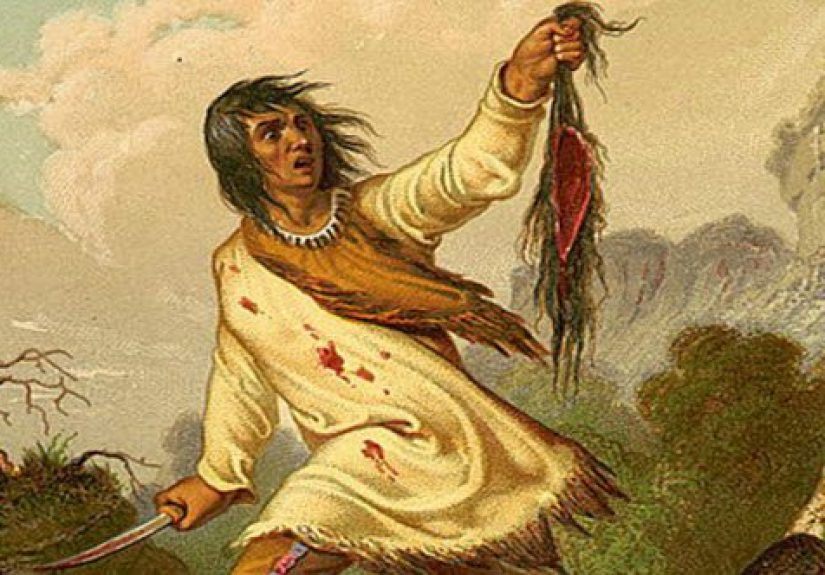
Once newspapers, memoirs, speeches, and paintings got involved, scalping became bigger than the act itself. It became a symbol designed to provoke outrage. Politicians used it to rally militias. Publishers used it to sell papers. Entertainers used it to spice up frontier tales. By the nineteenth century, melodramatic stories of scalping were circulating widely in the United States and Europe, helping turn the frontier into a theater of fear.
That theatrical version of the frontier outlived the actual frontier. Wild West shows, popular novels, and later films repeated the same formula: innocent settlers, savage attackers, and a rescue at the last possible second. It was great box office and terrible history. The result was a cultural memory in which Native Americans were blamed for a kind of violence that frontier governments and settlers had also used, encouraged, or profited from.
In that sense, scalping became a propaganda shortcut. Mention it, and audiences instantly knew who the supposed villain was. Never mind the land theft, treaty-breaking, militia campaigns, or scalp bounties in the background. Those details were inconvenient, and myth hates inconvenience.
Fact #8: The Legacy Did Not End When the Frontier Closed
The afterlife of frontier scalping is its own disturbing chapter. Human remains, including scalps, were collected, traded, displayed, and stored in museums or private collections long after the wars themselves ended. That history sits at the intersection of scientific racism, colonial collecting, and plain old disrespect. What had once been a token of war became, in some cases, a “specimen” or curiosity.
Today, repatriation efforts and changing museum ethics have forced institutions to reckon with that legacy. Native communities have pushed for the return of ancestors and remains, arguing correctly that these are not artifacts in the ordinary sense. They are human beings who were taken in moments of trauma and then absorbed into systems that pretended scholarship excused theft. That conversation matters because it reminds us that frontier violence was not only historical. Its consequences lasted for generations.
What These Horrific Facts Really Tell Us
The most important lesson is not that the frontier was violent. Honestly, that part is obvious. The harder lesson is that the violence was organized, rationalized, and narrated in ways that served expansion. Scalping on the American frontier was horrific not only because it happened, but because governments sometimes rewarded it, communities normalized it, and popular culture later weaponized it into a one-sided racial myth.
So when people talk about frontier history as if it were a rugged pageant of brave pioneers and nameless dangers, it is worth slowing down. The “dangers” often had names, homes, treaties, and legal claims to the land being invaded. The “bravery” was sometimes mixed with bounty systems, revenge raids, and the kind of storytelling that makes one side look human and the other disposable.
That is the real horror. Not just the act, but the world that made it thinkable.
Experiences of Life Around Scalping on the American Frontier
To understand the emotional reality of this history, it helps to imagine the frontier not as a stage set but as a place where people lived with constant uncertainty. A settler family on an isolated farm might hear weeks of rumors before seeing any violence at all. A rider arrives with a story from the next valley. A trading post passes along another tale. By the time the news reaches a cabin or village, nobody is sure what happened, only that fear has already arrived. In that atmosphere, every barking dog after dark sounds like a warning.
For Native communities, the experience could be even more devastating because the threat was often not random. It was connected to encroaching settlement, militia patrols, destroyed food sources, and the steady pressure of losing land. A village might wake up knowing that game had been driven away, treaty promises had failed, and armed outsiders were closer than ever. In that setting, every raid and retaliation carried more than immediate danger. It carried the feeling that an entire world was being squeezed smaller.
Children on both sides grew up in the shadow of stories they were probably too young to hear and too close to avoid. Frontier memory was built around warnings: do not wander far, do not trust the road after sunset, do not ignore hoofbeats, do not assume a quiet week means safety. Adults learned to read landscapes for signs of danger. Silence itself could feel suspicious. A trail with no traffic, a trading route gone empty, or smoke in the wrong place might change the mood of an entire settlement by noon.
There was also the exhausting experience of not knowing whether a story was true. Frontier communities ran on rumor almost as much as they ran on cornmeal, horses, and ammunition. Some reports were accurate. Some were exaggerated. Some were invented to justify revenge, mobilize militia support, or inflame hatred. But even false stories had real effects. They changed behavior, hardened prejudice, and prepared people to see enemies everywhere.
For those who survived raids or came upon their aftermath, the experience often shaped a lifetime of memory. Survivors did not just remember danger; they remembered disruption. A burned home meant winter looked different. A lost horse meant travel looked different. A missing relative meant every ordinary routine carried an empty space. Violence on the frontier did not end when the shooting stopped. It lingered in supply shortages, grief, displacement, and the constant calculation of whether to stay, flee, or fight.
Even people far from the actual event felt its weight. Ministers preached about it. newspapers printed it. politicians exploited it. Artists dramatized it. That meant frontier violence moved from campfires into public imagination, where it became something larger than the event itself. People experienced scalping not only as a direct threat, but as a cultural nightmare repeated in speech, print, and performance until it defined how neighbors understood one another.
That may be the clearest window into frontier experience: people were not living inside a heroic western. They were living inside a cycle of fear, grief, retaliation, and mythmaking. Some used that cycle to survive. Some used it to justify conquest. Nearly everyone paid a human price.





