Table of Contents >> Show >> Hide
- How We Picked These Chandeliers
- Chandelier Shopping Cheat Sheet
- The 8 Best Chandeliers to Brighten Up Your Space
- Visual Comfort & Co. Talia Chandelier (Julie Neill) – Best “bubble” statement
- Roll & Hill Lorna (via Rejuvenation) – Best Art Deco “wow” factor
- Serena & Lily Capiz Scalloped Chandelier – Best soft, coastal glow
- Pottery Barn Clarissa Glass Drop Chandelier – Best classic sparkle
- West Elm Laughton 3-Light Chandelier – Best modern minimal
- Rejuvenation Willamette 32" Round Chandelier – Best “textured glass” elegance
- Possini Euro Design Janae Starburst (Lamps Plus) – Best mid-century “Sputnik” vibe
- AERIN Hampton Chandelier (Williams Sonoma) – Best organic glam
- Installation, Safety, and “Living With It” Tips
- Conclusion
- Experience Notes: What People Learn After Living With a Chandelier (The Fun, Real-Life Version)
- SEO Tags
A chandelier is the quickest way to make a room feel like it has a personality. Not “I own a beige sofa” personality.
More like “I host dinner parties and definitely know what a vinaigrette is” personality. The right chandelier adds
light, yesbut also scale, sparkle, drama, and that satisfying sense that a room is finally finished.
The catch? Chandeliers are one of the easiest fixtures to buy wrong. Too small and it looks like a forgotten ceiling
fan pull-chain’s fancy cousin. Too big and your guests will start ducking like they’re entering a low-clearance
parking garage. This guide helps you pick a chandelier that fits your room, your life, and your tolerance for dusting.
How We Picked These Chandeliers
We synthesized guidance from trusted U.S. design publications, lighting retailers, and well-established home-improvement
authorities to identify chandeliers that consistently stand out for (1) design credibility, (2) build quality and
materials, (3) versatility across common rooms, (4) real-world livability (dimmers, bulb compatibility, maintenance),
and (5) a range of price pointsfrom “smart splurge” to “looks expensive, isn’t.”
Chandelier Shopping Cheat Sheet
1) Size it like you mean it
Start with the simplest room-sizing rule: add the room’s length and width (in feet) to get an ideal chandelier
diameter (in inches). Example: a 12′ x 14′ room = 26″ chandelier. This isn’t a law of physicsjust a solid starting
point that keeps you out of the “why is that tiny thing floating up there?” zone.
For dining rooms, proportion the chandelier to the table. A common guideline is choosing a fixture roughly
one-half to two-thirds the table’s width (or about 12 inches narrower than the table). Example:
a 42″ wide table often looks best with a chandelier around 28–30″ wide.
2) Hang it at the right height (so nobody bonks their head)
-
Over a dining table: a common starting point is about 30–36 inches from the tabletop
to the bottom of the fixture (for standard-height ceilings). -
In an open walkway: aim for about 7 feet of clearance from the floor to the bottom
of the chandelier. -
Higher ceilings: you’ll generally raise the fixture a bit so it doesn’t feel like it’s looming.
(Think “floating centerpiece,” not “interrogation lamp.”)
3) Choose the right light (not just the right look)
Chandeliers can be ambient lighting, task lighting, or bothdepending on bulb type, shade material, and how the
fixture distributes light. A few practical tips:
- Put it on a dimmer. Bright for cleaning, soft for dinner, moody for pretending you’re in a film.
- Mind the shade material. Clear glass = brighter. Fabric/drum shades = softer glow. Capiz and alabaster = dreamy diffusion.
- Don’t rely on one ceiling fixture alone. Layer with lamps or sconces for a room that feels warm instead of flat.
4) Match style to architecture (or intentionally clash)
If your home is traditional, crystal and candelabra silhouettes feel natural. If your home is modern, linear frames,
globes, and sculptural forms look intentional. And if you’re eclectic, congratulationsyou’re allowed to do whatever
you want, as long as you size it correctly.
The 8 Best Chandeliers to Brighten Up Your Space
Below are eight standout chandeliers (in multiple styles and budgets) that can elevate a dining room, entryway,
living room, bedroom, or even a high-style kitchen nook.
-
Visual Comfort & Co. Talia Chandelier (Julie Neill) – Best “bubble” statement
If you’ve noticed glass “bubble” chandeliers everywhere lately, this is one of the fixtures powering that trend.
The Talia’s clustered, swirled glass orbs feel playful and airylike your ceiling decided to accessorize.
It’s modern without being cold, and glamorous without going full ballroom.Where it shines: dining rooms (especially with round tables), foyers, and living rooms that need a focal point.
Style tip: pair it with simpler furniture silhouettes so the chandelier gets to be the main character.Buying note: choose the size based on table width or room dimensions, then put it on a dimmer to keep the glass glow soft and flattering.
-
Roll & Hill Lorna (via Rejuvenation) – Best Art Deco “wow” factor
The Lorna is an Art Deco dream: fluted hand-blown glass arranged with a sculptural rhythm that reads luxe from every angle.
It’s the kind of chandelier that makes a plain room look like it suddenly knows how to order oysters.Where it shines: dining rooms, dramatic entryways, and long tables where a linear fixture feels balanced.
Style tip: it plays beautifully with polished stone, burl wood, velvet, and warm metals.Buying note: because it’s a statement piece, measure carefullyespecially if you’re placing it over a table where sightlines matter.
-
Serena & Lily Capiz Scalloped Chandelier – Best soft, coastal glow
Capiz is basically nature’s diffuser: it softens light into a warm, flattering shimmer that makes a room feel calmer instantly.
The scalloped silhouette adds texture without visual heaviness, so it works even in smaller spaces where a bulky chandelier might overwhelm.Where it shines: entryways, breakfast nooks, bedrooms, and coastal-inspired dining rooms.
Style tip: pair with linen, light woods, and warm whites for an airy, “open-the-windows” vibe.Buying note: capiz looks best when you keep bulbs warm (not icy-white) and use a dimmer for a gentle glow.
-
Pottery Barn Clarissa Glass Drop Chandelier – Best classic sparkle
If you want a chandelier that feels timelessequal parts elegant and invitingClarissa is a reliable crowd-pleaser.
It delivers the sparkle people expect from a chandelier, but in a softer, more “modern heirloom” way than ultra-prismatic crystal.Where it shines: dining rooms, bedrooms, and refined entryways.
Style tip: looks especially good with traditional millwork, antique mirrors, and warm neutral palettes.Buying note: this style can read more glamorous if you use candle-style bulbs and keep the light warm and dimmable.
-
West Elm Laughton 3-Light Chandelier – Best modern minimal
Clean lines, sleek shades, and a profile that doesn’t bully the roomLaughton is proof you can have a chandelier that feels modern,
sculptural, and still practical. It’s especially great if you want the “designer look” without the “designer anxiety.”Where it shines: smaller dining rooms, kitchens (over a table or nook), and contemporary living spaces.
Style tip: works well with warm woods, matte finishes, and simple silhouettes.Buying note: because it’s more streamlined, it’s a good candidate for rooms where you need light but don’t want a giant centerpiece.
-
Rejuvenation Willamette 32" Round Chandelier – Best “textured glass” elegance
The Willamette brings Art Deco inspiration with a uniquely textured glass shade that feels special up close.
It’s a statement, but it’s not loud. Think: “quiet luxury,” but for your ceiling.Where it shines: dining rooms, living rooms, and entryways where you want a refined centerpiece.
Style tip: pair with mixed metals and natural textures (wood, wool, stone) so the glass texture stands out.Buying note: round chandeliers are especially forgiving in open layouts because they anchor a zone without needing perfect alignment.
-
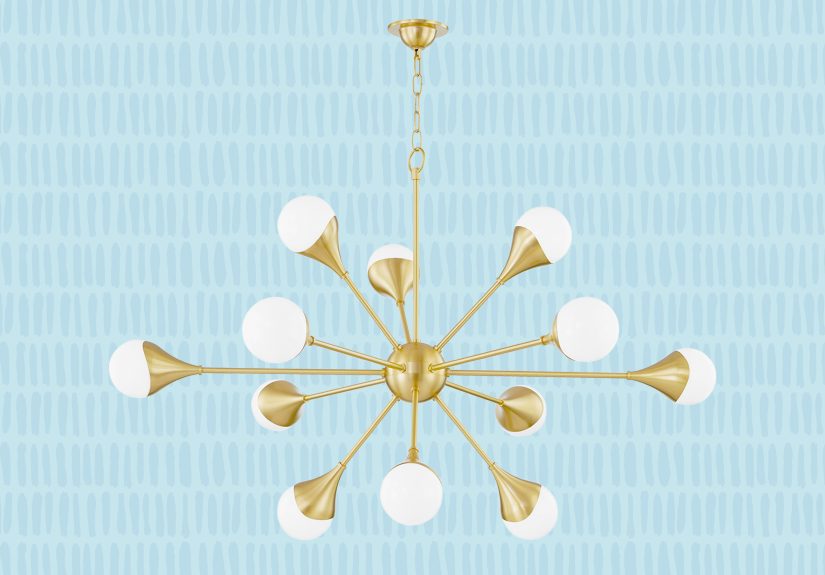
Possini Euro Design Janae Starburst (Lamps Plus) – Best mid-century “Sputnik” vibe
Sputnik chandeliers are the espresso shot of lighting: instant energy, instant personality. The Janae adds a touch of sparkle with crystal accents
and a starburst silhouette that looks great above a table or in an entry that needs a punchy focal point.Where it shines: dining rooms, foyers, and living rooms with mid-century or modern décor.
Style tip: let it pop against simpler backdropsclean walls, streamlined furniture, and a few bold art pieces.Buying note: because Sputnik styles expose bulbs, choose bulbs you like looking at (warm color temperature, consistent shape).
-
AERIN Hampton Chandelier (Williams Sonoma) – Best organic glam
The Hampton chandelier uses sculpted, leaf-like metalwork to create a “lit-from-within” glowelegant, soft, and slightly romantic without being cheesy.
It’s a great option when you want something decorative that still feels grown-up and timeless.Where it shines: dining rooms, primary bedrooms, and entryways where you want a warm statement.
Style tip: pair it with natural materials (stone, linen, warm wood) and restrained color palettes so the detail reads as intentional.Buying note: leafier silhouettes cast interesting shadowsanother reason a dimmer is your best friend.
Installation, Safety, and “Living With It” Tips
Before you install
- Turn off power at the breaker and verify power is off before touching wiring.
- Check fixture weight and make sure your ceiling box is rated to support it (especially for heavy chandeliers).
- Confirm hanging height with painter’s tape or a cardboard mock-up if you’re unsure.
- When in doubt, hire a pro. A chandelier is not the project to “learn wiring vibes” on.
Bulbs and brightness
For most spaces, warm light (often called “soft white”) feels more flattering and welcoming than cool daylight bulbs.
If the chandelier uses exposed bulbs, keep the bulb shapes consistent so the fixture looks intentional instead of chaotic.
Cleaning without regret
Dust builds up on chandeliers like it’s paying rent. A practical routine:
quick dusting every few weeks, deeper cleaning seasonally, and a gentle hand when dealing with glass drops, capiz, or fluted shades.
Translation: treat it like jewelry, not like a kitchen counter.
Conclusion
A chandelier can brighten a room in the obvious way (light), and in the sneakier way (confidence). The best choice is the one that matches your space,
hangs at a comfortable height, and fits your daily lifewhether that means dramatic glass orbs, coastal capiz shimmer, classic drops, or a starburst that
turns Tuesdays into “we should light a candle” energy.
Experience Notes: What People Learn After Living With a Chandelier (The Fun, Real-Life Version)
After reading enough homeowner stories and designer advice, a few chandelier truths show up again and againusually right after someone finishes installing
a gorgeous fixture and realizes the room still feels “off.” The good news: most of these lessons are easy to avoid if you know what to watch for.
Lesson 1: The dimmer is not optionalit’s emotional support. People often expect a chandelier to be the whole lighting plan. Then the first
dinner happens, and everyone feels like they’re eating under stadium lights. A dimmer instantly turns “bright” into “glow,” and glow is what you actually
wanted. Bonus: dimmers make glass, crystal, and capiz look expensive even when your budget is behaving responsibly.
Lesson 2: Exposed bulbs are a commitment. Sputnik chandeliers and open candelabra styles look amazing… until someone uses mismatched bulbs and
the ceiling starts giving “college apartment.” If the bulbs are visible, shoppers who end up happiest tend to pick one bulb style, one color temperature,
and buy extras so replacements match later. Consistency is the secret sauce.
Lesson 3: “Statement” doesn’t mean “battle for attention.” A chandelier is the room’s crownso it can’t be competing with 12 other crowns.
People who love their chandeliers long-term usually let the fixture be the feature: simpler curtains, calmer wall art nearby, and fewer shiny accessories on
the same sightline. The chandelier becomes the punctuation mark, not the entire paragraph screaming in all caps.
Lesson 4: Measure twice, live peacefully. A surprisingly common regret is choosing a chandelier that’s a little too small because it felt
“safer” online. In real rooms, undersized fixtures can disappear, especially in open layouts. A helpful trick homeowners mention: use painter’s tape on the
ceiling to mark the fixture’s approximate diameter, then stand in the doorway and look at it from multiple angles. If the taped circle looks timid, the
chandelier will, too.
Lesson 5: Cleaning reality should influence your choice. Crystal drops look stunning… and they collect dust like it’s a hobby. Capiz and
textured glass also prefer a gentle touch. People who are happiest tend to match the fixture to their maintenance personality: if you love sparkle but hate
fuss, consider simpler glass forms, fewer dangling pieces, or a chandelier with shades that wipe clean easily.
Lesson 6: The chandelier can “fix” awkward rooms. Designers often point out that chandeliers do more than lightthey define zones. In open
concept spaces, the right chandelier over the dining table makes the dining area feel intentional rather than like a table wandered into the kitchen and
decided to stay. Homeowners regularly say this is the moment their space finally feels designed instead of accidental.
Bottom line: the best chandelier isn’t just the prettiest one on your screen. It’s the one that looks right at your scale, behaves well with your lighting
plan, and doesn’t demand a monthly apology letter because it’s too low, too bright, or too high-maintenance. Get those basics right, and your chandelier
will do what it was born to do: make your space feel brighter, warmer, and a little more special every time you flip the switch.