Table of Contents >> Show >> Hide
- What Is Dmanisis Gora?
- How Drones Revealed the Hidden Mega-Fortress
- A Fortress More Than 40 Times Larger Than Expected
- Why the Discovery Matters
- The Role of Mobile Pastoralists
- Was It a City, a Fortress, or Something Else?
- What Archaeologists Found Inside the Site
- Drone Archaeology: Why Technology Changed the Story
- How This Changes the Story of the Bronze Age Caucasus
- Specific Examples That Make the Site Remarkable
- Why Readers Love Discoveries Like This
- Experiences and Reflections Related to the Hidden Mega-Fortress
- Conclusion
Every so often, archaeology delivers the kind of plot twist that makes Indiana Jones look underprepared. In the mountains of the South Caucasus, researchers have revealed that a 3,000-year-old fortress once thought to be impressive was actually enormous. The site, known as Dmanisis Gora in southern Georgia, was not merely a rugged hilltop stronghold. Drone mapping showed that it was a sprawling Bronze Age mega-fortress with an outer settlement, stone structures, graves, field systems, and defensive walls stretching far beyond what archaeologists could see from the ground.
The discovery is exciting not because someone tripped over a golden crown or opened a tomb full of dramatic curses. It is exciting because it changes scale. A place once understood as a smaller fortified site turned out to be more than 40 times larger than originally believed. In archaeology, that is the difference between finding a backyard shed and realizing the shed is attached to a shopping mall with ancient livestock parking.
Using drone technology, researchers stitched together nearly 11,000 aerial photographs to produce detailed maps of the site. These images revealed an extensive outer enclosure defended by a fortification wall about one kilometer long. The broader fortress-settlement may have covered roughly 60 to 80 hectares, making Dmanisis Gora one of the most remarkable Late Bronze Age and Early Iron Age fortified sites known in the region.
What Is Dmanisis Gora?
Dmanisis Gora is an ancient fortress-settlement located in southern Georgia, in the South Caucasus, a region positioned between Europe, the Eurasian Steppe, and the Middle East. That geography matters. For thousands of years, the Caucasus functioned as a cultural crossroads where people, goods, animals, technologies, and ideas moved through mountain passes and valleys. It was not the ancient world’s quiet corner; it was more like a busy intersection with better views and fewer traffic lights.
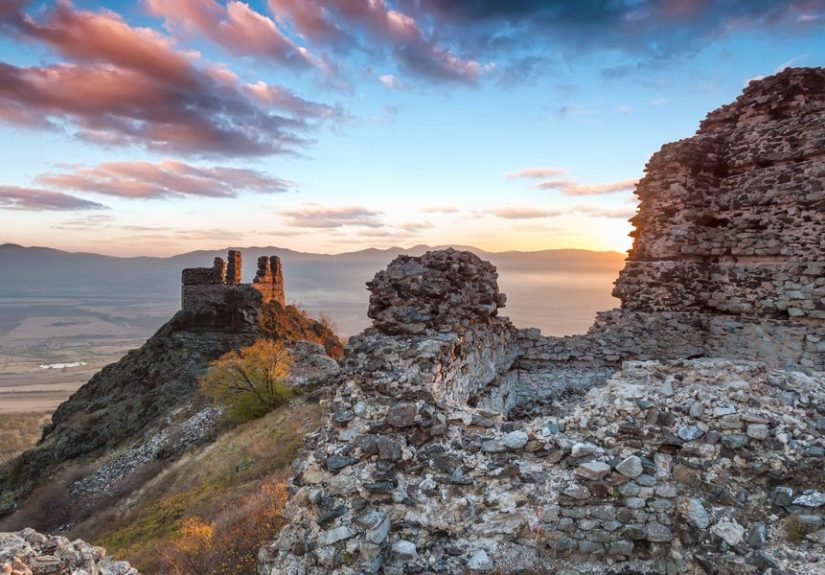
The fortress sits on a promontory between two deep gorges. This natural setting gave its builders an obvious defensive advantage. Steep terrain protected parts of the site, while stone walls strengthened vulnerable approaches. The inner fortress alone was already notable, with substantial walls and evidence of occupation. But the real surprise came when archaeologists realized that the visible ruins were only part of a much larger landscape.
Earlier excavation work in the inner fortress identified architectural remains and artifacts dating mainly to the Late Bronze Age and Early Iron Age. Radiocarbon evidence points to occupation around the twelfth to eleventh centuries BCE, with additional signs of later Iron Age activity. Pottery, animal bones, and stone architecture suggest that people did not merely hide there during emergencies. At least in the inner fortress, there is evidence for more sustained life.
How Drones Revealed the Hidden Mega-Fortress
The major breakthrough came when researchers visited the site during a season when grass cover had died back. What had looked like isolated walls and scattered stones began to appear as part of something much bigger. From the ground, however, the full pattern was nearly impossible to understand. Archaeologists could walk across the plateau, examine walls, and inspect stone alignments, but the site was simply too large to grasp with boots alone.
So the team turned to drone mapping. A DJI Phantom 4 RTK drone captured thousands of high-resolution aerial images. Specialized photogrammetry software then combined those images into orthophotos and digital elevation models. In simpler terms, the drone gave researchers the ancient equivalent of a bird’s-eye view, while the software turned that view into a precise archaeological map.
This method revealed hundreds of human-made features across the site. Researchers identified fortification walls, rectilinear and curvilinear stone structures, possible graves, field systems, and other architectural traces. The outer settlement, which had been largely invisible in earlier surveys, suddenly came into focus. It was not a small annex to the fortress; it was a huge protected landscape.
A Fortress More Than 40 Times Larger Than Expected
The numbers are what make this discovery so eye-opening. The inner fortress covers about 1.5 hectares. The wider defended area, however, may reach 60 to 80 hectares depending on how the outer walls and partial fortification lines are interpreted. That scale places Dmanisis Gora among the largest known fortress-settlements of its time in the South Caucasus.
The most complete outer wall runs about one kilometer from gorge edge to gorge edge. In collapsed form, parts of the wall are four to five meters wide, and preserved facing stones suggest that the original wall may have been more than two meters thick. This was not a decorative garden border. Someone invested serious labor in moving stone, shaping space, and creating a defensive perimeter on a massive scale.
Even more intriguing are the additional partial wall segments beyond the complete fortification. Some may have formed another perimeter, while others may represent incomplete or damaged defenses. Together, these features show that Dmanisis Gora was not a simple hillfort. It was a complex fortified landscape with multiple layers of protection and occupation.
Why the Discovery Matters
The discovery of this hidden mega-fortress matters because it challenges older assumptions about population, settlement, and power in the Late Bronze Age Caucasus. Archaeologists have long known that fortified hilltop sites were common in the region between about 1500 and 500 BCE. What remains harder to understand is how these fortresses functioned. Were they military bases? Seasonal gathering points? Political centers? Herding hubs? Safe places for people and animals? The answer may be: yes, depending on the site.
Dmanisis Gora is especially important because it seems to combine monumental architecture with surprisingly light evidence of dense occupation in the outer settlement. That is a puzzle. If so much labor went into building walls and stone compounds, why are surface artifacts in the outer enclosure relatively scarce? Why does the archaeological deposit appear thinner there than in the inner fortress?
One possible explanation is seasonal use. The site may have expanded and contracted as mobile pastoral groups moved through the region with herds. During certain times of year, people may have gathered around the fortress for protection, trade, ritual, coordination, or access to pasture routes. At other times, the outer settlement may have emptied out. Imagine a Bronze Age version of a seasonal fairground, military camp, livestock hub, and community meeting place rolled into oneminus the funnel cakes, unfortunately.
The Role of Mobile Pastoralists
Pastoral mobility is a key idea in understanding Dmanisis Gora. In mountainous regions, herders often move animals between lowland and highland pastures depending on the season. This pattern, known as transhumance, can create societies that are neither fully nomadic nor fully settled. People may maintain permanent strongpoints while also moving herds, families, or parts of communities across the landscape.
The location of Dmanisis Gora fits this possibility. It lies near routes connecting highland pasture zones and lowland areas. The outer settlement could have served as a staging ground where mobile groups gathered in spring or autumn. Its huge size may reflect not a year-round city packed with residents, but a flexible settlement that swelled when people and animals converged.
This interpretation is powerful because it widens our idea of ancient complexity. Large settlements do not always have to look like dense urban grids. They can be low-density, seasonal, or distributed. Dmanisis Gora suggests that ancient communities in the Caucasus may have built monumental spaces for a lifestyle that mixed mobility, defense, ritual, herding, and local authority.
Was It a City, a Fortress, or Something Else?
Calling Dmanisis Gora a “mega-fortress” is useful, but it also raises a tricky question: what exactly was it? It was certainly fortified. It was certainly large. But it may not have been a city in the familiar sense. The outer settlement appears less dense than many later urban centers, with open space between stone compounds and limited surface pottery.
That does not make it less important. In fact, it may make the site more interesting. Archaeologists are increasingly recognizing that ancient large settlements came in many forms. Some were dense cities with streets, administrative buildings, markets, and neighborhoods. Others were low-density settlements, ceremonial centers, seasonal aggregation sites, or fortified landscapes connected to herding and regional exchange.
Dmanisis Gora may belong to that broader family of complex but nontraditional settlements. It forces researchers to ask better questions. Instead of asking, “Was this a city or not?” we can ask, “What kind of community needed this much space, this much stone, and this kind of protection?” That question leads to a richer picture of ancient life.
What Archaeologists Found Inside the Site
The mapped features at Dmanisis Gora include more than defensive walls. Drone imagery and ground observation identified stone compounds, possible animal pens, graves, field systems, and architectural traces. Some structures are rectangular. Others are curvilinear. Some may have been roofed buildings, while others could have served as open courtyards or enclosures for animals.
Possible mortuary features, including cromlechs or low kurgans, were also identified in the outer settlement. Their presence suggests that the landscape had social and ritual meaning, not merely practical function. A fortress can protect bodies, but a burial landscape protects memory. When people bury their dead within or near a settlement, they mark belonging. They say, in stone and soil, “This place matters to us.”
Excavations in the inner fortress have yielded tens of thousands of pottery sherds, animal bones, and other artifacts. These finds help reconstruct daily life: what people ate, how they stored food, what animals they kept, what kinds of vessels they used, and how occupation changed through time. Pottery may not sparkle like treasure, but to archaeologists it is a gossip columnist with excellent long-term memory.
Drone Archaeology: Why Technology Changed the Story
The Dmanisis Gora discovery is also a perfect example of how modern technology is transforming archaeology. Drones, satellite imagery, GIS mapping, LiDAR, photogrammetry, and digital modeling allow researchers to see patterns that are difficult or impossible to detect at ground level.
At Dmanisis Gora, drones did not replace traditional fieldwork. They worked alongside it. Researchers still needed to walk the site, verify features, distinguish fortification walls from field boundaries, and evaluate whether stone alignments were natural or human-made. The drone provided the big picture; ground-truthing provided the archaeological discipline. It was a partnership between sky and soil.
Researchers also compared modern drone images with declassified Cold War-era satellite photographs. This helped them separate ancient structures from more recent agricultural changes. That detail is fascinating: images originally taken for military intelligence now help archaeologists understand Bronze Age settlement. History, it seems, enjoys recycling.
How This Changes the Story of the Bronze Age Caucasus
The Late Bronze Age and Early Iron Age in the South Caucasus were periods of major transformation. Fortresses became prominent across the landscape. Metalworking, warfare, mobility, and regional exchange all played important roles. Yet the region does not fit neatly into the same story often told about the Bronze Age Collapse in the eastern Mediterranean and Near East.
While many areas experienced upheaval around the twelfth century BCE, evidence from the South Caucasus suggests significant continuity in settlement patterns and material culture. Dmanisis Gora may help explain why. Flexible fortress-settlements linked to mobile pastoralism may have allowed communities to adapt to changing conditions. Instead of relying on a fragile centralized system, people may have used networks of strongholds, seasonal movement, and local cooperation.
That does not mean life was peaceful or simple. Fortification walls suggest concern with defense, competition, or insecurity. But the size and structure of the site may point to communal protection as much as coercive power. The fortress may have been attractive because it could shelter people and animals, support gatherings, and provide a recognizable center in a mobile landscape.
Specific Examples That Make the Site Remarkable
The One-Kilometer Wall
The complete outer wall is one of the clearest signs of Dmanisis Gora’s importance. Running across the plateau between gorge edges, it created a huge defended zone. Its size suggests planning, cooperation, and access to labor. It also shows that the builders understood the terrain and used natural defenses to strengthen human-made ones.
The 60–80 Hectare Scale
The total defended area is extraordinary for the region. A settlement of this scale invites comparison with much later towns in the South Caucasus. That does not mean Dmanisis Gora functioned exactly like a medieval city, but it does show that large-scale population aggregation was possible in the region much earlier than many casual readers might assume.
The Sparse Outer Settlement
The outer settlement’s relatively thin archaeological deposits are just as important as the walls. They suggest that size alone does not equal density. Dmanisis Gora may have been a large but flexible community space, shaped by seasonal rhythms rather than constant urban crowding.
Why Readers Love Discoveries Like This
Part of the appeal of this discovery is its human drama. A hidden mega-fortress sounds like something from a fantasy novel, but the real story is better because it belonged to actual people. They carried stones, built walls, moved animals, cooked meals, buried relatives, repaired structures, and looked out over the same gorges that archaeologists study today.
There is also something wonderfully humbling about the discovery. The fortress was not truly “lost” in a magical sense. Its stones were there all along. What changed was the way researchers looked. When grass receded, when drones flew, when images were stitched together, the landscape finally spoke in a language modern archaeology could read.
Experiences and Reflections Related to the Hidden Mega-Fortress
Standing at a place like Dmanisis Gora, even in imagination, invites a different kind of thinking. It is easy to picture archaeology as a hunt for objects: a pot, a coin, a weapon, a carved stone. But a mega-fortress teaches us that the greatest artifact may be the landscape itself. The wall is not just a wall. The gorge is not just a gorge. The open space between compounds is not empty. Together, they form a record of choices made by people who understood danger, movement, shelter, food, memory, and community.
For modern readers, the experience of learning about Dmanisis Gora feels oddly familiar. We also live in networks. We move between centers and edges. We build places for safety, storage, trade, and belonging. We gather seasonally for holidays, markets, festivals, work, and family obligations. The tools are different, of course. We have highways, smartphones, and calendar reminders that beep at us like tiny electronic sheepdogs. But the basic human need to gather, protect, and organize remains recognizable.
One of the most striking lessons from the discovery is that big things can hide in plain sight. The outer fortress was not buried under a city or locked behind a sealed temple door. It was spread across a mountain landscape, partly concealed by vegetation, erosion, agriculture, and the limits of human perspective. From the ground, the evidence looked scattered. From above, it became a pattern. That is a useful metaphor far beyond archaeology. Sometimes we do not need a new world; we need a new angle.
There is also a lesson in patience. Archaeology rarely works like instant revelation. The Dmanisis Gora story involved years of research, test excavations, repeat visits, drone flights, image processing, ground verification, and careful interpretation. Researchers had to resist the temptation to turn every stone feature into a dramatic headline. Some features may be walls. Some may be later field boundaries. Some may be graves. Some remain uncertain. Good archaeology is not allergic to mystery; it simply refuses to decorate uncertainty with fake confidence.
For travelers, history lovers, and students, the discovery encourages a more respectful way of looking at old places. A ruin is not just a pile of stones waiting for a caption. It is a compressed record of labor and landscape. The people who built Dmanisis Gora did not know they were creating a future archaeological sensation. They were solving problems in their own world: where to gather, how to defend, how to move herds, where to bury the dead, and how to make a place feel secure enough to return to.
The discovery also shows why technology should serve curiosity, not replace it. The drone was essential, but it mattered because archaeologists had the questions and training to interpret what it saw. A camera can collect images; it cannot understand a society. A map can show lines; it cannot explain why people built them. The magic happens when technology expands human attention.
In that sense, Dmanisis Gora is more than a 3,000-year-old hidden mega-fortress. It is a reminder that the past is still active. It waits in mountains, fields, archives, satellite images, and pottery fragments. It rewards careful eyes. And occasionally, when the grass is low and the drone battery is charged, it reveals a fortress so large that everyone has to redraw the map.
Conclusion
The discovery of the 3,000-year-old hidden mega-fortress at Dmanisis Gora is not just another ancient-site headline. It is a major step in understanding how Bronze Age and Early Iron Age communities in the South Caucasus organized space, movement, protection, and identity. Drone mapping revealed a site far larger and more complex than previously known, with a vast outer settlement, a one-kilometer fortification wall, possible burial features, field systems, and stone compounds.
Its importance lies in the questions it raises. Was Dmanisis Gora a seasonal gathering place for pastoralists? A defensive stronghold? A regional center of power? A low-density settlement that expanded and contracted with livestock movement? The current evidence suggests it may have been several of these things at once. That is what makes the site so valuable. It shows that ancient societies were flexible, inventive, and deeply connected to their landscapes.
As archaeologists continue excavating and analyzing Dmanisis Gora, the fortress will likely reveal more about daily life, mobility, conflict, ritual, and resilience in the ancient Caucasus. For now, one thing is clear: sometimes the past is much bigger than it first appears.
Note: This article is written for web publication in standard American English and is based on current archaeological reporting and published research about Dmanisis Gora, while avoiding copied source text, raw source links, and unnecessary citation placeholders.