Table of Contents >> Show >> Hide
- Why Cat Earrings Were the Perfect “Niche-with-Claws”
- From “Cute Idea” to Sellable Product
- Pricing Cat Earrings Without Guessing (or Underpaying Yourself)
- Branding: Make It Memorable, Not Corporate
- Photos That Make People Click (Even If You Shoot at Home)
- SEO for Google, Bing, and Marketplace Search
- Selling Channels: Online + Pop-Ups = Faster Learning
- Shipping and Packaging: The Unsexy Hero of Customer Reviews
- Keep It Legit: Records, Taxes, and Disclosures
- Scaling Without Burning Out
- Conclusion: The Business Started When I Stopped Treating It Like a Hobby
- Extra: of Real Experience I Wish Someone Had Told Me
I didn’t wake up one day and announce, “I shall become a Cat Earring Entrepreneur.” I woke up one day, stared at a pile of tiny clay cat heads on my desk,
and realized my “cute little hobby” had quietly taken over my living room like an uninvited (but adorable) kitten.
If you’re here because you love cat earrings, want to sell your own, or you’re wondering how anyone turns “I make stuff for fun” into
“I have invoices now,” welcome. This is the storyand the playbookof how I turned handmade cat earrings into a real business without losing my sense of humor
(or my earring backs, which tried to disappear daily).
Why Cat Earrings Were the Perfect “Niche-with-Claws”
Cats are a fandom, not just a pet
People who love cats don’t just “like cats.” They collect cat mugs, follow cat accounts, and can identify a Maine Coon from a blurry photo taken three blocks away.
That’s the magic: cat lovers buy cat things with intention. Earrings are a lightweight, wearable way for them to say,
“Yes, I’m a cat person,” without carrying a scratching post to brunch.
I did the “demand vs. crowd” test
Before I committed, I did a simple scan: online marketplaces, social platforms, and local craft show photos. I wasn’t looking for “no competition”
(that’s usually a red flag). I was looking for a gap: a style people clearly lovedyet not everyone was executing well.
That’s where a small brand can slip in and purr loudly.
- Demand signals: lots of searches, saved posts, “Where did you get those?” comments.
- Crowd signals: many listings, but repetitive designs, inconsistent photos, vague descriptions.
- My opening: playful designs + better comfort + better presentation + clearer product details.
From “Cute Idea” to Sellable Product
Step 1: Choose a style you can repeat
The first cat earrings I made were one-of-one little art projects. Beautiful. Not scalable. The shift happened when I designed
earrings I could make in batches without hating my life by day three.
I picked a few “signature shapes” I could iterate on:
sleepy cat, grumpy cat, cat-in-a-box, and tiny paw prints.
Think of it like a menu: the customer wants options, but the kitchen can’t cook 400 different entrées.
Step 2: Comfort is a feature, not a bonus
Earrings live on people’s ears. That means every design has to pass three tests:
weight, durability, and skin friendliness.
I learned quickly that “hypoallergenic” isn’t just marketingsome buyers are genuinely sensitive to certain metals (nickel is a common culprit).
So I started offering better ear wires and making it easy for customers to choose.
- Material choices: polymer clay, resin accents, acrylic charms, or enamel-style components.
- Hardware options: stainless steel, sterling silver, gold-filled, titanium (when possible), and clear labeling.
- Build decisions: reinforced jump rings, stronger adhesive where appropriate, and stress-testing drops (sorry, carpet).
Step 3: Prototype like a maniac
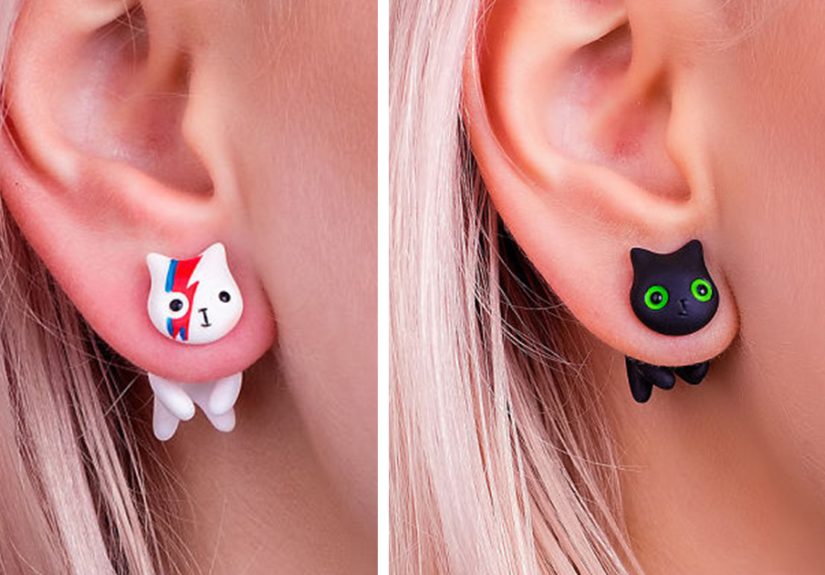
My best-selling design (a tiny black cat with a single dramatic eyebrow) took nine versions.
The first one looked like a bat. The second looked like a potato with ears. Version nine? Iconic.
I kept a notebook (and later a spreadsheet) for each design:
- Time to make one pair
- Material cost per pair
- Failure points (cracks, weak joints, paint smudges)
- Customer reactions (“SO CUTE,” “Are these heavy?” “Do you have clips?”)
Pricing Cat Earrings Without Guessing (or Underpaying Yourself)
Start with reality: materials + labor + overhead
I used to price based on vibes. The vibes were wrong.
A real pricing foundation starts with what it costs to produce an item: supplies, time, and overhead
(tools, packaging, platform fees, and the sneaky stuff like sanding pads you replace constantly).
A simple example (with real numbers)
Let’s say you make polymer clay cat earrings:
- Materials: clay $0.80, paint $0.40, glaze $0.30, ear wires $0.70, jump rings $0.20 → $2.40
- Packaging: card + sleeve + label + tissue → $0.85
- Labor: 25 minutes total. If you pay yourself $24/hour: 0.42 × $24 = $10.08
- Overhead: tools wear, studio supplies, utilities (estimate per item) → $1.25
True cost: $2.40 + $0.85 + $10.08 + $1.25 = $14.58
Now add profit (because “break-even” is just a fancy word for “working for free”).
If you aim for a margin that supports growth and occasional chaos, you might price at $24–$32 depending on your market and positioning.
Wholesale pricing: the “math with feelings” moment
I learned that wholesale isn’t “discounting a little.” It’s a different structure. Retailers need room to mark up,
and you need to still make money. If wholesale is part of your plan, design your product line and production process with that in mind.
Branding: Make It Memorable, Not Corporate
Your brand is the promise behind the product
My early branding was… let’s call it “creative chaos.” Different colors. Different photo styles. Different tone. Confusing names.
Customers didn’t know what to expect, which made shopping harder than it needed to be.
I simplified:
- One visual vibe: cozy, playful, slightly sassy (like a cat that knows it’s cute).
- Consistent names: “Grumpy Tabby Dangles,” “Sleepy Cat Studs,” “Cat-in-a-Box Drop Earrings.”
- A tiny story: every listing includes a one-line “why” behind the design.
Name protection (the grown-up part)
When I realized people were remembering my shop nameand not just “that cat earring lady”I took the idea of brand protection more seriously.
At minimum, do a basic search to avoid obvious conflicts, and understand what trademarks are and why they matter if you plan to build long-term.
Photos That Make People Click (Even If You Shoot at Home)
Bright, clear photos beat fancy photos
The turning point wasn’t buying a new camera. It was learning to create clear, bright images that show what the customer will actually get.
I used natural light near a window, a simple backdrop, and a repeatable setup so my shop looked cohesive.
The photo checklist I use for every listing
- Main “studio” photo: plain background, bright light, true colors.
- Scale shot: worn on a person or next to a ruler/coin (be consistent).
- Detail close-up: texture, paint lines, glitter, resin shinewhatever makes it special.
- Back/hardware photo: show the ear wires or posts clearly.
- Lifestyle shot: “cat café,” “cozy sweater,” “bookstore day” vibessubtle, not cluttered.
A note from experience: if your cat earrings are dark-colored, make sure the background and lighting keep edges crisp.
“Cute, but I can’t tell what it is” is the silent killer of conversions.
SEO for Google, Bing, and Marketplace Search
Think like your customer types
Most customers don’t search “artisanal feline-themed wearable polymer adornments.” They search:
cat earrings, cat lover gift, black cat earrings, kawaii cat earrings,
hypoallergenic cat earrings, or handmade earrings for cat moms.
Where keywords belong (without stuffing)
- Title: lead with the main phrase, then add specifics.
- Description: write for humans, use keyword variations naturally.
- Attributes/tags: materials, style, occasion, color, who it’s for.
- Alt-friendly image naming (on your own site): descriptive filenames help organization and accessibility.
Example listing title (human, searchable, not spammy)
Cat Earrings – Handmade Black Cat Dangles, Lightweight Hypoallergenic Hooks, Cute Cat Lover Gift
That title works because it starts broad (cat earrings), then gets specific (handmade, black cat, lightweight, hypoallergenic, gift),
without turning into a keyword landfill.
Selling Channels: Online + Pop-Ups = Faster Learning
Online marketplaces for validation
Marketplaces are crowded, but they’re also where customers already shop. I treated my first few months like a lab:
what styles got favorites, what prices got purchases, which photos got clicks, and which descriptions reduced “What size is this?” messages.
Pop-ups and craft fairs for instant feedback
In-person selling taught me things the internet never couldlike how many people will impulse-buy cat earrings if they can touch them,
and how critical booth setup is for stopping someone mid-walk. I learned to bring:
- Clear signage (“Handmade Cat Earrings,” prices visible)
- A simple display hierarchy (best sellers at eye level)
- Enough inventory in the top 3 styles (people love what others already love)
- Easy payment options (if paying is hard, buying doesn’t happen)
Shipping and Packaging: The Unsexy Hero of Customer Reviews
Protect tiny things like they’re priceless
Earrings are small, but they can still arrive bent, scratched, or snapped if you ship them like loose change.
My rule: the earrings should survive a dramatic toss into a mail bin and still look cute.
- Sturdy earring cards: keep pairs aligned and professional.
- Protective wrap: tissue + small bag + padding where needed.
- Rigid mailer or small box: reduces crushing and bending.
- Clear labeling: avoid smudged handwriting; use printed labels when possible.
Set realistic delivery expectations
Many small sellers use affordable domestic shipping options and clearly communicate delivery windows.
I stopped promising “lightning fast” and started promising “honest and consistent.”
That alone reduced customer anxiety (and my inbox pressure).
Keep It Legit: Records, Taxes, and Disclosures
When a hobby becomes a business
The moment money comes in, you’re in the world of recordkeeping. Even if you start as a side hustle,
treat it like a business early: track revenue, track expenses, and keep notes about how you’re working to be profitable.
My “future me will thank me” system
- Separate business account (even if it’s just a basic one)
- Monthly expense categorizing (materials, shipping, tools, fees)
- Inventory notes: what sold, what didn’t, and why
- Simple profit check: revenue minus true costs
If you promote products, disclose clearly
If you ever do collaborations, affiliate links, or gifted product promos, learn the basics of disclosure.
Transparency protects your audienceand your credibility.
Scaling Without Burning Out
Batch work saved my sanity
I used to make one pair start-to-finish. That’s slow and mentally exhausting. Now I batch:
- Condition and roll clay for multiple pairs
- Cut shapes in a batch
- Bake together
- Paint in sessions
- Seal together
- Assemble hardware in a final “assembly line” hour
Raise prices when your quality and demand support it
When I improved materials, photography, and consistency, my products became easier to trustand that trust supported higher prices.
A price increase is scary the first time, but it can be the difference between “cute side hobby” and “sustainable business.”
Conclusion: The Business Started When I Stopped Treating It Like a Hobby
The most surprising part of turning cat earrings into a business wasn’t learning marketing or shipping.
It was learning to respect my own work enough to build systems around it: repeatable designs, real pricing, clear photos, searchable listings,
and customer-friendly packaging.
If you’re sitting on a hobby you love, here’s my honest advice: start small, but start deliberately.
Make something worth repeating. Price like you matter. Photograph like clarity is kindness.
And when the first stranger buys your cat earrings? Celebrate. Then make two more pairsbecause that’s how momentum is born.
Extra: of Real Experience I Wish Someone Had Told Me
The first time I sold cat earrings “for real” wasn’t a dramatic Shark Tank moment. It was a Tuesday night, in sweatpants,
when a notification popped up that said: “Order #0001.” I stared at it like it was a cryptic message from the universe.
Then I panicked because I realized I had never actually timed myself making that design. I had priced it like a friendly neighborhood crafter,
not like someone who needed to buy more supplies next week.
My earliest mistake was treating every pair like a tiny masterpiece that deserved unlimited time. That’s lovely for art.
It’s brutal for business. I once spent nearly an hour perfecting whisker lines on a $14 pair of earrings, which is basically volunteering.
So I set rules: no design gets added to the shop until I can make it consistently, and no “tiny detail” is allowed unless customers can actually see it
from a normal human distance. (If the detail only looks magical under a macro lens, it’s a trap.)
Then came my favorite disaster: the Great Earring Back Apocalypse. I mailed a batch of orders and realizedtoo latethat some backs weren’t fully secured
in their little bag. A customer messaged me kindly: “I love them! But one back is missing.” I wanted to crawl into a cardboard box and live there forever.
Instead, I apologized, sent replacements immediately, and updated my packing checklist that same night. The funny part? That customer left a glowing review
about how fast I fixed it. Lesson: perfection is nice, but responsiveness builds loyalty.
Craft fairs taught me a different lesson: people don’t read your mind. I assumed everyone could tell the difference between stainless steel and sterling silver.
They cannot. I assumed people knew my earrings were lightweight. They did not. So I started labeling everything clearly and keeping a “try-on mirror”
front and center. Sales jumpednot because my designs changed, but because I removed friction.
Marketing was also humbling. My first product photos were taken at midnight under a kitchen light that made everything look like a crime scene.
When I switched to window light, a simple background, and consistent angles, I didn’t just get better photosI got fewer questions, fewer returns,
and more confident buyers. On social media, the posts that did best weren’t polished ads. They were tiny stories: a time-lapse of a cat face being painted,
a “before and after sanding” clip, or a short caption about why I made a design. People love process because it proves it’s real.
The biggest mindset shift was accepting that a business is a collection of boring systems that protect your creativity.
Pricing spreadsheets, inventory counts, packaging routinesnone of it is glamorous. But once those systems were in place,
I could actually enjoy making cat earrings again. The hobby didn’t die when it became a business. It got a backbone.