Table of Contents >> Show >> Hide
There is something delightfully disorienting about celebrity childhood photos. One second you are looking at a red carpet regular with perfect lighting, a stylist, and an entire glam squad standing just off-camera like a pit crew for cheekbones. The next second, you are staring at the same person in oversized overalls, a bowl cut, and the kind of school-picture grin that says, “I definitely had fruit snacks in my pocket five minutes ago.” It is pop culture whiplash, and honestly, it is wonderful.
The internet never gets tired of these throwbacks, and for good reason. Childhood photos remind us that before the Oscar speeches, chart-topping albums, and million-dollar endorsements, celebrities were just kids with awkward bangs, questionable sweaters, and faces that had not yet settled into what would later become world-famous features. Sometimes the resemblance is obvious right away. Other times, you need a full minute, a deep squint, and maybe a dramatic detective voice: “Wait… that tiny person becomes that movie star?”
That is exactly why the phrase “barely recognizable stars” works so well. It captures the shock factor. But the real appeal goes deeper than a simple before-and-after reveal. These photos tap into nostalgia, curiosity, and that universal truth that everyone, even the most polished celebrity on Earth, once looked like a kid who lost a battle with picture-day hairspray.
Why Celebrity Childhood Photos Hit So Hard
Celebrity throwback photos do not just entertain us because they are cute. They entertain us because they collapse distance. Fame usually makes people seem untouchable, almost mythic. Childhood photos ruin that illusion in the best way possible. Suddenly the pop icon is a gap-toothed second grader. The superhero actor is a kid in a silly T-shirt. The fashion favorite is a tiny human with an aggressively sincere haircut. Fame loses some of its polish, and the person underneath becomes easier to imagine.
That is part of why these images travel so quickly online. They give fans a peek at the “before” version of a public figure whose “after” feels almost too polished to be real. A childhood snapshot says: yes, this glamorous adult once wore strange shoes, made weird faces, and posed next to a birthday cake with the confidence of someone who had no idea the internet would one day examine every crumb.
There is also the guessing-game factor. Publications love posting celebrity baby and childhood photos because readers love trying to identify the star before the reveal. It is half entertainment, half visual trivia. The eyes may look familiar. The smile may survive the years. But the styling, the age, and the time period do a lot of sneaky work. Add an old-school haircut and some wonderfully tragic early-2000s clothing, and even famous faces become a puzzle.
The Funniest Part: The Awkward Phase Never Loses
If childhood photos teach us anything, it is that no amount of future fame can erase the awkward phase. In fact, the more stylish the celebrity becomes as an adult, the funnier the contrast can be. There is comic gold in seeing a person known for elegance, poise, or cool-girl energy as a child wearing a look that could only be described as “enthusiastically assembled by 1998.”
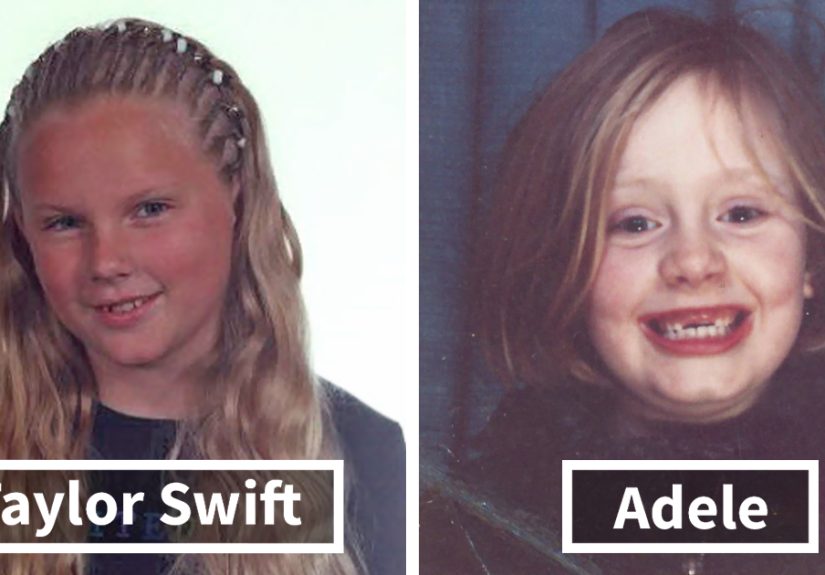
Taylor Swift’s old costume photos, Amy Schumer’s goofy throwbacks, and Adele’s sweetly awkward younger snapshots all fit that pattern perfectly. These are women who grew into commanding public images, but the throwbacks people love most are the ones that show pure, unfiltered childhood energy. The charm is not that they were always glamorous. The charm is that they absolutely were not.
That same pattern appears across actors, musicians, and TV personalities. The “barely recognizable” label often comes from temporary details: baby cheeks, braces, giant bangs, school uniforms, or trends that aged about as gracefully as a flip phone belt clip. Strip away the old styling, though, and many stars still have the same telltale features. A certain smile. A set of eyes. A specific expression that says, “Yes, I was always destined to be dramatic.”
Stars Who Prove the Point
Musicians Who Went from Cute Kids to Global Brands
Some of the most entertaining throwbacks come from music stars because their adult images are so carefully built. When fans see childhood photos of stars like Selena Gomez, Justin Timberlake, Gwen Stefani, Rihanna, Miley Cyrus, or Billie Eilish, the reaction is often the same: surprise first, then immediate affection. These artists are so visually associated with specific eras, aesthetics, and public identities that their younger selves can feel almost like alternate-universe versions.
Billie Eilish, for example, inspires a very specific kind of nostalgia in fans because her childhood photos show the soft, playful family world that existed before she became a modern pop phenomenon. With Miley Cyrus, the fun comes from seeing the kid version of someone who later built such a bold, shape-shifting public persona. Justin Timberlake’s throwbacks practically come preloaded with jokes about hair. Gwen Stefani somehow manages to look both adorable and like someone who might already have strong opinions about eyeliner.
And then there are the stars whose younger selves already hinted at what was coming. Sometimes a childhood photo does not just surprise people; it feels like a tiny origin story. The attitude is there. The stage presence is there. The future headline energy is absolutely there, just packaged in a smaller person with fewer styling resources.
Actors Who Look Like Completely Different Humans
Actors may be the true champions of the “wait, that is who?” reaction. They are already used to transformation, which makes their real-life before-and-after moments even more entertaining. Jenna Ortega’s childhood snapshots, for example, have the sweetness of classic family-photo nostalgia, while still giving fans those tiny clues that connect the kid to the star. The freckles, the expression, the face shape, the camera awarenessit is all there, just in starter-pack form.
Chris Hemsworth offers a different kind of throwback joy. Seeing him as a kid in a Batman shirt is funny not just because he looks younger and softer, but because audiences now know him as Thor. That is the kind of detail the internet loves: a childhood photo that accidentally becomes a plot twist.
Then you have former child actors and Disney or family-TV favorites, where the fascination shifts slightly. With stars like Candace Cameron Bure, Macaulay Culkin, Keke Palmer, Christina Ricci, Abigail Breslin, or Alexa PenaVega, fans are not just reacting to a random childhood image. They are reacting to time itself. These are faces audiences watched grow up in public, and throwback photos make people realize just how long that relationship has lasted. It is less “Who is that?” and more “I cannot believe we all got older.”
Models and Fashion It Girls Who Once Had Very Normal Hair
There is something especially satisfying about childhood photos of fashion stars. The reason is simple: high-fashion adulthood tends to erase all evidence of ordinary life. That is why old photos of Gigi Hadid, Emily Ratajkowski, or other modeling-world favorites hit so hard. They remind audiences that before the campaigns and couture fittings, these women were kids posing in regular clothes, squinting in daylight, or showing up in early snapshots that look wonderfully uncurated.
When a star like Gigi Hadid shares an image from one of her earliest childhood modeling experiences, the fascination comes from contrast. Fans know the adult version as polished, camera-ready, and almost supernaturally photogenic. Seeing the beginning of that trajectory in a child-sized photoshoot feels like opening chapter one of a story everyone thought started at chapter seven.
What “Barely Recognizable” Really Means
Here is the truth: most celebrities are not actually unrecognizable in childhood photos. Not really. The phrase works because it is dramatic, clickable, and kind of fun. But if you look closely, the clues are usually there. The face is softer, the proportions are smaller, the styling is chaotic, but some core features remain weirdly consistent.
What changes most is context. As adults, celebrities are branded. They are associated with signature hairstyles, beauty looks, fashion choices, public roles, and media narratives. Remove those things and the brain has to work harder. That is why a childhood photo can feel so shocking. You are not just seeing a younger face. You are seeing a famous person stripped of the visual shorthand that tells the world who they are.
In that sense, these photos are less about physical change and more about narrative change. A little kid in a school portrait is not yet carrying the meaning of “award-winning actor,” “global pop star,” or “tabloid fixture.” They are just a child. The fame comes later. The hairstyle crimes, however, arrive right on schedule.
Why Fans Never Get Tired of the Reveal
Because it is one of the rare corners of celebrity culture that still feels playful. Childhood photos invite curiosity without requiring scandal. They offer a reveal without a takedown. They are low-stakes, high-reward content. You get surprise, nostalgia, humor, and a tiny emotional reset all at once.
There is also a deeper comfort in seeing that transformation is normal. Fans love a dramatic celebrity glow-up, but what these photos really show is growth. People change. Faces mature. Style evolves. Confidence develops. The kid in a crooked school picture does not look finished yet, and that is exactly the point. Neither did any of us.
That is probably why the genre keeps thriving. Every time a celebrity posts an old photo, the public gets to enjoy two stories at once: the child they were and the icon they became. It is a visual reminder that identity is built over time, usually with a few regrettable outfits along the way.
The Experience of Looking at Celebrity Childhood Photos
Scrolling through celebrity childhood photos is a strangely specific experience. It starts like a game and ends like a minor existential event. At first, you are confident. You tell yourself you know faces. You have watched enough movies, enough award shows, enough red carpet clips to spot a celebrity in any form. Then a photo appears of a tiny child with an uneven haircut, a sweater that looks borrowed from a grandparent, and the expression of someone who has just been promised ice cream after the camera flash. Suddenly, your confidence disappears. That little person becomes a full mystery.
Then the reveal happens, and your brain does that wonderfully dramatic thing where it rewrites the entire image in real time. Of course that is the actor from your favorite series. Of course that is the singer with the instantly recognizable smile. Once you know, the clues feel obvious. Before the reveal, though, the face might as well belong to a random kid from a second-grade yearbook. That split-second shift from confusion to certainty is half the fun.
There is also an emotional side to it that people do not talk about enough. Looking at celebrity childhood photos often makes viewers think about their own childhood photos, and not always in a glamorous way. It triggers memories of school portraits, holiday snapshots, birthday parties in living rooms, and the universal experience of being dressed by adults who did not realize future generations would eventually judge those fashion choices. A celebrity throwback does not just show us their past. It quietly opens the door to ours.
That is why these images can feel oddly comforting. They flatten the gap between the famous and the ordinary. The movie star had a goofy grin. The fashion icon had a haircut situation. The comedian had a phase where the outfit was doing absolutely nothing helpful. It is reassuring, in a very human way, to see proof that polished adulthood is often built on a foundation of deeply unserious childhood photos.
And because we live online, the experience has become communal. People do not just look at these photos; they react together. They guess in the comments, argue over the eyes, make jokes about the bangs, and announce that a star has “always looked the same” or “changed beyond recognition” with equal conviction. It is one of the few internet traditions that still feels light. Nobody needs a scandal to pay attention. All it takes is one old snapshot and a crowd willing to yell, “No way, that is definitely not them,” right before being proven wrong.
For longtime fans, the experience can be even more layered. A childhood photo of a favorite actor or musician can make fame feel less like a finished product and more like a timeline. You are not just seeing the person before they were famous. You are seeing the version of them that existed before the public story began. Before the first big role. Before the breakout album. Before the award-season interviews and the carefully managed image. That can make the adult celebrity feel more interesting, not less. The glamour is still there, but so is the evidence that a real childhood came first.
Maybe that is why celebrity childhood photos have such staying power. They are funny, yes. They are clickable, definitely. But they are also tiny reminders that everybody starts somewhere, often looking a little chaotic. And honestly, that may be the most recognizable thing of all.
Conclusion
Celebrity childhood photos continue to charm audiences because they do more than reveal younger faces. They reveal contrast, growth, and the delightfully awkward road between ordinary childhood and extraordinary fame. Whether the photo belongs to a future pop giant, an award-winning actor, a child star audiences grew up watching, or a fashion favorite before the glam years, the appeal remains the same: these images let us see the human being before the headline.
So yes, some stars look barely recognizable in childhood photos. But that is only half the story. The other half is what makes the photos so addictive: somewhere in the messy bangs, giant smiles, and school-picture energy, you can already see the person they would become. Fame may rewrite the packaging, but the spark usually shows up early. Sometimes it just arrives wearing a very unfortunate sweater.