Table of Contents >> Show >> Hide
- The Quick Answer: How Many Funko Pops Are There?
- Why the Exact Total Is So Hard to Pin Down
- Funko Pop Statistics and Facts That Actually Matter
- 1. The Pop! line officially launched in 2010
- 2. Pop! is still the company’s heavyweight champion
- 3. Funko’s license machine is massive
- 4. Funko has sold more than 1 billion pop culture products since inception
- 5. Pop! Yourself turned customization into a real business
- 6. Chase variants usually land at 1 in 6 odds
- 7. Funko now uses clearer piece-count tiers for limited editions
- 8. Authenticity is a bigger deal than ever
- 9. Bitty Pop! proves Funko is still expanding the formula
- 10. Bigger is not always better: the company has also faced overproduction problems
- What Counts as a “Real” Funko Pop?
- Which Franchises Have the Most Funko Pops?
- Why Funko Pops Became So Popular
- Are Funko Pops Still Worth Collecting in 2026?
- Final Verdict
- Collector Experiences: What It Feels Like to Chase the Numbers
- SEO Tags
If you have ever looked at a wall of Funko Pops and thought, “There is no way humanity needed this many tiny square-headed gremlins,” first of all, fair. Second, you are not wrong. Funko has turned shelves, desks, dorm rooms, offices, and entire spare bedrooms into miniature museums of pop culture. From Marvel heroes and anime icons to musicians, athletes, cereal mascots, and characters your cousin swears are “underrated,” the Pop! universe has become enormous.
That leads to the obvious question: how many Funko Pops are there? The answer is both simple and delightfully annoying. There is no single number everyone agrees on, because collectors, retailers, and databases do not all count Funko Pops the same way. Some count only standard Pop! Vinyl figures. Others count chases, retailer exclusives, convention exclusives, 2-packs, 10-inch releases, Rides, Moments, and other spin-offs as separate entries. That is how one hobby turns into a math problem with better packaging.
Still, the best current answer is this: there are well over 23,000 individual Funko Pop releases, and the broader Funko collectible universe is much larger than that. If you count every Funko product and variation across the brand, the number climbs even higher. So yes, your wishlist is probably longer than your attention span, and Funko is at least partly responsible.
The Quick Answer: How Many Funko Pops Are There?
As of April 2026, one major collector database, POP’s Today, lists 23,462 individual POP! releases. That is one of the clearest current estimates for the Pop! line itself. Older collector tallies had already pushed the line past 20,000 total figures by 2023, which shows just how quickly the catalog keeps growing. Meanwhile, hobbyDB’s broader Funko tracking has referenced roughly 46,000 Funko products, which includes more than just standard Pop! figures.
So the smartest answer is not a single magic number. It is this: Funko Pops number in the tens of thousands, and a cautious, current estimate puts the line at more than 23,000 individual Pop! releases. If you include every sub-line, variant, exclusive sticker version, and adjacent Funko product, the total gets much bigger, much faster, and much more dangerous for your wallet.
Why the Exact Total Is So Hard to Pin Down
The reason collectors argue about Funko totals is not because they are dramatic. Well, not only because they are dramatic. It is because Funko releases figures in layers.
Different databases count different things
Some databases treat a common figure and its chase as two separate collectibles. Others split by sticker type, retailer exclusivity, international release, or box variation. That means one Batman can become three Batmen before you even open your browser.
Funko is not just one format anymore
The Pop! brand now includes standard 4-inch figures, larger Super and Jumbo editions, Pop! Rides, Pop! Towns, Pop! Deluxe, Pop! Moments, Pop! Albums, Bitty Pop!, and Pop! Yourself. Depending on how strict your definition is, you may count all of them or only the classic boxed figures.
Exclusives multiply the count
Retailer exclusives, convention exclusives, Funko Web Exclusives, and limited edition drops all create extra versions of characters that might look nearly identical at first glance. To a casual shopper, that is “another Spider-Man.” To a collector, that is a completely different life decision.
Funko keeps releasing new figures
This number changes constantly. Funko keeps adding new properties, new waves, new event exclusives, and new limited runs. So any count is basically a snapshot, not a permanent total carved into vinyl.
Funko Pop Statistics and Facts That Actually Matter
1. The Pop! line officially launched in 2010
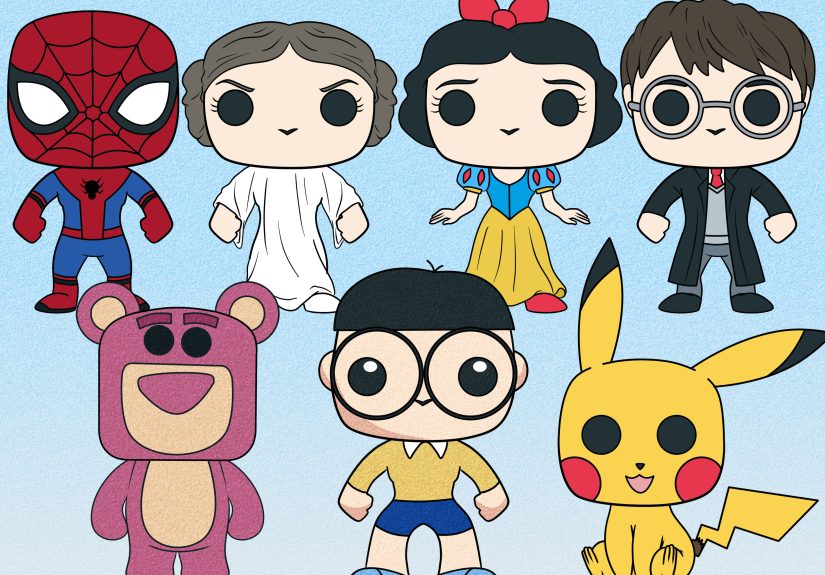
Funko may have started in 1998, but Pop! as a brand arrived in 2010 and became the company’s defining product. The standard design is now instantly recognizable: oversized square-ish head, tiny body, simple facial features, and a box that collectors somehow treat like both sacred art and cardboard. That clean, consistent look helped Funko make characters from wildly different franchises feel like part of the same shelf-friendly universe.
2. Pop! is still the company’s heavyweight champion
Funko’s official filings show that its core collectible products, which include Pop! Vinyl, represented 80% of sales in 2025, up from 77% in 2024 and 73% in 2023. In plain English, Pop! is not just Funko’s best-known line. It is the business engine. When people talk about Funko, they are usually talking about Pops, even when they pretend to be very serious investors.
3. Funko’s license machine is massive
One reason there are so many Funko Pops is simple: Funko has built an enormous licensing network. In 2025, the company said it had license agreements with more than 250 content providers covering about 800 active licensed properties. That means Funko can move across movies, TV, anime, games, music, sports, and nostalgia bait with the confidence of a company that knows collectors will absolutely buy a tiny vinyl version of almost anything.
4. Funko has sold more than 1 billion pop culture products since inception
That figure covers the wider company portfolio, not just Pops, but it says a lot about scale. Funko is no longer a niche collectible company for comic-con regulars and people with suspiciously strong opinions about box condition. It is a mainstream pop culture products giant with truly gigantic reach.
5. Pop! Yourself turned customization into a real business
Funko’s personalized Pop! Yourself program is not a cute side feature. It is a serious growth category. The company has said it has sold more than 2 million custom Pop! Yourself figures to date. Funko also said the program was its top in-store offering at its Everett and Hollywood retail locations and generated more than 20% of store sales after launch. Translation: people really do want a tiny version of themselves in a display box, and apparently that dream is stronger than inflation.
6. Chase variants usually land at 1 in 6 odds
If you have ever bought a Funko Pop hoping for the chase, welcome to modern gambling’s gentler cousin. Funko’s own collector glossary says a chase variant is usually found at about 1 in 6 odds, though some older releases were much slimmer at 1 in 36. That chase mechanic is one of the biggest reasons simple collecting turns into full-blown treasure hunting.
7. Funko now uses clearer piece-count tiers for limited editions
In 2025, Funko outlined new limited edition tiers ranging from ultra-tiny runs of 1 to 99 pieces all the way up to 7,501 to 9,500 pieces. That matters because collectors care deeply about scarcity, and Funko now labels that scarcity more clearly. Rare items are not just “hard to get” anymore. They increasingly come with transparent piece counts and new sticker systems built for the collecting era of screenshots, resale tracking, and humblebrags.
8. Authenticity is a bigger deal than ever
Fake Funko Pops are a real concern in the hobby, especially for expensive exclusives and older grails. Funko has responded with authentication upgrades, including stickers with QR codes and item-specific codes that let collectors verify authenticity. That is a smart move for a hobby where one sticker can raise a figure’s appeal and one fake can ruin a buyer’s week.
9. Bitty Pop! proves Funko is still expanding the formula
Funko is not relying only on classic full-size Pops. Its smaller Bitty Pop! line made Walmart’s 2025 Top Toys list, which is a sign that the brand still knows how to reinvent its shelf presence. In other words, even if you have no room left for standard Pop boxes, Funko has thoughtfully created a new way to take up your space more efficiently.
10. Bigger is not always better: the company has also faced overproduction problems
One of the wildest Funko facts is that the company disclosed plans in 2023 to eliminate about $30 million to $36 million of excess inventory. That moment became a cautionary tale in collectibles: when a line becomes too large, not every release can stay hot. It was a reminder that the market loves scarcity more than it loves endless supply.
What Counts as a “Real” Funko Pop?
If you ask ten collectors what counts as a Funko Pop, at least three of them will answer as though they are defending a dissertation. Here is the practical version.
Most people agree that the following belong under the Pop! umbrella:
- Standard 4-inch Pop! Vinyl figures
- Chase variants
- Retailer exclusives and convention exclusives
- Pop! Rides, Pop! Towns, Pop! Deluxe, and Pop! Moments
- Larger-size Pop! figures such as 6-inch, 10-inch, and Jumbo releases
- Bitty Pop! and Pop! Yourself, depending on how broad the list is
Where collectors split hairs is on whether sticker differences, international packaging, bundle exclusives, and tiny design tweaks deserve separate entries. The answer, annoyingly but honestly, is that it depends on the checklist you use. That is why two databases can both be credible and still give you different totals.
Which Franchises Have the Most Funko Pops?
While exact rankings shift over time, a few categories dominate the Funko landscape year after year. Marvel, Star Wars, Disney, DC, anime, Harry Potter, WWE, Pokémon, and major gaming franchises are all Pop! heavyweights. That is not surprising. These brands have huge character rosters, strong fan communities, and enough costumes, forms, poses, and alternate versions to keep Funko busy until the sun burns out.
That is also why a single fandom can spiral into dozens or even hundreds of related figures. One franchise can include commons, metallic versions, glow-in-the-dark variants, blacklight editions, convention exclusives, deluxe scenes, vehicles, holiday editions, soda-adjacent promos, and a chase because apparently peace was never an option.
Why Funko Pops Became So Popular
The brilliance of Funko Pops is not that they are the most detailed figures on the market. They are not. The brilliance is that they are recognizable, affordable, uniform, and emotionally easy to collect. A Marvel collector can display Pops next to a Disney fan, an anime fan, a horror fan, and a sports fan, and the shelf still looks coherent.
That standardization matters. It creates the visual comfort of a collection even when the fandoms are all over the place. One shelf can hold Darth Vader, Wednesday Addams, Hello Kitty, Kobe Bryant, and a glow-in-the-dark dragon, and somehow it still looks like a plan instead of a yard sale.
Funko also nailed the psychology of the hunt. Chases, limited pieces, exclusives, event stickers, and drops give collectors reasons to keep checking release calendars. The result is a hobby that blends fandom, nostalgia, completionism, and just enough scarcity to make people refresh a product page like they are trying to buy concert tickets.
Are Funko Pops Still Worth Collecting in 2026?
Yes, but not always for the reason people think. Most Funko Pops are best collected for enjoyment, display, and fandom rather than pure investment. A small number of grails and ultra-limited exclusives can command serious prices, especially when authenticated and kept in strong condition. But the average Pop is not a retirement plan. It is a fun collectible with a surprisingly effective ability to reproduce on shelves when you are not looking.
If you want to collect smartly, focus on what you actually love, track values through established collector databases, watch for authenticity features, and understand the difference between a fun release and a scarce release. Those are not always the same thing. Sometimes the Pop that means the most to you is the one worth keeping, even if resale value never goes nuclear.
Final Verdict
So, how many Funko Pops are there? The cleanest current answer is more than 23,000 individual Pop! releases, with the true total changing constantly as new figures, variants, exclusives, and formats roll out. If you widen the lens to cover the full Funko ecosystem, the count rises well beyond that.
The bigger takeaway is not just that there are a lot of Funko Pops. It is that Funko built one of the largest and most flexible collectible ecosystems in modern pop culture. The company sits on hundreds of licensed properties, sells billions of dollars in products over time, and keeps finding new ways to turn fandom into a boxed vinyl habit. That is why the line keeps growing, why collectors keep counting, and why the answer to “Do I really need another one?” remains a deeply unserious but emotionally complicated “maybe.”
Collector Experiences: What It Feels Like to Chase the Numbers
There is a funny moment that happens to almost every Funko collector. It usually starts with confidence. You buy one figure from a favorite movie, game, or show. Then you buy a second because the first one “shouldn’t be alone.” Then a chase appears. Then an exclusive. Then a deluxe scene. Then suddenly you are standing in front of a shelf whispering, “I am just going to focus on one franchise,” which is the collector equivalent of saying you will eat just one chip.
That is why the question of how many Funko Pops exist feels so personal to collectors. It is not just trivia. It is a measurement of how impossible completion really is. Once you learn that there are well over 23,000 individual Pop! releases and counting, something clicks. You stop thinking of Funko as a toy line and start thinking of it as a giant pop culture archive in vinyl form. That shift changes how people collect.
Some collectors respond by narrowing their focus. They go all-in on one property like Star Wars, One Piece, Marvel, or WWE. Others become sticker hunters, chasing convention exclusives or retailer drops. Some care most about box condition and protectors. Others take everything out of the box and proudly choose shelf joy over resale anxiety. Both groups will tell you they are doing it the sensible way. Both groups are lying a little.
One of the most relatable Funko experiences is learning that “same character” does not actually mean same figure. A casual buyer sees four versions of Spider-Man and thinks, “That is repetitive.” A collector sees classic suit, blacklight, comic cover, and glow chase and thinks, “These are clearly different works of art.” That is how Funko gets you. It turns minor differences into collectible events and makes your brain feel weirdly noble for noticing them.
There is also the community side. Collectors trade tips, compare sticker variations, debate values, warn each other about fakes, and celebrate when someone lands a grail. Even people who joke about Pops being “those little dead-eyed boxes” usually understand the thrill once they get a rare favorite in hand. Funko collecting works because it mixes fandom with a hunt, and humans are apparently very vulnerable to both.
Then there is the shelf problem. Every collector eventually faces the same household math: there are more Pops than available square feet. That leads to stacks, wall shelves, under-desk storage, closet overflow, and the bold but risky strategy of telling yourself the dining room cabinet is now a display case. Collecting Funko Pops is not only about counting figures. It is about negotiating with space, budget, and your own ability to say no when a limited edition drop lands at 11:03 p.m.
In the end, the experience of collecting Funko Pops is less about reaching the final number and more about choosing your lane inside a hobby that has become almost absurdly large. And honestly, that is part of the charm. Nobody can catch them all. This is not Pokémon, and even Pokémon would probably ask Funko to calm down. The fun is in finding the characters, versions, and memories that feel like yours. The count keeps growing. The shelf keeps changing. The hunt stays weird. That is exactly why so many people are still in it.